• Finding Fall: Pumpkin Spice—and Beyond—in the Poems of Emily Dickinson

    By Gerardo Garcia

    One of the first times I traveled out of state, I visited North Carolina during my high school’s fall break. I had just seen Wes Anderson’s Fantastic Mr. Fox and the expectation of a quirky, golden-brown dreamscape (from what I technically counted as the east coast) was especially fueling my excitement. I wasn’t disappointed, either. I was there for a campus tour, donned in my finest plaid button-up; the sun shined differently in the brisk Greensboro air, and the colorful leaves seemed to come straight out of Anderson’s elaborate set—yet, despite seeing it for the first time in person, my visceral reaction to the season felt familiar. Even in the unwavering heat of south Texas, the fall would make me feel pensive, more wistful—downright “fuzzy.”

    Cultural and literary depictions of autumn go back centuries, but the concern is always the same—how can we engage with an experience that is so dependent on climate and location?

    It may be slightly harder to discern through the lingering summer heat, but whether it be media, capitalism, or a breeze on campus, we’ve all unknowingly experienced a collective-subconscious impression of fall. The Rise of Pumpkin-Spice in particular has made the feeling of a 60 degree season more accessible than ever. Sipping our lattes in t-shirts and cargo shorts, we in Austin can indulge in some fuzziness while we wait for the cold weather to come—and although I’ll try anything pumpkin-spice, this new-wave of autumnal seasonal marketing isn’t our first, or best attempt at encapsulating the peculiar vibe of the fall. Cultural and literary depictions of autumn go back centuries, but the concern is always the same—how can we engage with an experience that is so dependent on climate and location?

    Take Vivaldi’s Four Seasons, for example. In the last movement of Autumn, passages representing horns, animal calls, and gunfire recreate a European atmosphere of hunting in the woods. Or Van Gogh’s Autumn Landscape, emphasizing fall’s distinct manifestations in nature—full of wilting trees and their leaves, rich in earthy and radiant oranges, we know for a fact that he’s not in Texas. Generally portraying harvest, change, and approaching mortality, these sensory depictions allow us to imagine a traditional idea of fall; however, here in Austin, Texas, we are too much in the sun for some of these pieces to land. 

    Then what does autumn mean to us here, anyways? Is it the promising start of a new school year and the inevitable end of a glorious summer, or is it the feeling of living in a post-pandemic grey space, anywhere between online and in-person? Maybe it’s being able to wear long sleeves by November. Although autumnal tropes allow us to experience the lush environments most commonly associated with fall, the effect, however mesmerizing, is somewhat isolating. Cider, overcast, and brittle leaves have merely been superimposed on me as concrete images to guide my impression of a “true” fall, seldom experienced, but when in conjunction with the abstract, the pull of these images becomes much more universal.

    Dickinson’s speakers, individualists through and through, are not reborn in the rain, but, with just as much exaltation, recognize their communion with nature.

    Austin can’t reliably provide us with this ideal vision of fall, yet some common sentiment remains as our autumnal angst yearns for expression. To remedy this, let us look no further than the poems of Emily Dickinson and the haunting beauty of Amherst, Massachusetts. The distinction of the seasons would’ve been especially pronounced to the observant poet; however, although heavily structured around observations of nature, Dickson’s poems tend to subvert the pastoral. Her interwoven use of abstraction and concrete imagery strike at our universal experiences of time, death, and personhood that transcend the specificity of her landscape. Defining and illustrating ideas through nature, Dickinson allows us to more clearly understand our obscure emotional response towards it.

    In fiction we’re often told that setting may reflect a character’s state of being—as within, so without. Dickinson’s speakers, individualists through and through, are not reborn in the rain, but, with just as much exaltation, recognize their communion with nature. Much greater than us, nature is untamed and often capable of dictating our moods entirely. Regardless of the lack of spectacle, a semisoft falling leaf on campus still manages to make me acutely aware, if only for a moment, of the liminal space my dreamlike twenty-some-year-old existence lies in—between life and death, past and future, summer and winter. But what if nature’s not working with me on a hot, windless afternoon?

    Dickinson’s fall poems often draw from the typical sights emblematic of where she lived. Though these motifs are prevalent, concrete images intertwined with abstractions—often personified or idealized with capitalization—add a level of description that goes beyond mere trope. Physical descriptions of nature are original yet familiar, complimented by an intellectual dimension (sometimes playful, other times—not so much) that begins to elucidate the philosophy of our fuzziness. Throughout the span of Dickinson’s 1,800 poems (only ten of which were published during her lifetime), are images of summer’s Vitality, winter’s Oppression, and the Robins of spring, but in her depictions of autumn, the eccentricities of form, subject, and voice—perhaps of the poet herself—coincide in harmony to emulate the curious allure of the season. Balancing the concrete and the abstract, Dickinson transports us to a sensual and colorful Amherst fall while defining the universal peculiarity we feel with the winding down of a year. Small like the wren, bold like the chestnut burr, here are three poems to get us staring out the window in transcendental repose.

    What does all this mean? That the season itself is experiencing the phenomenon of “sweater-weather,” of course.

    The morns are meeker than they were – 
    The nuts are getting brown –
    The berry’s cheek is plumper –
    The rose is out of town.

    The maple wears a gayer scarf –
    The field a scarlet gown –
    Lest I sh’d be old-fashioned 
    I’ll put a trinket on. 

    Dickinson was born into a distinguished family of the Amherst community. Her father, a lawyer, was a pillar of that community and a staunch church goer. In the early 1850s, Dickinson would renounce her regular church-going after refusing to make a formal profession of her faith. However, the reverence and simplicity of hymns would become one of the defining characteristics of her poetry, adding a spiritual layer to the secular subjects of nature, self, and death, ubiquitous in her work. “The morns are meeker than they were,” takes a steady inventory of changes during the fall and ends with a final reflection from the speaker, seemingly disjointed. The first stanza is exclusively focused on image and isolated by a full stop. The second stanza becomes increasingly overt in its personification of nature, unifying the correlation between speaker and subject by the end. 

    What does all this mean? That the season itself is experiencing the phenomenon of “sweater-weather,” of course. We can see the effects of autumn on the world in parallel to our changing sense of fashion and demeanor. These changes however, are difficult to describe as either good or bad: the mornings are waning, the nuts are ripening, the berry is full, the rose is not in season. By the second stanza, the language becomes more playful and insistent in its depiction of a fashion-forward fall, ending the poem with an unassuming carpe diem—a fashion statement. Ultimately, Dickinson’s portrayal of autumn is a liminal space both rich and foreboding as it offers a respite to the intensity of the summer while increasingly reflecting the decay of the coming winter. So, yes: you should wear that cardigan. 

    September’s Baccalaureate
    A combination is
    Of Crickets — Crows — and Retrospects
    And a dissembling Breeze

    That hints without assuming —
    An Innuendo sear
    That makes the Heart put up its Fun
    And turn Philosopher.

    It’s difficult to attribute dates to Dickinson’s work. Written in solitude and unbeknownst to her family, the poems were copied by Dickinson herself on to several hand-sewn books, commonly referred to as “fascicles.” Dickinson scholars estimate that in her most creative period (1858-1865) she composed nearly 1,100 poems. A prime example of Dickinson’s poetic convention, “September’s Baccalaureate” is most likely from this period, divided into two stanzas that strictly adhere to the alternating meters of the iambic hymn. Enjambment marks the shift in the poem’s second half, the Dickinson’s characteristic aphorism structure delineated by stanzas (“____ is a ____ / that ____”). 

    The subject of September ending coincides with the autumnal equinox, a period of transition and the first day of fall. Dickinson begins describing “September’s Baccalaureate,” a personified abstraction, with concrete, ordinary images. Deceptively literal—a combination of crickets and crows—the poem delves further into abstraction and metaphor. The first stanza presents us with an idea of fall that isn’t wholly unbelievable to us Texans. There is a stillness in the air—like sitting on the lawn after most classes have ended—where all we can hear are crickets, crows, the wind, and our thoughts. The coolness of the breeze marks the beginning of fall and reminds us of the passage of time (nostalgia ensues—“Retrospect”). The “Breeze” however, is also a personified abstraction—it “hints” at some vague yearning for the past, “dissembling,” appearing to be merely the wind, only to induce an unexpected moment of self reflection. Dickinson continues with the abstractions—Innuendo, Heart, Fun, and Philosopher. The effect is open-ended, paradoxically providing definitions that expand rather than pinpoint meaning. 

    More than scarlet leaves, or the corduroy of fantastic foxes, fall is a reminder that time passes—the tropes associated with it serve to represent that.

    This visceral feeling Dickinson describes—nebulous, hazy, and introspective—is what I believe to be especially characteristic of the season: a universal experience not entirely dependent on the grandeur of an ideal fall-scape. It feels almost reductive to attempt to define such an inarticulate emotion—so what better way to describe it than with equally obscure metaphors? The “Innuendo sear” is exactly that—only a suggestion of some longing in the air. The past is done, the future looms over us, and for a moment, we take our lives a little more seriously than usual to make sense of where we are in the present. The joys of the summer are gone, unattainable as we drift further away from the past. Foliage aside—how often do we find ourselves jolted into reflection as the year progresses towards its end? It suddenly becomes harder to go out to 6th, the nights chillier, reminding you of the lack of arms you once had around you, that maybe you’ll never have around you again—you call an Uber. 

    Besides the Autumn poets sing,
    A few prosaic days
    A little this side of the snow
    And that side of the Haze –

    A few incisive mornings –         
    A few Ascetic eves –
    Gone – Mr Bryant’s “Golden Rod” –
    And Mr Thomson’s “sheaves.”

    Still, is the bustle in the brook –
    Sealed are the spicy valves –         
    Mesmeric fingers softly touch
    The eyes of many Elves –

    Perhaps a squirrel may remain –
    My sentiments to share –
    Grant me, Oh Lord, a sunny mind –        
    Thy windy will to bear!

    In 1862, Dickinson wrote a letter to literary critic Thomas Higginson in response to his article, “Letter to a Young Contributor.” Seeking the advice of whom she considered to be a professional, Dickinson is ambivalent towards her own poetry. “The Mind is so near itself – it cannot see, distinctly – and I have none to ask –,” she humbly entreats. Higginson, though intrigued, ultimately deemed her work unsuitable for publication. In “Besides the Autumn poets sing,” Dickinson describes the fall through the meta perspective of an aspiring autumn poet. Dickinson establishes the ironic tone immediately. “Beside the Autumn,” is what one expects, the image of the poet singing next to their muse—something traditional straight out of the romantic poems of William Bryant, or the blank verse pastorals of James Tomson. “Besides,” however, is flippant, playful, and conversational. She describes “prosaic” days that lie between Haze and snow then, in the next stanza, their piercing mornings and reclusive evenings. The structure itself reflects the threshold fall lies in—the rhyme scheme (“abcb”, “defe”, etc.) is only apparent by the end of the stanza; the diction is casual, yet evocative; and the syntax is seemingly inconsistent—“prosaic,” falling somewhere between prose and poetry with the disruption of Dickinson’s iconic dashes conveying inflection, parenthetical, and end stop. The two quotes in this stanza not only suggest the death of flowers and the approaching end of the harvest season, but also draw attention to the pastoral tropes coined by other poets. When we’ve seen it all before—pumpkin-spice, bushels of wheat, orange leaves—what’s left? Dickinson answers that in the next stanza: stillness, stagnancy, and the transitory dreaminess of twilight. Hopefully, there’ll at least be a squirrel left to write about. Despite a hint of meekness in the voice, the speaker has accomplished writing something besides the typical autumn tropes, whether they know it—or not. 

    So, as the trees turn a little redder on my drive down Lamar, the moments to myself become that much more intense, wandering through the Haze. Amherst—what was once to me an unreal village of perpetual autumn—felt a little closer to Austin. More than scarlet leaves, or the corduroy of fantastic foxes, fall is a reminder that time passes—the tropes associated with it serve to represent that. We are consumed by the ardor of the summer, not realizing these days will end until we see it tangibly—a colder morning, a semester ending, a seasonal menu—footprints of Change. But while we observe, our minds can’t help but attempt to grasp at some meaning, to seek some connection between the world and ourselves. You don’t need a tree tunnel of gently falling leaves, either—it can be something ordinary—that you can find in Texas—that reminds you—everything comes to an end.

  • Cowboy Convictions: The American Legacy of Dime Westerns

    By Celeste Hoover

    Runaway cattle-rustlers, saloon shoot-outs, and frontier posses—these tropes and countless others of the American Wild West have achieved immortality through the dime western novel. Originally written as one-off serials or pamphlets in the late 19th century, the plots of dime westerns center on easily recognizable clichés: the ranger new in town, the lady in distress, and sheriffs forever chasing after outlaws. At face value, the dime western is an entertaining and amusing collection of tropes meant to distract the reader with idyllic visions of pioneer living. However, the genre is also a study of American history and culture. Its tropes reveal an underlying system of justice and righteousness. For generations, these mass production paperbacks and their cowboy protagonists have embodied a unique morality for American readers. For better or worse, the cowboy and his tropes have grown into an iconic part of the American character. 

    His virtuous intentions are praised and rewarded with a wife and land—yet his dangerous methods remain unaddressed.

    The Dime Western Cowboy Defined

    The dime novel churns out the quintessential, cowboy protagonist through formulaic plots and casts. Persistent tropes include some of the western cowboy’s most enduring and hilariously exaggerated characteristics. A loner by nature, the cowboy enters town as a mysterious stranger. Only the occasional love interest is able to pierce his toughened exterior. Despite a lack of education, he possesses a kind of country intellectualism; he is able to comprehend the old town and its customs almost immediately. Where his intellect fails, his other nearly supernatural abilities of gun-slinging, horse-taming, and seduction are more than enough to help the cowboy escape any close scrapes. And scrapes are never too far away. A strong sense of moral justice, despite the law, places him in the role of vigilante, fighting against the tyrannical authority of the town. This character and the tropes that surround him have created a persistent literary iconography around the cowboy.

    Cowboy Morality and American Identity 

    The Cattle Queen of Montana, written by Elizabeth Collins in 1894, further builds on this ideal frontier hero. The novel conforms to almost all the clichés of the genre mentioned above, yet it is worth examining for the fact that almost a century later, Ronald Regan would play the protagonist in its movie adaptation. Voters were without a doubt influenced by Reagan’s performance. He even purposely appealed to the popularity of the cowboy character in his famous 1984 campaign poster, which pictured him wearing a classic Stetson hat. The fact that a U.S. president was able to capitalize on the American idealization of the dime cowboy is a testament to how deeply rooted admiration of the character is in our social and political culture. 

    Reagan is cast as Farrell, the hired gun with a heart of gold, who ultimately falls for the heiress Cattle Queen. Swayed by her kindness and charity, he gives up a sordid career to help reclaim her family’s land. Farrell’s shift in priorities illustrates the self-determined morality of the western. He goes outside the law and engages in violent shoot-outs, all in the name of protecting the innocent lady in distress. His virtuous intentions are praised and rewarded with a wife and land—yet his dangerous methods remain unaddressed. The morality idolized by the dime novel is bloody and unrepentant.

    In 1872, after the completion of the Pacific Railroad and ‘settling’ of the West, Mark Twain published his great western, semi-autobiographical novel, Roughing It. Twain’s contribution to the dime elevated the genre from cheap popular literature into the American literary canon. Often called the Father of American Literature, his contribution to the dime western places the cowboy alongside other iconically American characters like Huckleberry Finn and Tom Sawyer. Twain’s legendary status in American history has made his dignified cowboy with a set of morals an integral part of our national identity.

    Mark Twain once called the genre “bloodthirstly interesting”.

    However, it is important to examine those morals and their basis. Twain’s cowboy takes the form of a ‘civilized’ eastern student thrown into the rough-and-tumble chaos of the Wild West. In confronting murderous prospectors, stage-coach robbers, and other outlaws, Twain’s protagonist must rely on an inner sense of morality to find his place among Western villains. His cowboy justifies the actions of some, based on what he alone judges as their noble intentions, yet insists on delivering others unto the law. He develops a sense of self-respect and ‘manly’ dignity through this entirely arbitrary moral code. Once again, the dime praises a sense of morality based on nothing but inner conviction, without regard for the bloody effects of the cowboy’s actions. 

    The Dangerous Legacy of Cowboy Clichés

    Mark Twain once called the genre “bloodthirstly interesting”. Dime authors often appealed to gorey plotlines to increase sales, making the cowboy protagonist a ruthless deliverer of his own justice. This violence also often involved racial violence directed towards Native American characters,  who were repeatedly caricatured and abused by the cowboy to display his own sense of justice in white society. Even Ronald Reagan’s cowboy character is originally hired to drive Native Americans off white homesteader’s land claims. 

    Similarly, dimes often presented glorified depictions of the Antebellum South. Plot lines and protagonists often have strong ties to the old Confederacy. Mark Twain’s dime cowboy is a prime example of the Southern ‘war hero’ who has since turned to western adventure. Discussion on the ethics of slavery or acknowledgement of the existence of black cowboys is almost non-existent. The dime western and its racially-coded sense of morality treat these conflicts in a deeply problematic way that is barely addressed today.

    The Modern Cowboy

    The dime cowboy and his paradoxical morality are still widely popular in modern media. ‘Western’ streaming shows, video games, and movies successfully draw on many of the dime’s tropes to entice an American audience. For example, the HBO show Westworld places the typical Western plot and characters into a dystopian setting. Wealthy customers are invited to live out their cowboy fantasies in a fictional and technologically advanced Wild West amusement park. The popular and critically acclaimed show has been nominated for 54 emmys and won nine of them. Clearly, something of the cowboy still appeals to American audiences. Yet, the premise of the show also participates in the dime’s dubious sense of morality. The park is originally designed to allow customers to live out their wildest, and often violent, Western fantasties without fear of retaliation. With this power, they attempt to recreate the glorified actions of the American cowboy, gun fights and massacres galore, without moral repercussions. Moreover, though the show’s cast is diverse, its audience demographics are 76% white. Like the dimes novels before it, Westworld appeals to a mostly white audience, and the cowboy’s ambiguous morality persists alongside his reputation of racial violence. 

    The future of the genre depends on a thorough understanding of exactly what the cowboy glorifies.

    The popular video game Red Dead Redemption takes a different approach to dime morals. It places the player directly into the role of the cowboy, trekking through the historical Wild West to find justice for their family. While players complete objectives and interact with characters, they are bound to an ‘Honor Code’ based upon their actions. Actions like saving civilians or aiding lawmen will earn the player ‘honor points.’ Other actions, like aiding thieves or violence against civilians, will deduct from their ‘honor points.’ The game describes this honor code as a “system that serves to measure the social acceptability of the protagonists’ actions.” Morality is not based in the player’s own sense of right and wrong, but in strict law. Through this, Red Dead Redemption attempts to redefine cowboy morality, basing it more closely on what is acceptable today, but still allowing the bloodiness that seems to be inseparable from the genre. 

    The Future of the Cowboy

    Despite its problematic history and arbitrary and racially biased sense of justice, cowboy narratives continue to draw large American audiences. The future of the genre depends on a thorough understanding of exactly what the cowboy glorifies, his dangerous tropes, and the dime western’s lasting effects on American culture.

  • The Feminine Continuum: from Madonna to Whore and Back Again

    By Harmony Moura Burk

    The portrayal of womanhood in literature situates the reader to always look, but never touch the characters before them. As untouchable beauties, chaste maids, and distressed virgins, women appeal to their male counterparts by remaining desirable, but they can never actualize this desire lest they become their own foils—the prostitute, the strumpet, the whore. Expectation dictates that women may either be desirable and sexless or sexual and repulsive—objects of love or objects of desire, never both.

    Sigmund Freud named this phenomenon the Madonna-Whore Complex, in which women are divided into Madonnas (pure, nurturing, maternal) and Whores (tainted, depraved, sexual), resulting in a situation where men simultaneously want sexual partners who have lost their dignity and romantic partners whom they cannot sexualize. As fear of women’s sexuality and desire for control reinforce the Complex, men generate layers of resentment and disdain that they then direct towards women who step outside these polarizing standards.

    This article is an ode to the women who fall somewhere between the lines, too flawed to be Madonnas and too intricate to only be two-dimensional Whores.

    In other words, women either get to be a glamorous portrait or a seductive home-wrecker. If, understandably, they fall somewhere between those lines (a sexy lamp maybe?), then too bad. They’ll be assigned to one category or the other soon enough. Literature doesn’t stray far from these categories. From the early novel to modern dystopian fiction, the specter of the Complex always haunts female characters. Looking to Don Quixote by Miguel Cervantes, for instance, highlights an early form of courtship and chivalry which defined acceptable ways to interact with a woman depending on her status. Jane Austen’s Pride and Prejudice shares in that rule-making process as defined by social status and propriety, albeit with a distinctly feminine twist, but still judges any would-be rebels. In contrast to these reflections of modern society, we also see the Complex manifesting in books meant to challenge people’s sense of community and society, such as the modern Brave New World by Aldous Huxley. Still, despite the vast difference in genres, themes and time periods, all three books feature characters defined by their proximity to the Madonna and the Whore. This article is an ode to the women who fall somewhere between the lines, too flawed to be Madonnas and too intricate to only be two-dimensional Whores.

    “O Virgin Undefiled, save him from the gulf of death” – Portrait of the Artist as a Young Man by James Joyce

    The Madonna is the saint, the untouchable lady who’s simply not like other girls. She is the subject of courtly love letters and long-winded sonnets that never actually name her or describe her in anything more than the most generic terms. This is the shepherdess in pastoral poetry, the mythological goddess, the Greek Muses, or the lover in medieval ballads we view as heavenly, without equal to a point where the speaker seems to forget to tell us who, exactly, he’s talking about. Since she might be tainted by a man’s touch, she needs to be kept at arm’s length. Since she can’t show any qualities that might make her unworthy of her position as a nurturing, gentle soul, she can’t voice any opinions or do anything to challenge society around her, otherwise, she risks imperfections that would keep her from maintaining her Madonna status. Sometimes, she isn’t even present at all. 

    Additionally, as the Madonna comes off as an angel or a goddess, she loses her human side, as humanity would make her equal to the other, less perfect, women around her. It’s no longer about how hot or smart she is, what she looks like, or even what she’s like as a lover—it’s about her detachment from “normal” people . As a result, she exists far above the rest, in the heads of knights and minstrels and people who daydream about Beyoncé. Because she couldn’t possibly be impure, she has no direct sex appeal and is beautiful in the way paintings are. 

    A man gained respect by devoting himself to a woman. As long as that was achieved, nothing else mattered. The damsel may as well have never existed.

    Unsurprisingly, the Madonna isn’t a figure that many women embody. She can’t be, otherwise she’d be common and flawed (the horror!). Literary depictions of women approach this issue one of two ways: one, the woman reflects efforts to achieve the perfect status demanded by the position of Madonna and becomes an unrealistic, over-stylized caricature or, two, the woman falls short and fails, making her more relatable but still incapable of truly achieving a respectable status. 


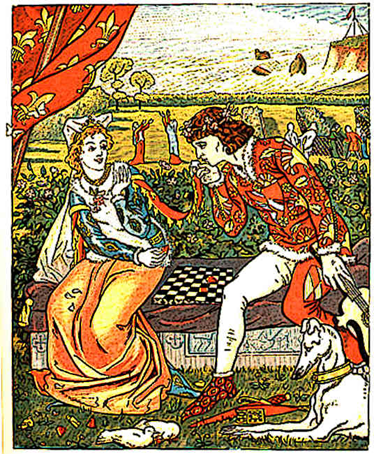
    Illustration depicting “The Franklin’s Tale” by Geoffrey Chaucer

    “Her name is Dulcinea, her country El Toboso, a village of La Mancha, her rank must be at least that of a princess, since she is my queen and lady, and her beauty superhuman, since all the impossible and fanciful attributes of beauty which the poets apply to their ladies are verified in her.” – Don Quixote by Miguel de Cervantes

    In the novel Don Quixote by Miguel de Cervantes, the journeys of the chivalry-obsessed Don Quixote involve squires, horse-back travel, and alluring maidens. Though women play a supporting role, the novel highlights how medieval courtship turned women into objects and conquests, determining men’s worth by their status, and not by their individual identities and desires. A man gained respect by devoting himself to a woman. As long as that was achieved, nothing else mattered. The damsel may as well have never existed.

    Cervantes’ version of the Madonna, Dulcinea del Toboso, is a step away from this idealized woman as she dares to have wants and desires—or, more accurately, Quixote thinks she does and structures his actions around them. Described as beautiful and without equal, Dulcinea inspires the titular knight on his quest for chivalry and respect. Despite many of Quixote’s actions revolving around her, she never appears once in the novel, or even directly affects the plot. In fact, when he thinks of her or asks for her memory to motivate him, it’s almost an act of prayer.Through the mere idea of Dulcinea, he achieves true chivalry and may go on gallivanting to his heart’s content. He needs her to become a knight, as she is the perfect example of a noble lady he can fight and pontificate over. At the same time, however, Quixote couldn’t possibly refer to her as attractive or express sexual desires for her—that would ruin his image of a courtly gentleman. He has to be unworthy of her affections in order for her to be worthy of his attention—otherwise there’s no point in his constant pining. In fact, he is so obsessed with promoting his image of a knight-errant in love that he spends hours at night thinking of her to imitate stories of knights pining after the object of their affections (which is about as unromantic as it sounds). The result is a strange, detached ghost of a woman who haunts the novel without ever actually showing herself, like a monster in a low-budget horror movie. Any closer to humanity and she risks becoming too common and too corruptible for Quixote’s purposes.


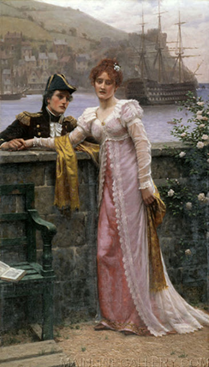
    Adieu (1901), painting by Edmund Blair Leighton

    “How Wickham and Lydia were to be supported in tolerable independence, she could not imagine. But how little of permanent happiness could belong to a couple who were only brought together because their passions were stronger than their virtue, she could easily conjecture.” – Pride and Prejudice by Jane Austen

    Most women exist in a strange middle ground between the Madonna and the Whore in which they manage, somehow, to hold the potential for both. This woman turns into a sort of Schrodinger’s Whore, in which she is pure and unblemished, yet she is always one wrong step away from completely ruining herself (and, often, her family). Picture Lydia Bennet. She is the youngest of five sisters within a family that placed extreme importance on marriage order. Mrs. Bennet spends most of the book searching for an adequate match for Jane, the eldest, and Lizzie entertains the thought of marriage only in relation to Jane already being paired off. Lydia, however, is on the backburner not because it’s not her turn yet. Her premature (in all senses of the word) elopement with the sneaky military officer George Wickham shows her refusal to embody the demure, patient younger sister role. She ignores the lines drawn around her, which in turn threatens the futures of all the Bennet sisters. Wickham takes advantage of her youthful openness and exploits it for his own gains precisely because he perceives her to be a woman who stepped out of bounds. In other words, Lydia is made vulnerable because she does not conform to social conventions of propriety and courtship. 

    She held all the promise of becoming a Whore, yet she was saved by becoming a bride.

    When the Bennet family and Darcy discover the elopement and endeavor to “fix” it, Lydia is simultaneously framed as both cluelessly childish and deliberately reckless. Elizabeth’s cutting judgement reprimands Lydia’s capitulation to desire and concessions to Wickham’s advances—regardless of the fact that Wickham was almost 30, and Lydia a mere 15. In the eyes of the Bennets, Lydia is to blame for the near-total collapse of their family’s social status. In fact, Elizabeth doesn’t even stop to consider that Lydia might just be a young teenager making bad decisions (though getting involved with a giant red flag of a man is probably a little worse than getting badly cut emo bangs and using dollar store hair dye). 

    In society’s rule-book, before Lydia is a child, she is a woman, and as such she must guard her purity above all else, even despite the prevalence of predatory men. She and her family are only saved by the intervention of Mr. Darcy, whose efforts only work because of a massive bribe to properly marry each other and thus return to an acceptable relationship that allows her to maintain her unblemished status with minimized scandal.Lydia, however, isn’t even the recipient of the worst aspects of male judgement. Her high social class and youth act to cushion her from any true consequences for her actions, ultimately resulting only in the grim future that being Mrs. George Wickham incurs. She held all the promise of becoming a Whore, yet she was saved by becoming a bride. Marriage thus redeemed the union—making it acceptable before God—because it asserts a normal social order. On top of that, it ascertains monogamy and legitimacy, key factors in establishing a family. This promise of motherhood and normalcy “save” the Bennets from social ruin (even if it means Christmas is going to be real weird for a while).


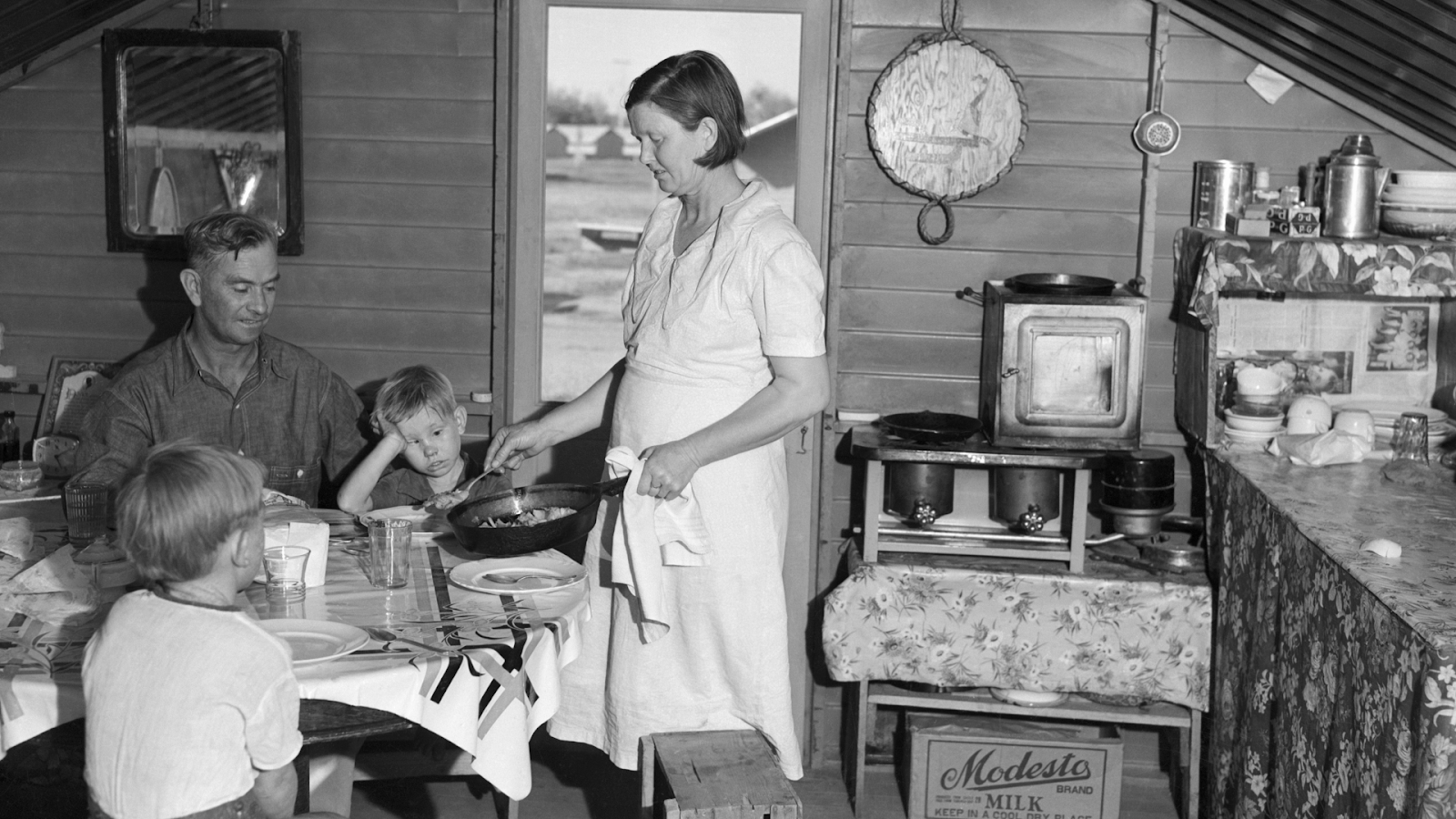
    An American family in 1939 – Credit: Bettmann Archive/Getty Images

    “Strumpet! Strumpet!” – Brave New World by Aldous Huxley

    No one does sexism like classic dystopian novels, but Brave New World manages to take it to a whole new level with the treatment of Lenina Crowne. Within the highly stratified class-based society of the novel, Lenina’s societal role is to provide sexual pleasure for the men around her. Her “education” consists, in part, largely of learning how to sterilize herself to prevent unwanted pregnancies so that her body can serve society’s pursuit of pleasure above all else. She echoes the mantra—“everyone belongs to everyone”—and views sex as a physcial experience akin to brushing teeth or taking out the trash. There are no emotions attached, nor is there direct stigma against her or other promiscuous women by Huxley’s dystopian society. Lenina represents the complete Whore, one who is sexually desired, but never emotionally.

    The Whore is detached from society, like the Madonna, but she is ostracized and lacks dignity and safety.

    When she meets John, the embodiment of “true” humanity who resists the mind-numbing drugs and brainwashing efforts that define Huxley’s dystopia, she is immediately enraptured by how strange he is. John, too, is enraptured, understanding her as the embodiment of the beloved in Shakespeare’s sonnets and the inspiring muse mentioned by ancient poets and philosophers. (John would be the kind of person to write notes app poetry about his crush and post weirdly specific but indirect comments on social media about them). That entrancement, however, quickly turns into disgust and rage the second she tries to sleep with him. Once the image of purity is scrubbed away, John cannot see her as anything but a strumpet. He reacts as if she were filthy, cringing away from her touch like it might corrupt him as well, and ultimately attacks her as a result. The next time John sees her, he loses control of himself and proceeds to brutally flog Lenina in public before ultimately turning his violence against himself for daring to be aroused and tempted. 

    At this final stop on the continuum, Whore with a capital W, women are once again untouchable. This time, however, it’s not because they’re viewed as superior and heavenly. The Whore is untouchable because she is depraved, and any who touch her bring shame and disgust upon themselves. The Whore is detached from society, like the Madonna, but she is ostracized and lacks dignity and safety. She is subject to beatings, assault, death and debasement because she is no longer worthy of admiration. All the while, men will still pursue her as a sexual object. She will still be stared at and touched and her assailants will (for the most part) go unpunished. For her, there is no winning, only a game of survival.

    “It’s kind of a double-edged sword, isn’t it?…Well, if you say you haven’t, you’re a prude. If you say you have, you’re a slut. It’s a trap.– Allison Reynolds, The Breakfast Club

    If both the Madonna and the Whore are viewed as unhuman, be that superhuman or subhuman, then there really is no winning for women under the Madonna-Whore Complex. Being maternal, nurturing and “pure” means cutting off parts of your humanity so that men may place you on a pedestal and then refuse to ever let you down. If you go the other way and choose to openly pursue your desires, to have any hint of a sex drive, or even think about telling a man you’re attracted to him (consent is scary to men I guess), then you may as well sign off any hope for respect or affection. Perfect or worthless, kind or hot, capable of doing no wrong or not worth pursuing. There is no nuance; women are forced into these dichotomies and quickly defined by their relation to the figures of Madonna and Whore. Meanwhile, trying to find a way out and exhibiting traits of both just means being a reverse Hannah Montana and getting the worst of both worlds.

    The solution, then, is to just stop caring. Women should express their desires as well as their reservations to whatever extent they please regardless of whether or not they will be labeled the Madonna or the Whore. Through this refusal, the game shifts back towards men and makes them responsible for overcoming their inability to simultaneously respect and be attracted to women. Redefining one’s own terms of womanhood reestablishes the human aspect of women both inside and outside literature.

  • November Munchies: Delicious Depictions from the Hothouse Staff

    With Thanksgiving on the horizon, the hothouse staff is thinking about food. We asked our staff to send us their favorite literary (or otherwise) depictions of food. Read below for some of the most mouthwateringly salient meals to grace our pages and screens. 

    Redwall by Brian Jacques

    Stephanie Pickrell, Managing & Website Co-Editor

    When I read the Redwall series as a child, one of the things that simultaneously delighted and infuriated me were all the feast descriptions. The story itself might have been about woodland creatures and epic battles between good and evil, but every other chapter there would be some sort of meal described in luxurious detail—dandelion soup and acorn bread and pastries stuffed with mushrooms. As a reader, I was delighted, but as a growing middle schooler, the feasts pointed out a hungry ache in my stomach that no school lunch was ever able to fill. Even now, I still wish I could taste the comfort of potato-beetroot soup with cream, served in an hollowed acorn shell.

    A Room of One’s Own by Virginia Woolf

    Megan Snopik, Website Co-Editor

    “One cannot think well, love well, sleep well, if one has not dined well.”

    In Woolf’s famed A Room of One’s Own, she tells a story of two meals. At Cambridge, the men’s college serve soles in “the whitest cream,” partridges “with all their retinue of sauces and salads,” potatoes “thin as coins but not so hard,” and a “confection which rose all sugar from the waves” for dessert. Whereas the women’s college serves “plain gravy soup,” stringy beef “with its attendant greens and potatoes—a homely trinity,” prunes “exuding a fluid such as might run in misers’ veins who have denied themselves wine and warmth for eighty years and yet not given to the poor.” The contrast between these two meals relates to the privileging of men in institutions of higher educations over women. The descriptors Woolf uses transports the reader to the site of these meals, making them thirst for gender equality.

    Studio Ghibli

    Jack Gross, Website Staff

    When it comes to food, it doesn’t get much better than Studio Ghibli and their overwhelmingly pleasant and palatable depiction of comfort dishes. While many examples come to mind, the image of bacon and eggs cooking on the iron skillet from Howl’s Moving Castle constantly lingers in the back of my mind anytime I crave breakfast food and often is enough to spring me into action. When I cook breakfast, I must reconcile with my disappointment that the fire isn’t smiling back at me, that the egg yolk isn’t a perfect unbroken yellow circle, and that the bacon isn’t sizzling in a perfectly symmetrical and even fashion. I blame Howl’s Moving Castle for my daily morning dose of disappointment, but also for my undying pursuit for the perfect breakfast.

    Austen Schreib, Marketing Team

    One of my favorite depictions of food is from the Studio Ghibli film, Spirited Away. While there are many scenes featuring food in this movie, my favorite is when Haku gives Chihiro a simple rice ball. Chihiro cries as she eats the rice ball and Haku comforts her. I think this scene encapsulates how food can act as a symbol of love between individuals. Even though the food itself may not be decadent, the care behind its offering is powerful.

    The Aristocats

    Celeste Hoover, Website Staff

    A classic comfort movie and a delicious meal, what better treat is there than Crème de la Crème à la Edgar? I have fond childhood memories of watching this scene from the film, The Aristocats, and attempting to recreate Edgar’s delicious milk and cracker concoction. Unfortunately, my kindergarten self quickly realized it is perhaps better left on the screen. Many soggy crackers were thrown in the garbage that day. The movie remains an excellent choice, however—just maybe steer clear of the Crème. 

    Fresh Guacamole

    Najeeba Shahim, Marketing Staff

    The Oscar-nominated short film Fresh Guacamole by Pes is by far one of my favorite cinematic depictions of food. Claymation is a satisfying medium in and of itself, but something about the way ordinary objects are transformed into delicious guacamole heightens the experience and reminds me of my own childhood and the times I’ve spent “pretend” cooking with whatever I could find. Every time I watch this clip, I always want to restart it find any details I may have missed, and just experience the whole film all over again. 

    The Importance of Being Earnest

    Clover Boxwood, Zine Board

    One of my favorite depictions of food isn’t from a description so vivid I could feel it, smell it, or nearly taste it on my tongue. No, I read The Importance of Being Earnest for the first time a few months ago, and in it, one of Oscar Wilde’s characters, Algernon, is often eating at silly, inopportune times. When questioned by his friend Jack why he’s sitting there, eating muffins, when he’s in such deep trouble, he says this: “Well, I can’t eat muffins in an agitated manner […] One should always eat muffins quite calmly. It is the only way to eat them.” Which is such a blunt, comedic, true line that now I’m going to remember it every time I eat muffins.

    Ratatouille

    Eun Jae Kim, Fiction Board

    As an extremely picky child who detested all vegetables, a beautiful plate of what seemed to be varying colors of pepperoni drenched in the sauce was a dream come true for my younger self. I dreamt that someday, I, too, would go to a fancy restaurant with small portions and cross chefs and taste this delectable dish myself. I still remember the horror and shock I felt when, years later, I realized that it was a dish made entirely of vegetables– namely, eggplant, tomatoes, squash, and zucchini, which were some of my least favorite foods on earth. Now, as I’ve somewhat developed my palate and become more open-minded with food, I once again embrace that childhood dream of trying this dish. 

    Malvika Mahendhravarman, Marketing Staff

    Despite having no knowledge of French cuisine, when I was six years old, I wanted to taste the symphony of flavors in a ratatouille after watching the now-beloved animated classic. The deep red, autumnal orange, and pale yellow discs spiraled beautifully, and you could almost smell the blend of earthy herbs coming from the piping steam. The movie insightfully comments on how food can produce a visceral memory and transport you back to childhood, where tears only lasted a day and could be solved with a mother’s warmth. For Anton Ego, the deep nostalgia that stems from the remembrance of a homemade meal made by an almost forgotten loved one is a powerful metaphor, for even as time hardens us, we are still children at heart.

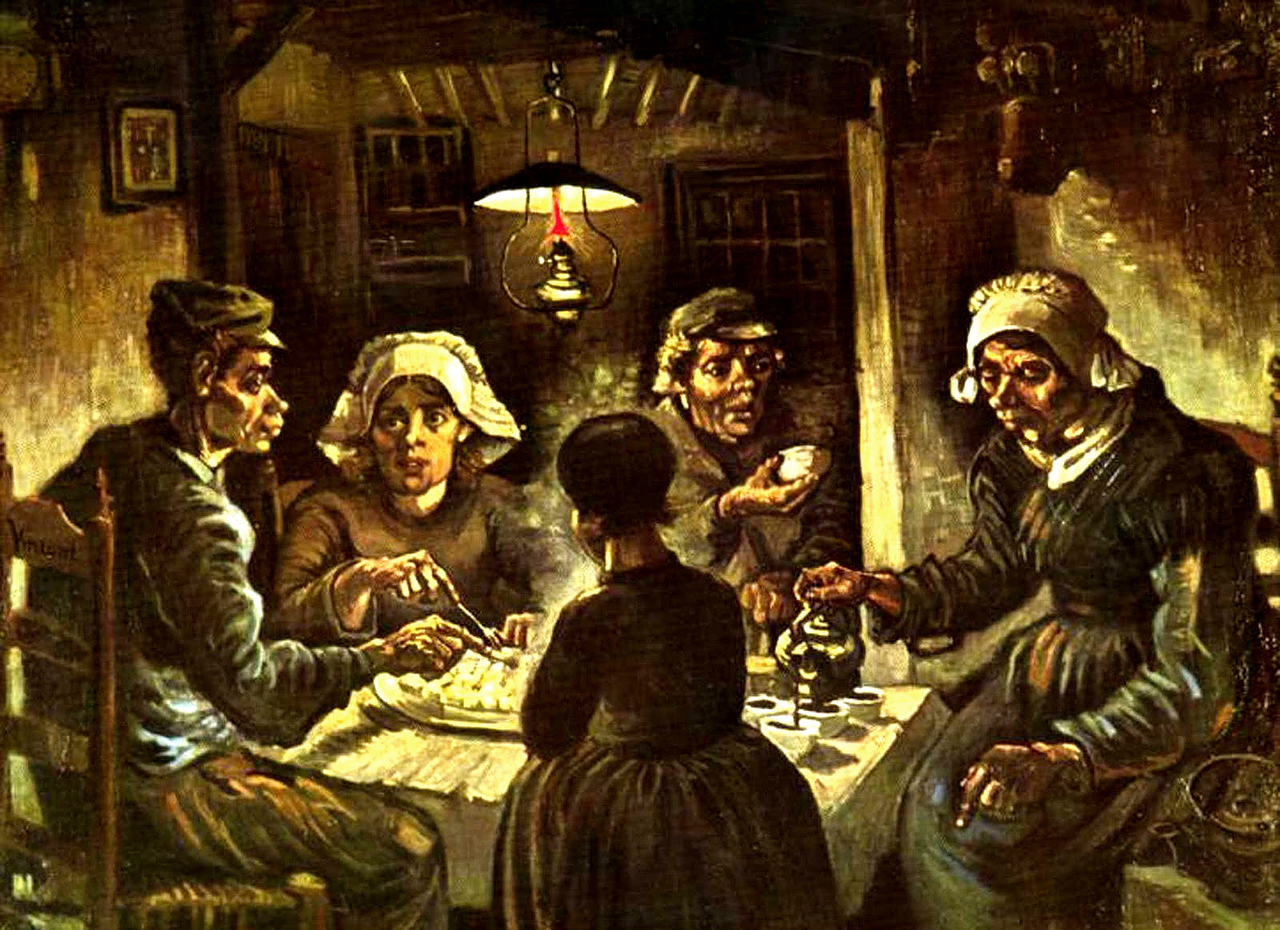
    “The Patato Eaters” Vincent Van Gogh

    Medha Anoo, Website Staff & Poetry Board

    When I look at “The Potato Eaters” by Vincent van Gogh, I feel like the only other person in the world. It reminds me of when I was soaked through with water—cold, miserable, starving—and someone poured me a cup of hot coffee. Hundreds of years ago on a different continent than mine, the people in the painting came to the dinner table weary and hungry and were soothed by hot food and drink, and as a child in middle of the monsoon season in India, so was I. 

    “Tutti Frutti” by Little Richard

    Charlie Sharpe, Zine Board

    Man, the swing of Little Richard’s voice in “Tutti Frutti” reminds me of two of my favorite things: the people in my life and the food. Be it a Friendsgiving meal, a potluck for D&D, or a cook-in date, the warm noise we make in the kitchen with the dropped pots and loud recipe re-readings is its own funky little song. We even have our little “a wop bop a loo bop a lop bom bom” when we all collapse into our chairs. I can’t help but get giddy when someone turns on the music and gets out a pan.

    Spongebob Squarepants

    Andrew Martinez, Poetry Board

    I kind of love the way that chum is talked about and depicted in Spongebob? There’s something about the way that everyone hates it, the way that it looks like chili from Wienerschnitzel, the way that I imagine it tastes like, a fishy-sloppy joe. I just really wanna taste it. I can’t say I’ve ever really wanted a Krabby Patty; catch me at the Chum Bucket. Honestly, people are probably just cowards and afraid to admit that it’s good – not me though. Chum<3

    Richard III by William Shakespeare

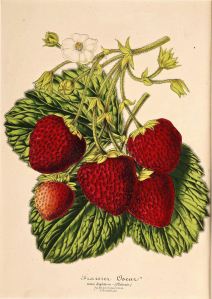
    Gerardo Garcia, Website Staff

    RICHARD
    Than my Lord Hastings no man might be bolder.
    His Lordship knows me well and loves me well.—
    My lord of Ely, when I was last in Holborn
    I saw good strawberries in your garden there;
    I do beseech you, send for some of them.

    ELY 
    Marry and will, my lord, with all my heart.

    In Act 3, scene 4 of Richard III, a council of lords meet to determine who will be coronated following the recent death of their previous King, Edward V (nothing to see here, folks). Buckingham skews the conversation in favor of the Duke of Gloucester, who enters right on queue. Conspiracy, soliloquies, and unsuspected murder have worked up quite the appetite for Richard as he eagerly orders some strawberries for the occasion—Hastings, however, spoils the meal soon after. Demanding that Hastings be beheaded for disloyalty, Richard swears he will not dine until he sees the same; without hesitation, his cronies lead Hastings to the block, as “the Duke would be at dinner.” Preceding one of its darkest moments, the strawberry is one of the brightest images in the play, illustrating Richard’s craving for them as absolutely bizarre and unsettling (I was lucky enough to play Richard during this summer’s Shakespeare at Winedale program, and found nothing more menacing than eating a juicy strawberry after the reveal of Hastings’ head on a platter). 

    The Lord of the Rings by J. R. Tolkien

    Harmony Moura Burk, Poetry Board & Website Staff

    Po-ta-toes. Boil ‘em, mash ‘em, stick ‘em in a stew. Amidst all the adventuring, magic, and dangerous hikes, the Lord of the Rings movies are filled to the brim with depictions of food and warmth. From the Hobbits’ multiple meals a day (second breakfast sounds wonderful) to the bits of bread being rationed out along their journey, food and the act of eating together create a sense of community and bonding in otherwise terrifying circumstances. Having grown up with Tolkein’s books and the movies, I can’t help but find comfort in watching the meals and food-related shenanigans embedded throughout the plot— especially if I have a nice, warm plate of my own.  

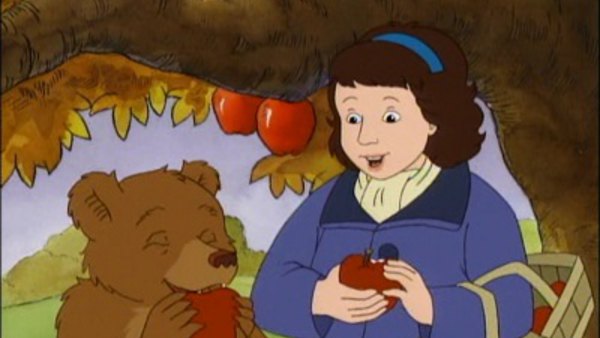
    Little Bear

    Turi Sioson, Fiction Board

    As any pre-pubescent kid who wasn’t allergic to apples, I loved applesauce.  I would dip carrots into their cinnamon-flavored cups to make eating the vegetable more exciting; I would eat two or three in one sitting.  But when I eat applesauce now, it’s hard not to think of one of my favorite episodes of Little Bear, my favorite childhood show.  In the episode “Applesauce,” Little Bear and his human friend Emily meet a Toad while apple-picking, and when they take him back to Emily’s house, he repeats, “Rapplesauce, rapplesauce!” in a plea to eat some of Emily’s grandmother’s homemade applesauce.  The ridiculous toad’s voice itched some kind of scratch in my childhood brain, and for years following, I would say, “Rapplesauce, rapplesauce!” anytime I ate the snack.  Though—to my father’s dismay—I’ve outgrown that little quirk by now, there’s still that lingering affection for applesauce that goes beyond a simple enjoyment of the taste.

    Sonnet 75 by William Shakespeare

    Kara Hildebrand, Website Staff

    So are you to my thoughts as food to life, 
    Or as sweet-season’d showers are to the ground.

    What I love about these lines is how they acknowledge food as a means to sustain life, yet we are able to attach our own meaning to it. How we choose to prepare food, the life, and the culture behind it carries a million things that only a warm meal can convey. Particular people, moments, feelings can be as life-sustaining as the flavors that remind us of them. 

    To the Lighthouse by Virginia Woolf

    Jasmin Nassar, Fiction Board

    Nothing has brought me comfort and peace more than Virginia Woolf’s writing. More specifically, her novel To the Lighthouse has one of my favorite literary depictions of food because of how warm, tender, and triumphant it is. The “savory brown and yellow meats” with the “bay leaves and its wine” make up a French beef stew that Mrs. Ramsay’s chef took three nights to carefully prepare. Woolf’s famous streams of consciousness and elaborate emotional discord are interrupted by this wholesome depiction of a beef stew, a sort of triumph in the midst of the emotional conflict taking place at Mrs. Ramsay’s dinner table.

  • Does It Spark Joy?

    Has anyone mentioned that it’s been a hard year? Unprecedented times? They have? Oh well, we’ll skip that part then and instead talk about the positives that shone through this last year. While we dealt with these… never-before-seen times, most of us found comfort in art. So, we present to you not a meditation on the pandemic, but a catalogue of the media that brought us joy, that sparked true happiness over this last year. These were the works that connected us to ourselves and to others, that distracted us in isolation, and that brought sincere positivity when there was little else to focus on — enjoy this compilation of recommendations of the profound and the absurd from the Hothouse staff.

    Literally All The Barbie Movies Up Until Circa 2006

    Kylie Warkentin, Editor in Chief

    In all times (but especially in those of distress), Barbie’s under-animated face and oddly blocky hair never fails to deliver the right amount of childhood nostalgia and genuine joy — and bangers! Though all Barbie movies in this time period (+ a select few 2007 ones) are excellent, some particular favorites are Barbie as Rapunzel and Barbie of Swan Lake. Speaking of: I have seen your silly Barbie Cinematic Universe movie ranking pyramids, Buzzfeed, and I laugh at your failure to include Barbie of Swan Lake OR Barbie as the Island Princess in the top tier.
    Please enjoy this delightful compilation of noises Preminger (played fabulously by Martin Short) makes in Barbie: The Princess and the Pauper.

    Backpacking Documentaries on YouTube

    Christie Basson, Managing Editor & Website Editor

    During the summer and through the ensuing months, my escapism has become documentaries from hikers and backpackers who complete hikes like the Pacific Crest Trial, the Appalachian Trial, and the Continental Divide Trial. When I started, was I an avid hiker, interested in dehydrating my own food, or excited by the challenge of packing multiple months’ supplies into a single backpack? Not particularly. And yet, as I watched people first venture into the wild, take their entire families on months-long hikes, and intimately capture the challenges of their journeys, I fell deeper and deeper into the world of thru-hikers. It was not only beautiful to see America’s landscape captured from various remote vantages, but it was soothing during our isolation to watch strangers connect and form bonds as they all tackled the same obstacle. These films (fantastically filmed and edited, by the way) captured the beauty of the solitary while celebrating the trust that we can build in ourselves and in our fellow humans by doing the things that scare us. While I am not yet signing up to hike from Mexico to Canada, I was inspired to plan a camping road trip this summer — we’ll see how that goes first.

    Carmen Sandiego, the series on Netflix

    Stephanie Pickrell, Website Editor

    Partly as a result of the anxiety of the pandemic, and partly because I secretly never grew up, I’ve been watching a lot of children’s shows in the past year, including Carmen Sandiego. The series follows the life of the super-thief Carmen as she travels around the world (another Covid impossibility) undermining the Villains International League of Evil (a.k.a. VILE) by stealing priceless cultural artifacts before they can, and then returning her thefts to the communities they came from. The show was inspired by a series of video games that started coming out in 1985, and I’ve enjoyed watching the show for the story adaptations, the art style, the amazing soundtrack, and of course, the absolute power of la femme rouge herself. In addition to that, the show packs an impressively international cast, my favorite of course being Detective Chase Devineaux, the Frenchman who never fails to embarrass himself, in one way or another.

    “Heel Turn 2” by The Mountain Goats

    Scotty Villhard, Website Writer & Prose Board

    In 2020, North Carolina-based folk rock band The Mountain Goats released four full albums of music: Songs for Pierre Chuvin, a solo album by frontman John Darnielle that throws back to the early days of The Mountain Goats when the songs were recorded straight to a boombox; Getting Into Knives, a lush and arcane album featuring nearly a dozen guest musicians; and The Jordan Lake Sessions Volumes 1 and 2, two broadcasted concerts featuring new takes on some of their older songs. The Mountain Goats are my favorite band, largely thanks to the incredible and ultra-specific songwriting of Darnielle, whose songs each tell a story with the sort of brevity and emotion that only songwriting can accomplish. This song, “Heel Turn 2,” originates on their 2015 album Beat the Champ, about the professional wrestlers that Darnielle would go and watch with his stepfather as a child. The song is about a wrestler who, finding himself at a dead end in his life and career, decides to perform a “heel turn,” and go from a good guy to a bad guy. It’s about perseverance and doing whatever it takes to get through the struggles you face. I’m not surprised it made its way onto a pandemic concert album. I’m suggesting this version as opposed to the original for the incredible emotion Darnielle conveys in the performance, as well as the amazing full-band outro (a piano solo on the album), though I recommend everyone go back and listen to all of Beat the Champ after this song. Then, if you’re like me, you’ll go and listen to every other Mountain Goats album, multiple times, and never stop.

    Emma (2020)

    Megan Snopik, Website Writer & Prose Board

    You must be the best judge of your own happiness.

    Emma Woodhouse

    This year was a tumultuous journey for me, but one thing you can always count on is new Jane Austen adaptations. Autumn de Wilde’s 2020 adaptation of Emma was a shining beacon and a reminder of the amazing things literary interpretation has to offer. The dazzling Anya Taylor-Joy stars as the smart heroine, Emma Woodhouse, in this brightly colored, expertly produced, charming film. 

    A Beautiful and Foolish Endeavour by Hank Green

    Lacee Burr, Prose Board

    While most people that downloaded TikTok during the pandemic are probably familiar with Hank Green from his funny yet oddly informative videos, you now have the chance to know him as a writer! A Beautifully Foolish Endeavor is the sequel to his first book, An Absolutely Remarkable Thing (which you should definitely read first). Both books are fun, fast-paced, and genuinely interesting — they’re the type of books you’ll pick up one day and end up reading all night. *Queue Stefon voice* These books have everything: mysterious alien robots, a puzzle that needs to be solved, and the power of friendship!

    Stg. Pepper’s Lonely Hearts Club Band

    Emma Allen, Poetry Board

    In August of 2020 I received a record player for my birthday and one of the first records I received — and the one I have to recommend for summer — is Sgt. Pepper’s Lonely Hearts Club Band by The Beatles. Specifically for summertime car rides I would recommend the following songs on the album: “With A Little Help From My Friends,” “Getting Better,” “Lucy In The Sky With Diamonds,” and “Lovely Rita.” I feel that I would be doing a disservice if I didn’t recommend Sgt. Pepper’s because I have found that the tracks on it rival sunshine itself and never get old— no matter how many times you hit replay. The album has this special way of transporting me to another fantastical world, making me forget about the extremely unfortunate one we have inhabited for the past 13-14 months. When listening to Sgt. Pepper’s, you’ll have no choice but to “admit it’s getting (*somewhat*) better”; I hope you love it as much as I do!

    The Selected Poems of T’ao Ch’ien translated by David Hinton

    Tom Jennings, Poetry Board

    All this brings back such joy I forget
    glittering careers. White clouds drift

    endless skies. I watch. Why all that
    reverent longing for ancient times?

    T’ao Ch’ien

    One book that brought me deep joy this year was David Hinton’s translations of the poetry of Tao Yuanming (his name is also rendered as T’ao Ch’ien or Tao Qian), a 4th-5th century Chinese poet who left his government job to be a wine-drinking poet-farmer. In doing so, he invented a new personal form of Chinese poetry, the influence of which (one only needs to look to Li Bai’s references to him) makes him a rather monumental figure. The intensely personal character of his descriptions of family and farming lifestyle shine through to form a vivid personality that survives translation. His love affair with wine flows through most of the poems, combining the philosophizing-on-impermanence with an endlessly enjoyable earthy wit and immediacy. His meditations on life and philosophy are timeless, and their depth richens with each subsequent read. I particularly enjoy the “Form, Shadow, Spirit” trio, where T’ao’s ability to cut through the delusions of attachment to both form and formlessness always makes for a beautiful read—obviously reminiscent of the Daosit literature before him and the Chinese Zen literature he would unknowingly influence after his time. His regard as something of a nature-prophet may be slightly misguided, but his closeness to nature as he describes his lifestyle always sparks thought as to our own relation to mind and biosphere.

  • Comics and Censorship: Saving Children and Winning Wars

    by Skylar Epstein

    In his 2001 novel, Comic Book Nation, Bradford W. Wright posits that there are intellectual pitfalls in analyzing a medium like comic books too deeply. Why? Because they’re just for fun. Comic books are entertainment for kids and teenagers, so the argument goes that attempting to apply the same methods of analysis to comics as we would apply to a classic, much-revered novel is misguided at best and futile at worst. I disagree with this kind of thinking because, in my opinion, comics are, and have been, incredibly successful barometers for the specific social and political climate they were published in. Even in the 1920s, when American comics still took the form of short strips, sandwiched between the sports and lifestyle sections of newspapers, comics marched to the beat of the American sociocultural climate and reflected the issues that people faced in their own lives. And, because they could be published quickly and were serialized weekly, comics were able to reflect changes to those issues in real time. Comics, because of their unique relationship to popular culture and their storied history with censorship, are both reflections of the sociopolitical climates they were produced in, and are manipulated reflections of history. 

    Analyzing the history of comics and their publication norms allows us to consider both the reality of American history and its self-idealization. Comics are always a push and pull between what individual comic book readers can personally relate to and how the general public will accept being represented. To illustrate the importance of relatability, we can look at how Shazam comics outsold Superman comics in the 50s since kids related more personally with Billy Batson, a young boy, than they could with Clark Kent. In turn, the impact of reputation and the American self-image can be seen through the Superman comics. They became controversial for adult readers when the villains condemned government corruption (76-80) too strongly during wartime since readers didn’t want to introduce any more instability into the foundational American system during times of crisis—even on a fictional stage. Thinking about this pressure between accurate representation and idealized imagery is especially important when one attempts to fully understand American culture in the moments it was challenged, like during the Great Depression and the Cold War.

    However, this subversive, counterculture trend for comic strip protagonists didn’t last forever, and newspapers moved to depicting more “mainstream” upper middle class families.

    Comics, as we all know, are easy reading. Comics made their first appearances in the early 1900s, and were mainly published in newspapers. The plots of comic strips are generally pretty simple, and are made even easier to follow by the bright visuals and onomatopoeia-d sound effects. The characters in comics speak like people; they use slang, make weird noises, and generally don’t mince their words. All of these factors working together means that the “funnies” section of the newspaper was accessible to a whole different type of audience—those with limited reading or language abilities. Since comics followed the money, newspapers realized that publishing comics gained them access to people who didn’t necessarily read the papers for the articles—such as the growing immigrant population in the United States, who generally spoke limited English. As more immigrants bought newspapers and read the comics, more comics tailored their content to their new readers. This meant that there was a point in time when comics embraced a truly multicultural attitude, and sympathized with the disenfranchisement that immigrants felt by portraying protagonists who struggled with the same authorities, like police and factory bosses. In this way, the “gutter art” (Weisner’s term for comics) embraced the margins. However, this subversive, counterculture trend for comic strip protagonists didn’t last forever, and newspapers moved to depicting more “mainstream” upper middle class families as the comic strips began gaining more attention from middle class audiences.

    Though the earliest comics were generally for the laughs (even the ones with the ‘family values’ undertones), the stories told in comic strips began to evolve. By the 1910s and 1920s, serialized comic strips were beginning to dabble in new, more complex, genres. The most common genres of these newer, longform serialized comics were action, adventure, and fantasy. It’s no surprise that the notorious “to be continued” cliffhanger made its debut in these pulpy action strips. Although there were fledging examples of comic strips delving into action and adventure in the 1910s (most notably, from creator C.W. Kahles who started blending humor and adventure in his 1901 comic strip, The Perils of Submarine Boating), action and adventure comics really grew legs after the 1930s, during the Great Depression. It is during this era that we finally begin to see superheroes popping up in comics. Intuitively, the rise of superheroes during the Great Depression makes sense, because superheroes could physically fight the issues of the times in ways the average citizen couldn’t. Batman could fistfight petty muggers who represented the spike in violent crime that followed the sweeping unemployment—and win. An earlier example of this phenomenon was a character called Captain Easy, who was originally a supporting character in Wash Tubbs (1924). By 1933, Captain Easy had his own solo strip, where he grappled with a dangerous world using his experience as a WWI veteran to solve crimes as a detective. The themes of Captain Easy are right there on the surface—the name Captain Easy is simple, evocative and effective—and gently guiding the characters of Wash Tubbs to exciting, yet simple solutions for their struggles told readers that life could be easy within the confines of his weekly comic strips. By the time that companies like DC began publishing comics as the books and issues that we’re familiar with now, the language, style, and general themes of comics had already been founded by newspaper strips like Captain Easy. 

    With their independent publishing houses established and their target demographic clarified, the first few publications that rolled out were really the Cambrian explosion of the comics industry.

    Comic book publishers relied on the genre foundations and visual language that the newspaper funnies had developed but the comic industry found a new freedom outside the constraints of newspapers. The main publishing houses (which included the companies that would later become Marvel and Detective Comics) began publishing comics as books and issues in the 1930s, beginning what many call the Golden Age of comics. The impact of these first few years can’t be overstated. The ability to publish comics outside of the restrictions of a newspaper transformed comics into their own independent industry. Now, instead of having to tailor their comics to the adults in the household who purchased and read the newspapers, the comic book publishers could hone in on specific audiences, which allowed them to publish more niche content than would be accepted by a broad reader base. The marketing for comic books targeted young people specifically, and became fantastically popular with kids and teenagers.  Some of this popularity can be explained by the targeted marketing, but the simplicity and the vibrancy of the stories told, alongside the ten cent price tag of comics, contributed to the youthful slant of the average comic book reader. With their independent publishing houses established and their target demographic clarified, the first few publications that rolled out were really the cambrian explosion of the comics industry. Once Superman rolled onto the scene in 1938, other heroes kept flying in, and superhero comics became smashingly popular. 

    Comics have always flowed with the tide of popular culture, but this was especially apparent during war. In the second World War, just after the Golden Age of comics began, comic books were used as propaganda in order to recruit young men into the army. To accomplish this, comic book publishers joined forces with the US government and the Writers’ War Board (WWB), a quasi-governmental agency created by the Office of War Information (OWI). Under this partnership, comic books that told the story of “the glorious victory of the US over the Nazis” were published, and the American way of life was exalted over all others. As an example, the cover page of an issue titled “This Is Our Enemy” showed the founding members of the Justice League staring in horror as the Four Horsemen of the Apocalypse, riding underneath a Nazi banner, lay waste to a city. 

    During the 30s and 40s, heroes were essentially inspirational patriots. In the words of the Human Torch, “America is not in danger… It’s still the land of the free!” Comics rallied support for the American war effort, laying out the path from conscription to heroism in technicolor yellow bricks. In 1943, approximately twenty-five million comic books were sold per month, earning the industry thirty million dollars in the course of the year. However, despite their fantastic commercial success, comics books eventually ran into the same issue that their newspaper strip predecessors did as critics entered the comic book scene with grave concerns about the state of our nations’ literacy. One journalist wrote, “These comics may be leading back to the drawings of the caveman, reducing our vocabulary to monosyllables such as ‘Oof!’ and ‘Zowie!’” This time around, the critics meant business. 

    The Comics Code of Authority heralded the end of the Golden Age of comics, and permanently changed the rules of engagement between comic book publishers, readers, and characters.

    There were two major policies meant to restrict the content of comics, both following major spikes in comic book popularity and in public criticism: the Editorial Board of 1941 and the The Comics Code of 1954. The general goal for both of these policies was oversight. Comic publishers wanted to assure parents that comics weren’t actually harming their kids in order to keep up sales. The Editorial Board of 1941 was established by the National Periodical Publication, and consisted of a board of experts in the fields of child psychology, development, and welfare. This board was tasked with making sure that comics were up to par with what they would consider “wholesome entertainment” for a growing mind. In 1956, the board was dissolved in favor of the much stricter Comics Code of Authority. 

    The Comics Code of Authority (CCA) is the most notorious comic book regulation in history. It heralded the end of the Golden Age of comics, and permanently changed the rules of engagement between comic book publishers, readers, and characters. The CCA’s reported goal was to see to it that “gains made in this medium are not lost and that violations of standards of good taste, which might tend toward corruption of the comic book as an instructive and wholesome form of entertainment, will be eliminated.” It took the form of a list of dos and don’ts for comic creators, and set the standard for what could be published. The comics industry had faced pressure from concerned parents and weathered countless storms of moral panics. The critics argued that comics were degrading to good family morals, and that they were leading youths into crime. The conclusion of this argument was that youth crime would only be slowed down if comic books were cancelled. The CCA, and its conservative, anticrime emphasis, was a last ditch effort to save the comic book from extinction, even if it meant bowing to the pressure of the critics. Basically, the CCA was a bulleted list of what comics could and could not show, covering depictions of horror, crime, religion, marriage, and the police. As such, the CCA crystallized into a plain list of what we expected from our heroes, and what values we were allowed to buy and sell. In fact, the common truism that “the good guy always wins,” was a rule in the original CCA document, which stated that in every case, good must always triumph over evil. The Comics Code of Authority ruled over comics until 2011, when it was finally dropped by the last of the major publishing houses. 

    The persistence of the Comics Code of Authority was originally powered by two things; the looming shadow of the Cold War and moral panic over the state of juvenile delinquency in the 1950s. During the Cold War in the 1950s, superheroes were pressured to perform the same heroically American acts as they had in WWII in order to show a united homefront against the Soviet Union. In the comics, the Justice Society started teaming up with the government, extolling the ingenuity and efficacy of the system. As Hawkman says, “It’s amazing what our government can do once it gets started, isn’t it, Green Lantern?” This idealism was certainly a message to foreign nations, since comics were still popular in international markets after their initial dissemination through Allied soldiers during the second World War. With the rising tensions of the Cold War, the CCA had a vested interest in cleaning up America’s international image. The CCA wanted comics to present “America as a place where good would always win, and the government would eradicate evil. Thus, the American system, as opposed to a communist one, worked because its citizens lived safely and happily.”

    Censorship continually defined the comics genre, and we still feel the ramifications of that peculiar anxiety today.

    But while comics were busy advertising good American values abroad, they were facing criticism for not adhering to those same values at home. The domestic arguments for censoring comics originated from the idea that comics were corrupting the delicate minds of American youth and transforming them into anarcho-communists. The American nuclear family, the authority of the state, the peace and stability of American institutions and the children who would join their ranks, needed to be defended on every front. The Comics Code Authority forbade publishers to reveal “cracks in the facade” and encouraged them to uphold the sanctity of the American family. Before its appearance on the scene, comics faced intense scrutiny for their content. Seduction of the Innocent (1954), a novel written by psychiatrist Frank Wertham, suggests that comic books were contributing to juvenile delinquency and that the link was so strong that the moral imperative for America was to ban comic books.  Stan Lee actually commented on Wertham’s conclusion that most of the kids in reform schools read comic books, stating that “if you do another survey, you’ll find that most of the kids drink milk, too. Should we ban milk?” Of course, Seduction of the Innocent was mostly bogus, filled with wild leaps of logic (some arguments including that Superman was a subliminal Nazi symbol because of the S on his chest), and blatant misreadings of the comic books Wertham used as sources. One such conclusion was that Batman and Robin are actually a gay couple, even though the text explictly outlines a familial dynamic between the two. My personal favorite Werthamism is that Blue Beetle is a “Kafkaesque nightmare.” But despite the ridiculousness that is apparent to a modern audience, the punches that Wertham threw towards the comic book industry landed, and the study went all the way up to the Senate floor. 

    The Comics Code of Authority lost some of its cultural force as time passed, and the general climate towards literature became less conservative, so that by the 1970s and 80s, comic heroes were able to regain some of their complexity and the plotlines didn’t have to walk the line of the stars and stripes. Censorship continually defined the comics genre, and we still feel the ramifications of that peculiar anxiety today. Analyzing comics in context comes down to thinking about changes. When considering comics’ relationship with children’s literature and censorship, a generational struggle unfolds. From the international political perspective, comics represented anxiety-ridden efforts to appear supreme against nations with different ideologies. Far from being simple, hokey, “fluff” reading, comics are rich with analytic potential, and are vital archives of American fears and hopes throughout the last century. But aside from that, comics are also worth studying because of what they weren’t allowed to say. The comic industry has been struggling against censorship since the very first comic strips were published. Knowledge of this censorship is just as important in understanding comics as their actual content is, because it reveals the complex web of social validation and rejection in American life. Comics have a lot to tell us about our own history—the good, the bad, the ugly, and the propagandizing—and we shouldn’t ignore the messages in comic books just because they’re enclosed in speech bubbles.

  • Should you read The Queen’s Gambit?

    by Megan Snopik

    The novel-to-screen-adaptation discussion has always been tumultuous, with one never quite living up to the “hype” of the other. The idea that the book is always better has also been debated in recent times, as quality film and television become instantly accessible to the home audience through streaming services like Netflix, Hulu, and Amazon Prime. The rise of these media giants in particular have led to the production of new and exciting TV shows, reboots, and adaptations galore. However, in this influx of media and adaptation, can the good series, the ones we really binge watch, stand up to the expectations set by their source texts? 

    In the case of The Queen’s Gambit, a highly successful page-to-screen adaptation, the 1983 novel by Walter Tevis was adapted into a 2019 Netflix limited series by the same title. The show presents a highly stylized, polished view of the 60s, but it contains a series of additions and subtractions from the original text that call into question whether or not reading source texts is necessary when we have adaptations to edit them for us. The Queen’s Gambit is an interesting case dealing with highly politicised times and starring a unique and fictitious female prodigy. While the series is quite similar to the novel in most ways, its largest divergence is in the success of the series. Not only did the show completely overshadow the success of the book, a record 62 million households watched The Queen’s Gambit in its first month, making it Netflix’s most popular limited series to date. However, dissimilarly from other adaptations, the series’s success did not correspond to a rise in novel sales (although it did lead to an increased sale of chess-related items). This uncommon case prompts the question: is this a singular example or is it indicative of a larger trend in the world of book-to-TV adaption? 

    In both versions of The Queen’s Gambit, the young orphaned Beth Harmon is raised at Methusen Orphanage after the untimely death of her mother. There, she takes informal chess lessons from a reclusive janitor in the building’s basement. She and the other girls are administered daily “tranquilizer” pills and, after a few doses, she develops a reliance on the sedatives. In her teens, she is adopted by Alma and Alston Wheatley, but within a few weeks,  Alston leaves Beth and Alma for another family. Beth, in the face of their financial hardship, begins playing chess competitively and wins state and national championships, splitting the winnings with Alma. As she attempts to become a chess grandmaster, Beth’s addiction to drugs and eventually alcohol causes trouble as she tries to balance her genius and her vices. 

    The frame of the show provides unique challenges, as the novel is written in the 80s and looks back on the 60s. The series then takes that 80s novel and reflects on it from the point of view of 2019. To comprehend everything the writers of this show had to consider in writing it demands a certain capacity for time travel. It’s hard to imagine how they managed to compile a unified, coherent end product that could capture the sensibilities of the 21st century while paying its dues to the style of the 60s and considering the atmosphere of the 80s when the story first entered the world. Upon Walter Tevis’s death in 1992, Alan Scott bought the rights to the novel, and ever since then, he had tried to get the book portrayed on the screen. After writing a screenplay to produce it as an independent film, contracts were rumored with filmmakers Michael Apted and Bernardo Bertolucci to direct, but financing fell through. Heath Ledger then  wanted to direct the film, but his death in 2008 caused that production to fall through. Finally, Netflix bought the screenplay in 2019 and started production on March 19th of the same year.

    Even though the book had been well received, the Netflix series has far-eclipsed the reach of Tevis’ original conception. While many other popular adaptations like Twilight or The Hunger Games had a rally of support behind the screen versions from readers who have long loved the novels (causing the adaptation to be widely anticipated) The Queen’s Gambit lacked an active readership who would do the same. As a result, the adaptation was received mostly without the context of the initial work. In fact, many believed it to be based on a true story and assumed Beth Harmond was in fact a true chess aficionado (or at least directly based on one). 

    As a result of this dissonance, there are many things about the novel that may shock the avid series-viewer. In the novel, our favorite protagonist, Beth Harmon, calls Jolene the n-word. The original Methuen is a co-ed orphanage, adding a level of sexual danger for the woman-run orphanage depicted in the series. Tevis also wrote a description of Jolene attempting to molest Beth while urging her to engage in mutual masturbation, adding a level of racialized sexuality to Jolene that Netflix decided to leave out. Instead, the TV series adds a few of its own flourishes. The show explains Beth’s tranquilizer and alcohol addictions through flashbacks to her childhood trauma, whereas the book frames substance addiction sans backstory. The series has the dreamy Townes reappear after Mexico City (and hint at homosexuality), has Benny become Beth’s sexual zenith (“what its supposed to feel like”), and has the wispy, French Cleo (and the night she and Beth spend together) completely recontextualize her first match with Borgov, inventing a whole new character.

    I myself saw the show before reading the book and was so taken by how unique its style was that I devoured the book in a flurry, trying to find all the details I so loved in the Netflix series. The iconic fashion was gone. The will-they-won’t-they Townes relationship was gone. The chess support line at the end of the last episode was gone. The fashion-forward, confident-yet-reclusive hero was gone. What the reader got was a stoic and eerily disengaged woman, obsessed with a game that modern audiences don’t really know much about. 

    Contrary to the show, the narrative style of Tevis, short and direct, alienates the novel-Beth to the society around her in every way – leaving her ability to play chess as her only avenue into the social circles around her. In the novel, Beth is not a bold, red-headed fashionista, but rather a socially awkward mousy brunette. The casting of model Anya Taylor-Joy to play Beth is one of the most divergent aspects of the series in terms of characterization, changing the trajectory and nature of Beth’s empowerment as it was depicted in the novel. While chess served as her singular lifeline there, the strong confidence that Taylor-Joy uses to power through the chess world creates a new sort of tension and a new narrative arc that gives Beth a stronger sense of inner strength and outer beauty.

    One of the biggest positive responses to experiencing The Queen’s Gambit in its screen version has been that women find it empowering to see young, uncredentialled Beth Harmon sit across the chessboard from men who condescend and smirk at her presence and then to watch her beat each one squarely. As she realizes her dream to become a grandmaster, we see her continue on the same path she decides on in the very first episode. No forces of sexism or political strife, or even serious financial barriers rise up to stop Beth from her victory. And when these forces do play out, they are easily disposed of at no real cost to Beth herself. Beth lives in a fantastic reality — and one the 21st century viewer (and surely any real woman from the 60s too) can’t help but envy. The mere anachronism of Tevis’s original construction of Beth in the 80s is just as prevalent in the 2019 version. Her journey to maturity, the bildungsroman written and rewritten by man after man for this precarious female character, makes less and less sense the more we think about it. 

    A large tension in both mediums is Beth Harmon’s enactment of womanhood, as she is depicted as antagonistic to her all male surroundings, threatening the status quo with her chess genius. While her achievements are certainly inspiring for women (in that they portray a reality which women aspire to and can live in vicariously through her), the lack of reality, and especially the lack of a political reality, for Beth makes her character act not as a strong female lead, but more as a lens for the experience men imagine women having. Other woman chess players from the time period corroborate this saying they experienced much higher degrees of sexism than either Beths ever did. The first (real) female grandmaster Susan Polgar stated she faced explicit “sexual harassment, physical intimidation, and, regularly, verbal and mental abuse” when she won her 1986 title.

    In the chess world, Beth is characterized as an anomaly, symbolized to the viewer through her striking red hair, her good fashion taste, etc., and we are told she is the exception and not the rule. Seen in her first match against the other female chess player, Annette Packer, she defeats female competition even faster than her male competitors. Then, later in the series when Packer comes to watch Beth in her second Kentucky open, Beth blows her off completely. Thus, if she breaks any competitive chess “glass ceilings” she quickly pulls up the ladder and closes the hatch behind her.

    In the case of this adaptation, reading the book led me away from believing in the myth that was Beth Harmon particularly in the possibilities for female empowerment it initially provokes. This series operates as an escapist illusion, made for the 21st century watcher. It erases the difficulties of everyday life (nevermind everyday life in the 60s) and it hits the right notes to inspire — if you don’t think too critically about its reality. So, if you want my take on if you should read the book, or heck, if you should ever think on or research too deeply the media you consume, I would tell you to proceed with extreme caution.The rights to a musical version of The Queen’s Gambit were bought on March 8th by a woman-run theatre production company called Level Forward, whose CEO stated, “The story is a siren call amidst our contemporary struggles for gender and racial equity, and we’re looking forward to moving the project forward.” We will see if the cycle continues…

  • Lovely, Lovely Absurdity

    By Scotty Villhard

    Before you read this article, please know that several sensitive and potentially triggering topics will be mentioned, including corpses, suicide, and references to anti-LGBTQ+ discrimination, racism, and ableism. In addition, there will be spoilers for Swiss Army Man, True Stories, and The Midnight Gospel

    It’s weird. It’s all very, very weird. And I love how weird it all very much is. The strange, the obtuse, the surreal, and the lovely absurd. So often we are afraid of the things that don’t make sense, and filmmakers work so hard to make nonsense terrifying on the screen. Surreal horror is a whole genre unto itself, from Suspiria to Eraserhead. We expect the strange and absurd to scare us. But what we rarely expect, and what I seek out, is when the absurd becomes comforting. I have lived with weirdness all my life, and when I see that weirdness on the screen, I feel found. I’d like to share some of that weirdness with you today, if you don’t mind. So take a seat, please, and pour the tea out on the carpet, because the absurd has come home at last.

    Swiss Army Man (2016) is a film about the farting corpse of Danielle Radcliffe. As Hank (Paul Dano), stranded on a desert island, begins to take his own life, he is stopped at the last minute when a corpse named Manny (Daniel Radcliffe) washes up on the shore, propelling itself through the surf via superpowered flatulence. Hank proceeds to ride this farting, talking corpse back to the mainland, bonding with him as he tries to make his way back home. If you couldn’t tell already, Swiss Army Man is a class act in absurdity. Manny is the swiss army man, a human multitool that Hank uses to chop wood, generate clean water (don’t ask), and hunt animals for food (again, don’t ask). But Manny, although he can speak to Hank, doesn’t remember the world, and doesn’t know anything about life. So Hank shows him, via elaborate sets and puppetry using branches and vines, what it means to him to be human. I cry every time I see this film. Hank, who begins the film as far from the rest of humanity as you can be, spends the rest of the film trying to communicate to a dead body why, exactly, humans and life matter so much. As he was saved by absurd circumstances, he uses absurd circumstances to explain the vast strangeness of life, from Jurassic Park to seeing a cute girl on the bus. I think this film hits me so hard because, in Hank’s attempts to explain mankind, he accidentally reveals that a farting corpse is no stranger than a film about resurrected dinosaurs, or a meet-cute on a beautiful summer’s day. The world is a strange and lovely place, and he wants to get back to it. But as the film nears its end, Hank remembers that people innately shun strangeness, hiding the idiosyncrasies that, ironically, we all share. They reject the happiness that he has claimed by acknowledging that what unites us all is how bizarre we each are, how random the things we do can be. I won’t spoil the final moments of the film, but in the end, the proper way of things is displaced by the singular, inexplicable joy of the weird.

    But the lives they lead are as real as any other, and the strangeness of those lives calls us to investigate the strangeness in our own. None of us lives a normal life.

    David Byrne, frontman of The Talking Heads, is a strange man, and over the course of his life he made a singular strange film: True Stories  (1986). The film takes place in the fictional town of Virgil, Texas as it prepares for the 150th anniversary of Texas’s independence, an event the townsfolk have dubbed the “Celebration of Specialness.” The emphasis is from the film; “specialness” is mispronounced throughout the movie, with emphasis placed on the “ness.” That’s not the only odd phrasing; as narrator and, well, tour guide, David Byrne directly addresses the audience throughout the movie in his own specific, peculiar little way. The film has no central character, no protagonist, no storyline. Instead it’s an ensemble piece, following a half-dozen people in Virgil as they prepare for the Celebration. Supposedly, Byrne based the characters off headlines from tabloids. Louis Fyne (John Goodman in his first screen role) is a lovelorn man, searching for a woman to marry him via advertisements on television and a large sign outside his home. Other characters include a couple who never speak to each other directly, a woman who hasn’t left her bed in decades, a woman who lies constantly, a voodoo practitioner, and a conspiratorial preacher. Each character is rendered in loving, strange detail by the actors and the script, which never hurries itself. Instead, True Stories invites the viewer to linger in Virgil, Texas, and to enjoy the Celebration of Specialness with everyone else. Unlike Swiss Army Man, True Stories never breaks the laws of physics. Not in any way that matters, at least. Instead, its absurdity is that of small-town America, that of the people who live their lives in places most people wouldn’t notice on a map. But the lives they lead are as real as any other, and the strangeness of those lives calls us to investigate the strangeness in our own. None of us lives a normal life. True Stories would argue that there is no such thing as a normal life, and it makes that argument by presenting lives that stew in their oddity. No one wants to leave Virgil, desperate to escape the clutches of this small town. They love their weird little lives, and so do I.

    Absurdity comforts me because it represents the world better than realism ever could.

    Some works create a surreal alternate world to separate it from our own. Others create these worlds to help us realize that ours is just as strange. The Midnight Gospel is an animated series on Netflix, created by comedian Duncan Trussell and Pendleton Ward of Adventure Time fame. The series uses audio from Trussell’s podcast, The Duncan Trussell Family Hour, contextualized as a pink-skinned humanoid named Clancy interviewing various creatures from dying simulated worlds. It’s as trippy and colorful as you’d imagine it to be, an absolute visual feast, but the real wonder is the juxtaposition of the audio and animation. Is the absurdity in the ongoing zombie apocalypse, or in the fact that Clancy and the president are talking about drug legalization as it happens? Or look at the third episode, where Clancy follows a fishman through a flooded world as they talk about real, Earth magic practices and meditation. The Midnight Gospel promises us that even when the world is ending, we will still find the time to have those late-night, so-sleepy-it’s-like-you’re-drunk conversations with each other, those esoteric back-and-forths that we ruminate on for years later. After these last few years when it’s felt like, one way or another, our world’s going to end, it’s comforting to see a show that reminds you both that the world is always ending and we still retain that thing that makes us most human; our desire to talk to one another, to communicate ideas and to receive ideas in return. The Midnight Gospel is dialectical, and through dialogues, reminds the viewer that their own life, as chaotic and cynical as it may be, still has so many thoughts to offer. Writing for Digital Spy, David Opie called The Midnight Gospel the “anti-Rick and Morty,” saying, “Trussell argues that the point of life is to search for meaning, no matter if we find it or not.” There’s something so comforting in that search as presented in The Midnight Gospel, which reminds us: whether we find our meanings or not, it was a hell of a ride. Absurdity comforts me because it represents the world better than realism ever could. I like realistic fiction, at times, but it never captures the weirdness of the world, the strange coincidences and beautiful eurekas that tie us together as people. The world is a little askew, always, and absurdism helps me see the loveliness in that when it might otherwise feel labyrinthine. I think absurdity might feel even more comfortable to those of us whose lives vibrate outside the frequencies of standard society. Many LGBTQ+ people do not like the word “queer,” and I will not hoist it upon them. But I love the word for myself, because I can embrace the strangeness that straight culture hoists upon me. It can feel absurd to be queer—the two words are even synonyms. Society pushes narratives that don’t fit me. But queerness, and absurdity, can be incredibly comforting. Maybe that’s why so I find refuge in absurdity, in the strange utopia of Swiss Army Man or the weird, loving Virgil of True Stories or the dialectic apocalypses of The Midnight Gospel or the thousands of other absurd worlds and characters and films and songs and shows and books and stories. In their strangeness I see myself, and I smile, for isn’t absurdity lovely?

  • Editorial Board Recommends Spring Reads

    We asked our editorial board to recommend their favorite spring reads – novels, poem collections, and short stories that embody feelings of spring for one reason or another. Some are filled with themes of growth and birth, others are filled with personal nostalgia, and yet others are filled with darker themes that carry us through to warmer seasons.

    Kylie Warkentin, Editor in Chief:

    They’re like worms.

    What kind of worms?

    Like worms, all over.

    Fever Dream by Samanta Schweblin, translated by Megan McDowell

    I am willing to bet that most people would not associate a book like Fever Dream with spring — I, however, have lived in Houston most of my life, and the humidity of springtime there reminds me viscerally of Schweblin’s suffocating, surreal novel. Translated by McDowell, Fever Dream is a conversation between Amanda, a woman laying prostrate in a hospital bed, and Daniel, a child (not her own) kneeling beside her who forces her to recount a series of stories within other stories to understand what happened to both of them and just what those worms are. Beloved former Website Editor Eleni Theodoropoulos wrote in a LitHub article that in Fever Dream, “[e]veryone is at the mercy of someone: David is at the mercy of Amanda, Amanda at the mercy of David, and the reader at the mercy of both of them.” There may not be any bees or flowers or other common indicators of spring, but this brief novel is an utterly compelling read for anyone who, like me, associates spring with a sense of heaviness and things yet to come.

    Christie Basson, Managing Editor & Website Editor:

    “It’ll be spring for you soon, Miss Cassandra,” said Stephen. We stood sniffing the air.
    “There’s quite a bit of softness in it, isn’t there?” I said. “I shall think of this as spring rain — or am I cheating? You know I always try to begin the spring too soon.”

    I Capture the Castle by Dodie Smith

    This novel – narrated by the most likeable character you’ll ever have the pleasure of meeting – reminds me of spring for a number of reasons. It was written during WWII by Dodie Smith (yes, as in the author of A Hundred And One Dalmatians) when she was nostalgic for carefree better days. She set the novel in an unspecified year in the 30s and it follows the eccentric Mortmain family, who live in genteel poverty in a ramshackle English castle, for the months of March through October. Our sixteen-year-old main character, Cassandra, grows up throughout this time, falling into first love and finding her own place in her family and as a writer. While we literally journey into spring (the season Cassandra is constantly searching for in the landscape around her throughout the first chapters of the novel) we also experience the themes of hope and possibility it brings. Cassandra’s honest, sincere, and hopeful narration carries this novel through the seasons and by the time the novel closes and autumn mists start rolling across the hills, it feels like we have followed through on the promise of growth and been rewarded with its fruits in the form of a more mature (yet equally lovable) narrator and landscape.

    Stephanie Pickrell, Website Editor:

    “Have you ever wondered why we silly girls are giving birth when there’s a war on?”

    “Surely God . . .”

    “God, God . . . He’s just a good accountant with an eye on the debit as well as the credit column. There has to be a balance. One life is wasted, another is born.”

    Primeval and Other Times by Olga Tokarczuk, translated by Antonia Lloyd-Jones

    Regarded as the book that propelled Tokarczuk to international notoriety and to the Nobel Prize for Literature in 2018, Primeval and Other Times presents a fabled history of Poland’s political turmoil throughout the 20th century. Despite the heavy background, the book itself centers on growth, birth, and motherhood, with a trace of nostalgia for simpler (if not necessarily easier) times. For me, the novel represents a double nostalgia, not only in my familial history, but in my childhood memories of walking through fields and picking berries in a place not unlike the town of Primeval. And most importantly of course, the city of Kraków, Poland announced in 2019 that they would be planting a forest named Primeval in Tokarczuk’s honor, reflecting literature into real-life growth.

    Vanessa Simerskey, Marketing Director & Design Editor:

    I peeled the skins off and put the flimsy, limp-looking green and yellow chiles in the molcajete and began to crush and crush and twist and crush the heart out of the tomato, the clove of garlic, the stupid chiles that made me cry, crushed them until they turned into liquid with my bull hand.

    “The Moths” by Helena Maria Viramontes

    I can’t help but associate spring as a time for drastic transformations and bountiful vegetation. However, Viramontes’s short story “The Moths” is a reminder that transformation isn’t always a smooth transition but has the capacity to be rough and cruel while still turning out something beautiful, like chiles turning into salsa as they burn your eyes. While the vegetation can take on different forms, so does the abrasive young Chicana in this story who grows into her “bull hands” and embraces her ancestry and herself. 

    Savannah Mahan, Poetry Editor:

    “[grow] over whatever winter did to us, a return/ to the strange idea of continuous living despite/ the mess of us, the hurt, the empty. Fine then,/ I’ll take it, the tree seems to say, a new slick leaf/ unfurling like a fist, I’ll take it all.”

    “Instructions on Not Giving Up” from The Carrying by Ada Limón

    For spring reading, I ask you all to read The Carrying (2018) by Ada Limón. The collection contains poems of grief, infertility, love, illness, and desire. With images of horses, trains, gardens, stray cats, seeds, trees, dying raccoons, and Kentucky landscapes, Limón meditates on the cycle of growing/living and losing/dying in our natural and political world. This quote especially illustrates the leaving of old hurt to embrace new beginnings. Limón does not erase the pain to make room for ungrounded optimism. She shows us that “the hurt [and] the empty” are still there, but it is nothing we cannot “grow over.” We recognize and observe this mess but also recover from past seasons. These poems show that spring will always happen, no matter how long or how many snow storms there are. With Limón, we leave the winter and the coldness to find some spots of sunlight to live in. I always find warmth in this collection of poems, and I hope all of you do too. 

    Sloane Smith, Prose Editor:

    “Later she remembered all the hours of the afternoon as happy — one of those uneventful times that seem at the moment only a link between past and future pleasure, but turn out to have been the pleasure itself.”

    Tender is the Night by F. Scott Fitzgerald

    While this may seem like a summer read, I think for me it’s a spring read for a few different reasons. The first reason, of course, is that I originally read it in the spring. The second reason is that it captures the spirit of travel and adventure of the summer months that I always start looking forward to during the spring. The third reason is that this book is full of waiting, just like spring is always full of waiting, in my opinion. The main characters are always growing tired of where they are, no matter how glorious the location is, and yearn for the next adventure, the next stage of their lives. Only later, looking back, do they realize how important their time had been. Spring is one of those in-between periods for me that ends up being beautiful to look back on.

  • From Script to Sound: Seven Standout Science Fiction Audiodramas

    By Skylar Epstein

    Earlier this month, I wrote about how audiodramas were carrying the torch of science fiction and telling incredibly diverse stories using an innovative medium. I mentioned a few notable audiodramas in my previous article, so I’ll be expanding on those here and introducing even more recommendations in this article. To give some context for the audiodramas, I’ll be linking the new and the familiar, and comparing the audiodramas that have captured my attention over the years with some science fiction novels and movies you may already know and love. But even if you haven’t read the books I’m comparing them to, these audiodramas are great standalone listens with which to diversify your story library. 

    If you liked Do Androids Dream of Electric Sheep? by Phillip K. Dick, you should listen to The Penumbra Podcast, written by Sophie Takagi Kaner and Kevin Vibert:

    Like Dick’s Do Androids Dream of Electric Sheep?, the dramas of The Penumbra Podcast unfold in a classically cyberpunk setting, a dystopian post-industrial urban society where high tech and low life come together. Even if you haven’t read Dick’s book, you may recognize it as the inspiration for the movie Blade Runner (1982). The novel has a gritty, neo-noir beat, as the plot follows a bounty hunter who tracks down androids fleeing their human masters in a post-apocalyptic San Francisco. However, unlike Dick’s vision of a fallout-ridden futuristic San Francisco, the humans of The Penumbra Podcast have fled to Mars, and our main characters dwindle their lives away in Hyperion City, the most beautiful city on Mars (as long as you don’t have to live there). The Penumbra Podcast melds film noir and cyberpunk beautifully; the classically sardonic narrations we expect from old detective movies casually reference laser blasters and ancient martian death masks, while the twang of gritty saxophone music rounds out the neo-noir atmosphere. It’s a masterpiece of sound design paired with worldbuilding that stretches even deeper than the sewers of Hyperion City (which, for the record, are ruled by eight feet tall man-eating rabbits). 

    But although the universe of The Penumbra Podcast is impressive, the strength of the story lies in the roguishly lovable cast. There are devilishly canny mafia business women, alluring “homme fatales,” reality TV stars with a penchant for killer robots, amatuer social justice documentarians—and that’s just in the first episode. What’s more, the majority of the characters are queer (including all of the main characters). The Penumbra Podcast takes the cyberpunk aesthetic that Phillip K. Dick fostered in Do Androids Dream of Electric Sheep? and runs with it, breaking down heteronormativity and atmospheric barriers as it goes. The Penumbra Podcast is creative, diverse, fantastically lovable, and definitely worth a listen. 

    If you liked Alien, directed by Ridley Scott, you should listen to Wolf 359, created by Gabriel Urbina:

    You might not have heard it here first, but you’re hearing it now. Wolf 359 is a staple of audio science fiction, and capitulates the genre just like the film Alien did in 1979. In Alien, the crew of the Nostromo is awakened in deep space to answer a distress call from an alien vessel. What happens after will inspire a host of other science fiction movies—to say it without spoilers, there’s alien eggs, an alien mother, and a chest-bursting scene. Gross, but iconic. Now, again, no spoilers—but Wolf 359 creeps down this same path in a masterfully-told slow-burn science fiction audio epic.  The story is about the crew of the U.S.S. Hephaestus and their mission to study the star called Wolf 359. The emotional arcs of the later episodes are scaffolded wonderfully by the light tone of the first season, and the later episodes carry a sense of levity, albeit one that is nostalgic for simpler times and easier decisions. 

    Wolf 359 just plain works—the main narrator, Doug Eiffel, carries the show through his sarcastic, goofy (and occasionally heartfelt and vulnerable) mission logs, but every character gets their chance in the spotlight, as there are interludes and special episodes covering each character’s backstories. The whole show works so well because of how strongly written the dynamics between all of the characters are. The crew cares about each other, and one of the most exciting parts about listening to this show is hearing how their bonds and moral codes are tested as the plot picks up. As for the plot itself, you’ll just have to go and hear for yourself. I’ve talked a lot about the stellar emotional notes that Wolf 359 hits, but I don’t want to understate the pure celebration of science fiction that Wolf 359 embodies. As I mentioned earlier, Wolf 359 has all the classic science fiction tropes; there’s plant monsters, body snatchers, talking aimlessly to stars, surprise when the stars talk back, artificial intelligence, shadowy government agencies, and a suspicious doctor. Wolf 359 is the full package. All in all, it’s one of the best pieces of science fiction I know, and one of the most successful longform narratives I’ve seen, heard, or read.

    If you liked Kindred by Octavia Butler, you should listen to Adventures in New America, written by Stephen Winters and produced by Nightvale Presents: 

    Adventures in New America, a 13-episode audiodrama produced by Nightvale Presents in 2018, was actually inspired by the work of Octavia Butler. Well, Octavia Butler and stand-up comedy, that is. Adventures in New America calls back to Octavia Butler’s 1979 novel, Kindred. Kindred is an afrofuturism story told from the past. The plot follows a young Black woman as she is transported from 1976 to the early 1800’s, juxtaposing the harsh past treatment of African Americans with the present reality of the 1970s where many of the same issues persist. Although Adventures in New America doesn’t use time travel as an explicit mechanic like Butler does, the story balances motifs that are blasts from the near past, like diners, coins, and a Cold War-style American nationalism, while still incorporating ideas that seem anachronistic to the conceivably 1950s setting, like modern guns and Poké Bowl restaurants.  So although the latter is less explicit, both Kindred and Adventures in New America use America’s past to invoke an afrofuturist critique of our present moment. Stephen Winters, the creator of the show, says that “Adventures in New America is the first sci-fi, afrofuturistic, political satire, buddy comedy serialized for new Americans in a new and desperate time.” It’s occasionally irreverent, and absurdist in the brilliantly endearing way listeners have come to expect from Nightvale Presents. 

    In episode five, one of the lead characters, Gerturde, asks, “Why ask for the possible?” and Adventures in New America takes this question and runs with it. The series features Simon, a sociopathic master thief; I.A as the “only Black man in America who can’t get arrested”;  Gertrude, whose agenda is almost as confusing as her inexplicable skill as a hypnotist; and Serena, a disgraced heiress to a radical African seperatist organization. Following all that? Good, because there are also vampire zombie terrorists plaguing the citizens of New New York. These aren’t your typical vampires inherent to horror fiction and the Gothic, though. As a Public Service Broadcast kindly informs the audience, “Where your movie vampire will recoil from a crucifix or a Menorah, a vampire zombie knows the creator God is already dead and has no religious-based fears. However, it can’t abide patriotism.” Essentially, “if you’re in mortal danger, fly a flag.” In moments like these, listeners are reminded that Adventures in New America is a political satire in addition to being a deliriously zany afrofuturist audiodrama. Zings about the prison system and institutional disenfranchisement are followed by rapid fire banter about race, biracialism, and what you become when you ooze between different labels too quickly to settle in one particular identity. Overall, Adventures in New America is sometimes scathing and always unique. 

    If you liked H.G. Wells’ The War of the Worlds, you should listen to King Falls AM, produced by the Make Believe Picture Company:  

    The War of the Worlds, an adaptation of H.G Wells’ YEAR novel that was narrated by Orson Welles, is one of the most notorious radio broadcasts in history because it interrupted a normal radio program to warn the listeners of an extraterrestrial threat. Welles’s commanding voice had people in New Jersey convinced that there was an ongoing alien invasion just outside of their line of sight. This was all fictitious, of course, but using the public radio format blurred the lines between reality and fiction. Although King Falls AM doesn’t start out with the cataclysmic gravity of The War of the Worlds, many of the same techniques and themes surface as the series progresses. Like The War of the Worlds, King Falls AM is set up as a radio broadcast—except King Falls is set in a lonely mountain town. As a college radio DJ (thanks for all the fish, KVRX), I was scandalized by radio personality Shotgun Sam’s nightly FCC violations. As a science fiction fan on the other hand, I was willing to let it slide. At first, the story is relatively low stakes, but it quickly becomes clear that something weird is going on in King Falls—and it’s not just the lake monster that crashes the yearly fishing competition. There are crop circles, body snatchers, pleather-clad vigilante justice, shadowy government agencies, and the trials and tribulations of trying to secure decent funding for public radio. But wait, there’s also a book that maybe sends people to other dimensions. 

    The quirky shenanigans and Gravity Falls-style small town eccentricities may seem incongruous with an epic science fiction narrative, but King Falls AM skillfully balances moments of light-heartedness and sweetness between the characters with a plot that is downright harrowing as the seasons progress (there are War of the Worlds-level stakes eventually, the narrative just eases into them). Although the show begins as a slice of lazy, small town life, King Falls AM ramps up into an emotional whirlwind, combining the realism of public radio with science fiction in a way that nods to the historical intersection of the two. 

    If you liked Brave New World by Aldous Huxley, you should listen to Within the Wires, written by Janina Matthews and Jeffery Cranor and produced by Nightvale Presents:

    The world Aldous Huxley created depicts a new kind of dystopic moment in science fiction—a kind of dystopia that looks like a functional, advanced society at first glance, but is actually much more oppressively insidious than it seems. The story opens in a hatchling center, where babies are created in test tubes before being born into strict castes that relate to their mental functioning. Every element of life is regimented and depersonalized, per government rule. The World State has removed human emotions, desires, and connections from society. Children are conditioned to be accustomed with death, and hypnotic phrases and psychological conditioning permeate the lives of Central Londoners. The tension in Brave New World is between a painless life or a meaningful one, but the dramatic backdrop of the domineering institution and technological manipulation were what made Huxley’s Brave New World notorious. While Brave New World opens in the Central London Conditioning and Hatching Center, Within the Wires continues the story of psychological conditioning and eerie utopia in a new reprogramming institute.

    Within the Wires is a wandering journey of meditation and institutional manipulation that absorbs the listener into the story completely, using guided breathing instructions and meditation exercises. Within the Wires guides the listener through a set of “relaxation tapes,” led by a smoothly unflappable narrator. Everything about Within the Wires is designed for immersion. From the gentle voice of the narrator to the direct addresses to you, the listener. Even the looping, melodic backing audio seems to cancel out background noise as it lulls you into the narrative. By the time the narrator guides the listener into meditation exercises, it’s like you’re already breathing in time with the rhythm of the audio anyway. You breathe your way into this story—just as you’re instructed to—and the physical sensations and rhythmic breathing reinforce the fiction that the story embedded in the “relaxation tapes” builds. A surreal mystery reveals itself slowly and hypnotically, and listeners have to parse through the physical haze of guided meditation to understand what the oblique references to an institute mean. Like Brave New World before it, Within the Wires calls on the audience to question the strangeness of the world they have joined.

    If you liked 11/22/63 by Stephen King, you should listen to ars Paradoxica, produced by The Whisperforge. 

    If the Eagles are Dad rock, then 11/23/63 is Dad sci-fi. The story follows a time traveler who goes back in time to prevent the Kennedy assasination. Although the premise is simple, the novel dives deep into the consequences of time travel and how even the smallest modifications could dramatically alter American history. The protagonist, Jack Epping, has to reckon with the intricacies of 1960s politics and how they relate to his 2007 present time, quickly realizing that preventing the Kennedy assasination might not be the ticket to a utopian 2007 that he thought it would be. Through 11/23/63, King explores the question of whether the tragedies that had defined this nation  produced the best possible version of our present. After all, the challenge to time travel is that you can’t promise you can make things better, but it’s always possible that things could be worse. 

    ars Paradoxica reopens this same question, as the main character, Dr. Sally Grissom, finds herself faced with the ability to fundamentally alter the course of history by changing a monumental event in the past —the bombing of Hiroshima and Nagasaki during World War II. ars Paradoxica begins sometime in the 21st century, when Dr. Sally Grissom’s initial test of her time machine goes sideways (and then backwards) and she finds herself transported back to the year 1943 at the height of the Second World War. Dr. Grissom knowshow the war ends, but what she doesn’t know is whether it has to end that way. Like Jack Epping in King’s novel, Dr. Grissom is whisked into the tumultuous politics of the past, navigating through the cultural anxieties and political insecurities of one of the most tense moments in American history—all while parsing through the secret agendas of the higher-ups of the military base where she does her research. She has to balance her ethical qualms about the atrocities that America perpetrated during the war with her fears that changing any part of the timeline would plummet the world into unchecked chaos. As the creators of ars Paradoxica state on the show’s website, the podcast is about science, America, and the deeply human desire to fix our mistakes.

    If you liked X-Men, you should listen to The Bright Sessions by Lauren Shippen: 

    Even though it’s about mutants, X-Men stands out amongst superhero movies because it focuses just as much on the heroes’ internal battles as the fight scenes. . The movies focus on the emotional personal stories of each of the X-Men and explores how people who are different relate to society through the allegory of mutations and superpowers. The Bright Sessions (2017) written by Lauren Shippen also focuses on the individual stories of extraordinary people. The concept of The Bright Sessions is simple: the plot unfolds in the session recordings of Dr. Bright, who works as a therapist for individuals with unexplainable powers. It’s important to note though that her patient’s powers are definitively “mundane” (as in, strictly earthly)—no Twilight vampire telepathy here, although I’m sure Edward Cullen could have benefited from one of Dr. Bright’s gentle therapy sessions. In this way, the characters of the The Bright Sessions are similar to the X-Men, since they all have powers that rely on genetic mutations and scientific explanations rather than myth or magic (sorry Wonder Woman!). 

    The Bright Sessions is famed for its character development, and the plot unravels the tangle of the patients’ lives, as the “atypical” characters cross paths and interact with each other throughout the course of the series. As one reviewer described it, The Bright Sessions,  chronicles what it might have looked like if the X-Men spent some time in therapy instead of running off to become superheroes. This recommendation goes out to anyone out there who wishes they finished Heroes (2006) when it was still popular, for everyone else who likes to make their friends mad by telling them that Avengers: Endgame is the highest grossing science fiction movie, or for anyone who needs to hear a story about becoming comfortable with your own strangeness.

  • Tracing Female Madness Narratives

    By Megan Snopik

    *Before you read this article, please know that several sensitive and potentially triggering topics will be mentioned, including suicide, self-harm, and sexual violence.

    What do Bertha Mason, Edna Pontellier, Esther Greenwood, and Britney Spears all have in common? Only one of them has a 14-times platinum single, but all of them have been said to be crazy. While it’s the tabloids for Britney, the rest of these women represent varying depictions of female insanity. Throughout literature, female insanity has been present and a reason to write off the feminine psyche when it steps out of its presupposed place. The narratives of (some of) these women, however, challenge this stigma and treat women not as an issue needing to be controlled, but as a woman who sees society differently. While they are contained by the page, what can make them so scary to society to medicate, incriminate, institutionalize, and even exterminate them? What if the female “hysteric” in these novels is just as sane as the rest of us? 

    The history of female institutionalization is certainly not a bright one, as the fictional stories discussed below often transcended the page into a lived (and violent) reality for many women. Ranging as far back as the ancient Greeks, who thought that the uterus traveled around the body to cause illness, hysteria has been defined as “everything that men found mysterious or unmanageable in women,” a definition made possible by men’s historic dominance in medicine. Hysteria has been used as a synonym for “over-emotional” or “deranged,” with symptoms ranging from depression to sexual desire. Oftentimes, women diagnosed with hysteria were of perfect health, but husbands, doctors, and society deemed any deviation from the norm as hysterical. As recent as 1980, the Diagnostic and Statistical Manual for Mental Disorders still listed hysteria as a disease experienced by women.

    Because hysteria functioned as a catch-all for any issues women experienced, many conditions (both physical and mental) were never properly treated. Many of the fictional women I discuss in this article did have actual mental health issues; however, their social status as women prevented their health from being taken seriously, often making their conditions worse or creating new issues entirely.  In the following examples of literature, women writers cataloging female madness reveal important truths about women’s mental health journeys, from the 1800s to today. 

    I

    “But I MUST say what I feel and think in some way — it is such a relief! But the effort is getting to be greater than the relief.”

    “The Yellow Wallpaper” by Charlotte Perkins Gilman

    It is impossible to speak of female hysteria without a discussion of “The Yellow Wallpaper,” a short story in which a female protagonist who recently gave birth is treated by her husband (a physician), brother (a second physician), and sister-in-law for a “slight hysterical tendency” by confining her to bed and medicating her hourly. As time goes on, she begins to see a woman in the wallpaper covering the walls of her room. In her isolation, she becomes more and more entranced with this woman and the fact that she is trapped, and eventually she locks herself in the room to help the woman escape her wallpaper prison. Finally, her husband returns to find her crawling around the room, and the reader discovers that the narrator has become one with the legacy of the “trapped woman” in the wallpaper and rebels against the desires and aesthetics of her husband, and society.

    The obvious commentary on men’s wishes to cure “hysteria” through confinement and sedation, and in the author’s case, institutionalization, was inspired by a tried-and-true practice of many doctors at the time. In this narrative, Perkins defined an early feminist movement against the medical maltreatment of women in the 19th century, as her husband and his sister drive the narrator to actual madness in the process of her so-called treatment. Perkins herself experienced similar treatment for her “postpartum psychosis” as prescribed by her doctor and her husband, saying that she wrote the story to change their minds about the practice (and succeeded!).

    Today, postpartum psychosis would more likely be called postpartum depression, a condition (according to the CDC) that 1 in 8 pregnant women experience. While an actual treatment for depression for women can be much easier to find today, the stigma that Perkins worked to dismantle against women’s treatment still exists.

     II

    “What it was, whether beast or human being, one could not, at first sight, tell: it grovelled, seemingly, on all fours; it snatched and growled like some strange wild animal: but it was covered with clothing, and a quantity of dark, grizzled hair, wild as a mane, hid its head and face.” 

    Bertha Mason in Jane Eyre by Charlotte Brontë

    Before the perfectly chaste Jane Eyre came to Mr. Rochester as a governess, he already had a wife stocked in his attic. Bertha Mason, the blueprint for the “madwoman in the attic” trope, perfectly modeled the depiction of female insanity in literature. As she sets fire to the Rochester mansion, crashes a wedding, and stabs Rochester’s brother, I think we can all see a little of ourselves in her. As a goody two-shoes, Jane continually describes Bertha Mason as not just mad, but evil, even going so far as to call her a German vampire (kinda sexy!),Rochester justifies the confinement of his wife because of her “congenial madness.” As if being locked up in a room for ten years with a drunken nurse would make one MORE sane.

    Beyond the implications of Bertha Mason’s imprisonment also lie the racialized histories surrounding her. According to Rochester, when he courted her in Jamaica—as per his father’s wishes—her race was overshadowed by her beauty relative to the rest of the town. He later learns that her mother was sent to an asylum and that she had an intellectually challenged younger brother as well. Whether this was actually the case, or just what Rochester told Jane so that she would forgive him the injustice of imprisoning his first wife in his attic, the reader never learns. What is clear is that Brontë uses a fear of Bertha—and her foreignness—to justify her treatment, seen in quotes as she calls her “the most gross, impure, depraved,” and actively depriving her of her humanity. 

    In recent times, Bertha’s character has been better understood as a victim of racial prejudice and marital abuse and has been reclaimed in narratives such as Wide Sargasso Sea, which prequels Jane Eyre from Bertha’s perspective. Written by Dominica-born British author Jean Rhys in 1966, the novel takes an anti-colonial feminist position and examines the ways in which patriarchy and coloniality displace women.

    Despite the racialized femininity of Jane Eyre, Bertha’s story can expose the dark underbelly of idealized protagonists like Jane and Rochester. Just as “The Yellow Wallpaper” established the conditions for the “hysteric” white woman, Jane Eyre reveals the extent to which even Perkins was privileged in her madness. 

     III

    “Despondency had come upon her in the wakeful night, and had never lifted. There was no one thing in the world that she desired.”

    Edna Pontellier in The Awakening by Kate Chopin

    In this 1899 American novel, housewife Edna Pontellier struggles with her unorthodox thoughts of femininity and motherhood in a society that just wishes she would conform. While vacationing with her children, she engages in an affair with the younger Robert Lebrun, who disappears from her life abruptly. Devastated by his departure, Edna never fully returns to New Orleans’s society or her motherhood duties. Her children are sent to her mother-in-law’s and she separates entirely from her husband. While Mr. Pontellier seeks medical help for her to no avail, she continues to wish for her freedom, sexually as well as spatially. Ultimately, as Robert leaves her too, she wades into the Gulf of Mexico at her vacation resort and drowns herself.

    This depiction of madness is definitely divorced (ha-ha—get it?) from the Victorian and subsequent depictions of femininity. Told from the point of view of the presumed “crazy woman” the reader quite intimately follows the psyche of a woman at odds with society. Even when she kills herself, the novel makes a powerful statement on the effect of society’s rigid expectations on women. As Edna awakens to the possibilities of an unrestrained femininity, society cannibalizes her freedom to the point where the world itself closes off to her, prompting her death. 

    While Edna’s illness cannot be accurately ascertained by the English major behind this screen, her symptoms most closely align with those of depression. Her withdrawal from family, friends, and then society, and her suicide point to her depressed mental state. These symptoms were not recognized in her society and so the only treatment she received was that of a pariah for her neglect of social conventions. Her specific depiction of madness perfectly encapsulates the treatment women received for deviating from “normal,” especially in their sexual desires. 

    The Awakening poses very specific questions about why women follow social scripts, and what happens when they stray. As Edna’s embodiment of freedom forces her out of society, her institutionalization looks different from the prior cases discussed. Without a support system at all, she simply decides the world cannot contain the life she wants to live as it becomes a prison in its own right.

     IV

    “If neurotic is wanting two mutually exclusive things at one and the same time, then I’m neurotic as hell. I’ll be flying back and forth between one mutually exclusive thing and another for the rest of my days.”

    Edith Greenwood in The Bell Jar by Sylvia Plath

    The Bell Jar is one novel crucially important to understanding the effect of society on women’s mental health. Often thought to be a semi-autobiographical novel, the main character Edith descends throughout the novel into her mental illness and describes her treatment at psychiatric hospitals and doctors in 1950s America. Edith feels at odds with the other women in the novel, who are ready for marriage and childbirth. As her sexual trauma and lack of a father couple with the stress of losing an academic writing opportunity, she finds herself deep in a depressive episode, all coming to a head with her attempted suicide (mirroring Plath’s real-life first attempt). She is then sent to asylums and mental hospitals to receive treatments still used today—like electroshock therapy—to treat, as contemporary critics say, her depression and bipolar depression.

    The struggles Edith faces—often at the hands of male doctors and even her own female doctor—to gain her freedom and sanity from the institutions mar the novel with brutal honesty. In the end, her anxieties of childbirth abate with the use of the 50’s version of birth control (the diaphragm), and she enters the interview which can gain her release from the treatment center.

    Edith’s case is a tough one for many reasons; however, this case is important for its depiction of mental healthcare’s inaccessibility to unmarried women in that time. Without the money and sponsorship of men, it’s very rare for the male-dominated medical field at the time to yield any sort of positive results for women. Thus, the trauma Edith experiences, through sexual violence and the loss of her father, was not recognized by society. For Plath, even in the publication of this novel, the fellowship which sponsored the writing of the novel withdrew funding upon reading the manuscript, saying it was “disappointing, juvenile and overwrought.” A few weeks after the publication, Plath committed suicide herself, leaving many to speculate on its autobiographical nature. 

    For Plath and Edith, their imperfect femininity prevented their interactions with society. Like the case of Bertha and The Yellow Wallpaper, their lives then become dictated by male doctors and anyone but themselves. While the ending of The Bell Jar suggests a positive path for Edith, Plath’s death presents a nonfictional reality of the consequences of inadequacy in women’s health treatments. 


    All these cases have been through the lens of women authors, all speculating the bounds and conventions of society and their effect on the female psyche over the last two hundred years. Current depictions of hysteria persist in our social narratives today, and we need not look further than the case of Britney Spears to see this. Her young commercial success, hypersexualization, and relentless stalking by the media led to her being deemed clinically unwell in the eyes of the law. The issue lays not in her mental health, but in the taking away of her personal power due to it. Calling back to the earlier definition of hysteria of “unmanageable” women, Britney fits the bill to a T, and her form of confinement comes in the form of her father’s conservatorship, allowing him to control every facet of her life. 

    Thus, the legacy of the female “crazies” in literature and real life shows the progress society has made and has yet to make in accepting femininity in all its forms. Not only must the general public be made aware of mental health resources and the effects of gendered medical treatments, but systemic change in the medical field and increased legal protections must be advocated for. As the continued insistence to play into a normative version of womanhood, whether that be through marriage, childbirth, sexuality, or any other stereotypical notions, women-identified folks must stand together in solidarity. To address societal norms of femininity in the words of Britney Spears, “Don’t you know that you’re toxic?”


    For further information about medical advocacy for women, see the below sites:

    A list of female doctors currently acting towards equitable healthcare.

    The leading organization in mental health awareness for black women and girls.

    The National Women’s Law Center resources for Gender discrimination in healthcare.

    The National Women’s Law Center Health Care and Reproductive rights policy tracker.

  • The Art of The Confidence Man

    by Scotty Villhard

    What turns a swindler into a con artist? What separates your ordinary robbers from your gentleman thieves? What is the distinction between a burglary and a heist? Media is full of these confidence folk, criminals of the finest quality. They can be found in films like Ocean’s Eleven (2001) and novels like Patricia Highsmith’s The Talented Mr. Ripley. Some of the most famous characters in fiction are con artists, such as the titular figure in The Wizard of Oz (1939). Classy criminals pack theaters, sell out books, and make up the casts of myriad cable television shows. But con artists don’t just commit crimes; they perform them. Their tools are not guns but words, not ski masks but costumes. But where is that line and what has us cheering when someone tricks a rube out of their wallet, but not when they take that wallet at gunpoint? When does the art come into the con?

    Tricksters appear in myth and folklore across virtually every culture on Earth. In Norse mythology Loki plays this role, wreaking mischief on the gods of Asgard, while in Greek myth Hermes is the inventor of lying. Within many Native American traditions, the Coyote stole fire from the gods, and plays the role of jokester and trickster in many legends. Ashanti mythology has its own trickster god, the spider Anansi, who was later adapted into fiction in Neil Gaiman’s 2001 novel American Gods. These trickster figures appear in many of the most popular stories in their respective traditions, often getting the better of the stronger gods. The role of the Trickster was rarely to trick mere mortals, but rather to reveal the follies of the powerful. In fact, the Trickster is often helpful to humanity; in Greek myth, Prometheus stole fire from Zeus to give to mortals, and the folk character Br’er Rabbit evolved in enslaved Black communities in the south as a figure of extreme resilience. But many of these legendary Tricksters carried a duality; as clever as they were, they could also be extremely stupid at times and humiliated themselves when a scheme blew up in their face. The con artists of modern fiction mimic these old tropes; they often target the powerful, occasionally protect the innocent, and while they may be clever, when they fall, they fall far.

    But unlike a traditional superhero movie, the huge street-leveling fights are replaced with battles of wits and resources.

    Lupin (2021) is a French Netflix limited series loosely adapted from the Arsène Lupin stories, written by Maurice Leblanc in the early 20th century. It stars Omar Sye as Assane Diop, son of a Senagalese immigrant, who has taken inspiration from the Arsène Lupin novels and become a gentleman thief. The series is a delight, in large part because it revels in the fun of being a world-class criminal. I mean, Assane has a chair shaped like a giant drama mask that he sits in while planning his heists. It’s excellent. But the central appeal of Lupin lies in the conflict between good and evil.

    While Assane is a criminal, and often on the wrong side of the law, he never does anything truly harmful. Without giving away too much, Assane has very reasonable motivations for his crimes throughout the show, and his actions are all targeted at a single, powerful, corrupt figure. It’s a revenge story, but the revenge is rarely compromised by moral squabbles. Instead, it’s a battle between opposing forces: Assane, guided by justice and utilizing his criminal genius, and his foe, guided by profit and empowered by his wealth. Lupin is, essentially, a superhero story: from poverty, a handsome genius takes on governments and billionaires. But unlike a traditional superhero movie, the huge street-leveling fights are replaced with battles of wits and resources. Assane becomes a trickster god, one who seems untouchable until you realize the people he cares about aren’t. Lupin illustrates one of the appeals of a good con artist story: a battle against evil not through violence, but through cleverness.

    Imagine, though, if instead of seeking to expose one man, Assane had embarked on a worldwide quest for karmic justice. That’s the plot of Great Pretender, an anime series (also on Netflix, released in 2020) about a group of globetrotting con artists who pull massive jobs on the rich and privileged, knocking them down a peg and making a pretty penny in the process. While Lupin stars the all-knowing criminal mastermind himself, Great Pretender instead focuses on Makoto Edamura, a street-level con artist from Japan who gets recruited by this cabal of tricksters for a job in America. Makoto has a strong sense of right and wrong; unfortunately, he’s more or less abandoned it in his life as a pickpocket and swindler. 

    It’s fun to see powerful people fall, and even more fun to watch the chain of events that gets you there, however unlikely it may be.

    The con artists in this show aren’t moral guardians or vigilantes, but karmic scam artists who target the corrupt rich because they have the most to lose and the furthest to fall. They themselves are incredibly wealthy, owning a private island, and are a very diverse team, composed of men and women from all across the world. Notably, Great Pretender features prominent female con artists, something not seen in either of our other examples. Something else key about Great Pretender is that Makoto is both the perpetrator and target of the cons, with the group often tricking him as well as the victim in order to achieve a larger goal. A lot of the fun in the show comes from  finding out what is and isn’t part of the con. Great Pretender pulls to the forefront the biggest appeal of con artist stories; it always targets the powerful. They never scam the poor, or working-class, or people who are being victimized. In fact, their targets often victimize others, and during the course of the con, the affected parties will receive their own restorative justice. Each arc is short and sweet, with the bad getting what they deserve and the heroes walking away rich. It’s fun to see powerful people fall, and even more fun to watch the chain of events that gets you there, however unlikely it may be.

    Unlike Lupin and Great Pretender, the protagonist of the ABC television show Better Call Saul (2015) isn’t some mastermind con artist. He isn’t rich. He’s not a genius. He’s not even especially handsome. And he doesn’t always take on the powerful. Instead, Jimmy McGill, known better as Breaking Bad’s Saul Goodman and played by Bob Odenkirk, starts his spinoff show as a broke public defender arguing in court on behalf of teenage vandals and sex offenders. This is really the origin story of a con artist, one who tries to make it on the straight and narrow but finds the safe lane a little too slow for him. What makes Better Call Saul great is that Jimmy’s grifts are tremendous fun, until they aren’t. It plays on our desire to root for the underdog, setting up situations in which Jimmy can justify his crimes as the only way to do what’s right, when really the only one benefitting is him. 

    The show takes a more realistic approach to the trickster archetype than Lupin and Great Pretender, exploring what can drive a person – an ordinary person, not a hero or a chosen one – into that lifestyle, and where it might lead them when they realize they aren’t the vigilante they imagined themselves to be.

    Half the time, his targets could appear on either of the other shows, such as a rich couple who has been stealing millions of taxpayer dollars and who refuse to admit it, even to their lawyer. Other times, though, Jimmy blurs the lines. Is he helping these senior citizens by illegally advertising a class action lawsuit to them, or is he helping himself at the expense of unethically manipulating the elderly? There’s a scene in the first season where Jimmy relays a story to his friend Kim about how he tricked some cops into letting his client go free. I won’t spoil it here, because it’s incredible, but Kim laughs along until the very end, when she realizes that Jimmy falsified evidence for his client, an action that could have him disbarred. When we first saw it happen, we saw it from Jimmy’s perspective as he puts one over on the cops who have been talking down to him for the entire series. But that’s not why Jimmy pulled the con. Kim doesn’t know why he did it, but we do, and as funny as the story is, we know that Jimmy didn’t do this for the greater good, or to take down those in power, or to free an innocent man. He did it as a favor to another criminal, to help a guilty man go free, and at the expense of his own attempt to go clean. 

    Throughout the show, Jimmy’s cons grow more and more amoral. Better Call Saul challenges the idea that con artists are heroes by depicting the slow descent of one into a villain. But as he breaks, so do his cons. While Lupin and the Great Pretenders might encounter a wrinkle here and there, Jimmy represents that duality of the trickster; as smart as he is, he can be incredibly foolish. As fun as it is to watch the con play out, it can be just as entertaining to wait for it to break. Even though we want Jimmy to succeed, it’s unclear whether we want him to succeed at the con or at becoming a good man. The show takes a more realistic approach to the trickster archetype than Lupin and Great Pretender, exploring what can drive a person – an ordinary person, not a hero or a chosen one – into that lifestyle, and where it might lead them when they realize they aren’t the vigilante they imagined themselves to be.

    Con artists and tricksters show up in media across the globe. In just this article, we’ve explored various folklores, a French limited series, a Japanese anime, and an American drama. Much of the fun of these cons come from how they “punch up,” a term borrowed from comedy where the punchline of a joke is someone with more power or privilege than the person telling it. It’s not funny when a poor old lady falls down the stairs, but it is funny when the snooty billionaire does. Similarly, it’s much more satisfying to watch a corrupt art critic be swindled in Great Pretender than it would be if they were picking the pocket of a working-class Joe. It’s the dream of economic revenge, of rising from an unprivileged place by ripping off the people who started at the top. Most fictional con artists start off poor (though few remain so). But tricksters also appeal because they are a fantasy, a superhero tale, improbable karmic retribution. Assane and Makoto become trickster gods in their own right, nigh-untouchable. But in real life, there are more Jimmy McGills than there are Arsène Lupins.