• Hothouse 2022 Yearbook

    As our final article of the semester, we at Hothouse are thinking of endings and the oh-so-lovely tradition of yearbook quotes. While they can be tacky, they also can really plumb the depths of the literary-leaning undergrad’s heart. Read on for the “yearbook” quotes of the 2021-2022 Hothouse staff and be sure to imagine us all with frizzy hair, braces, half blinking in the cameraman’s light.

    Kara Hildebrand

    We don’t read and write poetry because it’s cute. We read and write poetry because we are members of the human race. And the human race is filled with passion. And medicine, law, business, engineering, these are noble pursuits and necessary to sustain life. But poetry, beauty, romance, love, these are what we stay alive for.

    Dead Poets Society

    I remember watching Dead Poets Society when I was in middle school and this is the line that hasn’t left me since. It summarizes my love of writing which is, ultimately, what brought me to Hothouse. I’m graduating this semester, and this has understandably made me very sentimental about how I’ve spent my time at UT. I’ve had a chance to share my love of literature and storytelling through Hothouse, which is something I deeply cherish and hope to continue doing as long as I can. 

    Celeste Hoover

    Some things are more precious because they don’t last long.

    Oscar Wilde, The Picture of Dorian Gray

    This quote stands out to me each time I reread Dorian Gray, and the various shades of highlighting and circling on the page seem to prove it. I’ve been thinking of Wilde’s characteristically wistful take on endings as the year comes to a bittersweet close. I immensely enjoyed my first few semesters on the Hothouse staff, midnight writing sessions and deadlines (sometimes) included. This year has been all the more special to me because of how fast it flew by but, I know I’ll return in the fall and hopefully make some more fleetingly precious memories.

    Turi S. Sioson

    Really, he thought, if you couldn’t trust a poet to offer sensible advice, who could you trust?

    Neil Gaiman, The Graveyard Book

    I like this quote partly because I’m a poet and partly because I think it’s ridiculous in the best way.  Poets are unhinged in the best of times but tell a lot of truth in their weird, wild expressions; I like the idea that there’s sense in what other people might think of as unconventional or concerning.

    Andrew Martinez

    The erotic is a measure between the beginnings of our sense of self and the chaos of our strongest feelings. It is an internal sense of satisfaction to which, once we have experienced it, we know we can aspire. For having experienced the fullness of this depth of feeling and recognizing its power, in honour and self-respect we can require no less of ourselves.

    Audre Lorde, from Uses of the Erotic: The Erotic as Power

    I think more people should listen to Audre Lorde. I am grateful that I was able to come across the essay that this quote comes from. It continues to provide me with so much guidance. It inspires me to shut the fuck up and do something more, to be better. I want to demand the most of life and I want life to demand the most of me.

    Austen Schreib

    There’s a point, around the age of twenty, when you have to choose whether to be like everybody else the rest of your life, or to make a virtue of your peculiarities.

    Ursula K. Le Guin

    To be a writer is to welcome the wonderfully odd parts of ourselves. Good stories, and good storytellers, rarely lack personality. Going through my final semester studying English and Creative Writing helped solidify for me that my path in life does not have to follow or be compared to anybody else’s. The act of embracing my own identity, dreams, and progress will always be more than enough. There is freedom in accepting who we are, all our idiosyncrasies included.

    Stephanie Pickrell

    …outside time without extension who from the heights of divine apathia, divine athambia, divine aphasia loves us dearly with some exceptions for reasons unknown…

    Samuel Beckett, Waiting for Godot

    Maybe it’s not just me, but my life has seemed especially absurd this year, so what better quote to sum it up than something from an absurdist play? Perhaps it’s just the tiny rubber ducks that have exploded into my apartment and now populate every corner, or perhaps it’s the fact that my landlord still has not replaced the 20-year-old microwave that began sparking two months ago, but I’m starting to be convinced I live in some sort of sitcom. Only instead of a laugh track in the background, I get to constantly hear the demolition going on next door…

    Medha Anoo

    Deep down

    fish swim in cathedrals.

    And every one of us

     is called by name.

    “The Dam” by Miroslav Holub translated by Stuart Friebert and Dana Hábová

    This semester with Hothouse, I was lucky to explore my interests in art and literature at the intersection of faith and earth—which is where this poem falls—including in Claude Monet’s paintings and My name is Asher Lev by Chaim Potok. I also wrote on Shakespeare and theater, and am especially grateful to Stephanie + Megan for their direction on that piece.

    Gerardo Garcia 

    “I took a deep breath and listened to the old brag of my heart. I am, I am, I am.”

    Sylvia Plath, The Bell Jar

    Sometimes I’m desperately searching for a reminder that I’m still here, still me. When I write, like the beat of my heart, I know I am irrefutably alive. To the Hothouse staff, who understand this and more about writers and their finicky ways, I can no other answer make but thanks, and thanks; and ever thanks.

    Jasmin Nassar

    “There is no almanac for the living—a pulse flies and then stops. You are pain pinned to muscle—also grasses, breath, tree-dawns, and gears. You are dark arteries of quiet, the white heat smashed through deserts and levers and coasts—that flickering pause between thoughts. More even than your own life, you flow from what is. The stars swept into stillness, the ground drinking rain. You are the whole shape of sound. Whether or not you sing.”

    Joanna Klink, The Nightfields

    This semester has been one of obstacles and triumphs. The obstacles contained the usual: stressing over classes, long projects, and the incessant overthinking of what the future may hold. But the triumphs of this semester are what I hold on to, and one major triumph was that this was my first semester at Hothouse! Being on the fiction/prose board has been such an honor, especially because of how much I learned about the editing process. I got to become part of a community of individuals who obsess over the same novels and literary geniuses! I will always remember this semester as the one where I became part of the amazing Hothouse team.

    Megan Snopik

    And there she was

    Mrs. Dalloway, Virginia Woolf

    It’s really only fitting that I use a Woolf quote to end my time at Hothouse and UT too. In closing, I am thinking a lot about perfect endings, and if they exist. I am pretty decisive that they do not, but then again, being reminded of our presence and the stains we leave behind has a way of prolonging endings indefinitely. I have deeply enjoyed working with this excellent class of website writers. So, as Woolf says ” and there she was,” I say, “and there I went”.

  • On Archives and Ghosts

    By Megan Snopik

    [An archive is] not only the history and the memory of singular events, of exemplary proper names, languages and filiations, but the deposition in an arkheion (which can be an ark or a temple), the consignation in a place of relative exteriority, whether it has to do with writings, documents, or ritualised [sic] marks on the body proper.

    Jaques Derrida, Archive Fever

    The archive is an English major’s candy shop. Viewing the primary texts of your literary heroes, holding them in your own two hands, and absorbing the sheer importance of the pages can be a breathtaking experience. Archives exist all over the world, in many different shapes and sizes, and while they are not uncontested or completely accessible spaces, they are still key factors in the preservation of literary history (and history-history) for generations to come. Yet, this seemingly innocent idea of the “next generation”, the future, relies on the deposition of the old, a process of becoming historical. Thus, the potential of the archive is haunted by the old, as those that gave their material history away watch their manuscripts and diaries be poured over by aspirational humanities? students. The archive then functions as a sort of creative graveyard—the idea of a future relying on a dead or dying past.

    Take UT for example. One can look past the large oak trees across from Calhoun and Parlin and see the gorgeous Harry Ransom Center. The Harry Ransom Center holds collections aimed towards humanities research, boasting collections of famous authors, playwrights, musicians, artists, and filmmakers. They hold Robert De Niro’s archive of scripts, Jack Kerouac’s notebook documenting his writing of On the Road, original works by Frida Kahlo, (including her iconic self-portrait with thorn necklace and hummingbird), Gabriel García Márquez’s works, and one of only 20 complete copies of the Gutenberg Bible in the world. All amazing pieces of history, each deserving all the prestige, and attention they can get. And yet, the history that the walls of the archive contain and display also implies a sort of morbid exchange. 

    To set the scene for my first trip to the archive, I was an aspiring modernist scholar doing their thesis on Virginia Woolf, and was amazed by the fact that I, after making an account, clicking a few buttons, and filling out a form, could just waltz in, be escorted to a table, and have the marvels of (some of) Woolf’s handwritten letters and manuscript copies placed before me. Seeing, touching, and above all else, fangirling (in an academic sense, of course) over these texts made my amateur English student’s heart sing. For a while. 

    Of course, after the initial wow-factor subsides, you’re left alone, sitting at your table, buried in correspondence and manuscripts and postcards, thinking, “so now what?” Once your literary giants become real, what then? What are you supposed to do with the fact that the paper you have just put your grimy, inexperienced hands-on was once in the hands of one of your heroes? To me, it felt like a sort of the sword in the stone situation. I knew I just had to pull something—anything—amazing out of this information to make my personal amazement turn into academic paper-type amazement. But again, my hands felt inadequate, I was no aspiring King Arthur. I had touched greatness, and I now had to think of something, some understated, newly discovered, jaw-dropping, epiphany. I needed something groundbreaking, I needed to pick up my shovel (read: my Archive-Approved Pencil) and dig into the dirt (read: write on my Archive-Approved Paper) to exhume some distorted, 6-feet-under, ghost of Woolf. Gross. 

    Now is the part where I say I don’t really believe in ghosts. I find it a bit fool-hearted to think that dead people, especially the literary greats, care enough to stick around for whatever it is us modern folk get into. I think that if ghosts do exist, they would care deeply about their stuff. All of the letters and paperclips and writing desks and god-knows-what that archivists and historians have decided are essential and must be preserved, would probably turn some heads in the Purgatory of the literary greats. Yet, this desire to hoard and archive all this stuff is something we all do. Maybe with grocery store receipts at the bottom of canvas bags, with the camera roll on your iPhone, or the gum wrappers in the car console. We save things—or maybe we just forget to throw them away before they turn into history. 

    Why is it then that the archive can feel so magnanimous, so historically relevant and important, if then it is all just a collection of the things our ancestors forgot to throw away? What Woolf says about writing the Modernist impulse can also be applied to this type of archival pursuit:

    It is at the ghosts within us that we shudder, and not at the decaying bodies of barons or the subterranean activities of ghouls. Yet the desire to widen our boundaries, to feel excitement without danger, and to escape as far as possible from the facts of life drives us perpetually to trifle with the risky ingredients of the mysterious and the unknown.

    Woolf 1988

    To archive others is to recognize the ghosts present in ourselves. The archive might just represent our present fixation on the future, a Derridian desire to return to the origin to distract from the present. It might just be a mysterious haunted house (the kind with bats, of course) we willingly enter, flickery flashlight in hand, hoping to figure out just What Is Going On as we foray into the “unknown lands” of an archival text.

    Thinking about the archive, and all its problems and ghosts, is all well and good, until we return to our seat at the archive, and the table, and the box of materials in front of us, and Oh My God is that a booger mark on that letter? Who has time for ghosts or Derrida when you’re sitting at the HRC, and you need to glean some sort of meaning from looking at random documents from 1925, and it’s almost lunchtime? Maybe this is when we rip the mask off our ghosts, shout “Mr. Jenkins!”,  rationalize the last four hours of our life as an “amazing opportunity”, and move on. 

    (re: the “Mr. Jenkins!” reference) 

    I started by comparing the archive to a candy shop, then called it a graveyard, and then talked about digging up Virginia Woolf’s body. So I feel confident I’ve been clear on my position on the archive. But also, maybe the archive’s role is just to preserve these ghosts. To tether us to these decrepit beings that once were. Maybe the rows and rows of boxes (plots) store the answers to all our questions, and we just need to put on our big-girl panties and buy a bigger flashlight and request some more materials at the archive. History in the archive and elsewhere will always be troubled by its creation, preservation, and continual interpretation; yet, boldly pursuing the past reveals just as many ghosts to be conquered in the future.

  • What The Living Do

    By Medha Anoo

    I play “Say Shava Shava” from my favorite movie on loop for a few days and someone I know who follows me on Spotify asks me if I need to talk about anything. Why are you watching me on Spotify, I ask, and he shrugs. I was on desktop. When my friend named her playlist, “sad lady hours,” did she actually want someone to see her listening to it and reach out?

    For years, I have seen friends pass the same few photographs over and over around on Tumblr. Compositionally, they are perfect. They belong to agencies with names like Roger Viollet. They are portraits, really. Snapshots in time of people living their lives. Selling kebabs. Detailing pottery. Playing in the water. The subjects never look at the camera. Some are taken without their knowledge, behind their backs. I do not have the right to show these portraits to you.

    The people in these portraits do not have names. Do they know I know them? Do they know I have watched them share a meal with their friends?

    I don’t want to feel better; I want to know better. 

    I should have known that God is not in the meal

    but in the sharing of the meal. I should have told you

    that holiness resides in needing each other,

    in acts of survival made generous. 

    Julian Jarboe, EVERYONE ON THE MOON IS ESSENTIAL PERSONNEL, “First Contact”

    How much sharing? How much needing? Who decides?

    Much of Emily Dickinson’s poetry was not published during her lifetime. She instructed her sister, Lavinia, to burn her letters and poetry when she died. Instead, Lavinia recruited the help of Mabel Loomis Todd, their brother’s mistress, to edit Dickinson’s poetry for publication. Todd made major edits to Dickinson’s poetry, going as far as to cut pieces out to give the impression that something—or someone—is missing. For how long was our conception of Emily Dickinson the person really the work of this first voyeur? In Dickinson’s Misery, Virginia Jackson writes, “to be lyric is to be read as lyric—and to be read as a lyric is to be printed and framed as a lyric,” and I think about an article I read recently where the author says she had to stop journaling because she couldn’t stop writing for the people who would read it after she was dead. 

    From Mary Cassatt, an Impressionist printmaker, Woman Bathing:

    One of Cassatt’s central subjects was the woman. Here, she shows us a half-naked woman, not sexualized. There are other prints where we watch unnamed women brush their hair, wash their children, and arrange their clothing. Are these women dehumanized? We never see their faces. 

    No one watches me apply ಕುಂಕುಮ in the mornings. I wear ಕುಂಕುಮ if I know I am seeing someone. ಕುಂಕುಮ me feel whole. My ಕುಂಕುಮ is a black ink in a Lakmé liquid eyeliner bottle. It applies bright and wet before dulling to a dry matte. I have been asked if it is a birthmark. It might as well be. Am I performing ಕುಂಕುಮ? 

    During spring break, I visited the Art Institute of Chicago and was lucky enough to see one of Cassatt’s works in-person. What’s the difference between one voyeur and one thousand? Cassatt’s subjects do not exist without the person who watches them. Should we still watch? You hold a person’s existence with your gaze. Should you look away? I remember walking from Cassatt’s work to one of Odilon Redon’s flower paintings. I do not remember how I felt. 

    Detail. Courtesy of Wikipedia.

    Should you open the box? 

    If a tree falls in a forest and no one is around to hear it, does it make a sound? Claude Monet painted this Weeping Willow, but the tree itself does not exist. Where would Monet be had he not painted this painting? The collection of ten Weeping Willows was painted in 1919, in mourning for the tragedy of World War I. One more or one less would have no difference to anyone but him. For Monet, art is about light. He would think: How does it bathe my subject? How can I capture it in oils? How do I grapple with light when it changes in time increments I cannot fathom, when every time I blink my subject is oceans different than it was a moment ago?

    My favorite book is Chaim Potok’s My Name is Asher Lev. Asher’s mother asks, “Can you understand what it means for something to be incomplete?” Asher’s teacher answers, “…it would have made me a whore to leave it incomplete. It would have made it easier to leave future work incomplete. It would have made it more and more difficult to draw upon that additional aching surge of effort that is always the difference between integrity and deceit in a created work. I would not be the whore to my own existence. Can you understand that? I would not be the whore to my own existence.” If everything of your existence is chosen by the people who watch you, will you ever finish anything?

    Turn yourself inside out

    and paint your organs the color of what you see

    in your dreams.

    Shinji Moon, “Advice from Dionysus”

    In John Ashbery’s The Painter, the subject throws himself into the sea rather than paint it incomplete. He is buried in it, his only love. I wrote a paper arguing that the Painter was doomed for annihilation from the beginning because he would never complete his work. I thought a lot about his body during that week. Would he have been naked, like his canvas, when he was tossed into the sea? Does imaginary water rot imaginary bodies how real water rots real bodies? Did he float? Did the pressure of the ocean feel the way he thought it would when he tried to paint it?

    Water 

    crowned.

    Water grows, swallowing

    the road and its shadows,

    the house and its azure,

    the slate and its ABC. 

    There are no more warm dens.

    The earth is made of concrete. 

    Cranes have eviscerated the sky.

    Centuries rush over the ridge now.

    And not just on memories

    —on high voltage,

    not on teardrops

    —on drum armature,

    not on words

    —on thunder

    we live. 

    A step aside and the alarm rings,

    a step backward opens the abyss,

    a tremor explodes.

    Deep down

    fish swim in cathedrals. 

    And every one of us

    is called by name.

    Miroslav Holub, “The Dam” (tr. Stuart Friebert and Dana Hábová)

    Or, Asher’s teacher answers, “Asher Lev, an artist is a person first. He is an individual. If there is no person, there is no artist.” I think about how the Painter thinks of his wife as a complex of ruined buildings, how he is so trapped inside his own head he thinks everybody around him is waiting for him to be destroyed. But when he kills himself, his peers bury him at sea. The Painter is a Christian. He believed in the physical resurrection of the body. He should have been buried in the ground. And yet. The water eats him. 

     —and I understand, nobody will know when it is incomplete except for me, and until it is complete, I am still performing. What do I love for which I would give up myself? If I loved it a little less, would I even have my self? If I loved it a little more, was I ever really there?

    I don’t think I am a person who reads. But I love books. My mother is confused by this statement, because she is always watching me reading. I explain that a person who reads is meticulous. A person who reads owns bookmarks and probably belongs to a book club. According to my Storygraph, I read 29% of The English Patient. But I read it. I read Pride and Prejudice and think that there are very few action movies as gripping as the second half of the book. I read The Stone Sky and think about grief and intergenerational trauma and the inherent violence of parenthood. I read The Southern Book Club’s Guide to Slaying Vampires and think OHHHHHHHH. I don’t finish The Ministry of Utmost Happiness because it gets preachy. I don’t finish Autobiography of Red because I find it repetitive and then two months later my best friend and I stumble on a copy at a bookstore hours after we talk about Nataraja and the circularity of creation and destruction. We walk through the Institute’s Asian collection and talk about Radhakrishna and find out our families think of Uma differently. When we go home, I have a faith that has changed from what it was before. God is not in the meal but in the sharing of the meal. God is not in the story but in the sharing of the story. 

    That night, we pass time trying to master the dancer’s pose from Paul Manship’s Dancer and Gazelles because when I did it at the museum, my torso was twisted in the wrong direction. My best friend and I haven’t seen each other in four years, so this trip to Chicago is a long time coming. He directs me, telling me to hold my wrist looser, lift my chin, flex my calves. I fall over more often than not. His friend tries to model it for me with barely restrained glee on her face. The result is a set of 24 photographs and 2 videos, 

    And we cracked up. We cracked open. We fell apart like

    that, laughing.

    Ocean Vuong, On Earth We’re Briefly Gorgeous: A Novel
  • James Joyce Keeps His Head

    IN WHICH UNDERGRAD Gerardo Adrian Garcia REVISITS JAMES JOYCE’S EPIC NOVEL AND FINDS THE AUTHOR BOTH grandly admirable AND sort of nuts

    1. WHAT BOOK THIS ARTICLE IS ABOUT 

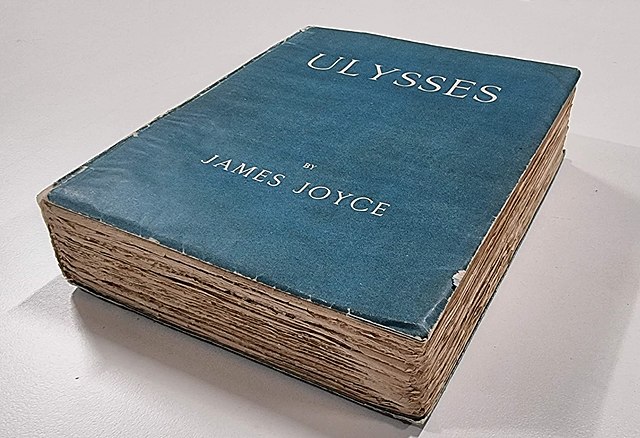
    James Joyce’s Ulysses, published February 2, 1922 by Sylvia Beach’s Shakespeare and Company, Paris, France. 

    First published in serial by The Little Review from 1918-1920, Ulysses lead to the arrests of the magazine’s publishers and was banned in the United States for the next 14 years. 

    In 1933, Random House received the rights to publish Ulysses in the States, contesting and overturning its illegality in court. The judge presiding over the case, tasked with actually having to read it, famously said this of it’s over 265,000 words: 

    “Joyce has attempted… with astonishing success to show… the screen of consciousness with its ever-shifting kaleidoscopic impressions… not only what is in the focus of each man’s observation of the actual things about him, but also in a penumbral zone residua of past impressions, some recent and some drawn up by association from the domain of the subconscious.”

    1. WHAT JAMES JOYCE IS REALLY LIKE 

    I HAVE NO IDEA. But the portrait I’ve created of the artist from surviving letters, accounts from his friends and family, and embarrassingly honest fictionalized self-inserts in his literature, is this: anxious, sad, funny, witty, pretentious, genuine, weird, and kind of an asshole.

    Joyce was born and raised in a suburb of Dublin, had six sisters and three brothers, and attended Jesuit school until his family could no longer afford it. He attended Belvedere College on scholarship and would graduate from University College, Dublin. Joyce moved to Paris in a failed attempt to study medicine and returned to Ireland upon learning his mother was dying.

    He then met a country girl named Nora Barnacle. They had their first date six days after meeting, ending in one of the great transcendent epiphany-moments of Joyce’s own life—a hand job. Joyce would set his magnum opus on the day their love was consummated: June 16, 1904 aka Bloomsday. He and Nora then went into self-imposed exile, moving between Zurich, Trieste, and Paris. They had two children and were living in Zurich when Joyce died.

    ‘He was a near-alcoholic; yet he pursued his writing craft with monastic austerity. He had the courage to face approaching blindness, eleven eye operations, and his daughter Lucia’s madness, but he ran from dogs and thunder. He renounced Roman Catholicism, but he could never rid his mind of the systems of Aquinas and Aristotle. He loathed and left his native land, yet his bitterness was inverted longing.’

    Joyce is also an enigma. He saunters around in your mind, around the seedy and uppity parts of Dublin, your own shit-town superimposed upon it, slick ash-plant cane in hand and eyes framed by the glint of golden glasses. When we read his fiction though, largely autobiographical, we meet someone more down to earth, insufferable at times, and I’d argue even recognizable. 

    1. LITERATURE JAMES JOYCE HAS CREATED AND WRITTEN THAT IS MENTIONED IN THIS ARTICLE

    Dubliners (short-story collection, 1914), A Portrait of the Artist as a Young Man (novel, 1916), Ulysses (novel, 1922), Finnegans Wake (1939). 

    3(A). OTHER RENAISSANCE MAN-ISH THINGS HE’S DONE

    Had performed as a baritone alongside famous Irish singers of his time; set a poem of his own to music; dabbled in the budding movie industry, opening a failed cinema; collaborated and partied with other rock star modernists and authors. Had lost his virginity at 14 to a prostitute; gained extensive knowledge of theology and languages at boarding school; wrote occasionally for magazines and newspapers; wrote poems, prose, one play, and a lot of kinky love letters; acted in school plays, taught in schoolhouses, and studied a little bit of medicine; possibly had a gay experience or two. 

    In Ulysses, Joyce broke through the narrow traditions of literature and established something surpassing just stream of consciousness. The novel is a literary multimedia; chapters in the novel emulate a specific style of literature—a play, a romance novel, a Cosmo-esque article, a catechism—and, in regards to the metric ton of allusion, Ulysses is something of a neurotically overactive Tumblr blog, filled with personal references to music, visual art, private memories, smutty confessions, and lines from other works that lead you down the derivative rabbit holes that comprise a person’s chaotic train of thought.

    1. A QUICK SKETCH OF JOYCE’S GENESIS AS AUTHOR UP TO ‘ULYSSES’

    Chamber Music, a collection of 36 short cheesy lyric poems, was published in 1907: “When I wrote them I was a strange lonely boy, walking about by myself at night and thinking that someday a girl would love me.” 

    In 1914, Dubliners, a collection of short stories, was published. “An Encounter,” follows a group of schoolboys who unknowingly come face to face with a pedophile; “Two Gallants,” has the same disturbingly accurate sleaze as Matthew McHounaghay in “Dazed and Confused”; and “The Dead,” reminds us why we don’t stay too long for the holidays. What Joyce accomplished was an artistic depiction of reality unburdened by the pretenses of literary culture. His plots are made up of the nothing occurrences of our lives that actually mean everything. And unlike other realist literature up to that point, Joyce truly expanded the spectrum of “real.” Awkwardness is real. Small talk is real. Shame is real. Sex is real. 

    Portrait of the Artist as A Young Man is Joyce’s impressionistic first novel. The novel tells the coming of age story of Stephan Daedalus, Joyce’s authorial self-insert. Stephen is insecure and does some awkward cringe-inducing things that I admittedly can imagine myself doing. Stephen goes about his life, one foot in the objective reality before him, and the other in his mind, full of conscious and unconscious reactions to the world, traversing memory, emotion, and thought. Joyce however, still fits it within literary tradition and the omniscient third person, desperately trying to find a way to express the more amorphous moments of the mind (like sporadic bits of music or disembodied lines from literature).

    —O, rocks! she said. Tell us in plain words.

    1. WHAT ‘ULYSSES’ IS APPARENTLY ABOUT

    EVERYTHING, and nothing. In a sense, it’s really about one thing: “that word known to all men.” The way it goes about that is, well, complicated—because Love, and Life, are complicated—but not. Let’s just start with the plot. 

    THE PLOT

    The action of Ulysses takes place in a single day. It is not an epic spanning months or years, or generations, but hours, minutes, and seconds. It begins at 8 AM and ends at 2 in the morning. It is about walking, and thinking. 

    I

    STEPHEN DAEDALUS is 22. He has come home from France after a failed attempt at med school. —Nother dying come home father, reads the telegram that prompts him to come back. I can’t mother. Sing for me Stephen. He now lives in the Martello tower with his friends, renting it from the Irish government sleeping in my orchard, a serpent stung me. He works as a school teacher, now in the very position of authority that instilled him with so much trauma in Jesuit school; I can’t mom. but Stephen is kind, albeit broody and pretentious. I can’t. Like Bloom, he wanders through the city all day, not quite fitting in with anyone around him.  Play for me. His “friends” ostracize and ridicule him, his father is busy with his own pals, and strangers don’t seem to notice him. Touch me, he thinks to himself. Looked at me all right. Soft eyes. You can come if you want. Soft soft soft hand. Going home. Nobody. I am lonely here. O, touch me soon, now. What is that word known to all men? I see you. I am quiet. Here alone. In F sharp major. Walking ‘cross the campus. Sad too. Fat cats go down alleys eating. Touch, touch me.

    II

    LEOPOLD BLOOM is a Jewish-Irish, middle-aged man, who also likes to walk. He is an advertising agent, a father, and a husband. He is our hero, one who sniffs his toenails, masturbates in public, and adores his wife (MOLLY BLOOM is a soprano singer who has been having a less than clandestine affair). Mr. Bloom, knowing this, is still generous with people, and it is that quality that renders him a heroic figure of love and humanity (what is the word known to all men?). Bloom wakes up and goes about his ordinary day: he cooks breakfast, goes to the bathroom, checks his mail (P. S. Do tell me what kind of deodarant does your girlfriend use. I want to know.), smokes cigars, pokes his head indoors, attends a funeral, represents clients, eats a grilled cheese, goes to the library, buys smutty books for his wife, goes to a bar, goes to a different bar, masturbates on the beach, visits a sick and lonely friend in the hospital, hangs out with prostitutes, kindly takes care of someone who’s had too much to drink, crawls into the bed he knows his wife and another man had sex in earlier that day, and for the first time since the death of their firstborn child, Bloom ends his day making a move on his wife, literally kissing her ass as he reaffirms his love and utter devotion for her with a physical, tangible, manifested gesture, before falling asleep. 

    III

    BLOOM and STEPHEN cross paths but do not meet until the end. Stephen’s friends have abandoned him after drinks on him, and prostitutes on him. Bollopedoom invites Stephen over and sobers him up.

    Of what did the duumvirate deliberate during their itinerary?

    Music, literature, Ireland, Dublin, Paris, friendship, woman, prostitution, diet, the influence of gaslight or the light of arc and glowlamps on the growth of adjoining paraheliotropic trees, corporation exposed emergency dustbuckets, the Roman catholic church, ecclesiastical celibacy, the Irish nation, jesuit education, careers, the study of medicine, the past day, the maleficent influence of the presabbath, Stephen’s collapse.

    MOLLY ends the novel in an unpunctuated continuous stream of consciousness as she the mythical presence in the novel saturating Bloom’s every thought throughout the day tells us what’s been on her mind unfiltered but also completely vulnerable realize the bigger picture for instance Molly cheats because Bloom has not touched her since the death of their young son Rudy utterly heartbroken despite her bawdy demeanor heartbroken even then can’t stand her sidepiece in comparison to Bloohimwhom she loves

    no thats no way for him has he no manners nor no refinement nor no nothing in his nature slapping us behind like that on my bottom because I didnt call him Hugh the ignoramus that doesnt know poetry from a cabbage 

    the multitudes we observe over the course of the day through Bloom occurs instantaneously in a boundless monologue that transcends both time and space yet occurs within the minutes it takes for her to fall back asleep a sleep to sleep because that is the mind lives a thousand lives before the uttering of a single word yes. 

    THEMES

    Music, literature, Ireland, Dublin, Paris, friendship, woman, prostitution, diet, the influence of gaslight or the light of arc and glowlamps on the growth of adjoining paraheliotropic trees, corporation exposed emergency dustbuckets, the Roman catholic church, ecclesiastical celibacy, the Irish nation, jesuit education, careers, the study of medicine, the past day, the maleficent influence of the presabbath, the fluidity of identity, the age of anxiety, which is indeed 22, and love.

    THE TITLE

    Each chapter in Ulysses parallels a book from the Odyssey. There are one-to-ones, but there are also other, more creative analogs in the entirety of the text. The Cyclops episode, for instance, you would really like, it’s where our unremarkable and thus wholly relatable Odysseus heroically outsmarts and blinds Polyphemus with a flaming torch while Bloom, our modern analogue, stands up to a narrowminded, shallowhearted, weakwilled, singlesided, redhaired, frecklefaced,  oneeyed, loudvoiced, bigheaded, worldwearied, wordslurred, dogguarded, nationalistcrazed, highschoolpeaked, barhopped, bigot, known only as “the citizen.”

    —Well, his uncle was a jew, says he. Your God was a jew. Christ was a jew like me.

    Gob, the citizen made a plunge back into the shop.

    His cigar burns fiercely throughout the scene leading up to the altercation.

    TRIPPY THINGS

    [from Sirens]

    Boomed crashing chords. When love absorbs. War! War! The tympanum.

    A sail! A veil awave upon the waves.

    Lost. Throstle fluted. All is lost now.

    Horn. Hawhorn.

    When first he saw. Alas!

    Full tup. Full throb.

    Warbling. Ah, lure! Alluring.

    Martha! Come!

    Clapclop. Clipclap. Clappyclap.

    Goodgod henev erheard inall.

    Deaf bald Pat brought pad knife took up.

    A moonlit nightcall: far, far.

    I feel so sad. P. S. So lonely blooming.

    ANNOYING THINGS 

    [from Schylla and Charibdis]

    —A father, Stephen said, battling against hopelessness, is a necessary evil. He wrote [Hamlet] in the months that followed his father’s death…[a lot of bullshitting later] Europe the church is founded and founded irremovably because founded, like the world, macro and microcosm, upon the void. Upon incertitude, upon unlikelihood. Amor matris, subjective and objective genitive, maybe the only true thing in life. Paternity may be a legal fiction. Who is the father of any son that any son should love him or he any son?

    What the hell are you driving at?

    I know. Shut up. Blast you. I have reasons.

    1. WHAT ‘JOYCIAN’ MEANS AND WHY IT’S IMPORTANT

    AN ACADEMIC DEFINITION of Joycean might be something “reminiscent of the writings of James Joyce… exhibit[ing] a high degree of verbal play, usually within the framework of stream of consciousness” (Google). But it’s also a stock word, like Lynchian or Kafkaesque, overused and seemingly nebulous in meaning. Once you see it, however, you cannot unsee it—Ingmar Bergman is Joycean; Seinfeld is Joycean; my breakfast was Joycean. In theory, Joycean is the elevation of our mundane, very real, day-to-day lives. Joyce argues that art lies in the commonplace, and in the banal is an inherent potential for the religious and the spiritual, a connection to humanity that in actuality is lived moment by moment, comprised of banal tasks, slow-burning developments, and an unmeasurable expanse of interiority. An “epiphany moment” especially pronounces this, where some normal thing, some daily occurrence, becomes a symbolic moment that unlocks this third eye perspective: a child overhearing a dirty conversation; a repressed teen staring at a girl’s ass as she wades in the water; “snow being general all over Ireland,”—these seemingly insignificant moments become touchstones to greater truths (the loss of innocence; the acceptance of self; the ubiquity of death).

    Things that are Joycean also recreate the chaos and absurdity of our minds. Daydreams, flashes of images, sound bites of voices, memories of loved ones, sexual fantasies, intrusive thoughts—randomized yet tangentially related neuropathways that spur each other on through association, in no seemingly apparent order, happening instantaneously, organically, and often simultaneously. Joycean things in this regard depict the mind as a psychedelic kaleidoscope of thought (something we see often in Ulysses and entirely in Finnegans Wake), beyond our understanding, yet organized by the sacred geometry of some god-like artificer, “within or behind or beyond or above his handiwork, invisible, refined out of existence, indifferent, paring his fingernails;” where words like “bababadalgharaghtakamminarronnkonnbronntonnerronntuonnthunntrovarrhounawnskawntoohoohoordenenthurnuk,” lie primordially in the subconscious, coherent to it, and Joyce, alone.

    A NOTE ON WHAT I HAD FOR BREAKFAST: Chorizo and egg with a side of waffles I made them every time for I’m slaving over a hot stove I’d joke meal that never fails to piss me off too bad it tastes so good easy to make hard part cooking the chorizo all the way through without burning it just having to stare while it sears in the pan sizzles this is your brain on mine too no such thing as thin love no such coffee’s ready 

    1. JOYCIANISM’S AMBIT IN CONTEMPORARY(ISH) STUFF 

    MODERNISM’S stronghold on contemporary storytelling is still going strong. Stream of consciousness alone comprises the majority of popular narratives today. Maybe it was Proust first, and a combined effort on the parts of Woolf, Faulkner, and other modernists of literature and art, but none rendered reality with the candor, the honesty, the banality, the full range of experience, as Joyce, none with the kaleidoscopic insanity that defies the neat syntax of Virginia Woolf, yet reads coherently according to the amorphous grammar of our intrapersonal thought.

    Beloved is a novel by Toni Morrison. It is a haunting piece of speculative fiction that frequently dips in and out of stream of consciousness, free indirect discourse, third and first-person narration, and contains some of the same freeform structures found in Joyce’s work, meant to convey a realm of consciousness not easily contained by rigorous prose.  

    Joyce, and in particular the genuine absurdity of Finnegans Wake, has been of particular interest to English scholar Anthony Burgess. A Clockwork Orange, his most successful novel, is particularly Joycean with its extremely stylized lexicon of the new world order of ultra-violence. 

    Chamber Music eventually accomplished what Joyce had hoped for—to inspire a composer to set it to music. With its introverted, surrealist musing, Joyce’s work would find an unlikely yet appropriate match with ex-Pink Floyd frontman, Sid Barret. Golden Hair, sounds like it was written by a time-traveling Elizabethan bard peaking on acid, which, is actually quite Joycean, and we played the album in the car after having bought a gallon-sized bag of Trolli Sour Crawlers trust me she said I sat in back and she drove us halfway to San Antonio in pulsing twilight what the fuck open the bag have somewhat open the bag oh my god crawling I can’t feel my haha

    “Slacker,” is a movie by Richard Linklater, shot continuously in one tracking shot. As one conversation or banal encounter reaches its peak, some other random, average person comes into frame at a crosswalk, until the next passerby becomes our main character. Some of rhe characters in the film? Co-op Guy, Shut-in Girlfriend, Has Conquered Fear of Rejection, and Pap Smear Pusher, who suddenly comes into frame trying to sell Madonna’s pap smear to our temporary heroes. The “Wandering Rocks” episode of Ulysses may be the first prime example of this kind of periphery madness. Told in 19 parts, every subsection follows a different narrative with overlapping continuities as characters run into those from other sections, hear the same bells striking across Dublin, or see the same couple making out in a bush.

    David Foster Wallace is the author of Infinite Jest.

    1. RE: THE ISSUE OF WHETHER AND IN WHAT WAY JAMES JOYCE’S BOOK IS ‘OBSCENE’

    IF Ulysses is obscene, then so is life. The scenes that are most often brought up in regards to obscenity are as follows: 

    in which Bloom takes shit

    in which Bloom is horny

    in which Molly is horny

    And yet, all of these moments are absolutely essential to the novel. True, there is a loss of romance seeing our literary hero tear off a piece of newspaper, ironically the page where a prize story is printed, to wipe his ass, but what is gained is astounding. It is real. Joyce forces us to acknowledge that disparity between fiction and reality, but nonetheless, manages to elevate it through art and language, forcing us also to observe our lives through the same lens, to find the overwhelming beauty in all of life’s moments, even the mundane ones. Because of this, we are captivated by Bloom’s toilet thoughts and the flow between the surrealist realm of the mind and the objective world of the body. Most of all, the language in the novel is consistently beautiful, even during these “obscene” moments. 

    Evening hours, girls in grey gauze. Night hours then: black with daggers and eyemasks. Poetical idea: pink, then golden, then grey, then black. Still, true to life also. Day: then the night.

    He tore away half the prize story sharply and wiped himself with it.

    1. ONE OF THE RELATIVELY MUNDANE ‘ULYSSES’ SCENES I FIND PARTICULARLY RELEVANT 

    Social anxiety is everywhere in the novel. We are confined mostly to the subjective mind of Bloom and Stephen, and like them, we don’t really know what other people are thinking of them. Bloom doesn’t know the extent of his wife’s love for him; all he knows is that he is being cuckolded. Stephen acts aloof and misanthropic, a lone wolf who doesn’t need anyone; but he is actually desperate for friendship, validation, and the approval of others. 

    In episode six, also known as “Hades,” Bloom crosses the river Liffey to attend the funeral of Ol’ Patty Dignam. He rides in a cramped carriage car with 3 other men. They start up some boy’s talk, and despite the proximity, seem to exclude and ostracize Bloom the whole time. Bloom tries to tell them a story and continually gets interrupted, even getting the punchline stolen from him. Bloom is as unobtrusive as the cracking leather seats they sit on. 

    But the peak of this moment is when Pat’s death is finally discussed. He died of alcoholism, and overdoes, and left behind his wife and children. While on the subject, the conversation steers towards suicide. 

    — The greatest disgrace to have in the family, Mr Power added.

    — Temporary insanity, of course, Martin Cunningham said decisively. We must take a charitable view of it.

    — They say a man who does it is a coward, Mr Dedalus said.

    — It is not for us to judge, Martin Cunningham said.

    Mr Bloom, about to speak, closed his lips again. 

    The moment is tense and awkward for no one but Bloom, whose own father committed suicide. Yet there is a sliver of opposition from Martin Cunningham, who knows. While Bloom remains silent, what is happening inside is breathtaking. 

    Martin Cunningham’s large eyes. Looking away now. Sympathetic human man he is. Intelligent. Like Shakespeare’s face. Always a good word to say. They have no mercy on that here or infanticide. Refuse Christian burial. They used to drive a stake of wood through his heart in the grave. As if it wasn’t broken already… He looked at me. And that awful drunkard of a wife of his… pawning the furniture on him every Saturday almost… Drunk about the place and capering with Martin’s umbrella… 

    He looked away from me. He knows. Rattle his bones.

    The novel holds a magic mirror to reality. The complexity of navigating life and bridging the gap between objective and subjective reality is ubiquitous in the book, but here it is in one of its most common, mundane iterations: the difficulty of social interaction, especially amongst “friends.” Bloom is demeaned throughout, ridiculed and excluded in subtle ways that render him an outsider to even his companions. But someone notices his discomfort, even knows the reason for it, and steers the conversation elsewhere—a benevolent act of the everyday and the all too familiar. 

    1. THE ONLY PART OF THIS ARTICLE THAT’S REALLY IN ANY WAY A ‘REVIEW’

    Ulysses is a thick book with some difficult passages and pretentious references, but it’s also pretty damn good, and not just because a bunch of stuffy academics with British accents say so. It might not be for everyone, but it’s for more people than made out to be, and the perfect book for a generation of internet-addicted, information obsessed, socially anxious half-adults, unable to sit still. Yes, it’s hard, but Mr. Joyce’s attempt at realism is a kind of art worth suffering for.   

  • Love and Lost Time: An Unromantic Study of Romance

    By Kara Hildebrand

    Meteorites 

    Let’s call him Damian, a name which means to tame or subdue in Greek. I decided he was The One for me with stars splayed out before my eyes and cool blades of grass scratching my cheeks. Despite my resolution, my palm seemed to recoil under his. He said he loved me and I may have kissed him so I didn’t have to reconcile the feelings of need and utter repulsion. 

    Our culture’s infatuation with love stems from years of romance novels and radio-numbed love songs. I believe stories, perhaps above all else, are what shape our expectations for relationships. My favorite book, Jandy Nelson’s I’ll Give You The Sun, spotlights the complexities of love and art, and is an excellent example of how the two are inextricably linked. The title comes from a game that twins Noah and Jude play where they divide up the world and exchange its parts. Jude trades most of what she has for a sketch that Noah unknowingly drew of the man that she would later fall in love with. This is what love is in I’ll Give You the Sun: something predestined, constructed of pieces that click into place in the perfect moment. 

    ‘I gave up practically the whole world for you,’ I tell him, walking through the front door of my own love story. ‘The sun, stars, ocean, trees, everything, I gave it all up for you.’

    I’ll Give You the Sun by Jandy Nelson

    Within the pages of I’ll Give You the Sun, love is art. Noah sees the world and passion through color and hypothetical paintings, the so-called “invisible museum” the novel describes populating his mind. This explosion of beauty as he kisses Brian is what we yearn for as we read “just one more page” of our beloved romances:

    The blindness lasts just a second, then the colors start flooding into me: not through my eyes but right through my skin, replacing blood and bone, muscle and sinew, until I am redorangebluegreenpurpleyellowredorangebluegreenpurpleyellow.

    I’ll Give You the Sun by Jandy Nelson

    Love is taught to us through starry-eyed brushstrokes as a phenomenon so earth-shattering and raw that it leaves us reeling. Of course, we want to mean everything to someone and discover the antidote to our vexations on the tongue of a perfect stranger. We want someone who would trade the world for us, who we would trade the world for. Novels like I’ll Give You the Sun paints an enviable picture. Brian and Noah’s slow-burn transcends time, distance, and homophobic antagonists, and Jude and Oscar’s romance is fated by prophecies from dead parents and even the universe of the novel itself. Such depictions may be beautiful, but that doesn’t make them realistic. 

    We’re conditioned by our media to crave love, and consuming novels with passionate, colorful romances inevitably becomes a stand-in as we wait for a well-timed vessel to project our fantasies onto. A vessel that, like Damian, can be ultimately worse than the absence of a lover ever could be. 

    Skin on skin

    Your female crushes were always floating past you, out of reach, but she touches your arm and looks directly at you and you feel like a child buying something with her own money for the first time.

    In the Dream House by Carmen Maria Machado

    We confuse love with passion and passion with anxiety. Anxiety that they won’t like us. Anxiety that we’ll be alone forever. Carmen Maria Machado’s memoir In The Dream House dissects passion, queer love, and abuse and shows how they are operate in conjunction with one another. Machado’s own experience with abuse demonstrates how it can disguise itself in unassuming gestures in addition to being loud and cruel. The relationship in this book is incredibly passionate, but it is not (for the most part) loving. 

    When Damian and I had been dating for a while it became clear that I was to meet him on his terms if I was to keep the peace, which meant nothing less than blind compliance. When he decided he wanted to see other people. When he changed his mind. I lost myself in the butterflies, confusing turbulence with worthwhile intensity, but he never particularly cared how much of me was there anyway. 

    Toxic relationships simulate passion because they prolong the asking of the “will they/won’t they?” question. Lovers caught up in them build their lives clinging to something volatile rather than risk loneliness. Machado’s relationship in In the Dream House is built upon physical desire and hostile arguments. Her lover that once seemed incredible begins to turn cold. She yells, she’s jealous, she throws things, but the turning point, for Machado, is while they’re making benign conversation with her girlfriend’s mother and she digs her fingers into her arm. 

    It is the first time she is touching you in a way that is not filled with love, and you don’t know what to do.

    In the Dream House by Carmen Maria Machado

    The toxic relationship deceives you over time, mutating you into a person that nods your head and bites your tongue. The passion sweeps you up in its current, carrying you miles away from your starting place until you have no way of finding your way back. In a brief chapter of In the Dream House, one of Machado’s friends overhears her girlfriend making her cry and turns cold to her even though Machado wishes that he would just pretend he hadn’t heard anything. So deep into the abuse, Machado is terrified of having to reckon with the reality of what she’s experiencing. Or the consequences if her girlfriend picks up on it. 

    The expectation for love to conquer all allows for love to conquer all, and love, or its doppelganger, destroys much in the process. Relationships become delusions guided along by empty promises; our self image becomes reliant on something we cannot grasp, fingers slipping through water. Words become love letters. Words that seem to bruise. Words that build up worlds and tear them down. 

    You would let her swallow you whole, if she could.

    In the Dream House by Carmen Maria Machado

    Soon I was unrecognizable. Forgiving past all rationality. Forgiving past straying kisses and bitter insults. Love is not twisting reality in our minds to make the pieces fit. It’s not chasing down that spark of nervous energy, which fades with a relationship on its dying breath. 

    The Green Light

    When the dust and the butterflies settle, sometimes we realize we were in love with ideas, not people. 

    His heart beat faster and faster as Daisy’s white face came up to his own. He knew that when he kissed this girl, and forever wed his unutterable visions to her perishable breath, his mind would never romp again like the mind of God. So he waited, listening for a moment longer to the tuning fork that had been struck upon a star. Then he kissed her.

    The Great Gatsby By F. Scott Fitzgerald

    In many ways, the story of The Great Gatsby is a story of tensions between former lovers who will never understand themselves or each other nearly enough to be a good match. The two are at odds by their very natures. Jay Gatsby’s entire life revolves around becoming this person he’s crafted in his head. Of course, he wants Daisy, but perhaps more as a puzzle piece in the completion of his self-image. Daisy Buchanan is routinely being shoved into a box she never seemed to quite fit into. By her influential family, by her abusive husband, and even by her so-called true love Jay Gatsby. She was always the product of others’ views of who she should be, and, perhaps out of rejection for such things, she’s fundamentally careless. She likes to appear wild and free only as long as it’s reversible, and this is potentially why she entertains Gatsby’s advances at all. The two are and never were on the same page, and Gatsby is too blinded by the idea of who he could be with her to notice. 

    I decided Damian was not the one for me in the white-hot midafternoon between sixth and seventh periods.

    Want to hang after school

    I realized, all at once, that nothing sounded more miserable. That primal need to contrive something in him that didn’t exist: just gone, like it was simply plucked from my chest. I didn’t even cry. 

    Gatsby, on the other hand, dies waiting for a call from Daisy that will never come. He’s stuck on this memory, this romanticization, of Daisy that the woman before him will never live up to. He hauls himself up the social ladder, makes a name for himself, throws lavish parties, all in the hopes of reconnecting with his true love, but what he never gets a chance to realize is that she’s not the woman she was when he first loved her, perhaps she never was. Nick tells Gatsby that you can’t repeat the past and Gatsby gives his famous response “Of course you can.”

    Dénouement

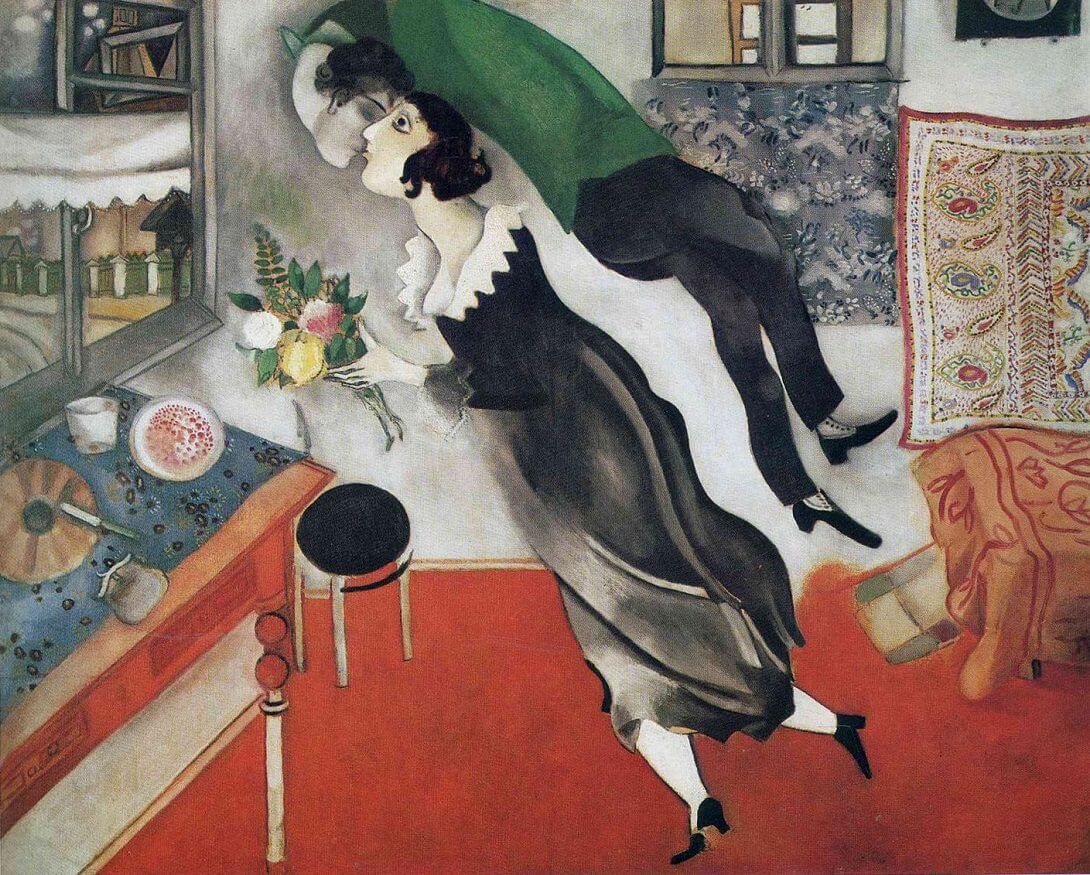
    The Birthday by Marc Chagall

    Real love doesn’t lie in the static of buzzing nerves, the intersection between a romanticization and an available body, words translated into promises. Real love is the euphoria that comes with feeling comfortable. Contorting your neck for a kiss, hovering inches above the ground. 

    Somewhere along the way, we realize that our idealistic notions of love and lovers will never be and that our search for something like them can betray us, leading the unsuspecting romantic into the arms of people unfit to love us. We grieve people, but it’s less common for us to adequately grieve ideas. The version of someone we fell for, even if they were never real, to begin with. The perfect earth-shattering kiss in the rain. The lover is sculpted by the author’s nimble hands to be kindselflesswittybeautifultalentedcaring.

    What is left when the misconceptions dissolve away? There’s only one way to know. 

  • Hark, Triton! Plumbing the Depths of Nautical Fiction

    By: Lana Haffar

    Grime, putrid and ancient, coats your shoes and your lungs. The wind bites and the salt spray stings your face and arms. Below you, the water churns in primordial agony. Around you, sunburnt tourists in cargo shorts enjoy a perfectly temperate afternoon. But to an eight-year-old, that catamaran in San Francisco Bay is a vessel. As I stood at that prow, I was Nemo, Ahab, Barbarossa, manning the ropes and conquering the unconquerable. In doing so, I joined a grand imaginative tradition of seafaring intimately linked with storytelling.

    Water, in its vitality and power, spawned flood myths in countless global cultures. One of the oldest recorded narratives, The Tale of a Ship-Wrecked Sailor, dates back to the Egyptian Middle Kingdom. And high school classrooms everywhere still wade through Homer’s Odyssey. But though humans have been grappling with the seas for millenia, nautical fiction as a modern genre coalesced during the era of Western colonialism, when a dirge of British and American novels flooded the literary landscape. Classic novels of the period, such as Daniel Defoe’s Robinson Crusoe (1719), Tobias Smollett’s The Adventures of Roderick Random (1740), and James Fenimore Cooper’s The Pilot (1821), are imbued with the hallmark attitudes of imperialism. As the crews of these ships journeyed abroad, they battled “savage populations” and led with their sword points. They were voyeurs in “foreign lands,” brave conquerors who delighted European audiences with their colonial authority. Figures of hypermasculinity stood at the prow, subduing the elements and effeminizing their enemies. Yet, despite these troubling themes, the novels themselves are complex. I believe there’s texture in them worth exploring. But if nautical fiction epitomizes male dominance, white supremacy, and imperial exploitation, what, then, is the modern reader to do with the genre? 

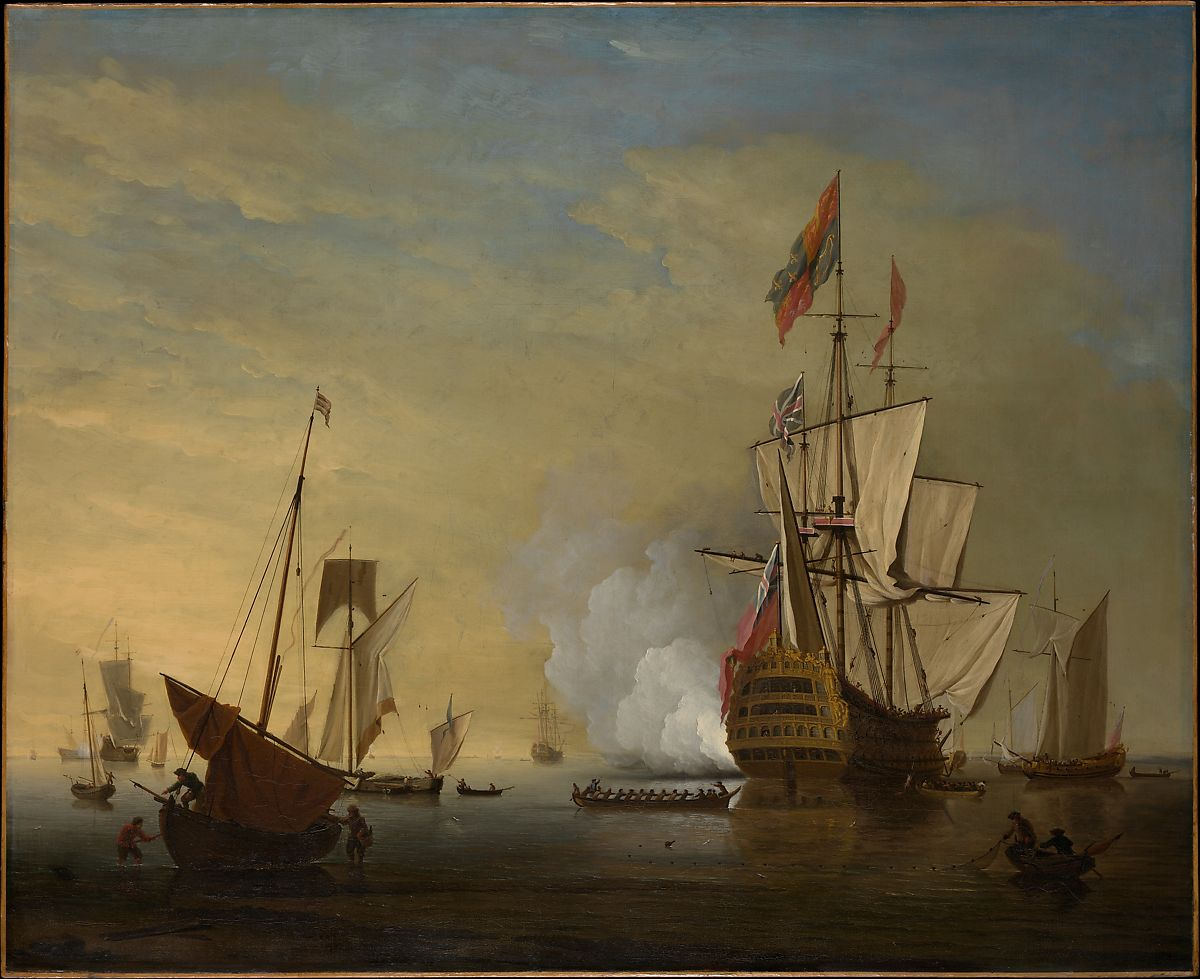
    Peter Monamy, Harbor Scene: An English Ship with Sails Loosened Firing a Gun

    “…I realized that these writers had pulled a fast one on me! I was not on Marlowe’s boat steaming up the Congo in Heart of Darkness; rather, I was one of those unattractive beings jumping up and down on the riverbank making horrid faces.” – Chinua Achebe, “The Education of a British-Protected Child.” 

    When Robert Eggers’ The Lighthouse barreled onto screens in 2019, I was once again reminded of my love for all things maritime. From rereading Ray Bradbury’s short story “The Fog Horn” to watching Ben Stiller’s exploits on a Greenlandic fishing vessel in The Secret Life of Walter Mitty (2013), fantasies of joining a crew of deckhands and dockworkers buoyed me in low moments. The freedom was intoxicating. If I could just charter a ship, raise the sails, and leave everything behind, I wouldn’t have to trudge to algebra, apply to college, and join the rat race. Among the brine and the bilge, I would find myself. To this day, I’m happiest when I’m on a boat, feeling the waves crest under me. Always, though, the admonition: this dream does not love you back. As Sylvia Plath wrote in her Unabridged Journals

    “My consuming desire is to mingle with road crews, sailors and soldiers … all this is spoiled by the fact that I am a girl … My consuming interest in men and their lives is often misconstrued as a desire to seduce them … I want to be able to sleep in an open field, to travel west, to walk freely at night…” 

    For many, this naval fascination has barriers to entry. Though Moby-Dick, 20,000 Leagues, Treasure Island, and the like are lauded as universal, bucket-list books, if you can imagine yourself on the threatening end of a ship crew’s flintlocks and cannonballs, true immersion can be harder. For non-white readers with intimate family ties to recent colonial histories, what incentive is there to root for the captain whose victory depends on brutal subjugation? And in a genre that often prizes violent domination over female-identified characters, such as sirens, goddesses, and even the ocean herself, is reading maritime fiction not a reminder of constant vulnerability? 

    These concerns are real and consequential. And yet, we read on, we read about swashbuckling and storms, about men battling waves and whales and undergoing metamorphoses. We admire clever language and analyze latent themes. Because just like water, our identities are malleable. In our boundlessness, our assigned societal roles don’t constrain us. We are all equally entitled to the allure of the sea, and one can saturate these existing texts with personal symbolism that feels true and relevant. In a decolonial voyage, we can seep into a text and absorb only that which suits our own soul. 

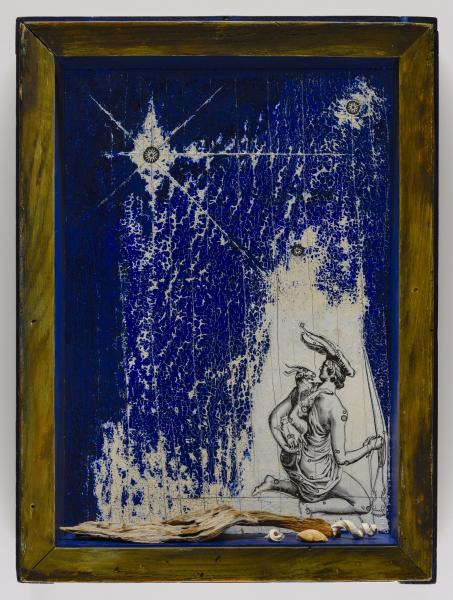
    Joseph Cornell, Ideals are like stars; you will not succeed in touching them

    Contemporary writers continue to see rhetorical potential in the sea. Adrienne Rich, in her poem “Diving Into the Wreck” (1973), likens a scuba expedition to an exploration of gender identity. Her solitary narrator states, 

    I came to explore the wreck.

    The words are purposes.

    The words are maps.

    I came to see the damage that was done and the treasures that prevail. 

    Expanding on the tradition of nautical fiction as a genre of adventure, Rich treats this endeavor with gravity and mystery, as gripping as Nemo’s trials on the Nautilus. Like the hardened sea captains of old, the poem’s narrator prepares to take the lonely plunge into the unknown depths of their psyche.


    Caden Bosch, the protagonist of Neal Shusterman’s Challenger Deep (2015), takes a plunge of his own. Aboard a ship destined for the deepest point in the ocean, Caden wrestles with shipmates and sea monsters. Gradually, Shusterman reveals that Caden is actually struggling with his burgeoning schizophrenia, and his mental odyssey is a method of rationalization. Yann Martel’s Life of Pi (2001) plays with reality and unreality as well, operating as both a naval adventure and a psychological one. With all the physical elements of a maritime saga—a wreck, a raft, an island—Pi also reckons with faith and self-identity in the mode of naval protagonists, like Captain Ahab, before him.

    The versatility, flux, and raw power of the ocean, as well as the challenges it throws at us, serve as imaginative fodder for endless new stories. In animation, films such as Ponyo (2008) and Moana (2016) have drawn from established folklore to highlight non-Western seafaring traditions and maritime myths. And retroactively, creators can insert themselves into narratives that have previously excluded them. We all fell in love with Elizabeth Swann and Anamaria in The Pirates of the Caribbean franchise, and just by their presence, a map of future possibilities unfurled. Most recently, the HBO series Our Flag Means Death promises a comedic take on the Golden Age of Piracy, complete with a diverse cast of emotionally complex shipmen. By adopting the charms of nautical fiction—the settings, the clothing, the drama—and transforming them for personal use, we expand the value of the genre. 

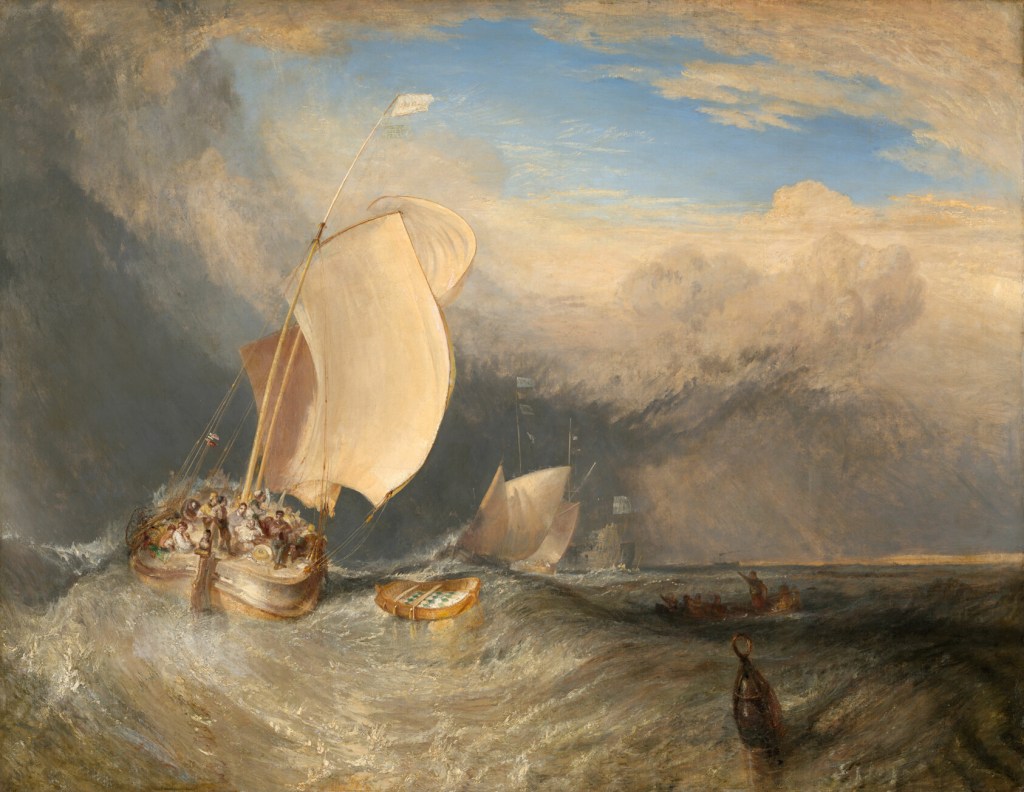
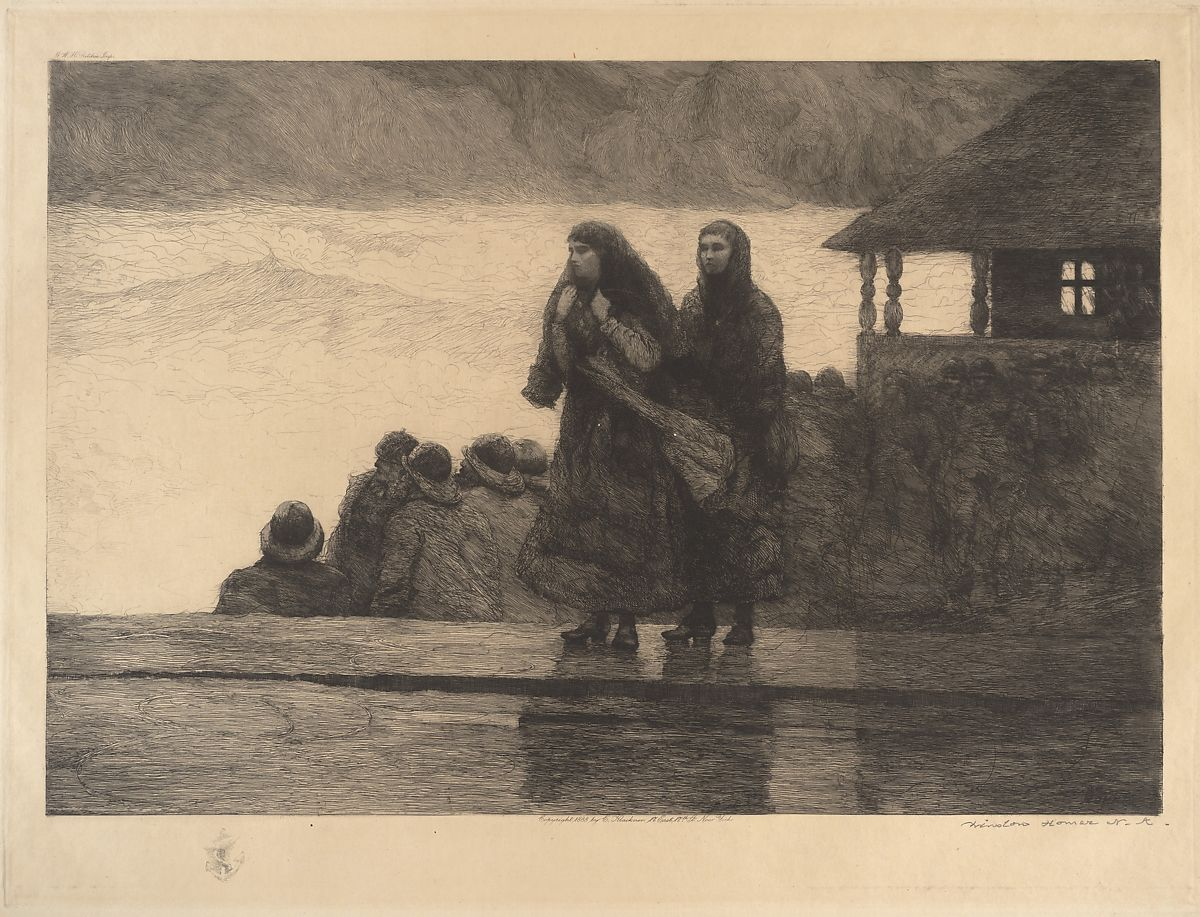
    Winslow Homer, Perils of the Sea

    Increasingly, there are reminders that life on the water is brutal. Broiling in the sun, dehydrated, weakened—the protagonists of maritime books knew filth and pain. This pain is no less relevant now, as boats perilously transport refugees across the Mediterranean. Or as floodwaters destroy communities and turn land into sea. Just like the truth of seamanship, this stuff is biting and cruel. But it generates books like David Eggers’ Zeitoun or pivotal moments in Zora Neale Hurston’s Their Eyes Were Watching God. When the tides rise, so does human creativity. It’s no merry fantasy, no Mutiny on the Bounty, but its function is the same: to survive and overcome. 
    Because that’s a true constant: we’re good at adaptation. To draw from Whitman, as we “ebb with the ocean of life,” there is bounty to be found in the narratives of others, historically complicated as they may be. In reading nautical works, part of our mission may be navigating the complex emotions that arise. But if little Matilda can excitedly read out the words, “Call me Ishmael…”, poised to become Ahab herself, then there may be something to find for us yet. Our own white whales; our own quests. And as we are continually reminded of the universality and necessity of the high seas, and the threat that their power holds, we’ll prepare for new voyages, both in literature and beyond. 

  • Pushing the Boulder: Existential Absurdism in Film

    By: Jack Gross

    “Tomorrow, he was longing for tomorrow, whereas everything in him ought to reject it. That revolt of the flesh is the absurd.”

    -Albert Camus

    Forsaken to an eternity of menial labor by the gods, a man must slowly push a boulder up a hill until he reaches the top. At the peak is where his exhaustive efforts are unceremoniously dismissed, as he must watch the rock roll back down, signaling the infinite cycle of this futile endeavor. This is the Myth of Sisyphus from Greek mythology, a story that has been repurposed and retold for centuries. However, it was most famously contextualized by French Philosopher Albert Camus in 1942 when he published an essay titled The Myth of Sisyphus.

    Camus uses Sisyphus’ predicament as the core example of existential absurdism. In the essay, Camus explains that it is not Sisyphus’ ascension up the hill that interests him, but rather Sisyphus’ resigned and stoic return, emphasizing his complacency in the face of never-ending torment. To Camus, this illustrates man’s greatest existential conundrum: the inevitable search for meaning in an inherently meaningless existence. Time carries us forward rhythmically, a concept lost on us through the hustle and bustle of monotonous labor and a mechanized life. It is when we are confronted with the essence and temporality of our existence that we experience the absurd. The remainder of Camus’ writing works to explain that the rational answer to feelings of the absurd is not suicide, but rather reconciliation.

    Camus describes the absurd man as a mime, acting out their daily rituals knowing these routines are meaningless, and he labeled art as the greatest mime of all. Contrary to Camus, I find that even though we are unable to derive meaning from art, artistic expression of the absurd is the greatest form of rebellion we have at our disposal, reflecting the creator’s perspective on the inscrutable world. Camus posits that absurdist art cannot attempt to present viewers with concrete meaning or answers, because there are none. Instead, art must restrain itself from grandiose attempts at presenting answers and must teach us not to desire reason but to come to terms with its absence. This compromise between incomprehensibility and acceptance is the key to an admirable piece of absurdist art.

    In his writing, Camus focused this idea on writers such as Dostoyevsky, but I’d like to extend this conversation to the rich catalog of absurdist films that have been released after the publication of Camus’ essay. These films depict the existential absurdity of life, and rather than desperately attempting to apply to mean, they instead bask in the ambiguity, and like Camus suggests, force the audience to reconcile with their proposed undefined existence. I believe these films shed a light on one of the underlying takeaways of Camus’ writing: ideological compromise.  

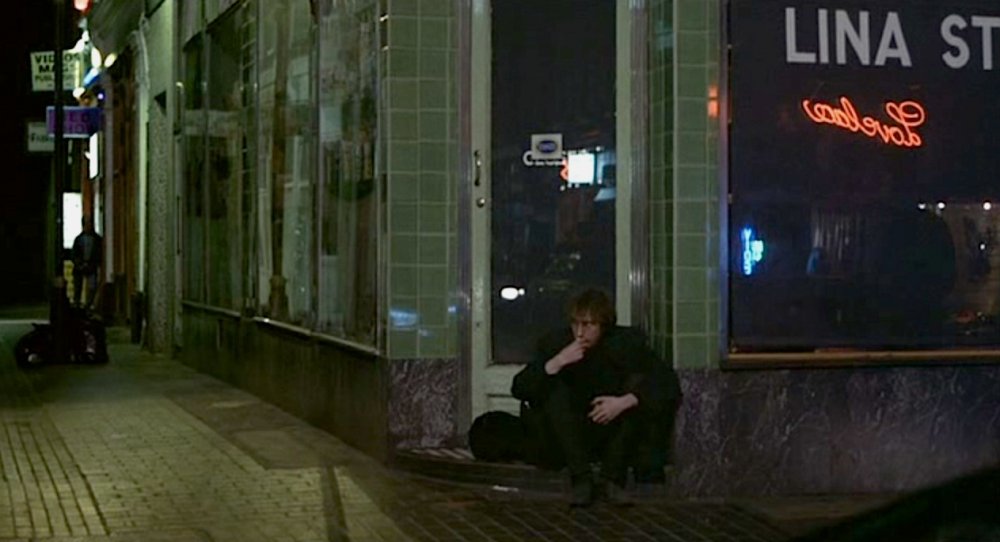
    Johnny sits alone on a desolate street corner, accompanied by nothing but his thoughts.  

    Naked (1993) Dir. Mike Leigh

    Set in the dreary, dingy, and desolate streets of East London, and armed with an impressive arsenal of nihilistic sentiment and pessimistic angst, Johnny passively bounces around from street alley to couch in Mike Leigh’s existential drama, Naked. Johnny, played by David Thewlis, is a man with no moral conviction, no inkling of decency or hope, and instead of struggling with Camus’ central dilemma regarding purpose in a meaningless world, Johnny has long accepted his life is without purpose. Rather than reconciling with this notion and living proudly as Camus implores us to, Johnny resorts to extreme acts of depravity, selfishness, and manipulation. Guided by vice and tempted by pleasures alone, Johnny makes no effort to strive for a better life or make meaningful connections with those around him. In a troubling counterintuitive manner, it seems Johnny’s acceptance of Camus’ philosophy has in turn made him a creature of sin, yet one that has a rather firm grasp on his cosmic place in the world. By the end of the film, after agreeing to move with his ex-girlfriend to Manchester, Johnny steals her money and limps away into the streets, representing the tedious nonsensical cycle reminiscent of Sisyphus’ own journey, as one wonders what street corner he’ll find himself on next.

    What makes this film even more admirable in terms of Camus’ writing is director Mike Leigh’s refusal to answer questions or reflect meaning. Leigh doesn’t once attempt to prove Johnny’s mindset wrong, instead, he presents it as realistic as possible, allowing the viewer themselves to make their own unbiased judgments and decisions. In this way, we are responsible for our own reading of the film and are made accountable for our own viewpoints regarding Johnny’s resigned acceptance of existential absurdism. We are shown a world without consequence and a character without conviction, and when the viewer accepts these truths, only then can they reflect their own analysis onto the work, much like that of Camus’ example involving the mime.

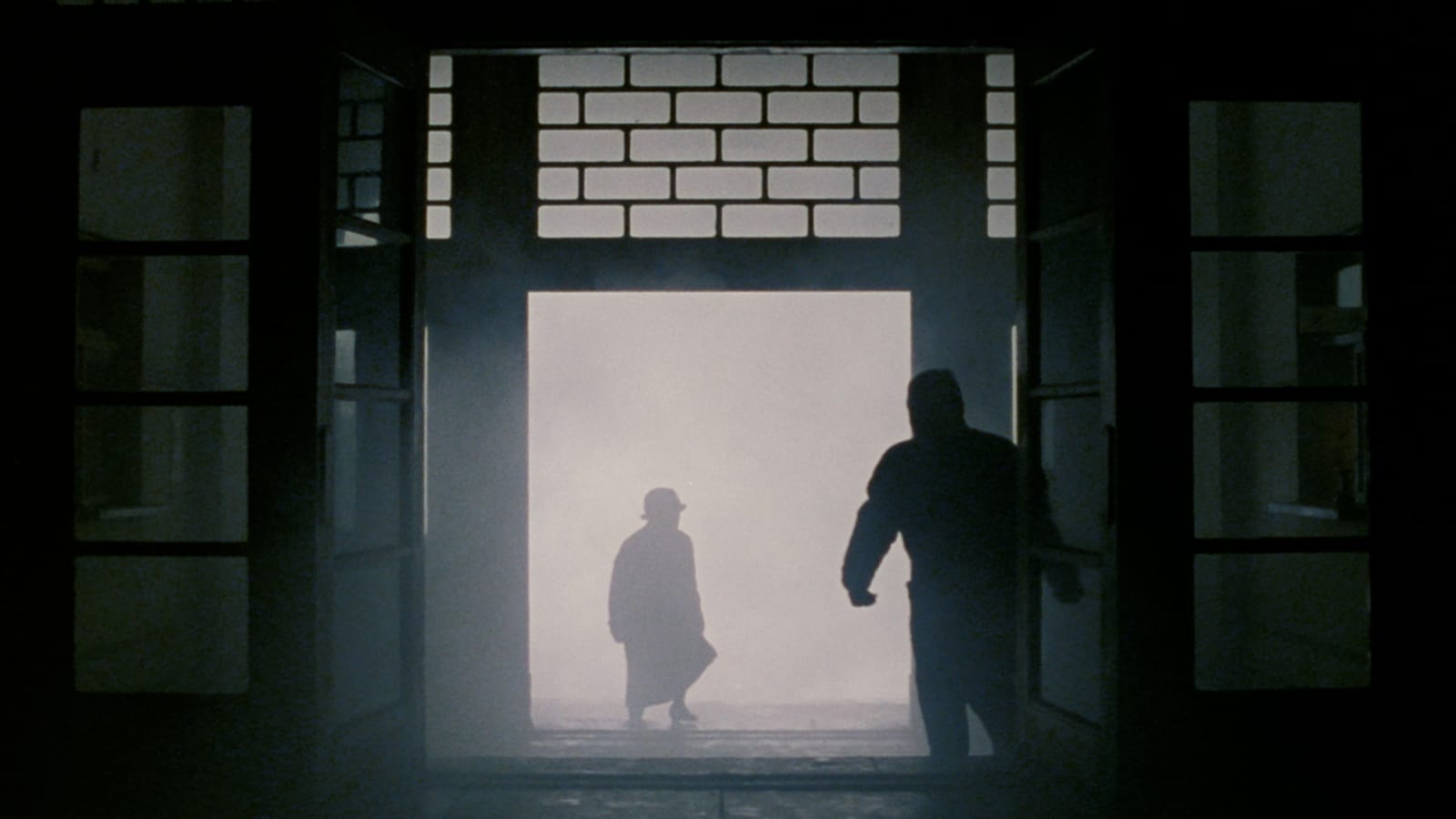
    Characters wander in from the thick fog of death into the processing center.

    After Life (1998) Dir. Hirokazu Kore-eda

    In Japanese filmmaker Hirokazu Kore-eda’s After Life, we are introduced to wonderfully poetic ruminations directly tied to existential absurdism. The film’s premise is deceptively simple: recently deceased spirits arrive in a liminal territory between living and death where they get to choose one memory from their lives to relive through the film before they pass on. Nearly everyone struggles to pick one moment, some outright refuse to choose, and others watch their entire lives on screen, attempting to pick the perfect moment. This forceful process of handpicking a single memory to live with forever is rooted in existential absurdism, as it suggests that beyond the single moment in their lives, everything proceeding and following it will be rendered meaningless once they pass, forever lost in the annals of their own minds. 

    Kore-eda depicts this act of selection not as an involuntary moment of tragedy, but rather as a necessary revelation that our time on Earth is terribly limited and only has the meaning we grant it. After Life isn’t so much an endorsement of the sanctity of life as it is a series of questions regarding the way we live life. While Kore-eda doesn’t attempt to apply indexical connections between life and purpose, instead he proposes the importance of coming to terms with one’s mortality, and in doing so, accepting that life is but a series of memories we will soon forget. This isn’t tragic when seen through the lens of After Life, rather it’s an idea we must all accept in order to live enriching lives.

    A captive and captor come to terms with their new relationship. 

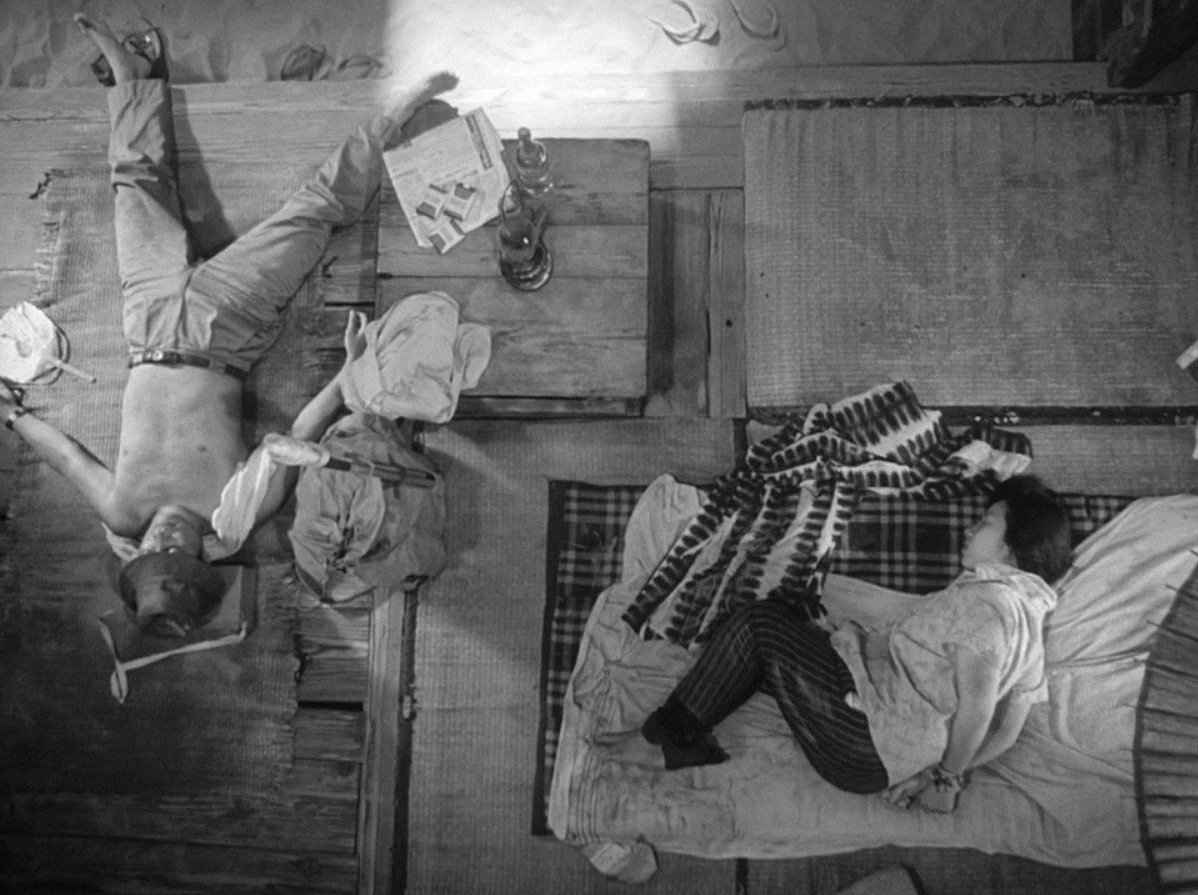
    Woman in the Dunes (1964) Dir. Hiroshi Teshigahara

    Known as a modern retelling of the Myth of Sisyphus, Woman in the Dunes follows an entomologist who scours long stretches of sand dunes in search of a beetle. His journey is infinitely complicated however when he is trapped in a deep sandpit with a mysterious woman and her small hut on the arenaceous floor. Here, the woman abides by her daily futile ritual: shoveling falling sand away from her hut in order to not be buried alive. This strange and impractical living arrangement acts as a metaphor for daily life and the constant struggle to gain purpose. Suddenly trapped in this hole, the entomologist suffers from a loss of identity, and an absence of freedom, and must learn to cope after a series of futile escape attempts.  

    The film works to reimagine the Myth of Sisyphus in contemporary society, conveying the desperate desire to escape domesticity and attain spiritual freedom while ensnared in a doomed life. Teshigahara’s film, like the others I’ve listed, doesn’t attempt to deny the inherent incomprehensibility and frustrating trivialities of existence, nor does it pretend to have answers to the unknowable, instead it provides examples of how one can reconcile with the enigmatic universe. In Woman in the Dunes, the entomologist discovers a small method for water production and has found happiness in his newfound usefulness as well as his moment of fulfillment. Like Sisyphus, whose stoic demeanor on his descent down the hill, the entomologist has found a semblance of bliss in his absurd life and has completely abandoned all hope of escape.  It’s important to point out that while the entomologist seems to find an answer, it’s truly only a method of acclimation and conformity because the indefinability of his circumstances is not resolved. This is how Woman in the Dunes represents the true essence of Camus’ essay.

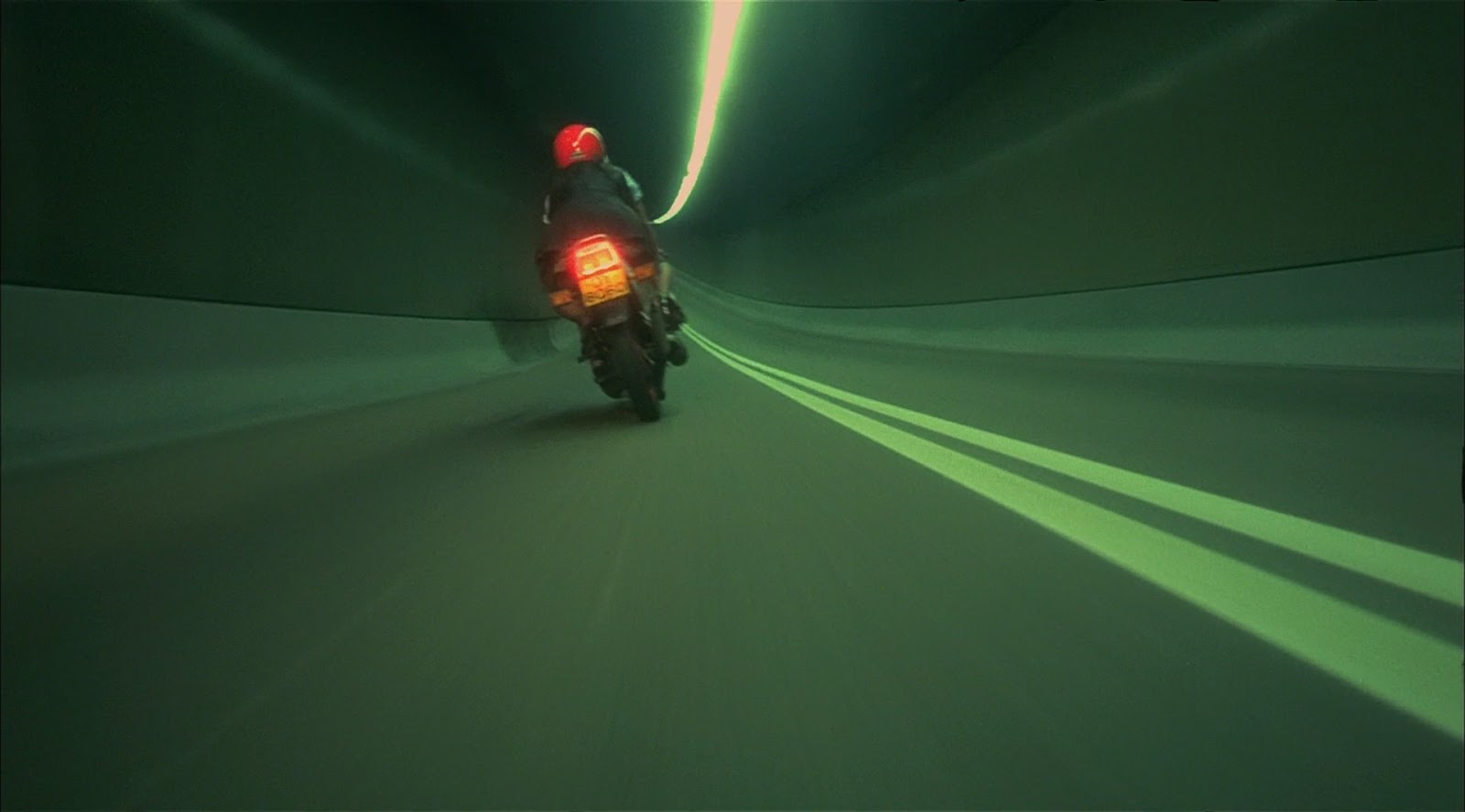
    A liberating motorcycle ride through the neon drenched tunnels of Hong Kong. 

    Fallen Angels (1995) Dir. Wong Kar-wai

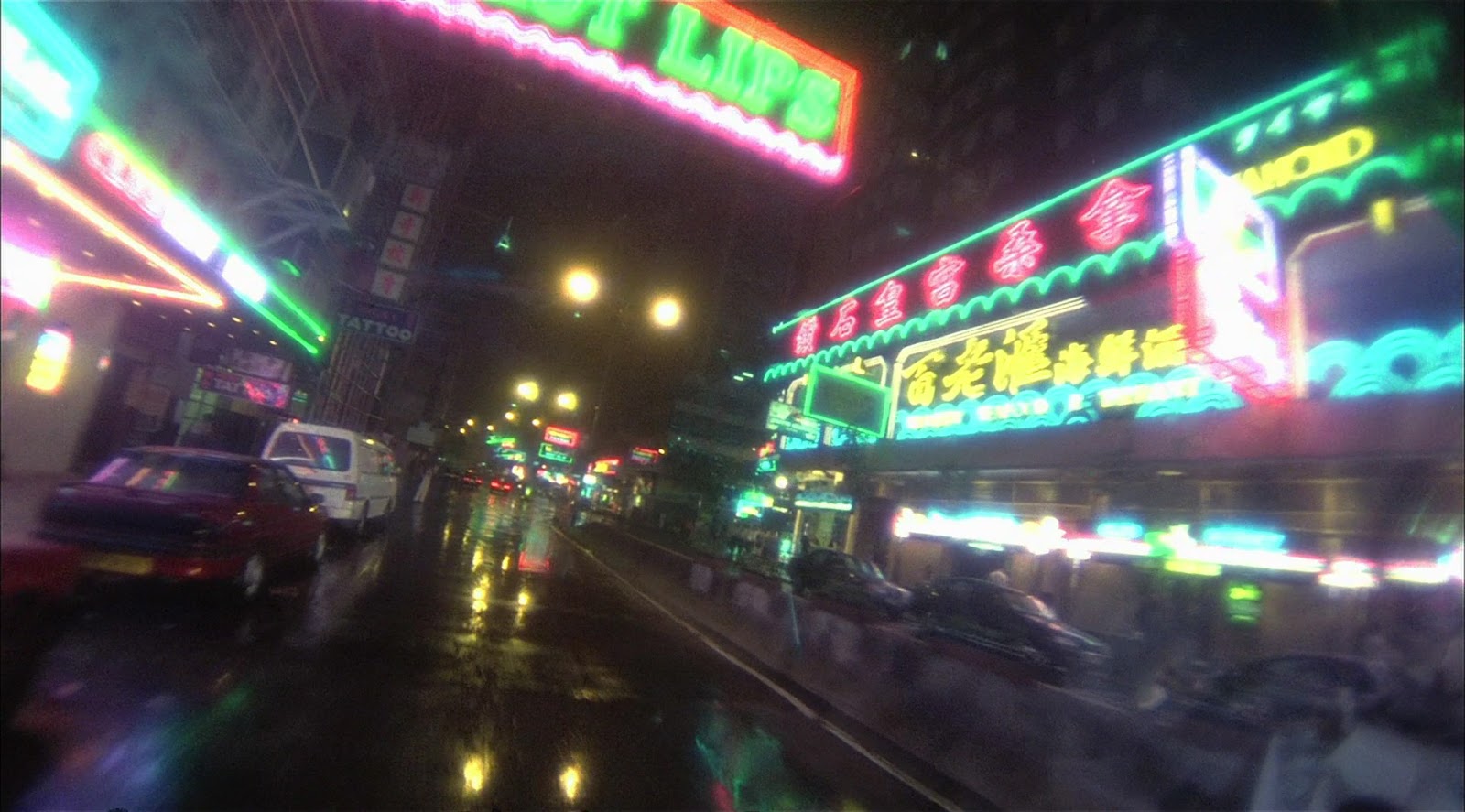
    In the green soaked cosmopolitan of Wong Kar-wai’s Hong Kong, various characters wander through the lost city, looking for requited love and instead find alienation and lovelorn anguish. They aimlessly interact with one another, weaving in and out of lives without meaning or purpose. In a Wong Kar-wai film, his protagonists often search for these key principles through connection, a feeling they are rarely granted in his work. 

    Whether it be the death of a father, the loss of a friendship, or a deeply troubling breakup, all of the characters in Fallen Angels find themselves in desperate need of direction.  In the film, we are not shown grand moments of intimacy or flourishes of love and hope, instead, we see small victories, however fleeting they may be. These brief instances give much-needed affirmation to our protagonists, affirmation not that their lives are moving in the right direction (because there is no right direction), but that everything will be ok despite their troubles. 

    The final scene in Fallen Angels depicts two characters riding on a motorcycle as the camera pans up towards the morning sky, the first shot of daylight we’ve seen in the entire film. Abiding by Camus’ understanding of Sisyphus, Wong Kar-wai and his characters find solace in their undefined placement in the world through their acceptance of their situations.

    A bright and colorful snapshot of the city from Fallen Angels, representing both a location for isolation and connection. 

    While some may reduce film in context with absurdism as an empty form of escape from the unbearable truths of life, I think Camus’ philosophizing instead indicates a different relationship. The visual and sensory catharsis we experience by consuming these absurdist works of art presents us with an alternative method, one that allows us to reconcile with concepts of existential absurdism without falling victim to the melancholy that Camus was deeply concerned by. As Camus suggests, great art cultivated by absurdist creators does not preach, proselytize, or attempt to present impossible answers. Instead, they present us with a clear pathway into accepting the enigma of the universe and our placement in a world devoid of meaning. In this manner, we don’t need to live in a fabricated reality to attain some semblance of fulfillment. I believe the films I’ve listed do more than an admirable job presenting Camus’ ideas and further reinstating the necessity of ideological compromise over a quest for a reason.  

  • Something in the Way: Unmasking the Literature Behind The Batman

    By: Celeste Hoover

    He keeps a diary, smudges his eyeliner, and broods around the house to a Nirvana soundtrack. He’s also a blockbusting, crime-fighting, vigilante superhero. Robert Pattinson’s newest iteration of Batman is popular because, well, he’s just really relatable. Like a slightly cooler version of my seventh-grade self, he wears his angst on his sleeve. The Batman is a drastic departure from precedent; in its best moments, it depicts a struggle between the intrepid superhero and a grieving man stuck in perpetual, pitiable adolescence. 

    However, to fully appreciate director Matt Reeves’ transformation of the character, we have to start at the very beginning, before even the Batman comics. Batman’s popularity has its origins in early 20th century literary heroes—masked vigilantes from all over the world who became best-sellers. In 1905, the Baroness Orczy wrote The Scarlet Pimpernel: a romantic, swash-buckling adventure novel that sold out within weeks of its publication. The story follows the heroic exploits of Sir Percy Blakeney, a dull-witted nobleman whose alter-ego, the Pimpernel, recuses those trapped in the violence of the French Revolution. He guards his identity from even his wife. The Pimpernel became a fixture of the public imagination for generations, as readers were fascinated by the anonymous and benevolent ne’er-do-well who hid behind a carefully crafted illusion. The protagonist effortlessly switches between the narcissistic, languid persona of Sir Percy and the self-sacrificing hero that is the Pimpernel.  

    Johnston McCulle closely followed The Scarlet Pimpernel’s success when he wrote The Curse of Capistano in 1919. Don Diego Vega arrives in Los Angeles during the early nineteenth century when the area is under Spanish rule. Similar to Sir Percy, Vega puts on a mask to help those in dire need. He transforms into the expert swordsman Zorro in order to defend the people of Los Angeles from political oppression, hidden behind the rakish, self-absorbed persona of Don Vega. By contrast, the debauchery of his alter-ego persona makes Zorro’s adventures all the more heroic. His righteous sense of justice also mirrors the Pimpernel’s: both fight for the underdog. Through Zorro, the masked vigilante with a hidden heart of gold quickly progressed from a one-time success to an enduring archetype.

    However, it was the Lone Ranger character that truly solidified the archetype’s, and Batman’s, place in the American canon. In 1933, stories of the masked cowboy would be told weekly on the WXYZ radio station of Detroit. Originally from a wealthy industrial family of Manhattan, the Ranger decides to go it alone in the Wild West. There he is most often pursuing arch-nemesis Butch Cavendish, a sadistic outlaw, and former confederate general that terrorizes the innocents of the frontier. As a cowboy and the American equivalent of a nobleman, he continues the masked vigilante’s legacy by anonymously fighting to protect the people of his community. All in his characteristic black mask, of course. 

    The Batman himself followed not long after. First attributed, though somewhat controversially, to artist Bob Kane and writer Bill Finger, Batman debuted in May 1939 in Detective Comics. As probably both serious fans and casual moviegoers are aware, traditional Batman is Bruce Wayne’s vigilante alter-ego. Wayne, a millionaire playboy by day, fights crime and guards justice in Gotham City by night. There have been six notable movie adaptations of traditional Batman thus far, each one a massive box office hit. Though perhaps grittier or more violent than the direct descendants of the Pimpernel, most film adaptations (prior to Reeves’) deviate very little from precedent. The Batman of previous films is merely the modern Pimpernel, Zorro, or Ranger. What began as a best-selling trend of the 20th century transformed into a modern archetype: the masked vigilante bent on justice hiding behind a rakish persona. 

    Understanding Batman’s literary precedents are crucial to understanding Reeves’ interpretation of the character. What makes The Batman so radical is its departure from two of the archetype’s most iconic components. (Warning, minor The Batman (2022) spoilers ahead.) Firstly, Pattinson’s Batman forgoes the playboy alter-ego. He struggles to reconcile his overwhelming desire for revenge with the responsibilities of a businessman and philanthropist. Wholly obsessed with vengeance, he is unable to assume a rakish disguise like Sir Percy or Don Vega. This Bruce Wayne is sulking, isolated, and devoid of public life. Unlike his literary precedents or many previous adaptations, this Bruce does not have the prodigious, almost superhuman ability to inwardly juggle two distinct identities. His grief and trauma consume him completely. Reeves’ Batman blurs the line between man and hero.

    Furthermore, Reeves deviates from Batman’s precedents in the character’s purpose: vengeance. Instead of fighting for justice in his community or for the oppressed, as the Pimpernel, Zorro, Ranger, and Batman of previous franchises, Reeves’ Batman has a deeply personal motive. He targets petty criminals in an endless desire to revenge the murder of his parents by a (supposedly) small-time thug. The Batman, who goes by “Vengeance,” has no higher ambition until the final minutes of the film. If anything, the Riddler more successfully fits the masked vigilante archetype. In his own twisted and grotesque way he is anonymously fighting for a cause larger than himself: to bring down the corrupt and protect innocents. In contrast, this iteration of Batman is working out his rage. All his fights are very personal. He lacks the self-sacrificing altruism of a Pimpernel or Ranger. Reeves’ movie transforms the Batman, he is no longer a selfless symbol of justice but a grieving man desperate to heal his own trauma. 

    The movie is a blockbuster success because it depicts a Batman we rarely get to see: he is the Pimpernel, Zorro, and Ranger stripped of nobility and higher purpose. He’s damaged and vulnerable, unable to overcome his own grief. Human, not superhuman. As Summaiya Jafri points out in a recent Hothouse Article, recent Spider-Man movies have also focused on a more damaged version of the hero. In the newest film, Spider-Man is similarly forced to forgo an alter-ego and struggles to maintain entirely selfless motives. So why are audiences drawn to this new kind of hero? Have we finally tired of a prodigious, god-like masked vigilante? Do we appreciate gritty realism? Do we see ourselves in the hero’s vulnerability? I’m inclined to think it’s a complicated, messy mixture of all of these factors. As our superheroes become more human, we’ll have to decide for ourselves if they’re still heroic.

  • In Pursuit of Eternity: Spirituality and Religion in Emily Dickinson

    By: Harmony Moura Burk

    When I was a little girl living in Brazil, my mom took me and some visiting family friends to a cathedral in São Paulo. We weren’t Catholic–I come from a strictly Prostestant background–but the cathedral was still a high point on the trip. At the time, of course, I didn’t fully understand all the nuances of religion, theology, and politics involved in that building. I did, however, understand that I was walking into something significant. There was something aesthetically powerful as the building loomed overhead, the chorus of voices in Mass echoed throughout the massive room, and the painted statues and stained glass displays gazed Something that amazed my tiny little mind. 

    “There is a Certain Slant of light,

    Winter Afternoons –

    That oppresses, like the Heft 

    Of Cathedral Tunes –”

    Emily Dickinson (#320 “There is a Certain Slant of Light”)

    Christianity and art have been intertwined since its beginning. The Bible contains entire books worth of poetry in the Psalms and the Song of Songs; the rise of lyrical recitation expands these poetics into the church, which are often filled with detailed architecture and stained glass displays. Growing up in church, I was exposed to religiously powerful forms of poetry and art for as long as I can remember.. The presence of God, the church, and the faith shaped my life. As an English and Philosophy major, however, I also recognize poetic elements within the church as professions of faith and humanity. It is to this end that I will turn to the works of the Belle of Amherst, Emily Dickinson.

    “Heavenly Hurt, it gives us –

    We can find no scar,

    But internal difference –

    Where the Meanings, are –”

    Dickinson grew up in a highly religious setting. Her life was shaped by Calvinist ideas, which were supplemented by the Puritan culture of 19th-century Massachusetts and Dickinson’s close connections to her local church and her religious family. Most of her poetry, however, contains both solemn and sarcastic depictions of traditional faith. Dickinson writes of oppressive cathedral bells and a traditional God who does not respond to her prayers, yet also speaks of a quiet Sabbath spent at home where God himself preaches to her and her garden-congregation in her poem “Some Keep the Sabbath by Going to Church” (#236). In the middle of all this, in a letter sent to her friend and mentor Thomas Wentworth Higginson, Dickinson described God as an “eclipse” worshiped by her family, echoing sentiments of detachment and alienation from the faith of those around her and traditional expectations brought about by the church. 

    “None may teach it – Any –

    ‘Tis the seal Despair –

    An imperial affliction

    Sent us of the Air –”

    It is difficult to know what Dickinson’s actual religious belief system was, or how she approached God and the church, particularly when we think about the ambivalence of poetic speakers. Still, an understanding of what Dickinson believed isn’t necessary to appreciate the religious aesthetics present within her poems, nor is it essential to grasp the way her poetry continues to resound with her readers on a spiritual level centuries after her death. To this end, I will turn to a few of the most prominent examples of these themes.

    This World is not conclusion (#373)

    This World is not Conclusion.

    A Species stands beyond – 

    Invisible, as Music –

    But positive, as Sound –

    It beckons, and it baffles – 

    Philosophy, dont know – 

    And through a Riddle, at the last – 

    Sagacity, must go –

    To guess it, puzzles scholars –

    To gain it, Men have borne

    Contempt of Generations

    And Crucifixion, shown –

    Faith slips – and laughs, and rallies – 

    Blushes, if any see – 

    Plucks at a twig of Evidence – 

    And asks a Vane, the way – 

    Much Gesture, from the Pulpit –

    Strong Hallelujahs roll – 

    Narcotics cannot still the Tooth

    That nibbles at the soul –

    This poem begins and ends with the notion of a restless spirit. The first line is a statement of the afterlife–one in which the invisible species exists beyond the reach of Philosophy and Sagacity. There is an acknowledgement of the ways in which we try to understand the world beyond death and, ultimately, return to the hope that there is something better than the world we live in now. The faith described here isn’t centered around mainstream Christianity or any other religion—it is one that “slips – and laughs – and rallies -” before the contempt of generations and the crucifixion. Dickinson demonstrates faith as small–plucking at a mere twig of evidence before it moves on–reproducing some of the internalized questions of doubt and personal reassurance in a way that recalls the biblical “faith as small as a mustard seed” capable of moving mountains. The last four lines of the poem have an even stronger contention–despite the gestures of the pulpit and the strength of hallelujahs, Dickinson refers to them as mere “narcotics” (a word which evokes the idea of substances used to induce drowsiness, stupor or insensibility.) which, for all their strength, cannot still the restlessness which “nibbles at the soul.” It is a poem of faith, and doubt, and the recollection of religion in the face of empty institutions and meaningless gestures. 

    I Dwell in Possibility (#466)

    I dwell in Possibility –

    A fairer House than Prose –

    More numerous of Windows –

    Superior – for Doors –

    Of Chambers as the Cedars –

    Impregnable of eye –

    And for an everlasting Roof

    The Gambrels of the Sky –

    Of Visitors – the fairest –

    For Occupation – This –

    The spreading wide my narrow Hands

    To gather Paradise –

    It is Dickinson’s acceptance of uncertainty and ambiguity which drives the poem many scholars consider to be her poetic manifesto. Dickinson’s manuscripts are filled with edits and variant words, replicating a weird 19th century version of a “choose your own adventure” game wrought with strange symbols, confusing handwriting, and a meter which allows you to sing almost any of her poems along to the Pokemon theme song (seriously, try it.) To understand Dickinson we must also dwell in Possibility–not in what was, or is, but in what might be. It is in the space of potential, just before action has been taken, that Possibility thrives. Furthermore, potentiality is contrasted to prose. The implication leans itself towards an interpretation that the speaker’s dwelling is, in fact, poetry itself. Poems, after all, aren’t bound to a single form like prose is. They can break apart in stanzas and punctuation; they can be scattered about the page; even the poetry manuscripts left behind by Dickinson exist in the realm of potentiality, containing alternative words and cryptic handwriting. 

               The “roof” described here is, notably, “everlasting,” existing despite death itself. The immortality she gained, though not literal (a zombie Emily Dickinson running around Massachusetts would be fun though, she’d probably love the idea), is nevertheless real through her poems. By dwelling in everlasting possibility and “spreading wide […] narrow Hands/To gather Paradise,” Dickinson achieved an everlasting status. This world was not her conclusion, but merely her beginning. The echoes of using her hands (aka her writing) to capture Paradise itself are full of religious overtones, as if Dickinson is aware that by capturing the spiritual experience in her poetry she taps into something far beyond the physical, mortal world. Something heavenly, full of possibility and creativity until the end of time.  Dickinson often plays with notions of immortality; this poem takes that concept and directly ties it to the work she produces, acting as a vivid explanation of how the “everlasting roof” of Possibility from which poetry arises serves as Dickinson’s bridge to heavenly Paradise and eternal recognition. As a result, poetry and Possibility become her prayer and crucifixion. 

    Because I could not stop for Death (#479)

    Because I could not stop for Death—

    He kindly stopped for me—

    The Carriage held but just Ourselves— 

    And Immortality.

    We slowly drove—He knew no haste

    And I had put away

    My labor and my leisure too,

    For His Civility—

    We passed the School, where Children strove

    At Recess—in the Ring—

    We passed the Fields of Gazing Grain—

    We passed the Setting Sun—

    Or rather—He passed us—

    The Dews drew quivering and chill—

    For only Gossamer, my Gown—

    My Tippet—only Tulle—

    We paused before a House that seemed

    A Swelling of the Ground—

    The Roof was scarcely visible—

    The Cornice—in the Ground—

    Since then—’tis Centuries—and yet

    Feels shorter than the Day

    I first surmised the Horses’ Heads

    Were toward Eternity—

    One of Dickinson’s most famous poems, and one which shows her in all her 19th century emo glory, the notion of poetic immortality is encompassed clearly within the first few lines. As with the previous poems, there is an acceptance of mortality and uncertainty. She is, after all, going for a carriage ride with Death and putting aside her “labor and [her] leisure” for him (though if Death looks like a smooth-talking Wiz Khalifa, who can blame her?). The phrase “flirting with Death” often means playing with your own mortality and taking risks, and it seems like Dickinson references this contestation of mortality as she deliberately uses themes of death and decay in her poetry while ambitiously pining after everlasting immortality. The image of a resurrected Christ, of the conquering of death and the religious motif of being “born again” and living eternally all are present in these twenty-four lines. Dickinson is toying with the idea of directly engaging with and accepting death. The last stanza, in particular, seems to play with the notion that Dickinson will outlast a mortal lifespan—this carriage ride happened “centuries” ago. She first surmised the position toward Eternity, but that does not mean this was her only carriage ride. If anything, one might stop to wonder what happened when they did reach Eternity and Dickinson herself, accompanied by Death and Immortality, descended from the carriage. 

    Publication is the Auction of the Mind of Man (#788)

    Publication – is the Auction

    Of the Mind of Man –

    Poverty – be justifying

    For so foul a thing

    Possibly – but We – would rather

    From Our Garret go

    White – unto the White Creator –

    Than invest – Our Snow –

    Thought belong to Him who gave it –

    Then – to Him Who bear

    It’s Corporeal illustration – sell

    The Royal Air –

    In the Parcel – Be the Merchant

    Of the Heavenly Grace –

    But reduce no Human Spirit

    To Disgrace of Price –

    If Dickinson’s acceptance of uncertainty and Death and her incessant drive within poetic possibility earned her immortality, it seems reasonable to ask how she viewed herself attaining such immortality despite the fact that most of her poems were never published in her lifetime. Here, we have Dickinson’s manifesto against publication and commodification of the human mind. There is an outrage against selling off one’s thoughts, something “foul” and “disgrace[ful]” to Dickinson. The last three stanzas in particular, however, are a notable series of rationalizations which explain such a stance. The second stanza is a dramatic statement that death is preferable to publishing, accompanied by an acknowledgement of a Creator (and all its implications of God and divinity). The third asserts that thought belongs to this Creator, while man is merely the one who bears the “corporeal illusion” of “the Royal Air.” These lines reflect Dickinson’s religious knowledge: they are references to the creation story of Genesis, in which God grants man the breath of life and divine inspiration. This “Heavenly Grace,” as Dickinson calls it, is precious. It echoes her previous praises of poetry and the mind, framing it as something inherent to the individual and worthy of admiration–worthy, even, of turning the poet immortal. It is no wonder, then, that Dickinson opposes what she refers to as the “Auction” of the mind, let alone that she rages against the notion of mankind commodifying that which isn’t ours to sell—that divine-given breath of Thought. The last stanza, which complains of the reduction of the Human Spirit to the Disgrace of Price, is particularly impactful. One could almost frame it as Dickinson’s justification for not publishing—she is, in a way, refusing to sell out. By resisting publication, her mind and spirit are untainted. Holy. Pure. 

    “When it comes, the Landscape listens –

    Shadows – hold their breath –

    When it goes, ’tis like the Distance

    On the look of Death –”

    There is a modern habit to equate “spiritual” with strict religious dogma or overly dramatic youth pastor retreats. This is a mistake. Art, poetry, and contemplation resound with the soul like no other. There’s a reason why concerts and art galleries can be life-changing experiences, why we get so attached to our favorite movies and tv shows, and why we return to the same authors and poets century after century. Perhaps Dickinson was right—it is by dwelling in Possibility and everlasting ambiguity that humans thrive and use their creative imagination to expand beyond their human limitations. It’s how we got technological advancements, how we got majestic sculptures and literature that lasts ages, and how we got the cinematic masterpiece that is the Fairy Godmother singing “I Need a Hero” in Shrek 2 (you can almost imagine the executive board pouring over every possible iteration of their cartoon villain singing while the castle is raided by a giant gingerbread man). In Dickinson’s case, however, there is something more. Some deep awareness of her religious atmosphere, an acceptance of the inevitability of death and the end of all mortal things that drives her to seek more—to create something beyond herself. Strangely, in her poetic nihilism, we also find a celebration of life. If death is inevitable, if the world beyond is undetectable to human reason and philosophy, then all we can do is dwell in the Possibility of what comes after and in what exists now, living our lives in pursuit of eternity despite uncertainty. In this way, Dickinson serves as a reminder of the importance of the spiritual, that which moves and grows with us and laughs at our attempts to contain it in mere labels.

  • Why Spidey Matters: How to Portray the Working Man’s Hero

    By Summaiya Jafri

    Who would have thought a nerdy kid from Queens could reach such unfathomable “heights”? According to research conducted by British retailer Game, The Amazing Spider-Man is the most popular superhero in fifty-seven countries, making him the world’s favorite comic book character by a long shot. What makes Spider-Man so appealing to audiences worldwide, and why does it actually matter?

    Since his introduction in Amazing Fantasy #15, Peter Parker has always been celebrated by the average man. “He’s the one who’s most like me—nothing ever turns out 100 percent OK; he’s got a lot of problems, and he does things wrong, and I can relate to that,” stated the late creator and comic visionary Stan Lee. Parker, a timid teenager already facing the terrifying supervillain that is high school, comes from the diverse New York City borough of Queens. Stan Lee and his partner Steve Ditko were quick to point out his working-class background. He has a slew of wealthy villains, the greatest of whom is arguably Norman Osborn as The Green Goblin. As the C.E.O of Oscorp, a company dedicated to scientific advances and military technology, Norman Osborn represents wealth and power in contrast to Peter Parker’s humble origins. 

    In 1962, it was quite rare for teenagers to be the main hero of the story throughout the comic book industry. Teenagers were mostly depicted as sidekicks, like DC Comics’ Robin, and heroes were usually idealistic adult men such as Batman, the vigilante alter ego of billionaire Bruce Wayne. The head of Marvel Comics himself, Martin Goodman, was doubtful of the character’s marketability. “Goodman’s objections were many. Allow me to cite a few: People hate spiders. Teenagers can only be sidekicks. A superhero shouldn’t have so many problems. He should be handsome and glamorous and popular,” noted Marvel writer Ralph Macchio in an article for Literary Hub. No one at Marvel could foresee the success Spider-Man would become.

    Spider-Man 2 (2004) showcases a unique portrayal of mental health and demonstrates Spider-Man’s loss of powers due to depression and stress, very rare for a superhero film.

    Whether on the page or on the screen, Parker is characterized greatly by his struggles. How Spider-Man is shown on film is largely significant as contemporary audiences are opting to head to the theaters to view their favorite heroes in action rather than purchase comic books. Sam Raimi’s Spider-Man trilogy (2002) tackles nuanced subjects. Peter Parker, played by Tobey Maguire, is an incredibly humanized figure who deals with grandiose, supernatural problems as well as everyday ones. His priorities range from supporting his elderly aunt, impressing the girl next door, and defeating scientists gone rogue. Throughout these films, Raimi and Maguire embrace Parker’s background, showing the grittier side of New York City through underground fights and cold-blooded violence. A key component to Parker’s story is the murder of his Uncle Ben in the first film, which dictates his moral philosophy and leads him to use his abilities for the greater good. Ben Parker’s famous phrase, “With great power comes great responsibility”, exists as a reminder as to why Spider-Man fights to make his city a better place for all. The films also showcase the wealth disparity between New Yorkers through the contrast of the Parkers’ family home and the Osborns’ penthouse. Throughout the series, Parker’s inability to pay his rent becomes a running gag and is reflective of ongoing housing problems in New York City, while his aunt’s home undergoes the threat of foreclosure. He aims to earn a living wage as a journalistic photographer, but his employer at the Daily Bugle, the infamous J. Jonah Jameson, underpays him. Spider-Man 2 (2004) showcases a unique portrayal of mental health and demonstrates Spider-Man’s loss of powers due to depression and stress, very rare for a superhero film. Parker is constantly on the brink of failing his college classes because his civic duties keep him from his personal commitments. His relationship with Mary Jane Watson becomes tumultuous and it takes a toll on his self-efficacy. In the third film, he also finds himself fighting his own best friend, Harry Osborn, who blames him for the death of his father. The emotional gravity of the Spider-Man trilogy makes it a compelling watch, introducing it to mass audiences and ushering in a new era for the superhero film genre.

    There is something sinister about making the characteristically working-class Spider-Man the protege of a wealthy billionaire.

    In Spider-Man: Homecoming (2017), we find the web-slinger juxtaposed with Iron-Man, a cocky billionaire who seems out of place in Parker’s New York. Peter Parker, portrayed by Tom Holland, works for Tony Stark as an intern which greatly derails the development of his character. Previously depicted as self-reliant in both the comics and Maguire’s trilogy, we see Spider-Man operate under the tutelage of Iron-Man and his cutting-edge technology. Homecoming explores the outcome of Stark’s apathy for the common man as it forges the wrath of Adrian Toomes, also known as The Vulture. The opening scene takes place shortly after the battle depicted in The Avengers (2012) and demonstrates Stark’s carelessness, which is uncovered as his company brushes off the salvagers who clean up the mess. When Toomes’s operation is taken over by Stark Industries, he decides to keep the alien technology recovered from the devastation to create powerful weapons. Mass destruction is common throughout superhero flicks, but it is rare for the audience to see its impact in a film. A fifteen-year-old must deal with the consequences of The Avengers’ actions, a villain born from the ashes of their destruction. Stark tells Parker to lay low because there are some things he just cannot handle, such as the illegal weapons being distributed by Toomes’s crew. The Marvel Cinematic Universe diverges from the original purpose of Spider-Man, who was intended to be a resourceful teenager and someone with which working-class children could identify.

    As someone from Queens, I can attest that the mythos of Spider-Man has resonated with us on a greater level than anyone could imagine.

    There is something sinister about making the characteristically working-class Spider-Man the protege of a wealthy billionaire. There are indeed moments where Parker’s own prowess shines through, such as his web fluid formula or his disablement of a feature embedded in his suit known as the ‘Training Wheels Protocol’ to unlock its full capabilities, but he is still heavily aided by Stark’s technology until the climax of the film. Stark takes away Parker’s suit and he is forced to defeat The Vulture in his own homemade outfit, thereby reminding audiences of the character’s core values. The most compelling aspect about MCU Spider-Man is its slower development of Parker’s character. Although he defeats The Vulture at the end of Homecoming, the next film, Spider-Man: Far From Home (2019) presents a return to the same reliance on Stark technology, thanks to the deus-ex-machina Stark plane that rescues him as well as provides him with a new suit. The MCU Spider-Man is at his strongest when he is most authentic. In Spider-Man: No Way Home (2021) he combats a multiverse of villains and the return of Maguire and Garfield’s respective Spider-Men. It feels all too natural to see each Spider-Man interact with each other, reinforcing the true spirit of the character we have come to love. At the end of No Way Home, the boy who started out as Iron-Man’s intern is left penniless with no loved ones to speak of. The suit revealed in the final moments of the film reflects his own, independent strength as he designed and created it. Although his journey had a rocky start, the future of MCU Spider-Man looks promising.

    As someone from Queens, I can attest that the mythos of Spider-Man has resonated with us on a greater level than anyone could imagine. I was introduced to the character at a young age by my dad and subsequently grew up alongside Peter Parker, reading the comics and watching each film adaptation regardless of who played him. The key to a successful Spider-Man story is highlighting all of his shortcomings without sugarcoating the reality of his hometown. While Sam Raimi and Tobey Maguire’s Spider-Man is raw and earnest, the Marvel Cinematic Universe’s take on the character is a colorful, CGI-filled offering that turns New York City into something out of a teeny-bopper flick on Disney Channel. Substituting Uncle Ben for Tony Stark may seem like the right move for audiences who may have grown weary of rehashing Spider-Man’s origin story, but it has proved detrimental to the foundation of Parker’s morality. Unlike Holland’s Spider-Man, Maguire’s version has no one there to guide him in his journey to becoming a hero. 

    The Amazing Spider-Man has stood the test of time, even with its ups and downs, which is why it is imperative that the rough patches are not glossed over. Spider-Man is deeply embedded in mainstream popular culture, but for reasons one may not expect. No matter which way you spin the web, Peter Parker is here to stay. 

  • Accepting the Weird: The Children in Karen Russell and Kelly Link’s Fiction

    By Morgan Jeitler

    On my copy of Kelly Link’s Stranger Things Happen is a review by Karen Russell: “Pity the poor librarians who have to slap a sticker on Kelly Link’s genre-bending, mind-blowing masterpiece of the imagination.” Pity, too, the librarians of Karen Russell.

    Karen Russell and Kelly Link are writers who continually defy genre. They create worlds where girls shed their wolf-like habits, a hat bites a pair of identical twins’ babysitter, a boy sneaks into the adults-only artificially-made-blizzard event, and more off-the-rails impossible-to-summarize mind-bending tales. The difference between their work and other writers’ works of speculative fiction? In many of their stories, children allow us to blur the line between the real and the imaginary, the acceptance of the world as it is, and incredulity, in a way that parallels the way these writers blur genre conventions. Link and Russell write fantastic fantastical stories with primarily adult characters, but the real heart of their fiction—and our experience of it—lies in how they write children. It’s not a question of believability (who are we kidding? If you want believable and you’re reading these writers, you’re looking in the wrong place entirely). Children are an avenue into accepting these worlds and these fictions with a real childlike delight, something that can’t be captured by adult characters in the same scenarios. Reading Russell and Link’s narratives is akin to experiencing what it is to be a child. The weird way we accept the strange and the bizarre in fiction mimics the matter-of-fact way children accept the world and all that is impossible to comprehend. When the two come together, it feels like harmony, like unity of form and content.

    In Russell’s “Ava Wrestles the Alligator,” the short story that later became the Pulitzer Prize Finalist Swamplandia, thirteen-year-old Ava has a conversation with her sixteen-year-old sister Ossie about Ossie’s boyfriend:

    “What about Luscious?” I gasp. “You’re not dating Luscious anymore?”

    Uh-oh. There it is again, that private smile, the one that implies that Ossie is nostalgic for places I have never been, places I can’t even begin to imagine.

    “Ossie shakes her head. “Something else, now.” 

    “Somebody else? You’re not still going to, um,” I pause, trying to remember her word, “elope? Are you?”

    The only indication that there is anything out of the ordinary for the two girls is Ossie’s response of “something,” which Ava then corrects back to “somebody.” Then the possession begins:

    “The ghost is moving through her, rolling into her hips, making Ossie do a jerky puppet dance under the blankets. This happens every night, lately, and I’m helpless to stop him. Get out of here, Luscious! I think very loudly.” 

    We realize Ossie’s boyfriend is a ghost and he visits via possession. It’s taken as true, as a fact of their reality, that Ossie has a boyfriend at all and that he is a ghost. Ava accepts this fact without question and without fear, in much the same way I stared voraciously out the windows on a plane as a child because my mother told me I’d find Care Bears in the clouds. It’s a kind of magical realism: magic is accepted as an, oftentimes mundane, fact of the world. Gregor Samsa wakes up as a roach. Or a very old man with enormous wings washes up on the beach. No explanation needed, no questions asked. The magic of these occurrences is treated with realism, not much more out of the ordinary than an animal at the zoo. The same is true of Ava and her sister’s ghost boyfriend, whom she strongly dislikes. Ava’s upset not because he’s a ghost and that should be impossible, but because he sucks—he’s a shitty boyfriend. 

    For Russell, especially in this story, there’s an added layer by virtue of her characters being children: we never know for certain, objectively, if what we’re given stems from the reality of the world or from their imaginations as children. Maybe her sister really is possessed by her ghost boyfriend. Maybe it’s just child’s play. Russell and Link don’t fully explain their worlds—and they don’t have to. Even when we do know more certainly that the elements of a world are a fact of that world (such as in Link’s “Secret Identity,” where a teenager searches for her internet lover at double-booked superhero and dentist conventions and we know for certain the superheroes are real), there’s still an element of unexplained magic. We don’t have to understand the working of the world because it’s told through the lens of children, and this lens allows Russell to construct a world that plays with the way children view their world through these genre-specific elements, often in humorous ways. In that same story, Ossie takes Luscious to the swamp prom. She tries to dance with him as he possesses her and we see Ossie “[struggle] with her empty sleeves, trying to slip her own hand under her dress” (Russell 18). Russell takes the actions of adolescents (grossly feeling one another up) and applies it to her story with a dry humor. It’s funny to us, not Ava or Ossie, because we read it seeing the absurdity of the situation.

    Fiction is special. It’s the only place, arguably, where one person can do absolutely whatever they want all on their own. It defies logic (to a certain extent—so long as it adheres to its own internal logic) to construct the Weird. Like women breastfeeding devils weird. Children, I think, are special in similar ways. They’re remarkably elastic. And imaginative. Children have no real defined sense of how the world works and they take things at face value. It’s not so bizarre when a kid tells you they’ve fallen in love with a two-thousand-year-old bog girl as it might be coming from an adult. Russell says she likes “to write from adolescent points of view because of that kid-elasticity—at that age, you can really straddle two worlds, a childhood realm that’s colored by games and fairy tales and an adult reality.” It’s this kind of tightrope walking that allows their fiction to work: the merging of both worlds, adult and child, fantastic and real.

    Other authors, too, write from the perspectives of children, but unlike in Link and Kelly’s work, there’s none of that kid-elasticity, that straddling of worlds. Take Stephen King’s It. There’s no wonder or innocence. Instead, the Losers Club understands, without a doubt in their mind, the horror in Derry should not be happening, that this space-alien-fearmonger should not be in their town and should not exist at all. Much of the novel is spent learning where the monster came from and how it sprouted a deep-rooted evil in the heart of their town. Russell and Link very rarely make their characters engage in any kind of understanding of reality as it exists in our world and as it should be.

    Because Russell and Link understand the wonder and inherent humor in how a child’s mind works, reading their work is to again become a child. But more than that, their children’s acceptance of the weird allows them to engage with the other side of the line children straddle – an emotional adult reality. Russell’s “St. Lucy’s Home for Girls Raised by Wolves” depicts the children of werewolves as they’re taught to be human, sure, and yes, Link’s “Vanishing Act” tells the story of a girl who becomes more and more invisible over the course of the narrative until she disappears. But these narratives also have more profound understandings of the characters that we’re only able to grasp through this strangeness. 

    In “Vanishing Act,” ten-year-old Jenny Rose moves in with her cousin Hildy’s family from abroad while her parents are in Indonesia. As time passes with Jenny Rose at Hildy’s home, she becomes more and more inconspicuous to the adults in the house. Hildy’s mother forgets a spot for Jenny Rose at their dinner table and doesn’t notice when Hildy adds a place and chair for her. Only the children of this story, Hildy and her friend Myron, observe the disappearance of Jenny Rose. It’s uncanny and how her invisibility works as part of the story’s internal logic isn’t entirely clear. Eventually, Jenny Rose’s “magic trick is over, the bathroom is empty: [she] has gone home” and all that’s left is a photograph sent from Jenny Rose labeled with illegible punctuation: Hildy can’t tell whether it says “Wish you were here.” or “Wish you were here?” The story’s conclusion is as uncertain as to its premise, yet Link represents, from the perspective of a child, the loss and smallness Jenny Rose feels.

    “St. Lucy’s Home for Girls Raised by Wolves” explores, quite literally, what it is to be human as Claudette leads the reader through the process of becoming one:

    Stage 1: The initial period is one in which everything is new, exciting, and interesting for your students. It is fun for your students to explore their new environment.

    Some struggle to adapt. Some adapt a little too well. But at the end, in one of the most rewarding concluding lines of a story, Claudette reunites with her werewolf parents, having become fully human:

    “So,” I said, telling my first human lie. “I’m home.”

    Silly as the scenario is, Russell so beautifully captures how tragic it is for this girl, Claudette, to grow up and away from the only family she has until she no longer knows them at all. And what does she do? The human thing: lie. In this case, the line Claudette straddles isn’t child and adult, but wolf and girl, though the two parallel one another closely enough.

    Karen Russell and Kelly Link’s fiction is weird. It’s strange and it’s delightful, and through the child’s perspective, we watch the fantastical elements grow darker and more real until we’re no longer laughing. These stories are witty and humorous in their speculation, but an emotional depth creeps in beside the supernatural until it tips the scale from the childhood realm that’s colored by games and fairy tales towards the emotional adult reality that anchors the stories to our world. Link and Russell’s worlds, strange as they are, are reflections of our own, distorted by perspective and the supernatural until the face beneath the rippling water is barely, and uncannily, recognizable as our own.

  • Hothouse Writers Talk Banned Books

    With Freedom of Information day next week, and some recent Texas-school book banning, we asked the Hothouse Website writers to recall books that they had been banned from reading—and everything they did to eventually read those books.

    Lolita by Vladimir Nabokov

    Megan Snopik

    In middle school, in typical future-English-major fashion, I was obsessed with reading “the classics” (you know, the ones on those lists on Goodreads…). After Catcher in the Rye and Oliver Twist—both of which I barely comprehended—I decided I wanted to read more girl-oriented books, and what better than Lolita. I marched into the library and asked my librarian for a copy—after not finding it on the shelves—to which my librarian blinked, looked 7th grade me up and down, and said, “maybe try The Hunger Games instead.”

    I of course bought it on my kindle and read it that night, but still, the audacity of recommending me YA Fiction when I obviously had ~taste~ was scarring to this day.

    Stephanie Pickrell

    For me, books weren’t banned individually as much as they were banned en masse. I was a belligerent reader, and books had to be wrested from me with force at home. At school, I had a little more peace to read, as my teachers didn’t seem to care as long if I read under my desk as long as I kept my grades up.

    In the eighth grade, my mother banned me from books completely. I don’t remember the reason—I have some vague memory of her getting the idea that books were preventing me from making friends. However, the opposite turned out to be true, as when I begged my friends for help, they delivered. Nearly every day, a different friend gave me a book to read, which I then kept carefully in my locker at school, or if it was small enough, stuck in the secret pocket of my backpack to read on the bus ride home. 

    Strangely enough, my mother’s book ban did work, if not in the way she expected.

    The Hate You Give by Angie Thomas

    Celeste Hoover

    In my freshman year of high school, the Katy school district banned the young adult novel, The Hate U Give by Angie Thomas. Overnight, the book was removed from libraries and school reading lists alike. They never gave a reason, but the racial justice issues of the novel made it obvious. Katy ISD did not want its students reading about the Black Lives Matter (BLM) movement. But, like most other students, I immediately went to a local bookstore and bought the novel. The cashier told me they had nearly sold out; Katy’s ban had fortunately backfired. Parents and teachers fought the district online and in public forums, the outcry even made national news. Tired of the backlash and negative publicity, or perhaps realizing it was having the opposite effect, Katy eventually repealed its ban on The Hate U Give. However, there are still books on KatyISD’s banned list and other district’s lists across the country. We need to continue this united effort to eliminate bans and give students free access to reading everywhere.

    The Pedagogy of the Oppressed by Paulo Freire

    Harmony Moura Burk

    Paulo Freire’s Pedagogy of the Oppressed caused controversy from the moment its author, a Marxist who lived through Brazil’s military dictatorship, began extrapolating his thoughts criticizing hierarchical modes of education and capitalism. To this day, Freire’s works are condemned alongside other Marxist thinkers, to a point where the current president of Brazil Jair Bolsonaro is attempting to ban his works. On a personal sense, coming from a conservative small-town background, any Marxist thinkers were strictly in a “do not enter” zone, to be breached only for the sake of understanding arguments I was meant to stand against. Family, school, even some friends all viewed anything close to Marx, or anyone remotely influenced by him, as antithetical to good ideology. Moving past this red line (pun intended), however, opened me up to a new series of valuable insights and critiques. Freire’s genuine care for others, and for students, impacted my views ever since I acquired his book as a pdf (so that I wouldn’t have to worry about hiding a physical copy or answering questions). Everyone should strive for communities of care and a deeper form of learning, and thinkers like Freire help pave the path forward.

    Tokyo Ghoul by Sui Ishida

    Lana Haffar

    Back in my day, we used to slink around the untrodden corridors of bookstores like men. We found the threadbare manga section, glanced behind us, and made a lightning-quick grab for whatever we could get. At the register, we played it cool, pointedly aiming the barcode at the seller before they could flip it over. It was daring. It was exhilarating. It was how we lived. 
    When I saw the brand-new manga shelves lining the main Barnes & Noble walkway, I nearly fainted. In broad daylight, in front of human eyes, were full volumes of all the best series. Had they no shame? Was manga finally cool in the States? Was I actually overreacting the entire time? Impossible! In my head I’d been a martyr, advancing the cause of a noble art form. I’d endured laughs (deserved) for wearing the latest Hot Topic merch (seriously?) to class. I’d lugged around copies of Tokyo Ghoul and Soul Eater through the cruel hallways of middle school. Now we were…the same. A tragic fate for a teenager.

    As a wizened adult, I’ve realized how exciting it is to see the growing popularity of anime and manga in the US. I love seeing an entire community talk about their long-standing passions. Though once relegated to the shadowy corners of my room, my volumes can now be displayed proudly. Even if the Hot Topic merch stays buried.

    The 120 Days of Sodom by Marquis de Sade

    Gerardo Garcia

    In high school, I used to spend hours scouring Google’s search results for “disturbing books” or “disturbing movies.” More than anything, I thought these works artfully employed the disturbed and the grotesque to make powerful statements about the depths of humanity.

    (It was then that I discovered the Marquis de Sade, and, thanks to some sadistic force in the universe, I shortly after would be portraying him for UIL One Act, getting intermittently flogged in Bass Auditorium during a monologue about the revolution.)

    The 120 Days of Sodom is an ornately written barrage of horrifying, satirical, pornography. In it, four pillars of society kidnap a group of children and sequester them in a remote palace for a hedonistic, 120-day romp of absolute depravity (the worst thing you can think of? yea, that times a thousand). The book has been banned by multiple governments and was nowhere to be found in my high school library. I remember ordering a tattered copy online, thick as the Bible. I’d read it during lunch and when the spine could no longer bear the weight of the pages, I visited the librarian—at the time, my girlfriend’s mom. I asked if she could tape the spine up, trying to hide the title, let alone the cover from her, but when she saw it, she let out a nostalgic sigh. 

    “I read Justine in college,” she said, stroking her finger up and down the freshly taped spine of my book. 

    The Immortals of Meluha by Amish Tripathi

    Medha Anoo

    The Immortals of Meluha is a fictionalized account of a man based on stories of Shiva the Destroyer from Hindu mythology. Books have never been ‘banned’ to me, but on occasion, my mother would tell me to come back to a book when I was older. The Immortals of Meluha was one of them.

    I read this book in the last few months, long past a point where anyone—or any authority—has influenced the books I read. My mother was right to ask me to wait; the first few chapters contain graphic descriptions of drug use and gore. I didn’t like the author’s writing style, so I dropped the trilogy. Had I really wanted to read the book, my mother would have acquired it for me, so I trusted her to tell me when a book was too mature. By now, I’ve read nearly all the books she suggested I wait for.

    The Bible

    Kara Hildebrand

    While I wasn’t exactly begging to read the Bible as a child, what it stood for was definitely off-limits to me. My parents didn’t raise me or my brother to be religious because they wanted us to choose religion if we wanted it when we were older. I remember my friends going to church every Sunday and being jealous, less of their faith, and more of their membership in this exclusive club that I wasn’t a part of. The Bible is complicated and problematic in so many ways, and I’m glad in retrospect that my parents kept me from that when I was at my most impressionable and left me to explore my beliefs on my own terms.