• How Neil Gaiman’s The Sandman Representation Continues to Impact and Inspire

    Written by Jeff Rose

    Discussions on the importance of LGBTQ+ representation and accurate media portrayals and novel adaptations continue to dominate much of literary culture today. Neil Gaiman and N. K. Jemisin recently talked about these issues in a  discussion posted on LitHub.

    As someone who read Gaiman’s The Sandman as a teenager, it was inspiring to see the way his work continues to influence new writers like Jemisin. Like Jemisin, I fell in love with American comics because of The Sandman. Gaiman’s comic showed me how impactful visual storytelling can be and how much of a literary art form it is.

    (more…)

  • Brontë Society to Publish Two Lost Charlotte Brontë Manuscripts

    Written by Kendall Talbot

    I thought I had experienced everything there was to experience regarding the Brontës: I have read all their published work, studied their lives in a class dedicated solely to them, and even made a literary pilgrimage to their home in Haworth (yes, the moors are as bleak and melancholy as Emily Brontë makes them out to be). So you can imagine my delight upon learning that there would soon be more of the Brontës for me to devour. MobyLives recently reported that two lost Charlotte Brontë manuscripts, a seventy-seven-line poem and a seventy-four-line story, will be published by the Brontë Society later this year.

    (more…)

  • On the Merit of Literary Awards

    Written by Madalyn Campbell

    LitHub recently published an article detailing award-winning books that have been generally forgotten in time. Scrolling down the list, even the most avid reader may find themselves facing completely unheard-of books. These books earned highest honors, yet they have been swept up in the tidal wave of history. How much merit do literary awards actually hold? Obviously, simply winning an award isn’t a guarantee your book will stand the test of time. Perhaps books that snag an award can find their way into the hands of people who read through award lists, but is that all awards are good for?

    (more…)

  • Shakespeare and the Problem with Proto-Feminism

    Written Emily Ogden

    Earlier this month, one of our contributing general staff members, Eleni Theodoropoulos, wrote an inaugural post for our “The Female Odyssey” column, about women and magic in fairy tales. Today, Emily Ogden contributes to that column as she talks about women in Shakespeare.

    If you are a fan of A Midsummer Night’s Dream by William Shakespeare, then I apologize in advance for this installment of our “Female Odyssey” column, in which I may just ruin this play for you. Shakespeare is widely regarded as a “proto-feminist,” one ahead of his time due to the strong female characters that often appear in his Renaissance plays. While I agree that he writes women who “talk the talk”—there are plenty of sassy, brilliant ladies that outwit their male counterparts—as far as being allowed to “walk the walk,” these same women are often completely robbed of agency in his stories.

    (more…)

  • Korean Thriller Novels on the Rise: Overturning the Scandinavian Reign

    Written by Kiran Gokal

    With the phenomenon of Oldboy and the recent popularity of Train to Busan, Korean cinema has established its position high in the crime thriller genre, creating a new generation of widely praised films. When I think of Korean thriller films, I think of action-packed films balanced with drama, comedy, and beautifully crafted, complex characters, in a way that is quite rare in Hollywood films. Simply just acknowledging the popularity of Korean thriller films, it’s no surprise that Korean thriller novels are also on the rise and aiming high. In her article in The Guardian, Alison Flood discusses a particular Korean novelist by the name of Un-Su Kim whose recent novel The Plotters was subject to a grand auction in the US and landed a six-figure sum. Korean thriller novels, it seems, have been caught in a wave of interest in recent years. This fact was strengthened by the praise and popularity following Han Kang’s novel The Vegetarian that sparked a flare of interest into the country’s literature.

    (more…)

  • The Woman’s Decision between Artist and Muse

    Written by Angie Carrera

    The debate about whether a woman can serve to be both artist and muse first emerged during the world wars, and consequently thrives today as a theory that is constantly being put to the test. Regina Marler wrote about the many women in the surrealist movement (including Leonora Carrington, pictured above) that were facing constant struggle between the worlds of muse and artistry. In her piece, she notes that while it is possible for women to be both muse and artist, the preferred of the two was a resounding “yes” to artistry as women began to develop their own views and voices as artists.

    (more…)

  • Tracking Witches from the Forest to the Home: Bewitched and the Fairy Tales Grimm

    Written by Carolina Eleni Theodoropoulos

    The realm of magic was always governed by women. Women are nymphs, they are jealous goddesses; they are lustful and vengeful monsters like Medusa, and dangerous women yielding destructive power like Pandora. In fairy tales they are witches, they are crones, they are evil stepmothers and hags. The norm in history and in the literature seems to be that magical women are to be burned, contained—but what happens when they resist?

    (more…)

  • American Shakespeare Center’s Macbeth: A Review

    Written by Kylie Warkentin

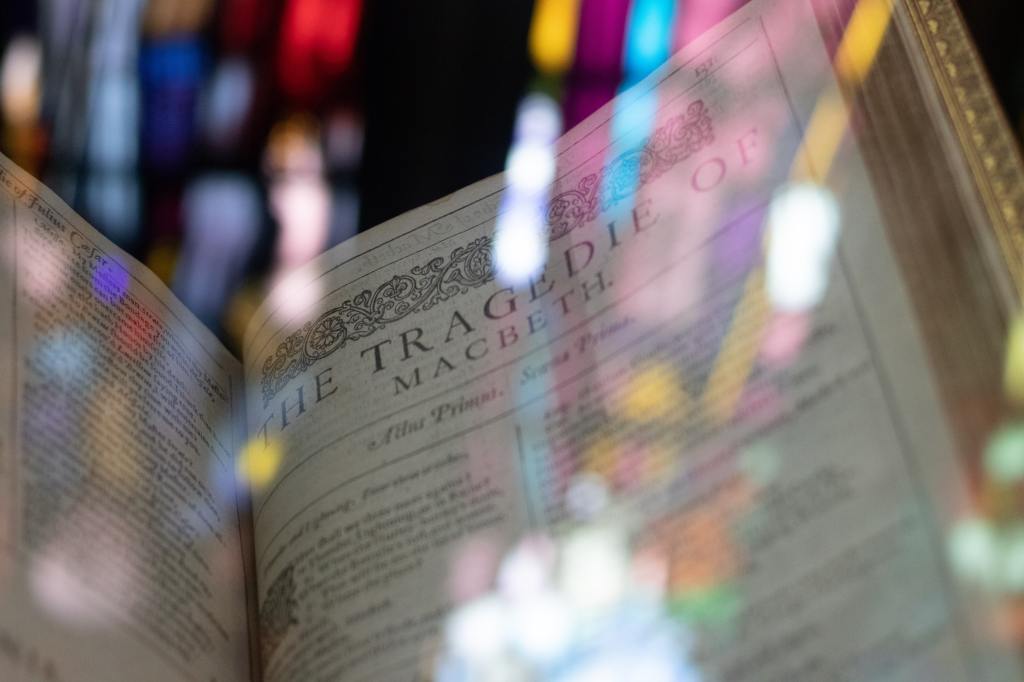
    While I stood in line on the night of February 28th waiting to be let into Hogg Auditorium for the American Shakespeare Center’s performance of Macbeth, Dr. Cullingford, a University Distinguished Teaching Professor and the Chair of the English Department, luxuriously slinked down the line asking after her Oxford Program students. As her sharp figure sweeped past, I thought to myself: Yeah, she’d make a pretty great Lady Macbeth.

    For the uninitiated (as I was, at least until I was forcibly made aware), the American Shakespeare Center is unique for its dedication to an authentic Shakespearean experience. Put flippantly (and in their own words), they “do it with the lights on:” the entire play is performed under universal lighting in an effort to mimic the lighting conditions of Shakespeare’s time, thus allowing the actors on stage to engage with the audience in an unique way. Additionally, before, during, and after the play, the actors perform music, as the actors in Shakespeare’s troupe would have done.

    (more…)

  • The Economics and Humanity of Instagram Poetry

    Written by Caitlin Smith

    Love her or hate, her, Rupi Kaur’s impact on the poetry world is undeniable. When first starting out, Kaur only posted to her Instagram account, but now has two published books under her belt: Milk and Honey (2015) and The Sun and Her Flowers (2017). Her poetry has sparked controversy among literary critics and everyday readers alike. One Buzzfeed article even claimed that her poetry, which aims to shed light upon South Asian issues, feels “disingenuous.” That hasn’t stopped her second book from selling over 600,000 copies, though.

    (more…)

  • The Problem with Antigone: A Martyr’s Motivations

    Written by Emily Ogden

    For fairly obvious reasons (he committed both patricide and incest), I could have written this segment of our Problematic Literary Faves column on Oedipus. But instead I decided to focus on his kids, who have just as many problems. Oedipus and his mother bore two sons and two daughters: Polyneices, Eteocles, Antigone, and Ismene. In the beginning of Sophocles’ Antigone, both brothers have died on opposing sides of a civil war. Creon, Antigone’s uncle and the king since Oedipus gouged out his eyes and exiled himself (see reasons above), has decided to deny his nephew Polyneices’ body proper burial rights as punishment for the side he chose. (This is actually quite a big deal, because it means Polyneices will not proceed into the afterlife.) Antigone defies Creon and buries her brother. Tragically, she is caught and left to die in a cave, where she hangs herself before poor Haemon, her fiancé and Creon’s son, finds her. He also commits suicide, which finally makes Creon wish he had handled this a bit differently, but of course this all came just a little too late.

    (more…)

  • Shailja Patel’s Migritude: Poetry in Motion

    Written by Katelyn Connolly

    Migritude is a text obsessed with movement. The content of Shailja Patels striking work of poetic theatre, first staged in 2006 and published in book form in 2010, is a meditation on the history, politics, and emotion of migration. Her story moves across Africa, Europe. and North America. Its form is an exercise in the fluidity of style, genre and narrative voice. In performance, it calls upon dance and choreography to drive home spoken word. And the text itself came to me and passed from my hands in a remarkably diffusive manner. My friend read Migritude for a class called Reading Resistanceat a college in Portland; she mailed it to me because she knew of my interest in memoir and witness; I passed it along to my old roommate here in Austin because her family are Gujarati emigrants, like Patels own. Each of us reads for a different reason, and the text continues to move physically across land and through new lenses of meaning.

    (more…)

  • Why Writers Can’t Write Alike

    Written by Kevin LaTorre

    Without a doubt, one of the most mythologized aspects of celebrities today is the strangeness of their preparations. On the basketball court, Michael Jordan slipped into his Tar Heels shorts, and Bill Russell vomited into his toilet bowl. On the ice, Alex Ovechkin made sure to, well, properly relax before and after his hockey games. The quirks of athletes, meant to induce the right mindset for the competition, strike the average person as bizarre. But the daily schedules of writers are no different. Readers marvel at the various oddities of these creatives, and in time, mythologize the myth-makers. Whether writers work early or late, sober or not, readers will always be intrigued by their days’ meticulous arrangements. Why? These men and women have found gold at the end of their constructed rainbows. We, as good little checkers-of-boxes, want to know what it took to climb the dazzling colors. As if it were only a hop, skip, and jump.

    (more…)