• Erin Hunter’s Bluestar: The Modern Tragic Victorian Heroine

    Written by Anna Dolliver

    Tragic female characters wander through the words of our favorite Victorian novels. From the ostracized Hester Prynne in The Scarlet Letter to the drowning Maggie Tulliver in Mill on the Floss, women who turn from traditional gender roles meet both praise and punishment in the pages of their stories. When they step out of line, these heroines gain a voice in a narrative dominated by conformity; rarely, however, do these transgressors find happy endings. Instead, their stories warn against breaking social boundaries.

    Later novelists experimented with this convention by turning tragedy into a distorted social liberation, as when Virginia Woolf gave Rachel Vinrace of To The Lighthouse a premature death to free her from an impending marriage and future as a Victorian housewife. We might be inclined to separate these tragic Victorian heroines from the protagonists of our modern literature, but a closer look at one novel suggests that this social suffocation has simply shifted into a new form — a feline form. In the modern children’s series Warriors, the Victorian warnings to conform or suffer a tragic life emerge through a similarly sorrowful figure: a cat of shifting names who ends her life as Bluestar.

    Though Bluestar may not look like the standard Victorian heroine, her complicated youth clearly mirrors the troubles present in many of her fellow subversive women. Being a cat does not exclude her from the social stigmas present in Victorian literature; in fact, the dramatic deaths in her life suggest that her female feline existence is just as harrowing as the lives of her Victorian sisters. As an apprentice, Bluepaw decides that she doesn’t “want to be remembered as the kit who was jumped on by a dead squirrel,” and she declares her ambition to become the leader of ThunderClan. During Bluepaw’s first battle with cats from another clan, her mother is killed by another cat. But instead of confiding in her sister and bonding over their sorrow, Bluepaw throws her energy into becoming a stronger warrior so that “she would take care of her Clan.” This blue-furred woman’s focus on occupational ambition rather than familial well-being would outrage a conventional Victorian reader; one would expect the heroine’s choice to hinder her journey. A few chapters later, it does.

    Bluestar prioritizes catching mice and chasing other cats away from her clan borders above spending time with her sister, unaware of her impending death. Snowfur becomes the mate of Bluefur’s rival for clan deputy, Thistleclaw, and Bluefur grows torn between supporting her sister and criticizing the tom who stands between her and a promotion. When Snowfur expresses her interest in Thistleclaw, she dodges Bluefur’s criticisms by saying there’s “nothing in the warrior code” against their relationship. Bluefur then “rolls her eyes” at the notion that Snowfur is “just following the warrior code” and replies, “Well, there’s nothing in the warrior code about sleeping or eating. Maybe you should give those up, just so you aren’t breaking the code!” Bluefur makes light of the very system that guides the cats’ social interactions, threatening its validity while mocking her sister. Later, Bluefur begrudgingly supports her sister to honor her mother’s memory, but the Bluefur’s defiance of the warrior code remains, and the tension between the heroine and Thistleclaw leaves the bond with her sister strained.

    As any sensible Victorian society woman — or society cat — would know, such blatant defiance of social norms foreshadows tragedy in the life of the transgressive culprit.

    Even as Bluefur nurtures her relationship with Snowfur, she oversteps another tenant of the social boundaries. Like Wuthering Heights’ Cathy Earnshaw, Bluefur becomes a wild, candid girl (or cat) who acts outside her station as her romantic interests begin to stray beyond her socially permitted options. She develops feelings for Oakheart, a cat from a different clan. Since the warrior code — the law among forest cats that keeps the peace between clans — forbids relationships across clan boundaries, she starts to see Oakheart in secret. As any sensible Victorian society woman — or society cat — would know, such blatant defiance of social norms foreshadows tragedy in the life of the transgressive culprit.

    Snowfur finds out about their relationship one evening on a walk, and within pages, she is killed by a “monster” — what the cats call a car. Bluefur’s guilt for the death amplifies as she thinks to herself, “Oh, Starclan, why did I tell her about Oakheart? She wouldn’t have run off.” This loss mirrors the earlier death of Bluefur’s mother, intended to check the cat’s ambition. Though other cats seek to support her, like her friend Thrushpelt and the clairvoyant medicine cat Goosefeather, Snowfur’s death leads Bluefur farther away from her warrior code-approved relationships. Bluefur pushes her energy back into training, and she has nightmares of her nephew, Whitekit, drowning — a fear that foreshadows her eventual death by water.

    When Bluefur goes on another patrol months later, she encounters Oakheart again. Despite calling him a “smug fleabag” at the Gathering, Bluefur fakes an injury to speak with him, and Oakheart invites her to meet with him later in the evening. On her way to their meeting place, the spirit of Snowfur appears to her, insisting that she return to her clan. Rather than listen to her family and the warrior code, Bluefur ignores her pleas and spends the night with Oakheart, where they build a nest after arguing over which cat is a “fish-face.” Like the transgressive Victorian heroine, Bluefur is warned that her actions will have consequences, yet she continues to set her own path by seeking clan leadership while defying the warrior code. In Hester Prynne fashion, Bluefur soon discovers that she will have kits by Oakheart.

    The deputy of her clan grows sick, and Bluefur finds herself torn between her desire for leadership and the impending role of a mother. She has her kits, and her clan assumes that Thrushpelt is the father. When Oakheart visits ThunderClan to see Bluefur, her rival Thistleclaw threatens him and defends his accusations with the warrior code. When Bluefur explains the situation to her clan’s leader, she says that Thistleclaw acted wrongly because “the warrior code speaks of fairness and mercy.” Rather than following the code to the letter, Bluefur interprets its ideals and lives according to her own values informed — but not directed — by the warrior code. As the deputy gets weaker, Thistleclaw declares that he will become the next deputy; soon after, Bluefur sees a vision of Thistleclaw soaked in blood. While she was previously torn between her career and motherhood, this image solidifies her decision. Bluefur travels through the snow to give her kits to Oakheart and his clan, inventing a game called “Secret Escape” to persuade them away from ThunderClan. Death comes again as Mosskit, one of her three, dies in the cold. Like the exponentially increasing sorrows that Thomas Hardy’s Tess Durbeyfield experiences in Tess of the d’Urbervilles, Bluefur must face the loss of her family, her child, her love, and finally her life.

    When Bluefur returns to her clan, the leader observes that she must be “destined to suffer.” Still, he selects her as the next deputy, and Bluefur declares that she will “give every breath in [her] body to serve” her clan. She later becomes leader and receives nine lives and her final name, Bluestar. As the years pass, Bluestar sees her nephew, Oakheart, and countless other cats die as she continues her duties as a leader. Her deputy, Tigerclaw, attempts to kill her, and the bouts of depression that have followed her through life take hold once more; she starts to spend all of her time in her den, trusting no one but Fireheart, a cat prophesied to protect her clan. Near the end of her life, Bluestar loses touch with the cats around her and lives more in her head than in a shared reality with her clanmates.

    In Bluestar’s final days, she brings the deaths of Maggie Tulliver and Jane Eyre’s Bertha together in one last effort to protect ThunderClan. When dogs attack Bluestar’s clan, she realizes that they are chasing her successor, Fireheart. Frantically, she thinks, “No! Not that one! You cannot use him as prey!” Bluestar distracts the dogs and leads them off a cliff, jumping into the water below. Like Bertha’s leap off the balcony, Bluestar enacts her own death in order to achieve her goals. But just as Maggie Tulliver drowned in the arms of her brother, Bluestar’s end arrives with her family beside her. Fireheart brings Bluestar’s body to the shore, and she speaks to her kits before she “close[s] her eyes and [gives] way to dizzying blackness.” Bluestar reconnects with her family, but at the cost of her life.

    Many transgressive women of Victorian literature have space to determine their lives between the pages of their novels, yet a heroine’s ownership of her personal narrative often leads to tragedy by the end of her book. Whether they lose family members, became ostracized from their communities, develop mental health problems, or meet untimely ends, Victorian female protagonists who step beyond their social standing trade their personal agency for startling consequences. Though the tragic Victorian heroine is no longer a staple of modern literature, the trends present in their stories emerge once more in the lives of modern cats such as Bluestar. Though their social codes and species may differ, Bluestar and the tragic Victorian heroine’s shared refusal to fit into the narratives set by their communities invites parallel traumas into their lives and deaths and indicates the problems still present for women in feline-centric literature. Literary human women may face fewer ramifications for reclaiming their stories in modern literature; in the case of Bluestar, however, it seems that the female cat still has obstacles to overcome before her narrative can escape the bounds of the feline patriarchy.

    Image found on Kate Cary’s blog

  • Why Gladys Schmitt, Pittsburgh’s Pioneering Novelist and Professor, Deserves a Closer Look

    Written by Kevin LaTorre

            Nestled into the southern edge of Carnegie Mellon, Baker Hall resembles an airport terminal with its long concrete hallway. The comparison to an airport came to my mind readily, since I had only passed through Pittsburgh’s few hours earlier. The famed campus outside prizes scientific prestige, with even the humanities building bearing that impression of stripped practicality. But when I took the curling staircase up to the second floor of the Thomas S. Baker building, I found a little nook of an office waiting off to one side. It overlooked the front entrance, and its windows gazed out across the pathway to the Roy A. Hunt Library. A glass case on the wall showcased a tidy array of novels and poetry. Through the door, arm chairs and desks were scattered here and there. This office is the Gladys Schmitt—the “Glad” to the initiated—Creative Writing Center, named for the writer who made a name for her craft at the university known mostly for its scientific focus.

            Not many readers have heard of Gladys Schmitt outside of Pittsburgh. For that matter, not many readers have heard of Gladys Schmitt inside Pittsburgh. And yet, she wrote twelve books of prose and poetry, and founded one of the nation’s oldest creative writing programs. She lived, wrote, and taught in Pittsburgh until her death in 1972, but—despite a few renewed looks at her work in the last few years—the city has mostly kept her to itself. Nevertheless, Schmitt is a writer worth reading and a teacher worth honoring. A dip into her compiled stories, a glance at her educational pursuitsthat’s all it might take.

            To begin at the beginning, Schmitt started writing far sooner than you might expect: four of her verse plays were staged when she was only in elementary school. This immediate output, from a young girl born in 1909, was only a prelude to the rich writing she would produce. A college-age Schmitt published “Progeny” in Poetry Magazine in 1929. 1942 received her first novel, The Gates of Aulis, followed closely by King David in 1944. The Literary Guild honored this novel with an award, doing the same for Confessors of the Name in 1952. No life events seemed to slow the stream of her writing. Not when she took an her assistant editor position with Scholastic Magazine and spent ten years in New York City, her longest stint away from Pittsburgh. Not when she began teaching at Carnegie Tech (later Carnegie Mellon). Not even when her mental health deteriorated in the 1960s; her poetry collection, Sonnets to an Analyst, was created during this time and published posthumously. Her writing survived every hurdle as she herself did, and grew alongside her.

    We had never heard of her, never thought of hearing of her before, even as we considered the graduate program which Gladys Schmitt first made possible when she fostered a creative haven at a technological school. We should have.

            It’s in Sonnets to an Analyst that Schmitt reflects on herself, and so I’d say there’s nowhere better to begin understanding her than in its sixty-nine sonnets. Wendeline Wright in the Pittsburgh Post-Gazette wrote in 2015 that “Schmitt is at her best when she dives into the heads of her characters”; Sonnets finds Schmitt diving into herself. The first line of Sonnet 1 declares, “I do not buy your terminology.” Later lines add, “Twenty-odd years I’ve lain in the bed I made: / ‘Love suffereth long, complaineth not, is kind.’ / Charity? No: a masochistic bind. / Chastity? No: turned off, withdrawn, afraid.” Schmitt rejects the words which are foisted on her. She rejects them because she prefers an identity of her own, even if the words are framed in the famed idea of love in Corinthians 13:4 , which her upbringing would require her to adopt. Her own choices outweigh “the bed [she] made,” no matter what it may be. Again in Sonnet 11, the speaker resists words that would define her. This time they are her grandmother’s promise that “my unseemly rage / and puny lies could plague my dying Lord,” which the speaker disbelieves. She responds that “[p]ity burst out of the torn womb with me. / Pity was in my playthings, in my bread. / Pity embraced His lacerated head.” Through her pity, Schmitt refuses her expected relationship to religion. To be sure, God appears in her novels (David the King is a clear biblical adaptation and The Godforgotten tells the story of how he disappeared). But in her sonnets, Schmitt steps inward and away from her expected place as a religious woman. It’s a step disguised by the neatly-trimmed sonnet form, but it is a personal departure—a personal redefinition—all the same.

            Gladys Schmitt was not the only entity that Gladys Schmitt redefined. I’ve already mentioned that she founded Carnegie Mellon’s Creative Writing department. But it’s key to consider how Schmitt championed this degree as part of the university’s overall redefinition in the 1960s. The university organized the Carnegie Education center to develop new curricula for both high school and university English courses; through 1968–69, Carnegie Tech became Carnegie University and then Carnegie Mellon University. In 1969 Schmitt capitalized on this change by introducing the Bachelor of Arts in Creative Writing. English had only been an area of study at the school since 1919, when it was a women-only major in the Margaret Morrison Carnegie School for Women. Only fifty years after the university created—and trivialized—English, Schmitt expanded its practice in a decidedly un-scientific direction. By fighting for her craft and its teaching, she managed to legitimize it.

            I had the chance to visit Baker Hall as a prospective graduate student with the Professional Writing Program. CMU added the Master of Arts in Professional Writing in 1980; just like the Creative Writing Degree, it’s one of the first of its kind. Our reception during that open house in March happened across the hallway from the Gladys Schmitt Creative Writing Center, in the more administrative English office space. We enjoyed our tidy donuts and Keurig-made coffee with no thought of the little spot across the hall. We were unaware of why it was important, why its armchairs, typewriters, and desks welcomed students to sit, read, or write inside. After all, the room’s namesake died in 1972, long before she could see her lasting effects on the university. Schmitt’s last publication was the compilation of her stories back in 2014. We had never heard of her, never thought of hearing of her before, even as we considered the graduate program which Gladys Schmitt first made possible when she fostered a creative haven at a technological school. We should have. Gladys Schmitt chose her own definitions of who she was and of what her school could become. As a writer and an educator, she deserves more than the passing curiosity I gave her in March, and more than the unthinking ignorance everyone gives her currently.

    Image courtesy of Carnegie Mellon Undergraduate Admission

  • You Pick. No, Really: Interactive Media Allows Power Like You’ve Never Known

    Think the only relevant piece of choose your own adventure literature is Netflix’s Black Mirror: Bandersnatch? Think again. And this time, think about it by playing staff writer Christie Basson’s choose your own adventure game…about choose your own adventure games.

    – Kylie Warkentin, Website Editor


    Play Here


    Relevant Links:

    What kind of content has Netflix been offering?

    Have our attention spans really been evolving?

    What did Sydney Stewart say about video games?

    Kino-whom?

    How has this been translated to the theatre?

    What did the VP of Product for Netflix say?

    Just what did Fox announce?

    Witcher? Isn’t that a video game?

  • Of Werewolves and Walleye: Why Kid Rock Belongs in the American Horror Canon

    Written by Alex Taylor

    Anyone at all familiar with Kid Rock’s “All Summer Long” knows of its ties to Lynyrd Skynyrd’s “Sweet Home Alabama.” The former uses musical riffs from the latter and even pays tribute to its chronological predecessor in the song’s lyrics—Kid Rock says, “[We were] Singing Sweet Home Alabama all summer long.” If one is to fully understand the myriad nuances of the song, however, it is impossible to recognize its stated influences without an equally careful consideration of those that go unmentioned. Often, an examination of what an artist leaves unsaid can reveal much about their text that is hidden between the lines, waiting to be uncovered by a meticulous reader. Just as “All Summer Long” draws on Lynyrd Skynyrd, it simultaneously uses riffs from another song that is, perhaps, less familiar to the ordinary listener: Warren Zevon’s “Werewolves of London.” Listening to the first fifteen seconds of each song makes their connection immediately clear—and the similarity between them extends beyond just their form. Like “Werewolves of London,” Kid Rock’s “All Summer Long” is the story of a werewolf, one worthy of a place in the American horror canon.

    One of the most common images in the song, and one that appears in its opening line, is that of hair. It is the defining characteristic of the people mentioned in the song—indeed, the only physical description given of the female the singer “[would] love to see…again” is of “her hair.” Indeed, the only physical details the listener is given of the singer himself are that “[his] thoughts were short” despite the fact that “[his] hair was long.” Hair, perhaps, does not belong solely to the lupine, but certainly it is a distinguishing characteristic of wolves. That the songwriter found hair an important enough attribute to emphasize in his characters shows the importance of their image as hairy people—and the hairiest people of all are those that take the shape of wolves by the light of the full moon.

    At the end of the first stanza of “Werewolves of London,” Zevon writes, “Aaoooooo…Aaoooooo.”

    Transformation, of course, is one of the most important aspects of the werewolf, and, fittingly, it is another of Kid Rock’s subtle, sublime images. There is an emphasis on change and the “in-between,” a state in which lycanthropes perpetually exist. At the beginning of the song, we learn that the singer is “caught somewhere between a boy and man,” in the same realm of divided existence occupied by the werewolf. Indeed, though he points out that the girl he sings about is “far from in-between,” the mere fact that he chooses to focus so heavily on the idea of dual-existence is telling of the kind of images he wishes to invoke in the listener’s mind. In the first stanza of the song—a position of power where the most important images are often placed to emphasize their importance—the singer chooses to emphasize hair and the in-between, all whilst the tune of “Werewolves of London” chimes softly in the background, lurking behind the lyrics. The first stanzas of both songs, too, are punctuated by similar, brilliant lines. At the end of the first stanza of “Werewolves of London,” Zevon writes, “Aaoooooo…Aaoooooo.” The fastidious listener might observe that this is meant to represent the howling of the wolf—and it is especially telling that the end of Kid Rock’s first stanza ends with the line, “Ahh Ahh Ahh,” a more subtle reference to the wolf-like nature of the characters in “All Summer Long.”

    In imagining the howling of a werewolf, one would be remiss in ignoring the imagery of the moon that pervades Kid Rock’s supernatural narrative. Perhaps the most obvious of these moments is one to which the singer gives the utmost importance: “But man I never will forget,” he vows, “the way the moonlight shined upon her hair.” The line itself ties the girl’s hair to the moonlight, images that are clearly representative of the werewolf. It is a subtle detail, easy to miss in a song about good times—and yet it is a clever way of showing that the girl is a dangerous, man-eating lycanthrope.

    Additionally, that much of the song is set at night—as, indeed, most werewolf stories are—is another of Kid Rock’s masterful touches in crafting his elusive horror story. At one point in the song, the singer says they were “Catching Walleye from the dock,” and as any bright student of ichthyology knows, the best walleye fishing occurs at night, when the fish is most active. Indeed, walleye themselves are nighttime predators; the walleye’s “mouth is large with sharp teeth, and it has low-light vision that helps it find prey at night” (if, perhaps, you find my explanation lacking, you can find more information about walleye here). The walleye, a seemingly minor detail in the course of the song, establishes the scene while simultaneously reflecting the nature of those who catch it. For the singer to catch walleye, he must be standing outside at night, looking into the dark, tumultuous waters and watching the luminous eyes of the nocturnal predators that lurk both by the dock and by his side.

    At the end of the song, when Kid Rock sings, “Man I’d love to see that girl again,” the astute listener is left wondering, “Why is he unable to see her again?” The most obvious answer to the question, perhaps, is that the girl is a werewolf. During one of her moonlight massacres, therefore, she must have wandered too far, never to return. But though he regrets losing her, he admits that she will always be a part of him. He sings, “She’ll forever hold a spot inside my soul,” by which he clearly means that she has bitten him and infected him with lycanthropy—an incurable disease which will eventually devour him, just as it did his female acquaintance. Perhaps, even, she has passed the virus to many of the other loiterers—the singer tells us after all, of their insatiable lust for the dark and the moonlight when he says, “We’d blister in the sun / We couldn’t wait for night to come.”

    “All Summer Long” is a story that—on the surface—appears to be nothing more than the tale of summer revelers in Northern Michigan, but the incredibly clever Kid Rock masterfully weaves a darker, more sinister story in the background. It is truly a feat unsurpassed by American horror writers—to have told the werewolf story through hints and subtle imagery, to bury it so deeply in the text that it has yet to be discovered is a feat of American literature. He has managed the seemingly impossible—he has told a story without having to really tell it at all. Like a werewolf, the song is, to all outward appearances, normal—until, that is, you examine it carefully under the moonlight.

  • Idyll Generations: Sifting Through My Grandmother’s Bookshelves

    Written by Anna Dolliver

    I spent my winter break surrounded by stories both spoken and concrete. Over the past few months, my grandmother has been sifting through and donating objects around her ranch to make more space. After decluttering cabinets with my mother and unearthing old records with my uncle, she invited me to help her with the bookshelves. We spent a few days sorting through the bookshelves in her storeroom, then her hallway, then her bedroom, then her living room. To my excitement, Tennyson greeted us on three separate shelves like three chance encounters with a childhood friend.

    My freshman year English teacher gave me my first copy of Idylls of the King. The Signet Classic, inscribed with an encouraging note on writing and scholarship from my teacher on the front cover, has followed me from apartment to apartment, from bedside table to the corner of my desk. Even now it sits on my coffee table, always within sight to encourage and inspire me as a writer and future educator; her words motivate me to put my pen to paper and remind me of the impact of a thoughtful note or a heartfelt mentorship.

    So what, I thought, was Tennyson doing in so many places around my grandmother’s house? He wasn’t Elmer Kelton, Madeleine L’Engle, or one of my grandmother’s other favorites whose copies crowded her other shelves. Through the books, I fished for family stories from my grandmother in hopes that I learn about their owners.

    At first glance, the smaller book appeared the more attractive of the two. With a blue-and-gold cover engraved with an intricate pattern of gilded vines and scales, the book introduced the reader to “Alfred, Lord Tennyson, POET LAUREATE” on the title page. Thomas Y. Crowell & Co. printed this copy in 1892, the year of Tennyson’s death; from this, my grandmother guessed it belonged to my father’s Grandpa Bull. Whoever purchased it must have fawned over its illustrated pages and delicately designed cover as much as I did, because the only mark that marred its pages was a dainty “Dolliver” written in pen above a street address. Despite its pristine appearance, I felt less connected to this book; the mystery of its ownership allured me, but the meager notes left me more drawn to its contents than the ambiguity of its origin.

    The second book, a Standard English Classics copy from 1913, bore an unassuming green cover. In the introduction, the editor explained that the copy contained five selections of the National Conference on Uniform Entrance Requirements in English for the 1915 to 1919 exams: Tennyson’s typical poetry collection adapted into a digestible high school textbook. Though it contained the smallest amount of Tennyson’s own work — a sizeable portion of the text was analysis of Tennyson, his life, and the excerpts included within — I kept finding myself drawn to this copy. My grand-aunt’s cursive signature, “Ila Kenley,” marked the first page above an all-caps note of “BLANK VERSE” and a smaller addition of “iambic pentameter.”

    Unlike the previous copy, a beautiful book preserved save for a location and a last name, Ila’s book contained a collection of notes and scribbles in both pen and pencil.

    Though I never met her, we share a compulsion to note major events in the margins for later reference — many of her annotations noted the “Death Speech of Elaine” or thematic concepts of “Strength.” She underlined sections sparingly, so the few key lines she emphasized — platitudes like “The king who fights his people fights himself,” and “He makes no friend who never made a foe” — felt all the more poignant. Despite the cursory review of the text typical of a high school student preparing for an exam (the introduction lacked a single mark), Ila’s marginalia left me wondering about her attachment to the text. The Maid of Astolat’s death note was the only section where she had written the line numbers along the side. Had she written a report on this passage, or had she simply been called upon to read in class? The small sketches of personality in her stray pencil marks led me to ask my grandmother about Ila, from other books she had read to what their relationship had been like. These stories led to more, each anecdote branching through the family tree, bouncing from one sibling to another until they stretched back down into my grandmother’s own life.

    As my grandmother and I looked through her bookshelves, we found story after story. Neither of us are the best at letting things go — I cling to my memories through writing stories, and she tucks items of any personal significance into cabinets, shelves, and boxes all around the ranch. I have my characters who enable and encourage over-analysis of my past, curating what-if’s into prose and poetry. My grandmother has her dyed Easter eggs from 1974, the ones painted by my father, aunt, and uncle that were “just too pretty to throw away.” Though we recognize that sorting all the things that clutter the shelves and rehoming them to people who will make the most of them is a necessity, we both struggle to say goodbye to the past. Separating the books into three piles — Keep, Donate, and Give to Friends — felt bittersweet for us both.

    But going through the shelves and looking at the books together let us relive those memories and give them their space so we could translate them into family stories, set them in a donation pile, or both.

    On finding a photo book of Mikhail Baryshnikov, my grandmother insisted we watch White Nights together. After finding a collection of Pushkin stories, I told my grandmother about the books and films of my Russian science fiction class. Book after book trailed us into stories about our family’s past, branching down into the present as we talked about my recent experiences at college and her trips to the ballet. At the end of our shelf spelunking, my grandmother set aside stacks of Nancy Drew books to the San Angelo literary council. She told me how those books had been her main companions in the summer polio epidemic of 1949, when many of her friends were paralyzed or equipped with iron lungs, her mother spent days anxiously shooing flies away from their home, and she lingered in her room with only the perceptive teen detective to keep her company. With the stories stowed away in our minds, it was easier to part with some of the books, even as we tucked others back into the shelves for later reminiscing. Despite my grandmother’s attachment to her books and my growing appreciation for the memories linked to each one, we both felt relieved when we looked at the donation and gifting stack — new homes for these books meant new connections across the pages, new ponderings about the origins of marginalia, and new discussions over books and bookshelves.

    Though we looked through books upon books upon books over the break, my grandmother and I still have plenty of shelves and cabinets to explore in the coming months. As we walked downstairs after an evening of shelf-sifting, a name caught my eye on one untouched bookshelf — yet another copy of Tennyson’s Idylls of the King. Whatever drew our family to Tennyson’s poems and the other annotated books, whether for school assignments or personal penchants, my grandmother’s stories over those time-weathered spines bring more relatives into focus in my mind. Next time I see my grandmother, I hope to share more stories about the other Idylls and items that linger on the walls.

    Photo by Radu Marcusu

  • Slow Your Roll: A Reader’s Quest to Appreciate the Plotless Novel Using Hemingway’s  The Old Man and the Sea

    Written by Alyssa Jingling

    In one of my classes last semester, I read a novel called Gilead by Marilynne Robinson. In the literary world, it received mixed reviews; many readers disliked how slow the novel felt. The novel is written in epistolary form: a father is writing to his son, and all of the points of action in the novel are sprinkled in through flashbacks outside of the letter.The class had mixed opinions on it, but despite its odd slowness, I absolutely loved it.. While I will admit that I agree with critics on the pace of the book, I surprised myself by still enjoying it.

    The main character, Ames, is an elderly preacher in a small town. He has acknowledged the fact that his time left on Earth is limited, and he’s doing his best to enjoy it with his friends and family. The ambling pace of the book actively forces the reader to slow down while reading. On his walks through town, Ames often stops to observe and appreciate the little things he notices, like “the peacefulness of an ordinary Sunday. It is like standing in a newly planted garden after a warm rain. You can feel the silent and invisible life.” Ames also notes that the “moon looks wonderful in this warm evening light, just as a candle flame looks beautiful in the light of morning. Light within light…It seems to me to be a metaphor for the human soul, the singular light within that great general light of existence.” These observations help the reader slow down as well—you don’t want to skip ahead to find action, you learn to appreciate the imagery.

    Reading this novel allowed me to foster a habit similar to Ames’s: I’ve used Ames as a reminder to be more mindful in my own life and to notice the little blessings I can see. And yet, as I pondered Gilead and just how much I enjoyed it, I realized that I was a sort of hypocrite. There I was, praising the slowness of a novel, yet for years I had fumed about how slow and boring Hemingway’s writing is.

    The worst offender: The Old Man and The Sea.

    I may not be the brightest English major in Parlin, but I just can’t be fooled into finding significance in toiling over a big fish. Does the fishing trip represent life? Is the big fish love? Why does the old man dream of Africa? What do you want from me, Ernest?

    One hundred pages of an old man who sits in a little boat in the sea, trying to catch one fish. That’s it, that’s the plot! Or so I thought in seventh grade. I figured, since I first read the novel in seventh grade, I would pick it up again to see if my tastes have changed. After all, I liked Gilead, so maybe I could take my newfound appreciation for slowness and poetic detail and apply it to Hemingway.

    Since The Old Man and The Sea is just over 100 pages, it didn’t take me long to read. I’ll admit, I had to read it in two sittings—I actually began falling asleep about halfway through. As I was reading, I felt the pace move quicker than I had remembered. I think I attribute this change not only to age, but also to the fact that now, I was reading with a purpose—I was trying to find notable things to write about. And though I did dog-ear (gasp!) about every other page with a detail I found interesting, it was difficult to maintain this interest when the pace slowed down drastically every time Hemingway described fishing techniques in detail. It’s easier to read about Portuguese men-of-war described as beautiful “iridescent bubbles” and “the falsest thing in the sea,” even though I used to avoid them on the beaches back in Florida. Perhaps the reason why these oceanic descriptions interest me is because they invoke a sense of nostalgia for the sticky air and sand I frequented as a child. On the other hand, reading about “a small line” that “had a wire leader and a medium-sized hook” that fastened “to a ring bolt in the stern” made me stop and calculate how many pages I had left to read.  

    Despite rereading the book at an older age and with a purpose greater than “I had to for a class,” I still couldn’t bring myself to enjoy the plot. I may not be the brightest English major in Parlin, but I just can’t be fooled into finding significance in toiling over a big fish. Does the fishing trip represent life? Is the big fish love? Why does the old man dream of Africa? What do you want from me, Ernest?

    I embarked on this writing journey foolishly thinking it would turn out one of two ways: I would either be set in my seventh grade ways and still hate Hemingway, or I would pull a full 180 and fall in love with him. As many things in life tend to do, the actual outcome fell somewhere in between. Just as I fell in love with Robinson’s writing style against my expectations, I developed a newfound appreciation for Hemingway’s use of language. I love his explanation about calling the sea la mar–he notes that people use the feminine form to express love for the sea, but they use the masculine el mar when they’re upset. The images are often extremely detailed, and I could imagine myself laying on a beach with nothing better to do than to reread this novel (I imagine the smell of the salty air would only add to the seaside poetry of it all). However, I still don’t get the hype about Hemingway. Action in a plot can be enjoyed by nearly all readers, but details and descriptions are subjective. They’re nice, but for a novel (which is typically longer than a poem), it can be tiring to just read images instead of following a plot.

    Perhaps the reason why I liked Gilead’s lack of plot but not The Old Man’s is because I was able to take more away from Gilead. Amid the poetic descriptions, Hemingway’s old man gives little pieces of advice, sometimes about fishing, sometimes about life. But even the life advice, like being exact instead of lucky so that “when the luck comes you are ready,” doesn’t speak to me as deeply as Ames’ musings. If I was talking to the old man, I imagine I’d just smile and nod at him, just thinking of him as a lonely old guy.

    So, I’m sorry Hemingway, I still don’t get you. But it certainly was a beautiful ride.

  • Why The Picture of Dorian Gray Wants What Cardi B Has

    Written by Sydney Stewart

    We live in a society.

    What does society, more specifically, our society, value? Money, senseless wealth, overt decadence. Humans stumble along, foolishly pursuing worthless treasure at the expense of their souls, yet, there are some who call out against the unstoppable tide of modern consumption and capitalism. One well-known critique of immoral wealth and rampant sin is Oscar Wilde’s The Picture of Dorian Gray, in which a man falls within the treacherous pits of opulence. While Wilde may have attacked senseless beauty and luxuriance, what critic critiques our society? Where is our savior from the quagmire of degeneracy? Enter, Cardi B.

    “He’s so handsome what’s his name?”

    “Dorian Gray?”

    Oscar Wilde’s The Picture of Dorian Gray mirrors Cardi B’s “I Like It” in a myriad of ways, and both act as a critique against their respective materialistic societies. To begin, both “I Like It” and The Picture of Dorian Gray similarly exhibit brutal violence as occurring concurrent to, and as a result of wealth. In The Picture of Dorian Gray, Dorian Gray generally brings about destruction wherever he goes in his path to pleasure. The violence present in “I Like It” is more understated—a muted, babbling brook, as opposed to raging whitewater rapids. Cardi B references gang violence when she declares she’s “certified, you know I’m gang, gang, gang, gang (woo-),” which subtly hints to her association with the infamous and violent Blood gang. Yet, the artists respective consequences for their violence differs dramatically.

    Unlike Dorian Gray, Cardi B evades punishment and continues on her lyrical rampage with decadence and extreme wealth. Moreover, there is the fact of the sheer opulence witnessed in both “I Like It” as well as The Picture of Dorian Gray. Cardi B enumerates the various expressions of her self-made wealth, stating that “I like dollars, I like diamonds / I like stuntin’, I like shinin’” and expounds upon these material manifestations of prosperity through with other declarations such as “I like those Balenciagas” (NB: a Spanish luxury fashion corporation). Much like Cardi B, Oscar Wilde fixates on material opulence in The Picture of Dorian Gray.

    “I believe that if one man were to live out his life fully and completely—”

    “Flexing on bitches as hard as I can—”

    “I believe that the world would gain such a fresh impulse of joy that we would forget all the maladies of medievalism and return to the Hellenic ideal—’

    “Eating halal, driving the Lam’”

            However, “I Like It” and The Picture of Dorian Gray possess nuanced differences, such as those betwixt a floral Darjeeling tea, versus a fragrant Nilgiri. There is, of course, the disparity in the treatment of beauty. Beauty in “I Like It” remains a tangential theme that is only peripherally referenced by few lyrics. Cardi B remarks on the beauty of the material items she buys (Balenciagas—more specifically, “the ones that look like socks”), and occasionally comments on her “banging body” which is “hotter than a Somali.” In The Picture of Dorian Gray, Dorian Gray—similar to Cardi B—emphasizes his physical beauty, though to a greater extent. Then, there is the issue of how Cardi B and Dorian Gray’s respective wealth is accrued. Cardi B is a self-made millionaire—she, through her own tenacity and industriousness, worked as a stripper before beginning her lucrative musical career. Thus, “I Like It” acts as a shrine to her wealth, and a salute to her Afro-Latina heritage, whereas Dorian Gray likely is thriving off long-held family money, rather than money he has earned himself. Furthermore, the stakes are low for Cardi B—her oil painting, which hangs in the minds of her fans, remains vivid and unmarred by her insinuated wealth. Dorian Gray’s portrait, however, decays. However, Cardi B’s “I Like It” goes beyond simplistic glorification of materialism, and, similar to The Picture of Dorian Gray, brutally critiques our society.

    “On one occasion he took up the study of jewels—”

    “I like going to the jewelers—”

    “He procured from Amsterdam three emeralds of extraordinary size—”

    “I put rocks all in my watch (Cha-ching)—”

    Since “I Like It” and The Picture of Dorian Gray both address the same themes, with some slight nuances, does this mean Cardi B acts as our critic against our dependence on material goods? The answer is an emphatic yes. Cardi B, while a millionaire who has achieved her level of wealth through playing the capitalistic system, on numerous occasions speaks (or sings) against the tide of capitalism that decimates our society in her song “I Like It.” To begin, Cardi B declares that “I need the dollars,” which, at face value, may insinuate her dependency on wealth. However, this phrase is likely sung as an ironic critique of our society’s dependence on money and material goods. Cardi B’s argument occurs again when she states that she is “’bout my coins like Mario.” Here, Cardi B acknowledges her wealth through likening herself to the popular video game character, Mario, who runs through a side-scrolling video game world, aiming to collect as many coins as possible before saving Princess Peach. 

    Does this not reflect our own senseless drive to run through life, and accrue meaningless bits of wealth, striving towards a shining, yet imprisoned emblem of freedom?

    Furthermore, Mario acts as a representation of our capitalist and market-driven society. He was a created character for a video game industry that has long-dominated the video game field, and out-sold competitors with the image of an iconic mustachioed plumber, and continues to impact our society, and further the insane wealth of the multi-million-dollar company, Nintendo. Cardi B’s statement acknowledges the capitalism in our system, and she ironically sings the lyric as to draw our attention to our own senseless and materialistic endeavors.

    To conclude, Cardi B and Oscar Wilde both create similar works that depict and critique wealth and decadence. Both works enumerate signs of extreme opulence and its associated violence, and both critique the direction our materialistic society is traveling towards. However, the pair possess nuanced, particular differences, as in how the wealth was specifically accrued, and how beauty is particularly addressed in both works. Comrade Cardi B, the seemingly superficial millionaire, acts as the harsh critic and enemy to our materialistic capitalist American society.

    Photos found on Hollywood Unlocked and Adam Harrington Rare Books

  • “I Write Plays”: Walking Through The Terrence McNally Exhibit at the Harry Ransom Center

    Written by Kevin LaTorre

    I sign my name in the guestbook of the Harry Ransom Center when I visit the Terrence McNally exhibit for the second time. Alongside the academics and the Northerners and the enthusiasts, “UT Student” is a nondescript designation. If a stack of brochures had been available, I might’ve picked one up, slipped it into my notebook, and kept it in the same way I keep playbills. Back in the front lobby, the receptionist and the two security guards all pitter-patter together in light Texas accents. Weather, grandchildren, the like. The ladies’ buttery voices might be what’s causing McNally to grin up there on his mounted photograph. He knows the lines of Texas’s old women, having grown up in Corpus Christi. I approach the playwright’s picture on this first wall of his exhibit, just before his documents and photos appear on the walls of the following room. This little waiting room—his little waiting room, he might correct with mock seriousness—has a theatre’s pre-show silence, as well as the headshot of the balding playwright who has written the show. He is eighty years old, the display tells me. I give the old man an impressed nod, and I turn the corner into the larger exhibit. There are no curtains hanging here, but somehow I expect to hear their heavy fabric drawing back. Maybe there are pulleys squeaking as they reveal the unlit stage.

    McNally first reappears as a little blond boy in 1942 Corpus Christi, all curls and shorts, his mother holding him on her hip. Corpus Christi also gifted McNally the first person to encourage his writing: Maurine McElroy, his high school teacher. Their displayed correspondence spans from 1959 (Terry the college student) to 1998 (McNally the acclaimed playwright). Though, like a polite young boy, he always addresses her as “Mrs. McElroy.” McNally grows into a man for the first time on these handwritten pages. They will soon become typed once technology ages with him, but these pages came from his fingers and his pens. This first costume fits him loosely enough to allow him a quick-change before the next scene. The pages bob and dip out of the light, and his sleek new suit reemerges on the wall’s next panel.

    His 1960 play Rollercoaster is the first McNally script that appears in the exhibit. He wrote this as a student at Columbia, and the two displayed pages stage the tale of an old man who is struck by a tiny projectile from somewhere above him, and—

    A man reads the display over my shoulder. He has cut across the room diagonally, atypical for a theatergoer. He prefers the “goer” to the “theatre,” and so he crosses the stage freely as if he were the actor. The woman he left back by the door does not look over to him. I think that maybe she didn’t notice him go, or that he said something moronic and she finds McNally’s performance far more rewarding anyway. The man and I look over the information card for “Roller Coaster,” which cues the playwright Edward Albee to arrive on the scene. He darts out from the stage left wings and seduces the young McNally—or McNally seduces him—before his cameo ends as quickly as it began.

    The boy who was the student, who then became the playwright, has now also become the lover.

    When I move past this footnote romance, McNally assumes a wide smile and beams out from a photo of himself at twenty-six years old. He will not appear as a photo of himself for the rest of the performance. Instead, he will be only his words, his stories, and his performers. He tries out the new style in a typescript of And Things That Go Bump In The Night, his Broadway premiere. Its brief run didn’t survive the critics’ onslaught, but John Steinbeck lends a supporting role here with a few of his scrawled letters. He consoles McNally because Broadway needs his subversive gay comedy more than it knows. Old John strikes the pose of the cowboy: “Who ain’t been thro’ed, ain’t rode.” And so McNally rides on.

    Further down the wall, a woman in black is lingering by the two screens showing The Kiss of the Spider Woman and Love! Valor! Compassion!. From this distance she looks like she could be anyone; that is, she could starch her black clothing and transform into a domineering opera legend, or perhaps wear only a waitress’s uniform and bluff her way out of a one-night stand. She hears the actors through the provided headphones, but I imagine their voices and dances filling the space of the room. McNally, the effusive musical-lover, wrote the books for both shows, and so hearing his creations reverberate from the wooden floor to the high ceiling is easy. Even as McNally’s words acquire music, I can still discern them under the glitzy little screens’ bright lights, remaining just as comic, just as alive.

    Nathan Lane speaks McNally’s boldest words in Love! Valor! Compassion!, where he captivates in the role of the flamboyant, floundering Buzz. The exhibition’s video bathes Buzz in the blue light he enjoyed back on that 1995 stage, and he declares, “We want gay music!” Like McNally, musicals are Buzz’s outlet, but for all his comedy, he suffers the outraged futility of a lonely gay man dying of AIDS. He screams that he wants “a West Side Story where Tony really gets it,” a theatre where the actors die and the audience must keep “waiting for nothing.” Unapologetic, he nevertheless adds, “Fair is for healthy people.” The comedy is no longer dark. Just silent. McNally has lost many friends to Buzz’s “fucking scourge.” I can find their names online after the exhibit, but at this moment there is no need. He has already named them with Buzz’s blunted pain.

    A young couple moves through the room just a little too quickly. They stroll by, as hand-in-hand as ignorance and bliss—they haven’t heard McNally’s performance, and the cheerful, painted backdrops of old movies are waiting in the next room. For date conversation, they might prefer balmy Hollywood to grave AIDS; after all, Hollywood has palm trees and earthquakes.

    The immune couple passes the next screen, where a news broadcast documents McNally’s 1998 play Corpus Christi. As is his wont, McNally reimagined Christ and his disciples as gay men in the play’s namesake setting. The night of its October opening in New York, Christian groups assembled in the street outside the playhouse to protest the show’s content, as they had already done for a few weeks. As they had done since Corpus Christi first appeared the previous spring, and as they would continue to do for its ten-week run. McNally did not comment on the controversy; Corpus Christi would stand alone on its own words. His words, funny enough. I can almost hear a joke he might make with the play’s company as they all listened to the chanting outside. Who knew Catholics actually understood Latin? I wonder if it would lighten the mood, or if that room remained silent like this one. The furor did eventually pass, and I put the headphones back and move along.

    In their raised glass box, the show’s final lines signal the coming curtain call: They are McNally’s four Tony awards, facing out towards the lobby. These are his final words to any of us still watching. Not a razzle-dazzle dance number, and not a rousing tap display. Just these testaments, their round faces proud in the light, proud in their applause. In The New York Times, McNally once wrote, “I don’t write literature. I write plays.”

    Despite all the pages pinned to the walls of this sparse little stage, I find McNally entirely true to his character as he bows, and I can only applaud him, because like a fool I forgot my flowers at home.

    Photo by Somedayprods.

  • Why Diversifying Your Bookshelf for Black History Month Isn’t Enough

    Written by Selome Hailu

    It’s become standard practice to celebrate Black History Month by sharing favorites written by black authors. Libraries host storytimes with black children on the pages; bookstores create display tables of Hurston, Baldwin, and Hughes. New works by prolific black writers are often slated for February, such as Toni Morrison’s newest essay collection The Source of Self Regard, which came out on February 12th. The buzz is unmistakably important — a study published by Roxane Gay found that nearly 90% of books reviewed by the New York Times were written by white authors. Her research was conducted in 2012, but the public conversation about books is still largely eurocentric. In the face of such glaring disadvantages for black writers, the importance of amplifying their work cannot be overstated. But while scanning lists for up-and-coming black authors is enriching for the reader and even creates bestsellers, it can only do so much to revolutionize literature at large.

    For emerging black writers, white approval is almost always essential for success.

    The publishing industry is an overwhelmingly white institution. Lee and Low, a multicultural children’s publisher, investigated the business as a whole and found that 79 percent of people working in publishing are white. That number increases to 82 percent when looking specifically at editorial staffs, which are only 2 percent black. Writers create the specific content we read, but it is up to editorial departments to decide which stories make it to the printing press. This gatekeeping in the publishing industry puts the continuous production of the literary canon into almost exclusively white hands. For emerging black writers, white approval is almost always essential for success.

    Dr. John K. Marshall, professor of English at Marshall University, wrote Black Writers, White Publishers, an interrogation of how publishing has impacted African American literature and suppressed even the most prominent voices in the field. His criticism proceeds from examples of writers like Toni Morrison, Richard Wright, and Ralph Ellison being forced to delete scenes and change titles to make sure their narratives weren’t “too inflammatory.” In analyzing the power dynamics between black writers and the largely white institutions they’re writing for, he exposes the expectations and barriers black writers face, and how these experiences differ from those of white writers. Marshall’s book serves as proof that the versions of the “diverse” books that end up on our shelves exemplify racist censorship imposed upon black writing. Further, this censorship becomes a cruel privilege when considering all of the stories that remain unpublished.

    The research makes it clear that the disproportionate demographics of the publishing industry create a disproportionate amount of successful black writers. And as long as the book business only drives focus towards reading individual black authors, consumers will remain ignorant of the larger forces keeping the list of famous black authors so short. But while hiring practices within book publishing should be the first site of reexamination, readers at home are not completely powerless in the effort for inclusion. Every book purchase supports a publishing house, not just the author of the book. Armed with this knowledge, consumers can direct their efforts to support new black writing towards new companies as well.

    Penguin Random House, Simon & Schuster, Hachette, Macmillan, and HarperCollins are affectionately known as the “Big Five” for their dominance in book publishing. Naturally, each is guilty of the massive employee diversity gap pointed out by Lee and Low. They have each developed different “diversity programs,” including efforts to hire more people of color as interns. But as these companies attempt to make up for generations of excluding marginalized voices, there are multiple smaller publishing houses already empowering black creatives beyond just entry-level positions.

    Africa World Press is driven by a mission “to provide high quality literature on the history, culture, politics of Africa and the African Diaspora.” Founded and run by Eritrean immigrant and former Rutgers professor Kassahun Checole, the company primarily produces scholarly work, including multiple books by University of Texas professor Toyin Falola. They also publish titles in fiction, poetry, and children’s literature, and have expanded in reach, now holding offices in Eritrea, Ethiopia, Ghana, and England.

    RedBone Press began in direct response to the underrepresentation of black lesbian women in lesbian and feminist literature. Founder Lisa C. Moore has since included gay black men in her mission. The Lee and Low diversity baseline survey investigated sexual orientation as well as race, and found that 88 percent of publishing professionals identify as heterosexual. Given the statistics, RedBone’s intersectional feminist approach to publishing is unlike anything the industry had seen before its inception. Celebratory and unapologetic, their work creates a necessary platform for black queer writers.

    Haki R. Madhubuti founded Third World Press in the midst of a successful career writing and teaching at the university level. Mentored by black literary greats such as Gwendolyn Brooks and Dudley Randall, his prolific poetry and nonfiction work rendered him a pioneer of the Black Arts Movement. He built creative institutions that worked to make the arts more accessible to black people, and says Third World Press was his “direct and most tangible [response] to the Black Arts Movement’s call to action.” Third World Press is the oldest independent publisher focused on black writing, and they have remained a constant source of important black literature, supporting well-known writers such as Gil Scott-Heron and August Wilson.

    Other black-run publishers include Black Classic Press, Broadside Lotus Press, and Just Us Books. Lee and Low pushes the industry forward in both their research and their expansive body of inclusive children’s literature. This Black History Month, challenge your reading habits a little more than usual. Picking new reads from the New York Times bestseller list is by no means a fatal flaw. But when searching for books that reflect your ethics, try to see if the profiting companies practice what they preach. A purchase from a black-owned press is an investment in a fair, truthful black literary culture — one where writers will not have to dilute their stories to cater to exclusionary standards.

  • Three Literary Power Couples that Enamored the World with their Romance and Writings

    Written by Christie Basson

    The 21st century loves a good power couple. From the unshakability of Michelle and Barack Obama to the creative genius of  Beyoncé and Jay-Z to the classic elegance Meghan and Harry — the masses have supported the coupling of powerful people for decades. Honestly, there is nothing better than two awesome creative spirits joining forces and elevating each other to new levels. This promise holds especially true in the literary world. While many romanticize the tortured writer, sitting in the lonely dark with nothing but their typewriter, we need not look far to see proof that creativity feeds creativity. Therefore, with Valentine’s day fresh in our minds, I think it’s worthwhile to delve deeper into some of my favorite weird and wonderful literary power couples who shook up their social circles and the rest of the world with their love (and writing).

    Elizabeth Barrett Browning and Robert Browning

    missedinhistory-podcasts-wp-content-uploads-sites-99-2015-09-Thomas_B._Read_American_1822-1872_-_Portraits_of_Elizabeth_Barrett_Browning_and_Robert_Browning.jpg

    Both authors were successful even before they united forces. Elizabeth had published two volumes of poetry (Seraphim and Other Poems and Poems by Elizabeth Barrett) and a number of Greek translations, while Robert had published works such as Pauline and Sordello. Though Elizabeth was born wealthy, she had weak lungs that led her to be reclusive in her younger years. Her poor health was a big part of her life and her work. It was therefore with much hesitation that she started a relationship at all — she feared she could only bring heartbreak to a suitor, who would probably outlive her. She met Robert when he wrote to her in admiration of her poetry, his praise quickly progressing from that of her work to her personally. Elizabeth’s father was also very strict about her suitors and did not think Robert was worthy of his daughter. This may be another reason she was hesitant to start a relationship with him, but ultimately his devotion convinced her to let herself fall in love with him.

    From their letters an enduring love blossomed and on September 12th, 1846, they secretly eloped and fled to Italy where they lived together for fifteen years. They had one son and much success before her death in 1861. Her work like Aurora Leigh and especially Sonnets from the Portuguese outshone her husband’s (so much so that he was sometimes referred to as Mrs. Browning’s husband by socialites). Though the Sonnets is one of Browning’s most popular works, she was originally hesitant to publish it because it centers around the couple’s courtship and marriage. While Emily thought it might be too intimate to share, Robert persuaded her to share it. He himself received acclaim for works like The Ring and The Book and My Last Duchess. The couple dealt with some unique challenges, such as Emily’s health and the fact that he was younger than she (at thirty-six, Elizabeth was seen as a spinster by Victorian society) but their relationship was strong and built upon mutual support. One has to look no further than the Portuguese Sonnets to find proof of their devotion.

    Life in a Love

    Escape me?

    Never—

    Beloved!

    While I am I, and you are you,

    So long as the world contains us both,

    Me the loving and you the loth,

    While the one eludes, must the other pursue.

    My life is a fault at last, I fear:

    It seems too much like a fate, indeed!

    Though I do my best I shall scarce succeed.

    But what if I fail of my purpose here?

    It is but to keep the nerves at strain,

    To dry one’s eyes and laugh at a fall,

    And, baffled, get up and begin again, —

    So the chase takes up one’s life, that’s all.

    While, look but once from your farthest bound

    At me so deep in the dust and dark,

    No sooner the old hope goes to ground

    Than a new one, straight to the self-same mark,

    I shape me —

    Ever

    Removed!

    – Robert Browning

    From the Portuguese Sonnets:

    How Do I Love Thee? (Sonnet 43)

    How do I love thee? Let me count the ways.

    I love thee to the depth and breadth and height

    My soul can reach, when feeling out of sight

    For the ends of being and ideal grace.

    I love thee to the level of every day’s

    Most quiet need, by sun and candle-light.

    I love thee freely, as men strive for right;

    I love thee purely, as they turn from praise.

    I love thee with the passion put to use

    In my old griefs, and with my childhood’s faith.

    I love thee with a love I seemed to lose

    With my lost saints. I love thee with the breath,

    Smiles, tears, of all my life; and, if God choose,

    I shall but love thee better after death.

    – Elizabeth Barrett Browning


    Percy Bysshe Shelley and Mary Shelley

    Mary-and-Percy-Shelley.jpg

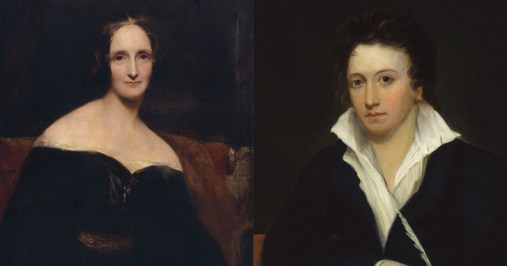
    Another couple whose relationship was not approved of by others was Mary Wollstonecraft Godwin and Percy Bysshe Shelley. The two met when Percy studied under Mary’s father at the Godwin house. Percy was already married to Harriet Westbrook (with whom he had eloped when she was sixteen) — but that didn’t stop the couple from secret rendezvous in the graveyard.  Eventually, they eloped to France with Mary’s stepsister Claire Clairmont in tow (Yes, that is the same Claire who would later have an illegitimate child with Lord Byron — this family had a whole walk-in-chamber of skeletons). The trio enjoyed their adventures through Europe until the money ran out and they returned to England in 1814. Mary fell pregnant shortly after and was often abandoned as the other two went on outings. There’s been some speculation that Percy and Claire also had an affair, but diaries from the time have mysteriously disappeared.

    On February 15th of 1815, tragedy struck, as Mary’s daughter was born two months premature and only lived for two weeks. Percy’s apathy concerning the death and Mary’s subsequent depression drove a wedge between the two, although they remained together during this period. They decided a change of scenery might help Mary recover and traveled for a while, eventually meeting up with Lord Byron. What follows is, of course, the famed tale of how each writer created their own frightening story, with Mary creating the first science fiction book with Frankenstein. With Frankenstein, Mary (eventually) found literary acclaim, but shocked the Victorian society with her gruesome subject matter — few could believe the tale came from a woman. She would later pen novels like Lodore and Falkner (which centered around strong female characters and included her political critique) and The Last Man, a story about a post-apocalyptic world dealing with the aftermaths of a plague. Percy was much more famous during their time, even with all his controversies, and published works like Queen Mab: A Philosophical Poem, Prometheus Unbound, as well as many contentious texts on society and religion such as “The Necessity of Atheism”. In 1816, two years after he had left her, Percy’s wife, Harriet, committed suicide. She was only twenty-one and in her suicide note, she left instructions concerning the care of their two children. A few weeks later, Percy and Mary got married. They spent six more years together before Shelley drowned in a boating incident. The two often influenced each other’s work, proving that in regards to their publications, their literary relationship played as a big a role as their romantic one (which was at times rocky).

    Love’s Philosophy

    The fountains mingle with the river

    And the rivers with the ocean,

    The winds of heaven mix for ever

    With a sweet emotion;

    Nothing in the world is single;

    All things by a law divine

    In one spirit meet and mingle.

    Why not I with thine?—


    See the mountains kiss high heaven

    And the waves clasp one another;

    No sister-flower would be forgiven

    If it disdained its brother;

    And the sunlight clasps the earth

    And the moonbeams kiss the sea:

    What is all this sweet work worth

    If thou kiss not me?

    – Percy Bysshe Shelley

    From Mary’s diary:

    How happy I shall be, my own dear love, to see you again. Your last was so very, very short a visit; and after you were gone I thought of so many things I had to say to you, and had no time to say.


    Allen Ginsberg and Peter Orlovsky

    ORLOVSKY-obit-popup (1).jpg

    Allen Ginsberg met Peter Orlovsky in 1954 in San Francisco, when both were in their twenties. They started a relationship that ended only with  Ginsberg’s death in 1997. They first met through a painting Ginsberg had seen and admired for which Orlosvksy was the model. Ginsberg later claimed he was in love with Orlovsky before he ever met him. They wasted no time in moving in together, determining they would be each other’s “life-long loves.” Two years into their relationship Ginsberg published Howl and Other Poems which remains some of the most revolutionary work of the Beat Movement. Among his works, Kaddish and Other Poems and The Fall of America also stand out.

    Orlovsky was not a poet before the two met, but with Ginsberg’s encouragement, he started to write and share his own work. Orlovsky became a central figure among the Beat poets, teaching at Jack Kerouac’s School of Disembodied Poets and acting as inspiration for various characters in Kerouac’s books. His relationship with Ginsberg was not without problems — both had other lovers and took time apart every now and then — but they always found their way back to each other. Running with the Beat crowd meant life in itself was a bit of an adventure — the Beats were known for sex, drugs, and experimental poetry after all — but the couple themselves centered their lives around experiencing life to the fullest, traveling as often as possible and embracing new ideas and cultures. They had an open relationship that often led them on their own journeys and by many standards, the Beat Movement was their liberator — they experienced freedom from the constrictions of conservative America at the time to explore not only their desires but their fascinations with human nature and its complexities. They remained “married” until Ginsberg died from liver cancer at age 70.

    Letters they wrote to each other:

    but I do feel good and so dont worry dear Allen things are going ok — we’ll change the world yet to our dessire — even if we got to die — but OH the world’s got 25 rainbows on my window sill. . . 

    – Orlovsky

    I read Bill your poems, I’ll type them & send them soon, everything is happening so fast. I feel like I can write even. Are you OK? Write me happy letter, don’t be sad, I love you, nothing can change love, beautiful love, once we have it. . . . – Ginsberg

    I’m making it all right here, but I miss you, your arms & nakedness & holding each other — life seems emptier without you, the soulwarmth isn’t around. . . . – Ginsberg

    When we parted in Tanger

    We said ten years or perhaps a few months

    Whatever fate and railroads bring, whatever cities or deserts —

    Now I am in the holy land, alone

    Reading Cavafy — it’s half past twelve.

    My letters haven’t reached you, yet you’re somewhere here, Petra or Syria

    Perhaps have entered the gate to this land and are looking for me in Jerusleum —

    I wrote to all your addresses and to your mother

    Tonite I am reading books & remembering our old nights together naked —

    I hope fate brings us together, a letter unanswered, held in the red hand —

    or crossing some modern street corner, look joyfully in each other’s eyes.

    – Ginsberg

  • The Novelty of the Non-Novel: A Reflection on House of Leaves and Its Nontraditional Contradictions

    Written by Alex Taylor

    There are some books that are better read standing up—others that are best digested lying in bed. There are few books, however, that are best enjoyed in front of a mirror at 3 o’clock in the morning. For anyone who has read Mark Z. Danielewski’s House of Leaves, this image might seem familiar—it may even reflect their own experience reading it for the first time. Or it may not. Despite the fact that the text never changes, no two read-throughs of House of Leaves are ever the same. House of Leaves is one of the few books I have read where going through it for the first time isn’t so much a process of reading as it is a process of experiencing the text—an important distinction that has made House of Leaves a classic worth encountering again and again.

    In my last article, which you can read here, I mentioned looking up and down the bookstore for a copy of House of Leaves. Though it is traditionally sold as horror and is known as a horror classic, House of Leaves isn’t a book that can easily be pinned into one genre. Like it does in its form, style, and content, House of Leaves rejects categorization. The Wikipedia article for House of Leaves claims that it belongs to the horror, romance, satire, and postmodern genres—all of which are applicable to the novel, despite their seeming incompatibility. But House of Leaves embraces contradictions. Between its covers, a blind man writes literary criticism about a film that doesn’t exist, fake articles are attributed to real scholars, and the ordering of the pages is a suggestion at best. It is a book about defiance—about defying the past, defying the boundaries of the page, and even defying what it means to be a novel.

    House of Leaves is as much a novel as Bernard Rose’s Candyman is a movie about writing your thesis—kind of, but not really. At its most basic level, House of Leaves is the story of Johnny Truant, who has picked up the life’s work of his friend’s recently-deceased neighbor, a strange, blind man who goes by the name Zampanò. Zampanò’s work, The Navidson Record—a collection of writing scraps, literary criticism, and fragmented notes about a fictional documentary by the same name—makes up a large portion of House of Leaves. At its most basic level, The Navidson Record is about a family that discovers their house is much larger on the inside than the outside would suggest. Zampanò’s work is filled with missing notes, blacked-out pages, and fictitious references. Johnny’s own story weaves in and around Zampanò’s disordered essay. But it doesn’t stop there. The Introduction, Appendices, and even the Index of the book contribute to the fragmented and disorganized story. It is anything but a unified novel.

    And the form of the novel itself is done away with in varying degrees throughout House of Leaves. As if preparing you right from the start for its strangeness, the front cover is smaller than the rest of the book—a clever design that mimics the shape of the Navidson house. The text similarly breaks the rules. Sometimes it overlaps itself, sometimes it is scrawled in the margins (upside-down or otherwise), and sometimes there is only one word per page. A few footnotes have footnotes attached in a cyclical manner that leads right back to the first—others are simply left blank, encouraging the reader to fill them with whatever they can imagine. Another footnote, such as a list of names and references, might last for seven pages. You might have to read a page left-to-right before turning it precisely 180 degrees just to read the upside-down footnote at the top—and then, following the footnote’s footnote, you might end up on a page you read thirty minutes before. And sometimes, if you want to understand what’s written, you’ll need a mirror.

                House of Leaves is nothing short of an experience.

    Part of what makes House of Leaves so fun to experience is its interactivity. There is so much packed into it that a lifetime of re-reads wouldn’t be enough to unlock its secrets. There are hidden codes throughout for the reader to solve—I still have pages of decoded text scribbled down on papers that stick out from between the pages of the book. House of Leaves encourages the reader to play along with the disorganized text, adding their own footnotes and pages onto its pile of academic notes, letters, poems, pictures, and riddles. When the words are backwards and need a mirror to be read, it is more than just a strange experience—it draws the reader into the story, making their reflection a part of the overall text.

    House of Leaves is a wonderful, inspirational horror story for anyone who loves the genre. Stephen King, the master of horror himself, referred to the book as “the Moby-Dick of horror” in an article you can read here. Whether you’re looking for a riddle to solve, an academic text on the nature of filmography, or a love story on a dark background of fragmented text, House of Leaves is an unforgettable experience that every horror fan can look forward to.

    Due to its experimental nature, though, House of Leaves does require a measure of patience—especially if you, like me, can’t bear to leave a single word unread. Some of the codes are impossible to decipher without help (thankfully, there are internet forums dedicated just for that), and reading through a seven-page list of names is a senseless and arduous task. Be ready to be both infuriated and amazed—at times, an incomplete piece of the text or a nonsensical passage written in stream of consciousness will make you want to tear your hair out. At others, the breathtaking images of the Labyrinth in Navidson’s house or the gritty, brutal details of Johnny’s life will capture and haunt you. Throw away your expectations, your preconceptions of what a novel is, and pick up House of Leaves. Turn the lights off and grab your flashlight as you step into the dark hallway of its pages—and make sure to keep a mirror close at hand.

    Photo found on slashfilm.com

  • Connections and Confessions: Finding Understanding in Plath and Confessional Poetry

    Written by Alyssa Jingling

    “I’m surprised you’re not analyzing ‘Daddy,’” my poetry professor, Dr. D’Arcy Randall, said as we discussed my Sylvia Plath research project. “So much of your poetry is based around your family struggles.”

    It was more than halfway through the semester, yet this moment was the first time I realized that she was right-—I use my poetry as a way to examine my relationship with my family and the rest of the world. Through poetry, I am able to examine my identity as I understand it, and how others view it: How does my family see me? My friends? How do I see myself in society?

    Before researching Plath, I did not notice familial themes in my own writing. However, upon reading some of Plath’s work and about her life, I began making connections between her relationships, her poetry, and her mental health. Sylvia Plath is touted as a great feminist writer who examined womanhood in society—and she is—but her poetry holds so much more than just that. Plath wrote raw and honest poetry about how she was viewed because of her mental illness and the people in her life, like her father and her husband. Poetry helps me process my current emotional state, but that never truly helped me grow mentally until I learned that Plath did the same. With the guidance of my incredible professor, I began to see those similar connections in my own work. 

    It’s so much easier to understand someone else before understanding yourself. Isn’t it funny how we know more about the moon than our own oceans?

    I know my poetry is nowhere near Plath’s level of beauty and sophistication; it really isn’t even similar in style. Plath had an incredible grasp of meter that helps pace her poetry and give it a lyrical quality when read aloud. My poetry is less refined and subtle in its emotionally-evocative language, and more primitive in its use of poetic devices.  However, despite differences in quality and even style, I think I understand Plath and her relationship with her father better because of my own poetry. Better yet, I have a decent grasp on my own relationship issues because of my poetry. It’s so much easier to understand someone else before understanding yourself. Isn’t it funny how we know more about the moon than our own oceans?

    Poets writing confessional poetry focus on the “I” in their work, allowing the poet to be the speaker in the poem. This focus allows poets to directly acknowledge the emotions they were feeling that were so powerful it compelled them to write poetry about it, to be the one enduring the troubled life detailed in the poem. I believe confessional self poetry may have given Plath a sense of control over her life, a desire I completely understand. When life feels out of control, the sufferer grasps for anything over which they can have power—unfortunately for Plath, she wanted to control her own death. In “Lady Lazarus” from her posthumous collection Ariel, the speaker struggles to control her own death, while “Herr Doktor” keeps reviving her. This German character can easily be connected to the (unfortunately antisemitic) description of her father in “Daddy.” I, too, write about my father in my poetry, though I utilize childhood flashbacks to describe him—a stark difference in content, a similar method of framework.

    A handful of the poems I wrote in my poetry class mention my father. In fact, the first poem I wrote was about a place my family used to visit frequently: Lake Okeechobee. Although I did not mention my father explicitly and did not connect the content with him at the time, the memories I invoked when writing—and now reading—that piece all feature him as the main character. He began to be mentioned more explicitly as the semester progressed. Today, my poetry still maps out my memories that feature my father. Even when I don’t mention him, he’s there between the lines, blowing bubbles through his snorkel hose, or squinting at the sky, trying to identify the plane about the land on the runway before us. Not a day goes by where I don’t miss the relationship I used to have with my father. Even writing this now, I can feel the familiar weight of that particular strain of depression sink into my rib cage, dripping into my stomach like oil. The poetry helps to staunch it.

    I’ve come to learn and to trust that when I choose a seemingly random topic to write about, it usually contains a subconscious meaning. This understanding helps me to acknowledge the connection between the topics I write about and my mental health. Unlike a journaling brain-dump, poetry provides structure, and it forces me to think about the words I’m putting onto the page. Of course, I still have to reread the piece in order to find out exactly how I felt when writing it, but there’s far less digging than I would have to do through a stream-of-consciousness-type chunk of text. And, if the poet wants, other readers can benefit by reading the work and vicariously feel the emotion evoked through the poet’s words. Poetry is a way to take ugly, heart-wrenching, or even harshly mundane feelings and turn them into something beautifully cathartic. It has helped me process my self and my relationships in a way that helped me grow, and this I owe to Plath.

    Photo by Judie Snow Denison, 1954