• Self-Reflection, Self-Presentation, and Self-Consciousness: Becoming the Audience to Your Own Diary

    Written by Kayla Bollers

    Dear Diary,

    I’ve been thinking about you a lot lately. It’s been a whole year since I wrote my last diary entry. I don’t remember why I abandoned you, but after reading through the pages I poured myself into throughout the years, I have come to need you again.

    I see you as an alluring form of rumination, a component of the thought process, a coping mechanisma space to be my most genuine, unfiltered self. And yet, sometimes I find that even with you, I am self conscious. I want to spill my heart to you without restraint, but I hold back, thinking of everyone who would disapprove of what I have to say.

    Before I met you, I read iterations of your existence woven throughout children’s fiction. Out of pure fascination, I began to mimic this new type of storytelling, so incredibly authentic and yet so secretive. I obsessed over you, collecting journals and notebooks of all shapes, sizes, and colors. Some had rainbow covers, and others were fit with a lock and key. Some diaries even came with pens that wrote using invisible ink. My parents gave me one of those for my birthday. There was a thrill associated with confiding in you, a shallow prick of excitement because only you knew the stories I told you. And that was special.

    e1
    2006, Age 7. “Dear Journal, I’m done my chores so I’ll shout to you a secret. We are going to Daniel and Courtney’s house! I can’t wait to tell them how I am saving the world.”

    The children’s series that convinced me to search for you was Anne Mazer’s The Amazing Days of Abby Hayes. Abby, the main character, uses her journal as an outlet for her emotions and a way to chronicle her life. She writes, doodles, and even rates the weather in this multifaceted, stream-of-consciousness-style notebook. Snippets of this journal appear throughout the pages of the series, and so we see Abby through two lenses: the narrative of Anne Mazer and Abby’s fictional self-reflections.

    e2.PNG
    2007, Age 8. “Dear Journal, I was going to read a book called Amazing Days with Abby Hayes but I thought I would spend time on you.”

    8-year-old me discovered a whole new set of ways to talk to you, Diary, through Abby Hayes! You were more than a bragging right, more than my gossipping partner in crime. You opened up a private, safe, free place for me to just be, devoid of rules or guidelines. I realized that my thoughts didn’t need to fit a template; I could say whatever I wanted to say with as much or as little organization as I saw fit. I could channel my personality into my thoughts, I could share a quote that piqued my interest, I could complain about the rain or even jot down a quick poem. You became a compilation of written works and a venting space, patterned with uncanny precision after Abby Hayes becausewellI was unabashedly unoriginal.  

    e3.PNG
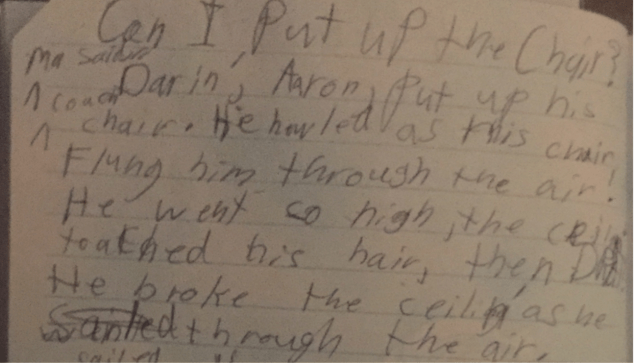
    2007, Age 8. Poem titled: “Can I Put up the Chair?”
    “Darin’ Aaron put up his/ chair. He howled as his chair/ flung him through the air!/ He went so high, the ceilin’/ touched his hair, then He broke the ceilin’ as he/ sailed through the air.”

    Despite this enthusiasm, I wouldn’t say I began to take you seriously, Dearest Diary, until I was an eighth grader. And by seriously, I mean visiting you consistently and with a clear intention in mind. My motive for confiding in you at this point was to commit to any form of comforting consistency in the midst of my entire world having been shaken to the core with my parents’ turbulent relationship. My handwriting became erratic, my thoughts increasing disorganized, and the color of my pen switching with every entry to whatever I happened to pull out of my backpack first during this time. But amidst my coping with my parents’ subsequent divorce, a challenging academic workload, the first B’s I’d ever received in my life (the end of the world, right?), and cliquey friends that stabbed me in the back, I had you by my side, and that counted for something.

    e4.PNG
    June 14th 2013, Age 15. “Dear Diary, Joshua’s birthday was great, went well I guess. We aren’t getting the laptops. I was so excited about finally getting my laptop back… but no. Dad makes the excuse that Mom is too unstable…”

    At this point, my relationship with you had evolved from a safe space into something greater. My understanding of you plunged into deeper waters; you became an integrated component of my overall thought process. You served as the intermediary between my conscious and subconscious; a channel to recount events, while simultaneously defining vague feelings and complicated emotions. The self-consciousness I felt around you that arose during my adolescence melted away, and what remained was an authentic version of myself that I genuinely adored. Metacognition was the best medicine for my trauma, and my favorite channel for overcoming frustrations and setbacks in life.

    e5
    2014, Age 16. “Today everything went almost perfect. Isn’t it just ironic when you thought nothing could mess up your day, and then something pops up to put a damper on things? Today it was that I left my folder with papers that needed to be signed at school. Oh well, hopefully I can get it back. If that’s all, then I’m lucky!”

    In high school and college, we lived through moments I despise; instances of delirium and the birth of mental illnesses that were only inevitable given my upbringing. Our interactions  became drained of substance and emotion. We became strangers to each other; our conversations reduced to a lingering account of dreams, days that went “ok” coupled with many more that went horribly wrong, gaps of increasing distance between entries that left me with much guilt regarding my dwindling commitment to you. Finally, my conversation with you faded away altogether with two final accounts: one in 2017 and one in 2018. I abandoned you, Diary, and even to this day, I’m uncertain as to why. Perhaps life was just too busy; maybe I didn’t have the strength to confront the darkening thoughts and ceaseless nightmares that you reminded me of. Whatever the case may be, I needed time away from you, and through writing this confession, I’ve come to accept that that’s okay.

    e6
    February 13th, 2014, Age 16. “Dear Diary, (6 AM) Ugh… Murky dream. I can’t remember anything about what I dreamed last night. I need to get more sleep next time. My eyes are blurry as I write because I just woke and it feels like someone removed my stomach.”

    Visiting you for the first time in a while last week shattered my expectations. Rather than feeling like a different person now compared to that of my entries, I found that I was and amthe same. Each page drew me further into my memory and probed lingering flashes of selfhood. My entries to you united me with my past; instead of showing me who I was, the diary reminded me of who I am. These thoughts captured on paper will never be blurred by time .Instead, they prevent me from losing the parts of myself that I adore while simultaneously providing a record of how far I have come. My final diary entry brought me to tears; my determination to live in the face of hardships back then inspired me to continue to fight against my present demons. Keeping you, Diary, altered my future self for the better by reminding me of who I want to be and where I want to end up. 

    e7.PNG
    April 6th, 2018, Age 20. “Despite the crap that went down over the past 3-4 years, I still believe in hope… This is my story. I will continue to tell it and live it. I’m not going to explain everything at once, it takes far too long. But know that your beloved author, Kayla, has been through entirely too much. And yet, here I am.”

    I feel exposed when people see you (which is pretty much never), but I secretly wish that people will find you someday when I am long gone. I long for someone to chance upon my chipped, wooden treasure chest where I’ve hidden the rest of your volumes away I even reveal this “secret” location in the front of each book I cover in my spilt-ink musings. 

    There’s a guilty pleasure in fantasizing about a stranger’s discovery of my most guarded thoughtsand an even guiltier satisfaction in imagining how I might affect their lives the way Abby Hayes did mine. I want them to fall head over heels for you, to experience the intimacy we share.

    It is inevitable that I will struggle through my self-consciousness as I come to write with you again, but the more I record, the more that feeling will erode. This isn’t the end for us, Diary. You are my deepest admirer, and someone that I deeply admire for all the ways you remained open and loyal to me. In this way, you are more than a spiral notebook or leather-bound pages; you are my personal, personified confidant.

    And I look forward to falling with you once more.

  • Breaking Down The Wall(ace): A Chat about Infinite Jest
    Alyssa Jingling is the Marketing Director for Hothouse Literary Journal and someone who took a class on David Foster Wallace this past semester. Kylie Warkentin is the Managing and Website editor for Hothouse Literary Journal, and she also took that class on David Foster Wallace. In the class, they had to read and discuss Infinite Jest. These are their thoughts [duh duh].

    What’s up with that?

    Alyssa: wow, what a great question! honestly? I’ve read infinite jest twice now and still… I’m like yo what’s up with that and I’m starting to think that maybe that’s the point
    Kylie: i keep forgetting you’ve read it twice. the will power.. the endurance….
    Alyssa: yeah I forget sometimes too. I’m telling ya, 16 year old me retained maybe 5%
    Kylie: but yeah i think i agree with you i think obviously you’re meant to get something new from the table every time
    Alyssa: yeah with 1,100 pages theres… A LOT. genre: encyclopedic
    Kylie: i DO think. it’s weird that other people have read it…if that makes sense. like they’ve also committed this feat
    Alyssa: the fact that no two ppl can really read it the same way attests to the fact that we can’t fully communicate w/ each other??
    Kylie: i like that take but also my positive spin on it: it helps us TO fully communicate with each other
    Alyssa: that’s kind of very george eliot v. henry james, yeah?
    Kylie: i dont even kno who those people are. which is so brave of me to say.
    Alyssa: okay george eliot wrote middlemarch which is 800 pages of pure delight and also very heavily “the more I write about my characters the more ppl can understand them” and james was basically like “whats the point ppl can’t truly connect” which was very modernist of him???
    Kylie: OH okay yeah then i think that’s definitely true i think DFW definitely does overwhelm the reader w info hoping something will stick
    Kylie: but i do also hate this take everyone’s had in class thus far that there are no solutions offered to the problem…..there’s no point…….no point to anything
    Alyssa: wait so is that the solution or u think that no one can see the real solution
    Kylie: no i think that’s a misunderstanding of IJ. like i think it’s a really reductive view to be like ‘there are no solutions or any positive offerings in the book,’ so i think that take is annoying
    Alyssa: yeah true but it can be hard to a. find a solution and b. agree on one?? I feel like a lot of the ppl who don’t see a solution either a. don’t understand the book or b. identify/empathize w the depression narrative
    Kylie: no exactly, but i also dont think it has to be a big solution u kno ? like u can get something out of the book w/o it being this big earth shattering thing. that’s also probably a point
    Alyssa: u mean the solution DOESNT have to be a 11000000 page book?
    Alyssa: also I feel like this book can diagnose ppl w depression b/c cages??? DEPRESSEDT
    Kylie:  GOD i wish it weren’t
    Alyssa: it can be a google hangout chat w ur friend?? it can b tiny
    Kylie: exactly  <33333
    Alyssa: <4
    Kylie: but also i didn’t like it which brings us to our next question

    Do you think Infinite Jest failed you?

    Alyssa: mmm no. i believe that if one can’t get a message from anything–from IJ to Goodnight Moon–then they failed as a reader. there’s always a message even if it’s small, or not what the author intended
    Kylie: i definitely agree with that. i do think though if we think of failure as, ‘okay whatever DFW was trying to do didn’t work on me,’ then yes it can maybe ?
    Alyssa: but we can’t read books/view art like that, can we? once the author puts the work out there, it’s a free for all
    Alyssa: the book, as hellish as it was (at times) (most of the time) (two times over) fostered good conversations and made me Think™
    Kylie: see i am not so sure i fully agree w that i do think there are some caveats etc but also yeah i think there’s more to IJ than DFW’s intended message and that’s where i think it DIDN’T fail me
    Alyssa: I think we can acknowledge what the author SEEMED to want to get across, but that shouldn’t be treated as the goal esp. when the author is dead
    Alyssa: also we know what happens when the author tries to keep putting their message out @ jk rowling
    Kylie: LMAO
    Kylie: okay yeah i’ll take that
    Kylie: but i think his whole thing of everyone’s trying to transcend themselves and no one can connect … well no, not really i don’t think. and i think IJ is too solipsistic
    Alyssa: that connection/solipsism thing just really brings me back to modernism which is funny bc he was trying to be post- postmodern. but it really reminds me of Howard’s End?? “Only Connect” and stuff
    Kylie: yeah that’s where i think he messed up i.e. how he used the postmodernist tools to be post postmodernist were way too alienating. so for me i was like. go outside. hug someone. choose to talk to others. it’s okay that we’re egocentric in some intrinsic way you know
    Alyssa: but is it possible to NOT be egocentric??? does altruism exist???? but yeah like lets try therapy or something. or like……friendship
    Kylie: yes exactly that’s what im saying the difference almost doesn’t even matter.
    Alyssa: but yeah i think he was stuck in some sort of literary movement cage tbh
    Kylie: yeah i definitely think it was a work for his specific time you know. like you mention literary movement cage…yeah
    Alyssa: i kinda sorta feel like “This is Water” and IJ had the exact opposite messages. bc ur “go outside” message was like….. Water summed up
    Kylie: AGREE. good point etc. and obviously they have different aims but i don’t see why there can’t be some connection between the two. if u understand that u r an individual then u can learn how 2 be nice 2 others
    Kylie: plus i think it’s so funny we’re discussing the message of communication in IJ….over chat
    Alyssa: honestly? Dave would love this
    Kylie: ladies n gentlemen….we got em

    What are three things you liked about Infinite Jest?

    Alyssa: okay some things I liked were: the locker room scene bc I felt like that was a wholesome Just Guys Bein Dudes moment
    Alyssa: our class discussions as a whole bc they help me understand Life and IJ and Communication better :’-)
    Alyssa: and the absurdity of the plots??? Wheelchair assassins coming for tennis bois??? wth???? luv it
    Kylie: ugh those are good ones. i also liked the discussions it inspired in class but i also liked (i am a dual citizen of canada for those who do not know) that the canadian side of the plot compelled me to do some research about canadian history and ask my dad questions like it was a fun way to kind of learn about my background
    Kylie: i also liked that i learned a lot about the narrative structure of the novel because i’ve always been interested in that in a general way and when you REALLY look closely at DFW’s work in IJ it’s bananalands out there. very interesting
    Kylie: and i liked the ending (‘ending’) because i think this is the first work i’ve read where the ending is kind of out of purview but not sight. those may mean the same words. anyway i thought the ending was cool
    Alyssa: dave would love this chat but he would hate the word bananalands and tbh??? I love that
    Alyssa: v interesting!! to me, the ending was overdone!
    Kylie: LOL
    Kylie: let’s unpack that
    Alyssa: it was very stereotypically postmodern sorry dave. the bell jar? that ending. song of solomon? that ending. bright lights big city? you guessed it
    Alyssa: @ professor pipkin luved ur class
    Kylie: well i guess we should clarify what we mean when we say ending
    Alyssa: the whole idea of leaving the ending open so that u can kind of guess what happens to the characters but it doesn’t explicitly say. very symbolic for “new beginnings”
    Kylie: oh you thought it pointed to new beginnings ???
    Kylie: well i guess beginning the book over would be a new beginning. fair.
    Alyssa: in general! but again, it’s open
    Alyssa: but yeah also gately? seems to point to a new beginning for him, similar to Esther in the bell jar or whatshisface in bright lights big city
    Kylie: to be honest i didn’t even consider the sea part the ending
    Alyssa: oh??? what’s ur ending
    Kylie: i tied that back to Gately’s beginning with AA and that whatever we construct the ending to be would be us working chronologically to figure it out (so the ‘ending’ would be what we think happens to Hal, Orin, The Entertainment, etc.)
    Alyssa: ooh
    Kylie: yeah i thought the point of his ending might be also that DFW is like haha you think this is the ending ?? it made me think of great gatsby, which is where im getting this from. literally just the fact that it recalls a famous weird ending, and then he’s like LOL not this though
    Alyssa: oh man!!! never connected that
    Kylie: that’s what i liked
    Alyssa: if we take zadie smith’s interpretation of endings, basically it’s supposed to break the fourth wall. like, “ur gonna close this book n all the characters will b DEAD”
    Alyssa: “bc it’s a book”
    Alyssa: “stupid”
    Kylie: thank you ms smith maam. but also i got the opposite i liked that the characters seemed to play out forever in their narrative !!! like the story is story but they’re still there
    Alyssa: u read a 1000000 page book u can say whatever u want on it, but for the inescapable cage folks, smith’s interpretation probably makes more sense??
    Kylie: oh true that’s actually a really good point. not the first, but wow yeah actually tea

    What are three things you disliked about Infinite Jest?

    Alyssa: only 3??? lol
    Kylie: ME TOO
    Alyssa: okay: I don’t like his treatment of women. i dont like the footnotes and tbh? i didn’t read most. and i don’t like the message that we can’t connect i am depressed enough as it is mr. wallace no thank u
    Kylie: oh i shouldve mentioned sonic landscape for my likes. i liked that the novel was really audible
    Kylie: anyway dislikes: i don’t like the sections where he seems to push us to our limits (e.g. the “It” abuse section, the Lenz violence section, the dead baby section) it was just too much. i don’t like his premise that we’re all trying to transcend ourselves because i like myself. and i don’t like the culture around the book
    Alyssa: okay weird flex but good for u
    Kylie: she’s not great all the time but that’s me
    Alyssa: u should like urself i like u 2 bro
    Kylie: infinite jest but DFW talks like a jock in a 90s teen movie. bruh

    What are your top two weird Infinite Jest experiences?

    Alyssa: OOF. waking up in the morning and seeing dave’s face next to me in bed bc I fell asleep reading it. thinking about the novel while being really really drunk
    Kylie: oh hate that. my first weird experience was meeting someone who had also read IJ and he tried to talk to me about it and i had THE most visceral reaction like i did NOT want to talk about it, i couldn’t articulate my thoughts in a way that covered all the nuance, i just couldn’t believe someone actually liked the book
    Kylie: and then my second was uhhhhhh I tried to watch the new season of bojack horseman but had to turn it off after ten minutes because i couldn’t get past the thought that IJ had already covered all this
    Alyssa: i feel like having a visceral reaction about IJ just proves that it is literally sublime which is sexy
    Kylie: sublimity makes me want 2 vomit it was more like No Thank You but FIRMER
    Alyssa: if sublimity makes u want to vomit then sublimity is sublime

    Final Thoughts?

    Alyssa: as hellish as this book was, I am very glad that I gave it a second chance in an academic environment that was well-supervised by a very knowledgeable prof bc now I think that it’s very Valid of me to not want to read it again
    Kylie: that’s hilarious. agree.
    Kylie: my final thought: i think it made me a better person but not in the way it probably was thinking it would
    Alyssa: maybe this is what Dave wanted all along but this book/class? I feel much more connected with roughly 15 more ppl than I did in august. is that too wholesome of a way to end this article lol
    Kylie: absolutely not we’re keeping it
  • From Stone Tablets to eBook Tablets: In Defense of Good, Old-Fashioned Paper

    Written by Abbey Bartz

    Ah, progressthe heartless wheel that bulldozes over good things in pursuit of “better.” So many good things have been crushed under its weight as humans come up with solutions where no problem previously existed.

    Take typewriters, for instance. Such magnificent machines, with their pristine rows of circular keys. Few things can compare with the satisfying clack that you hear when you punch a key and a letter appears on the page. There’s nothing like the cheerful ding and swish as you reach the end of a row and move to the next. Truly, typewriters are masterpieces of human engineering. And yet, someone decided that these marvelous machines should be replaced by computers. Computers! Shiny, heartless pieces of soulless modernity, with screens that will ruin your eyes and rot your brain. They freeze and crash and lose important documents that you thought you’d saved. Tell me, dear readerdid a typewriter ever decide that an appropriate time to install an update is in the midst of an essay that’s due in two hours? No, of course not. Typewriters would never be so rude. 

    Progress has unmercifully killed so many good things, and I fear that books will be its next victim. In this age of digitization, everything is going from print to screen, from cozy bookshelf to the chaotic cloud of intangible information floating above our heads called the Internet. Handwritten letters have nearly died out. Newspapers aren’t far behind. Books may face a similar fate, thanks to the eBook. 

    I will probably be the last person on earth to give up paperback books. When I am old, I will sit on my front porch with my well-loved copy of The Outsiders and tell my grandchildren with their shiny iPhone 97s that things were better back in my day when we used real paper. I fear the day when all bookstores go out of existence and Amazon has taken over the planet and people have forgotten what it feels like to cradle a real book in their hands.

    But eBooks are great, you might say. They have so many advantages! They’re cheaper than the print version. They can be downloaded onto any device, so you can carry a whole library on your phone if you wanted to, without the strain of  lugging around a ton of books. They’re eco-friendly; they can be bought from anywhere, and no trees are sacrificed to print them. To all that, I’d sayyou’re right. But if we do a simple cost-benefit analysis, I think we will find that books are always, ALWAYS, better.

    Remember when you would reach the end and shut the book in awe, blinking your way back to reality? How could clicking on a screen and waiting for the next page to load, all the while being pelted with text messages and Facebook notifications, ever compare to that?

    eBooks are so cheap and easy to produce that anyone (anyone!) can publish one and finagle you into buying it. Printed copies of books must pass under the watchful eye of publishers, who must decide whether they think the book is of good enough quality to justify the effort of printing it. They must also pass through the hands of bookstore owners, who must decide whether they think the book will sell enough copies to dedicate their limited shelf-space to it. These individuals are our trusted gatekeepers, ensuring that we are only presented with the best literature our world has to offeror at least, that we are protected from the worst of it. In the digital world of eBooks, there are no such gatekeepers. The vast, uncharted realms of the  internet has no judges to decide what is put out into the world, and it has no limits for the number of sub-par works that can be flung into its voids. How can a reader know what is worth their time and hard-earned money? Each eBook becomes part of the cacophony of digital media swirling above our heads (that darned internet!), and thanks to a few good reviews (most likely posted by the writer in disguise, their doting family, or a few other villainous accomplices), you will be tricked into paying for a lousy novel that is worth neither your time or the meager amount of money that you have paid for it. You will spend much money and countless hours on lackluster electronic literature, when you could just pop down to the bookstore and buy an excellent paperback.

    eBook addicts argue that their versions take up less space than old fashioned hardbacks, but the electronic versions deprive us of the joy of having overflowing bookshelves and holding books in our hands. You can tell a lot about a person by what’s on their bookshelf, the way they arrange it, and the state their books are in. By knowing what they’ve read, you can guess what sorts of thoughts have been rattling around in their head. You’ll get a better idea of who they are from books than from anything they could tell you about themselves. 

    Next time you meet someone, take a look at their bookshelves (if you happen to make it to their home). Look at how many books they have. A few on a single shelf, or books overflowing onto every possible surface in the room? Look at how the books are arranged. Are they in alphabetical order, in neat rows on well-dusted shelves? Or are they stuffed in haphazardly, looking as if began with tidy rows before they ran out of space? What do each of those arrangements tell you about that person? Then look at the titles. Pride and Prejudice, The Great Gatsby, To Kill a Mockingbird. Classic masterworks of fiction. Harry Potter, Divergent, Fangirl. Adolescent favorites with which the owner could never part, although they have long ago outgrown them. Twilight, The Fault in Our Stars, Fifty Shades of Grey. The dregs of fiction which are only read to be relevant. Then look at the books themselves. Are they in perfect condition, as if they have never been opened? Or are they worn and well-loved, like teddy bears that have been dragged through the mud because their owners can’t stand to go anywhere without them? Open one. Are the pages pristine and unmarked, as if the reader couldn’t bear to ruin a masterpiece? Or has the owner underlined their favorite lines? Are there notes written in the margin, as if the reader had some thought while reading that they couldn’t let slip away unrecorded? Are the pages wrinkled and dog-eared (eek!), or are they flat and smooth?

    What do each of those tell you about the person? How would you know any of this, if all their books were in a digital collection, locked away on their phones? One could, I suppose, argue that Goodreads (Goodreads!) can tell you what they have read, much the way a physical bookshelf could. But then you are trusting that they have kept their online bookshelf up to date. Even if they have, the list of titles they have read does not tell you nearly as much as a bookshelf could. And how could you get to know them then? 

    It baffles me that people think reading an eBook can replace reading a real book. They think opening a device, scrolling through an endless loop of covers, and clicking on one, is the same as choosing a book from a shelf. What could possibly compare with picking out a real book? The experience of running your fingers down the spines of a line of books in precise rows on a shelf, pulling one free from its neighbors, feeling the satisfying crackle of the spine as it’s opened for the first time, with a whiff of that intoxicating new book smellit’s unmatched. Think of getting lost in a world of ink and paper, velvety beneath your fingers. Curling up in a big chair and forgetting that a world exists outside the covers of the book in your lap. Seeing how far you’ve come as the pages behind you multiply, while the pages before you dwindle. Remember when you would reach the end and shut the book in awe, blinking your way back to reality? How could clicking on a screen and waiting for the next page to load, all the while being pelted with text messages and Facebook notifications, ever compare to that?

    eBooks aren’t just killing books; they’re killing bookstores. Bookstores! Havens for book lovers, where the intelligent and imaginative can find solace in rows of titles. Places where bookworms can recommend books for a living. Where children can read aloud from picture books to their stuffed animals. Where readers can float between the shelves, then settle onto the floor with their newest find, not even caring that they’re in the middle of a row. If bookstores die out, where will these people go?

    The people who work there might become librarians, if libraries survive the book-apocalypse. But in a world where all becomes digital, libraries will likely just be collections of computers, and books will be phased out. In this eBook age, those who dream of working with books will instead have to work in a cubicle somewhere, selling their souls to the corporate machine. The children will spend their time with their eyes glued to screens that will slowly turn their brains to mush. The readers of physical books will disappear, fading into oblivion. And the stuffed animals? They will probably never recover from the anguish of never being taught to read.

    Perhaps printed books kill trees, but honestly, can you think of a more noble reason to die? Trees probably dream of the day they will be cut down and will become vehicles for human knowledge and imagination. They are probably more than willing to make the sacrifice.

    There is no denying it. eBooks are evil. And perhaps they don’t mean to be! But they are nevertheless contribute to the decline of printed literature, and that is something I simply cannot abide! Books are one of the best things in the world, and it would be a shame for them to be crushed under the heartless wheel of progress. I would hope that, as with vinyl records and Polaroid cameras, there would always be some quirky souls like me who will never give up on paperbacks in the name of the digital.

  • On Magical Realism: Touches of the Fantastic in the Everyday

    Written by Lindsey Ferris

    Sometimes life can be mundane, and all we want is a little bit of magic to come and shake it up a sparkle to the reality of life that makes us appreciate the everyday through a new lens. This is what magical realism does for us, whether in the realms of literature, cinema, or art. Within the genre, conflicting ideas are tied into one by magical events playing out in a realistic representation of everyday life. Sound like surrealism or fantasy to you? It’s not! Fantasy usually involves our world or a completely new reality entirely that is vaguely similar, while surrealism focuses on dreams and imaginations instead of the physical realities of the world. So where does this leave magical realism? As we can see, magical realism is of a different breed.

    Magical realism was first brought to life in the early 1900s in central Europe; however, the Latin American authors of the mid-1900s authors have made it the true success it is today. Now, some would say you can’t think of magical realism without thinking of Gabriel Gárcia Márquez, a titan of Latin American literary magical realism, or Frida Kahlo, the embodiment of Latin American magical-realistic art. These creators helped define magical realism as what it is today.

    The characteristics that magical realism rests on are, first, that there has to be a real world setting whether the destination exists on a map or not. Second, magical and mythical elements must be deemed real without any justification. The rules of the world exist because the characters believe in them no further explanation is needed. The most important and distinct quality of the genre is its ambiguity. If the setting and magical aspects were explained, then the story would lose its credibility as a ‘realistic’ story and break the image for the reader, edging into the world of fantasy. A third characteristic that defines magical realism is its vivid storytelling. 

    Of course, these listed characteristics extend past literary examples of the genre. They can and should! be applied to other mediums, as well. The brightness of storytelling can be seen in the vibrant strokes of color within paintings, the engaging storylines of a film, or even in the colorful music that urges the soul to dance. 

    ART

    Self-Portrait with Thorn Necklace and Hummingbird, 1940, By Frida Kahlo
    Source

    Frida Kahlo was a Mexican painter known for her self portraits inspired by nature’s beauty and Mexico’s society and culture. Her portraits are celebrated for using her pain as an inspiration and muse for her subject matter. Many of Kahlo’s artwork rests in the genre of magical realism; they portray a realistic view of herself surrounded by magical elements, different from surreal art that stresses the irrational dreamlike imagery. Self Portrait with Thorn Necklace and Hummingbird is an important painting to focus on when discussing Kahlo’s magical realism because of its striking elements of animals and their unnatural behavior, all of which capture Kahlo’s own feelings of displacement in society. 

    Kahlo paints herself with the now-iconic joint brows and red tinted lips peeking below a faint mustache. She stands before a lush background of vibrant leaves. The magical elements include the animals closely surrounding her without fear. Butterflies nestle in her traditional Mexican hairstyle, and a monkey picks at her shoulder while a slinking black cat looms behind her. The active animals are complemented by the still hummingbird that nonchalantly rests on Kahlo’s chest like a pendant. Once a fluttering bird that moved so quickly its wings were invisible, the hummingbird is now entrapped in Kahlo’s necklace with its freedom is stripped away. This haunting feeling is echoed in the empty face of Kahlo in the self portrait. Each familiar animal is portrayed in an unfamiliar way, causing a dreamy effect for the viewer, further accentuated by Kahlo’s haunting look. The alarming necklace of thorns is another magical aspect, as it digs into her neck and causes pearls of blood to bead up without any visual discomfort from Kahlo. Frida Kahlo said, “I don’t paint my dreams. I paint my reality.” Her use of magical realism made this exploration of her reality tangible to the viewer and conveys truths and understanding that would not be possible with any other genre, surpassing the confines of realistic representation. 

    FILM

    MV5BMTcyNTk2OTM1OF5BMl5BanBnXkFtZTgwMTc5ODIwMjE@._V1_SY1000_CR0,0,668,1000_AL_
    Photo by Archive Photos/Getty Images – © 2012 Getty Images

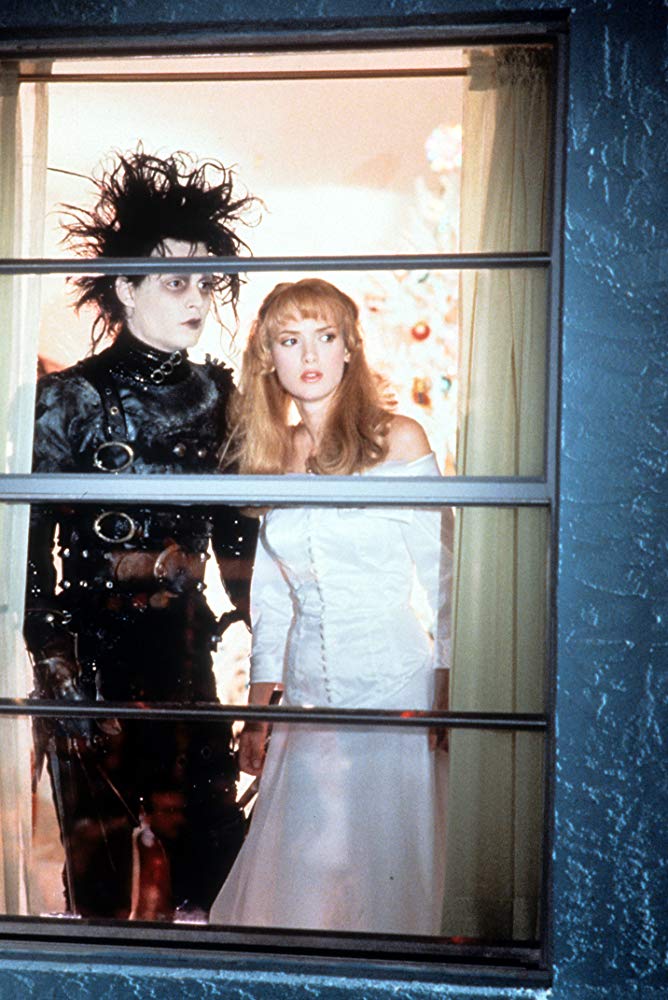
    Tim Burton’s 1990 film, Edward Scissorhands, shares the life of a man put together by a scientist but not quite finished, as demonstrated by his scissor hands. And yet, he is still accepted into society, despite the cutting tools he has instead of hands. The nonrealistic creature is portrayed with human feelings, and is used as a critique on society’s quick judgement of people that are different. The magical elements of the film include Edward Scissorhand himself, as he functions as a modern version of the Frankenstein myth. This film is similar to many fantasy and gothic films; however, it is magical realism. The genre is used to hyperbolize the closed minded 1950s suburban neighborhood. Their sherbet colored homes with matching cars represent the characters predictably mundane lives. Edward Scissorhands is an exaggerated version of an outsider sent to challenge their conformity. The audience’s disbelief is momentarily suspended as the characters portray themselves to be living in a typical, suburban neighborhood and accepting Edward’s hands as their reality. By sharing Edward’s story through magical realism, the audience can be privy to a hyperbolized story of overcoming ostracization to become a cohesive society. If Edward was a “normal” boy and the story did not rest in magical realism, then the audience may not sympathise with his character as much as Burton would like. The genre adds to the narrative and creates a spark that grabs viewers attention.

    MUSIC 

    The Columbian band, Puerto Candelaria, started in Medellin, Cloumbia, and has stated that writer Gabrielle Gárcia Márquez was the inspiration behind their sound. Their songs consist of upbeat and silly tunes that make listeners want to move their bodies and dance. Puerto Candelaria has acknowledged their sound seems young and naive, but claims that this effect is a product of Márquez’s influence. The band creates a magical realist sound through the happy horns and jovial vocals contrasting against their setting, Medellin, which was once dubbed the murder capital of the world. Within Puerto Candelaria’s music, the magical realist characteristic of vivid storytelling is heard in the cheerful tone that shines through the music and shares a tale through song. The real world setting that they are placed within is the city where their music is produced; the magical aspect is how Medellin society accepts Puerto Candelaria’s cheerful music despite the threatening city surrounding it. By using their music to create a carefree environment in a potentially dangerous city, Puerto Candelaria achieves magical realism status.

    BOOK

    With the constant mentioning of Gabriel Gárcia Márquez, it’s safe to say he might be an important author to focus on when discussing magical realism. Published in 1968, The Handsomest Drowned Man in the World is a short story that was built on Márquez’s Columbian folklore from his hometown, Greek myths, the Bible, and Columbia’s violent history. The premise of the short tale is that a drowned man washes up on shore and the villagers decide to hold a funeral for him. They soon discover that this man is large and I mean large. Large as in he could not fit through a normal doorway! To add to his unearthly characteristics, he is majestic enough to win the affection of the village women despite being dead. What completes this magical realistic story is the villagers’ acceptance of the handsome drowned man without skepticism, and believe him to be a fantastic, natural occurrence in the real world. The mundane setting of the village is transformed by the drowned man’s appearance, as they rush to create a funeral appropriate for someone of his stature. Once a dry island incompatible with someone as remarkable as the drowned man, the village is reborn into a tropical oasis of overflowing flowers. After the drowned man’s funeral, the village is left with the mark of his magical presence imprinted upon the island; villagers become dedicated to building structures appropriate for such a majestic being by having beautiful homes with wider doors and vibrant gardens to pay homage. Márquez has said, “There is not a single line in all my work that does not have a basis in reality,” and he proves that within not only The Handsomest Drowned Man in the World, but in every intriguing story he produces.

    Throughout the article, we can see that magical realism is a way to make the fantastic possible in everyday life. Through these different avenues of art, film, music and literature, characteristics of the genre are shared that compliment the narration of life the creator wishes to portray. The genre of magical realism opens another door into truth for the reader to explore the mundane as something new and exciting.

  • On Trying to Fly: Remembering Toni Morrison

    Written by Kayla Bollers

    This year, we lost a wonderful and inspiring creator with the death of Toni Morrison on August 5th. If a room full of critics or a shelf of scholarly reviews can’t summarize Toni Morrison’s greatness, then a single article will of course struggle to do her justice. But my reverence and admiration for such a powerful literary presence compels me to offer my personal encounter with Morrison and her work. It feels vital to remember her now with the news of her upcoming memorial, both for how she resonated with me personally, and for how she changed the landscape of writing for an entire generation.

    My journey with Morrison began when I took an English course last year devoted to her novels. We dove into seven of these works throughout the semester: A Mercy, Beloved, Jazz, Sula, Song of Solomon, The Bluest Eye, and God Help the Child. Those three months flew by faster than I expected them to, and by the end, I found myself clutching onto Morrison’s novels instead of selling them back to the co-op. 

    Toni Morrison’s literary accomplishments are unprecedented. She was the first Black, female author to hold both the Nobel and Pulitzer prize while she was alive. The literary community even created a Toni Morrison Society during her life, when it is more common to do so posthumously. With these prizes and honors in mind, I humbly add my own tribute. To truly celebrate Morrison’s legacy, I believe it’s important to cherish our interactions with the text and revel in the beauty of her writing, which I have reflected on ever since I discovered her work.

    What I find most mesmerizing about Morrison’s novels is their tendency to center around historical, unconventional, and—at times—mythical scenarios. Morrison combines realism with magic and the supernatural to draw a remarkable parallel between her fiction and folklore. These incorporations are thrilling and immersive, particularly in the case of God Help the Child. In this novel, a young woman named Bride discovers that her breasts are missing, and soon finds herself trapped in the body of a little girl. This transformation forces her to confront unresolved traumas, reflecting an internal need for resolution in Morrison’s characters. Until Bride processes her grief and experiences rebirth, the restoration of her body cannot take place in the physical world. Moreover, she must come to terms with her past relationships and the pain that came with them before she can continue to live in the present. Similarly to most folklore, Morrison provides her readers with a moral about the lasting psychological impacts of trauma, both on an individual and a society.

    The more I embrace Morrison’s advice and lean into my interests, the more I have watched my writing benefit from the passion I have for these subjects.

    I am also fascinated by the way that Morrison incorporates the alternating perspectives of multiple narrators to mimic the conversational rhythm and flow of oral tradition. She uses this more auditory approach to innovate past the standard form of the European novel and to connect more intimately with her readership. I was taken aback by Morrison’s ability to unite distinct voices into such a masterful harmony, combining contradicting perspectives in a way that built momentum rather than fostered confusion. This rings especially true in Part II of her iconic first novel, Beloved. Sethe, Denver, and Beloved’s fragmented voices all intertwine to form a more complete, emotionally potent narrative. This type of storytelling emphasizes the necessity of community, as each character develops through their relationships and connections to other characters. By switching perspectives within a single passage, Morrison allows these characters to tell their story communally, providing voice and agency to a people who have often been silenced by the majority.

    As a woman, I find it easy to relate to the frustration of Morrison’s female characters, especially as they struggle against constraining societal norms. Florens’s wounding efforts to win over the blacksmith in A Mercy, for instance, reflects a relatable pressure to please finicky, male authority figures for the slim promise of companionship. Although Morrison’s characters sometimes strive to fill the void with a partner, these advances often result in traumatic (and sometimes deadly) consequences, unveiling the implications of the damaging standards that the patriarchy imposes. 

    Morrison also captures the crucial, and yet, often misunderstood interactions between daughters and their single mothers, from which Florens’s loneliness originates. Sula and her mother, Hannah, grow distant from a similarly painful encounter, when Sula overhears Hannah tell someone that she likes her but does not love her. Beloved also feels contempt towards her mother, Sethe, who killed her to protect her from the traumas of slavery. These stories forced me to reexamine the relationship I have with my mother, who raised my brother and I alone during our adolescence. Though at times I felt the same pain as Morrison’s daughter characters or a sliver of neglect during our squabbles, I realize in retrospect that my mother faced the same pressures of protecting us and providing for us without the support of a partner. Ultimately, Morrison juxtaposes these mothers’ flaws with their strength in protecting their children, even if their love proves deadly. As Sethe tells Paul D. in Beloved, “Love is or it ain’t. Thin love ain’t love at all.”

    Morrison wrote often about racial issues facing her characters. Colorism weighs heavily on the lives of her protagonists, with skintones fetishized depending on their proximity or distance to the white ideal. Morrison also examines her characters’ relationships to Transatlantic slave ancestry, incorporating elements of escape from slavery into Song of Solomon, A Mercy, and Beloved. And while I cannot fully relate to the racial conflicts in Morrison’s novels from the perspective of her Black characters, I appreciate her boldness in tackling these issues. In a society characterized so heavily by denial, it’s easy for us to look away from the headlines and turn off our televisions, but the shootings, murders, and protests revolving around racial inequality still remain. These tensions should unsettle us, and Morrison does not shy away from them. Morrison’s literature forces me to confront my privilege through a more critical lens, while also empathizing with the struggles of her characters.

    As a writer,  Morrison took risks. Her subjects turned many heads and prompted objection. However, one of her guiding principles in writing was, “If there’s a book that you want to read, but it hasn’t been written yet, then you must write it.” She has inspired me to turn away from fear and pursue some of the more polemic subjects that I’d like to write about, including PTSD, toxic masculinity, climate change, and abuse. The more I embrace Morrison’s advice and lean into my interests, the more I have watched my writing benefit from the passion I have for these subjects.

    In Song of Solomon, Morrison writes, “You wanna fly, you got to give up the shit that weighs you down.” This quote has pushed me to recognize the moments in my past that weigh me down: losing friends, seeing my parents fight, my first breakup. Like Bride, I struggle to live in the present, allowing pain from years ago to resurface and hurt all over again. It is comforting to read Morrison’s stories, because even if they don’t always have happy endings, she encourages us to embrace the past instead of running from it. That is what I’ll remember most about Toni Morrison and the invaluable gift of her writing to the world.

  • Maidens, Mistresses, Mothers, and More: Archetypes in The Epic of Gilgamesh

    Written by Natalie Nobile

    In ye olden times, we had real women.  Women with long flowing hair who were properly grateful to be protected and provided for.  These women knew feminine strength was their inherently emotional disposition, which is why they always make such caring mothers—it’s in their nature!  Yes, back at the beginning, there were no frivolities like gender politics.  Everybody lived as they were born: according to the great Freud, their “anatomy” was their “destiny.”

    Or not.  Ancient societies were overwhelmingly patriarchal, and women were dehumanized, but women didn’t always just accept that.  It may seem so, but readers must account for obfuscating biases.  When interpreting female characters in ancient literature, we encounter two problems within the texts themselves.  Most of the first translators were men—largely in the 18th to 19th centuries. As a result, the bias of the translators became entangled with the text.  Worse, these stories were (usually) products of patriarchal societies, and thus unlikely to record women as they actually were—you know, with thoughts and stuff. But it’s illogical to assume that because women were represented by male writers and historians as without agency, this was true.  In fact, fragmented portrayals of women who went against their society pepper the peripherals in one of the earliest written works: The Epic of Gilgamesh.

    “Madwoman!” you cry.  “The whole heart of this story is King Gilgamesh’s quest to understand his bestie Enkidu’s death, and his ultimate acceptance of civilization’s value!  There aren’t any proto-feminists here; get back in the attic!” NAY. In this bromance, rebellious women have simply been covered by patriarchal indignation.  Most women in Gilgamesh act like one of three reductive stereotypes: Maiden, Mistress, Mother.  A young virgin, the Maiden represents ideals of female purity. The traffic of women as ‘gifts’ between men (like fathers ‘giving away’ the bride), demands that the gift hasn’t been ‘unwrapped.’  The Maiden is unused material, ready to be used. Physical use is where the Mistress comes in.  An eroticized depiction of womanhood focusing on the use of female bodies for male pleasure, the Mistress does not freely express her sexuality, but is instead a fantasy of female sexual abilities. Not to get Oedipal or anything, but in this sense the Mistress stereotype is oddly similar to the Mother.  The Mother is not a realistic depiction of motherhood, but a Madonna-fied ideal; her every thought and action are compelled by ‘motherly emotions’ for her children. Who she was before motherhood doesn’t matter: she belongs to her offspring. This trinity represents patriarchal constructs of how women should behave.  But do any of the women in Gilgamesh burst free from these stifling confines?  Spoilers: yeah.

    Try as we might, a good maiden is hard to findperhaps because the story hyper-focuses on Gilgamesh and Enkidu’s bromance. Whatever the cause, the few maidens we encounter are unnamed, present in the story only by mentions of their sexual use.  Gilgamesh exercises the right of prima noctum: “By divine decree pronounced, / From the cutting of his umbilical cord, she is his due.”  From his birth, Gilgamesh has the right to use female bodies as he wills. Gilgamesh’s wild “rampages,” in which he “leaves no girl to her mother,” imply another explanation for Uruk’s lack of maidens: he has seduced or raped them all.  The role of the Maiden lives entirely in her ability to become a sexualized mistress, and then, presumably, a childbearing mother—overwriting the identity of her youth.  The Maiden’s character depends on her nascent sexuality, which is all possibility and neither controlled nor acted upon by her.

    Maiden, Mistress, and Mother, though stifled by society, are nevertheless put on a pedestal by it. 

    The Mistress in Gilgamesh appears as Shamhat, often euphemistically translated as a ‘dancing girl.’  In reality Shamhat is a sacred priestess of Ishtar (a culturally venerated form of sex work) who “lay[s] bare her charms” to seduce Enkidu into civilized society. But Shamhat has no personal motivation, only doing “women’s work”—here, pleasuring men with sex—because she is commanded to by her tyrannical, rapist king, Gilgamesh.  Though Shamhat is “not bashful,” there’s no sign she would choose this gig of her own accord. Indeed, she is denied not only voice and choice, but also recognition as human. When Enkidu “yearn[s] for … a friend,” only Shamhat’s tales of “Gilgamesh” make “her words [find] favor” with Enkidu. Shamhat, the woman he’s had sex with for “six days, seven nights,” cannot provide him human friendship.  She’s described as “like a guardian deity,” teaching him the ways of civilization, but this compliment rings hollow. Gilgamesh never mentions paying Shamhat for her week of work, which belittles her labor. She exists as a portal (yes, her character is basically a vagina) to facilitate Enkidu’s journey rather than truly participate in it. Shamhat represents not a female sex worker, but rather a fantasy of one who works for free.  After all, objects don’t need money for labor.

    Ninsun, Gilgamesh’s mother and exemplary of the Mother, provides the consoling voice of wisdom in this tale.  But rather than wise matriarch, she’s basically a Magic 8-Ball for Gilgamesh to shake answers out of.  Ninsun, “knowing and wise, who understands everything,” interprets her son’s dreams without a stray word, speaking only when spoken to.  Later she shows more personality, even asking the sun god, “Why did you endow my son … with a restless heart?” Questioning a god? Promising! And yet, the only reason Ninsun asks this question is her emotional upheaval over Gilgamesh’s safety.  Since Gilgamesh passes through his danger with flying colors, Ninsun’s worry is framed as foolish – a woman who just can’t understand that a man’s gotta do what a man’s gotta do. Ninsun acts more powerfully when she takes Enkidu “as [her] adopted son,” accepting him into the family of Gilgamesh.  If we examine this action, however, accepting another son simply fulfills her role as an idealized mother; it’s power only in the domestic sphere. Her adoption of Enkidu mirrors his previous initiation by Shamhat. Shamhat shows Enkidu the physical pleasure a woman can provide; Ninsun shows him the familial comfort a woman can provide. The other Mother figure, Aruru the birth goddess who “created the boundless human race,” is “summoned” and “commanded” to create.  Instead of acknowledging her power, the epic treats her like a vending machine that takes orders and spits out humans. In Gilgamesh, the Mother is less of a character and more of a fecund field for men to sow their seeds in and take comfort.

    Ishtar stands in stark contrast next to soft, caring Ninsun. Sexual as she is, Ishtar may appear to be a mistress, but who can control her?  She commands men, telling Gilgamesh, “you shall be my bridegroom.”  Rather than waiting for him to speak, or offering herself, she tells him what she wants.  Ishtar acts in ugly ways, throwing male lovers aside as if they were the mistresses. Gilgamesh responds to her advances with a litany of insults; Ishtar’s father, Anu, justifies the jibes, saying Ishtar “provoke[d] the king.”  She, however, has no respect for the society that sanctions such abuse, and simply wants to take revenge against Gilgamesh by setting a beast on him. She coerces Anu, saying that “if you don’t give me the Bull of heaven, / I’ll strike [Uruk] to its foundation.”  Anu complies.

    Ishtar threatens Uruk, a demigod’s city, and gets away with it!  Ishtar is uncontrollable because she is powerful, in the most basic sense.  Though Ishtar is depicted as speaking like “a low-class streetwalker,” in her ‘trashy’ behavior she is free.  Ishtar is a caricature of a sexual woman, greedy and forwardbut her derogatory characterization is a double-edged sword.  Though it is intended to make light of her, her wicked ways lead to liberty: Ishtar experiences a degree of freedom enjoyed by no other woman in her society. Nobody expects wisdom, or purity, or service from Ishtar’s conduct; they expect ugliness and faithlessness, lust and callousness, pure wicked glee.  In her rejection of social norms, Ishtar becomes an exception to the norm, free from submission to men.  Her behavior is tolerated, but not wanted; she is desirable sexually, but not romantically; from the pantheon of heroes, she is an outcast, a maligned goddess.  Still she, a woman, drives events which lead to the death of Enkidu and Gilgamesh’s quest for immortality. After Enkidu’s death, Gilgamesh makes sacrifices to “Ishtar, the great queen,” asking her to accept his offerings, “welcome [Enkidu,] and walk at his side.”  In the end, he too must bow to her power.

    But let’s wait on the girl power party hats.  Ishtar breaks the rules of society, yet the writer who inscribed this epic wrote her dialogue as ‘trashy.’  Assuming the authorial intent of a scribe who died over 3000 years ago and whose writing remains only in literal bits and pieces, is thin ice. Nevertheless, it’s within reason to assume that this scribe did not intend Ishtar’s disregard for social norms to be a laudable quality, but rather a laughable one.  Ishtar is an antagonist, and though she wreaks havoc within society, she’s still subject to it. Were she free to exercise all her power and authority, she wouldn’t have to ask for the Bull of Heaven: it would just be her bull.  What if Ishtar did fully rebel?  Are there any women in Gilgamesh who don’t bow to men, even if only to manipulate them?

    I’m so glad you asked.  Allow me to present the Tavern Keeper at the End of the World, Siduri.  In all likelihood, Siduri was a cult iteration of Ishtar (see Abusch). So the ‘tavern keeper’ is an Ishtar that has taken her rejection of social norms one step further: she lives outside society entirely.  In an epic that often evokes the loneliness of the wild, Gilgamesh’s arrival annoys her. When he approaches, she “bar[s] her door.” Gilgamesh threatens to “shatter [her] doorbolt,” but she responds by questioning his identity, asking why his “cheeks are emaciated” and why he is “clad in a lion skin, roaming the steppe.”  The attributes she notes imply doubt not only of his proud name and honesty, but also of his strength. She tells him he “shall not find” immortality, and that he should return to civilization and have a family, for that “is the work of mankind.” Unbidden, she explains her opinion of his life’s meaning. She discourages his quest, since at “the waters of death, what will [he] do?”  Siduri doesn’t believe in him. At most, she gives him directions, in which she embeds a direction to give up. She does not actively work against Gilgamesh, but she doesn’t need tohis power means nothing to her.  Thus the socially unacceptable woman, like Ishtar, casts off the bonds of society by becoming lone Siduri.  By not aiding Gilgamesh, she occupies a grey space in the morality of this epic. Siduri’s appearance is too brief to divine much from, but her very existence destabilizes the text’s gender roles.

    Ironically, if Ishtar and Siduri were judged by male standards, they’d be heroes rather than obstacles to overcome.  In her rowdy sexuality and violent power, Ishtar is much like Gilgamesh; in her distance from civilization and cautious attitude, Siduri is like Enkidu.  They both escape the repressive sex-gender system of their society by being outcast from it, but in context with the epic’s main themesthe value of human companionship and societythis is a drastic punishment.  Maiden, Mistress, and Mother, though stifled by society, are nevertheless put on a pedestal by it.  For our two outcasts, however, it appears the benefits outweigh the loss. When a story’s society no longer expects someone like Ishtar to do what is required, acceptable, or pleasing, the outcast woman attains freedom greater than her female peers.  In the reader’s mind, the ancient woman and her expected roles of Maiden, Mistress, and Mother part ways.  Like Siduri, she can forge a new path to heroism as a lone voice in the wilderness, her words unbound by man-made law.

  • What If We Could Define Science Fiction?

    Written by Stephanie Pickrell 

    The science fiction genre has struggled with its own definition since its beginning. It encompasses everything from intergalactic space battles to horrifying dystopias, and even science fiction writers themselves disagree on exactly what it means to write sci-fi. However, the discourse on science fiction hasn’t developed as fast as science fiction itself, and we lack an articulate way to talk about its values, faults, and intricacies.

    One such way to make sense of such a sprawling genre is to analyze stories by their approaches. Science fiction is frequently defined (at least more than other genres) by the “what if?” question. “What if” aliens attacked Earth or “what if” humans could grow wings? The “what if” question allows us to define a genre with a very wide scope, but it doesn’t reflect the complexities of the differences within science fiction. As a science fiction nerd myself, I’ve outlined three approaches that science fiction writers often use, whether they know it or not, to ask varying degrees of “what if”: the backdrop, the vessel, and the instrument.

    First, the backdrop approach. One requirement of science fiction that nearly all of its supporters can agree upon is its futuristic setting. However, in the backdrop approach, futuristic setting becomes almost the evidence for it being part of the genre. In general, this approach treats the future as a setting, but doesn’t specifically use the future for thematic purposes. This is not to say that science fiction of this kind is any less science fiction, or has any less merit. On the contrary, stories that subscribe to this approach can be every bit as fulfilling as literature from any genre. The only difference between the backdrop approach and the other approaches to science fiction is that it treats the futuristic “backdrop” as a new arena for questions that could be asked in any other genre.

    The most illustrative example of this approach is Star Wars. The series is a must-watch for any true science fiction nerd (excepting the prequels, of course), but the only thing that is “science fiction” about it is its setting. Evil empires, rebels, and forces of mysterious power are not unique to science fiction, and the questions they raise can be found across all genres of fiction. What makes Star Wars qualify as science fiction is the setting, but it doesn’t utilize the opportunities of the genre much further. 

    Recommended backdrop books:

    The Martian Chronicles, Ray Bradbury

    To Say Nothing of the Dog, Connie Willis

    Secondly, the vessel approach. Science fiction of this approach regards the genre as a vessel for change, whether social, political, or anything else. It’s arguably the most popular approach to science fiction today, and probably the largest. Writers who use this approach focus mainly on issues of the present in their depiction of the future, often using the work as an advocate of or warning against certain political circumstances. The vessel approach overlaps with a good deal of the dystopian genre, although stories don’t have to be dystopias in order to fit under it Whereas the vessel approach generally asks the question “What if this technology existed?”, the vessel approach asks, “What if this societal issue is taken to its extreme?”. 

    Science fiction of the vessel approach has been making itself heard lately in popular culture. In the case of The Handmaid’s Tale by Margaret Atwood, the social issue taken to it extreme is strict religiosity and rigid societal roles. In Unwind, a popular series by young adult author Neal Shusterman, the extreme is political divide over abortion rights. Although the approach (as well as dystopia in general) is gaining strength today, it’s not just a recent phenomenon. Even Frankenstein, perhaps the most widely known example of “classic” science fiction, follows this approach. In its case, the extreme is an obsession with science and domination over nature.

    Recommended vessel books:

    Fahrenheit 451, Ray Bradbury

    The Handmaid’s Tale, Margaret Atwood

    Thirdly, the instrument approach. Writers under this approach use science fiction as an instrument with which to explore deep philosophical questions. What does it mean to love if love can be manufactured with chemical impulses? What does it mean to be human when robots are slowly replacing us? What does it mean to enforce justice when humans collide with a radically different alien species? The instrument approach takes the questions that philosophers have debated for thousands of years and sets them in a futuristic setting that challenges their traditional answers.

    Not coincidentally, many instrument approach stories involve aliens. Strange alien cultures are the perfect way to challenge ideas that are so universal to humanity that we often don’t think to acknowledge them, never mind actively question them. For example, Orson Scott Card’s Speaker for the Dead deals with how humanity reacts to a previously non-violent alien species suddenly and inexplicably killing the one scientist allowed to study them. The moral, philosophical, and even religious question that Card asks through the narrative are so intricately tied to science fiction that those questions could not be asked without the genre as an instrument. This approach in science fiction gives us an opportunity to examine our societies and ourselves with some distance and to see with new eyes the truths we take for granted.

    All this is not to say that science fiction has more thematic importance than other genres, even more traditional, realistic fiction. Realistic fiction is just as capable of asking important questions. But science fiction has so long suffered from a lack of recognition for its merits, and its not only equal but unique potential for philosophy is severely underestimated.

    Recommended instrument books:

    Speaker for the Dead, Orson Scott Card

    Foundation, Isaac Asimov

    These approaches—backdrop, vessel, and instrument—are not mutually exclusive. It is entirely possible to have a science fiction story that fits into all three categories, and in fact, most have some element of all of them.

    For example, Mary Shelley’s Frankenstein can be explained in terms of all three approaches. Typical of the backdrop approach, the story centers on a single invention and asks, “What if we could manufacture life?” Under the vessel approach, Shelley focuses heavily on the main character’s obsession with science and asks, “What if society became obsessed with the power of science?” And finally, under the instrument approach, the story explores the nature of innocence without childhood, the nature of feeling human without being human, and other questions that, while not impossible to ask through other types of fiction, lend themselves particularly well to science fiction’s imagination.

    Science fiction is expanding rapidly, but still remains largely unmapped and misunderstood. By finding different ways to categorize its goals and themes, we are finally able to describe the fluid and changing nature of modern science fiction without sticking intergalactic adventures in the same box as experimental dystopias. Sci-fi deserves recognition for its faults as well as its strengths, but we need to define ways to describe it, first. 

  • What Rereading Teaches Me About Myself

    Written by Chloe Manchester

    As a student, the end of August seems much more of a beginning than the first of January. When summer’s end is around the bend and September rolls around, I suffer a severe melancholy that can only be cured by the acutely erudite and affecting prose of Donna Tartt’s The Secret History; I’m on my sixth read. Tartt waxes poetic on the blithe atmosphere of summer sinking into the heavy curtain of fall, of leaves and light darkening around the despondent stir of a college town, and tells a compelling story through the Nick Carraway-esque narrator, Richard Papen, fresh off the bus from California for the first time. The magic of possibility is a familiar thrill. 

    Rereading as a practice is a worthwhile task. The reading experience of a book will never be the same because of the ever-evolving versions of ourselves we inevitably bring to it. Certain life experiences make a reader more sensitive to details in the book, and the reader gains a new appreciation because life itself has influenced how they understand the book. Rereading can also bring a surprising sense of pride at the intellectual distance a reader has run – understanding a word or allusion, recognizing a joke that previously flew over one’s head, or knocking a favorite character off his pedestal and seeing his flaws for what they are. On a more playful note, rereading can remind one of the silliness of passages read in a different state of maturity. Sergio Pitol articulates this idea better than I could in his book The Magician of Vienna:

    During adolescence, when every reader is still a wellspring of generosity, one may read with enjoyment, with enthusiasm, and even copy in an intimate notebook entire paragraphs from a book that, when reread years later, when his taste has been refined, he discovers with surprise, with scandal, even with horror, that it was all an unpardonable mistake. To admire as a masterpiece such a revolting load of tosh! To consider as a fountain of life that clumsy language that doubtlessly had been stillborn? How disgraceful!

    How precise! 

    At first read, the characters from The Secret History are bewitching, intimidating, impossibly intelligent. Richard is captivated by their glamorous style, their prowess at Ancient Greek, and their close bond (especially enticing considering Richard’s own glaring lack of companionship). By the time Richard discovers their dark secret, he is too fascinated by them, and too invested in his friendships with them, to be properly horrified. Haven’t we all been dangerously charmed at some point or another? The Secret History is a siren call, luring readers in with exquisite sentences and enthralling characters to a point at which the reader is too distracted, too enchanted, to see the moral depravity tucked between each page. Of course I fell prey! Tartt has tested me, I’ve lost almost every time, but now the tides are shifting. It took until my fifth read to snap myself out of the reverie, to see the debauchery as something to be reviled, rather than written off as a side-effect of intelligence. Now I see the characters’ pretension as laughable something to be pitied and their curated sense of selves to be exhausting, derivative. Isn’t maturity funny like that? I am no longer blinded by my own desperation to be smarter, more fashionable, more mysterious like Tartt’s characters. But surely I never wanted to be like them? Surely there is something more to learn from the book. Perhaps one day I will master it. 

    I remember my past self, I mourn the impossibility of ever returning to that particular me.

    Rereading allows space for me to remember my past self, however distant or near she may be. I remember little moments, big feelings. While I hardly think I could ever find Tartt’s language to be a revolting load of tosh (as Pitol charmingly put it), it is entertaining to read what I found most meaningful while deep in the throes of teenage angst. At fourteen, I watched The Twilight Zone with my parents every Friday night, managing to enjoy their company despite the pitiful glances,all of us wishing I would just make a goddamn friend and spare us this misery. At fifteen, my sister’s departure for college left me an only child with layers of silence upon silence. At sixteen, I had a best friend, and on rainy days we would put our yellow raincoats on and circumambulate the lake, watching the slate of rain under the amber depth of streetlamps. At seventeen, I had a boyfriend. I couldn’t tell if I liked him and I learned how to write. At eighteen, I had a new boyfriend, and I liked this one even less. I tried to force love, I tried to make him love my booksboth catastrophic failures. At nineteen, I was lost and weepy and bitter about having to settle for a school constructed of dull beige blocks in Texas instead of the ancient ivy-coated stone of a New England college like I’d always planned on. At twenty, I cannot believe I am the same age as the characters in this book. No murders yet (knock on wood). 

    I am an avid underliner, and so have clear evidence of what I found and find especially striking. The markings on the pages of my well-worn book remind me of those divine specifics. Like rings on a tree stump, the vibrancy of the ink reveals what year I underlined which specific passage, in turn reminding me of who I was at that moment in time. At fourteen, I related too heavily to Richard’s matter-of-fact assertion that “in short, I felt my existence was tainted, in some subtle but essential way.” At sixteen, my world burst open, and every experience “had the quality of a memory; there it was, right before my eyes, and yet too beautiful to believe.” At eighteen, I wept reading that “it is a terrible thing to learn as a child that one is a being separate from all the world, that no one and no thing hurts along with one’s burned tongues and skinned knees, that one’s aches and pains are all one’s own.” 

    Glancing at these annotations is like a gut punch of nostalgia, and seeing those lines opens up an emotional chasm I can’t help but fall into. I revel in how impossibly far away they seem. I remember my past self, I mourn the impossibility of ever returning to that particular me. I’m satisfied with how much growth it took to make this version, right now, my present-tense self. I can rely on the static stability of this and every story to support me as I shift and transform and change, functioning as a constant against which I can measure my growth. Richard is naive, and maybe I am too, but we’re working on it together. Who knows who I’ll be next fall.

  • The Codependency of the Classes in Bong Joon-Ho’s Parasite

    Written by Leah Park

    Bong Joon-Ho’s newest film, Parasite, was released to spook viewers in theaters around the globe this October, becoming the first ever Korean film to obtain the prestigious Palme d’Or at the Cannes Film Festival, and another notable addition to the increasingly popular Korean New Wave film genre.  In Parasite, a film allegorizing the “parasitic,” borderline symbiotic relationship between the upper class (represented by the Park family) and the lower class (represented by the Kim family), Bong argues that these two classes depend on one another in an unhealthy relationship. This relationship ends up consuming both the Kim and Park families, despite being initiated and maintained by the very class society that they live in. Bong presents his audience with an important question through his juxtaposition-heavy filmmaking style: which class needs the other more? 

    Parasite begins in the hot monsoon summer season of South Korea, introducing to the audience the family that represents the lower class: the Kims. They live in a small “semi-basement,” a form of household often attributed to the lower class in South Korea, and are constantly looking for ways to make moneylegally or not. The Kims are gifted a rock by a family friend’s son, Min-hyuk, who promises them that it will grant them material wealth. Ki-woo, the son of the Kim family, finds work through Min-hyuk as a tutor for the daughter of the wealthy Park family, Da-hye. From there, the Kims begin creating the circumstances that lead to the dismissal of each member of the Park’s household, until the entire Kim family have replaced the entire Park household staff: Ki-woo serves as a tutor for the Park’s youngest daughter, Mrs. Kim serves as the new housekeeper, Mr. Kim serves as Mr. Park’s driver, and Ki-jeong serves as the art tutor for Park family’s youngest son. 

    The film eventually progresses into showing more of the unhealthy, dependent nature of the relationship between the Kims and Parks. It is through this relationship that the director displays the allegorical relationship between lower and upper class society. While the Kims struggle to understand the nature of upper class society, the Parks are unable to tolerate the idea that the lower class deserve humanity. Along with other scenes, Bong demonstrates the cruelty of the upper class through Mr. and Mrs. Park’s —here, the Parks dehumanize the lower class by remarking on their “quaint” behavior and unpleasant smell. Eventually, the relative peace between the two families is broken by the weight of these class differences. The relationship deteriorates further and further until the two families come to blows in a violent, fatal confrontation, where (spoiler!) Mr. Park recoils from the “poor” smell of Mr. Kim during a fight, leading Mr. Kim to snap and fatally stab Mr. Park. The film thus ends with members of the Kim and Park family murdered or seriously injured due to the inability of the two classes to understand one another. The Parks disappear from the house they once called home, while the Kims are left in the bleak cold of winter, with Ki-woo looking soberly and knowingly into the camera before the film abruptly cuts to credits.

    I would often hear the audience laugh at a particularly absurd moment, only for the laughter to abruptly end as something horrific was then shown on screen.

    When I left the theater after watching this film, I —and I think a lot of the audience— was left with an immense sense of inner-conflict, since what we had seen allegorized the problems with today’s class society, specifically with regard to the relationship between the upper and lower classes. And I think that is what Bong intended to do with his direction for the film, as he stated to GoldDerby that it’s “a very natural duty for creators to reflect the times they live in.” Not unlike the lower and upper classes of today’s society, the Kims couldn’t survive without the Park family’s funding, while the Parks could not survive without a lower class staff performing the tasks they are incapable of doing as a result of their gross wealth. 

    Though Bong is interested in showing the interdependence between upper and lower class, he is also sure to highlight the staunch differences between the two, as represented by the completely opposite reactions of the Kims and Parks to the same situation. This duality is most strongly shown in the emotional climax of the film, in which a heavy torrent of monsoon rain (common in South Korea during the summer season) fills the theater screen. While the Park family cannot go on their birthday camping trip as they originally planned and must return home early because of the rain, the rain instead allows for them to enjoy a gathering of other socialites at their home without trouble. The Kims, on the other hand, return to find their “semi-basement” home flooded, displacing them and forcing them to stay in a crowded gymnasium with the other lower class members of society. 

    Bong emphasizes the difference between the classes not just through his characters, but also with the setting. There is a beautiful moment in this scene of the film where, as the Kim family (sans Chung-sook) flees from the Park family, we see the physical and metaphorical difference between the upper and lower class as the three members of the Kim run barefoot, wet, and cold through the heavy rain (that barely disturbs the sleeping Park family) into the poorer parts of the city. The family’s staggering descent downward via tunnels and stairs symbolizes the increasingly dehumanizing conditions of the poorer class, where the lower they go, the worse the conditions. This contrast is made even more apparent when, the morning after the monsoon storm, Mrs. Park calls Ki-jeong from inside her large walk-in dresser as she puts on makeup, inviting her to her son’s birthday party. Ki-jeong wearily answers her call from her position on the gymnasium floor, where she is searching through a pile of clothes with the other lower class families who are without a home.

    What I find most important about this film is the feeling of conflict it creates within the audience using contrast, often using symbols or differences in tone. I would often hear the audience laugh at a particularly absurd moment, only for the laughter to abruptly end as something horrific was then shown on screen. Bong and many other directors of Korean thriller often use this very technique in the aforementioned Korean New Wave film genre, a genre that includes titles such as Oldboy by Park Chan-wook and Train to Busan by Yeon Sang-ho. By contrasting humor with horror, the audience is left mistrusting their perception of the happenings on screen. As a result, we are drawn further into the world depicted in the film because often this world is not outrightly horrifying, nor is it outrightly humorous. However, the mixing of both of these genres often leads to a sense of paradoxical emotions and absurdity. This duality highlights the horror of the class conflict between the Kims and the Parks, underscoring exactly what Bong wants us to see this situation as: absurd. The fact that the Kims are able to manipulate their entire family into the employment of the Parks is absurd. The fact that the Parks are unable to function properly without the help of the lower class Kim family is absurd. The fact that society has made this very situation possible in a realistic sense is absurd. 

    Bong, by leaving us with a final still of Ki-woo look straight at us seems to ask us, the audience, what we are going to do about the horrors of the film. And I find myself asking, yeah, what am I going to do about it? What are we, together, going to do about it?

    Bong wants us to embrace this question, even if it makes us feel conflicted. 

  • The Problem with Race- and Ethnicity- Based Genres

    Written by Vanessa Simerskey

    In the Spring of 2019, I had the opportunity to take Latinx Short Stories with Professor Garcia. I was eager to take this course because I felt an internal need to explore different authors and experiences within the Latinx community that I am a part of, but haven’t had much exposure with. Throughout the course, the amazing Professor Patricia Garcia asked us to consider what it means for a story to be Latinx. Although we never came to a concrete conclusion, the question remains in my mind: Are Latinx stories deemed so because of the author’s ethnicity? Or because of the story’s content?  Although ethnicity-based genres like Latinx self-differentiate art in a world dominated by white authors and their literature, lumping all non-white literature into a broad, ethnicity-based genre creates the idea that all authors from the same ethnic background have the same experiences. The ethnicallyand, often, raciallydivided genres we know today were essentially constructed to divide literature and art into white and non-white categories, often done in a misguided attempt to celebrate these works. However, these genres built upon ethnicity hurt the creators of these works. Ethnicity-based genres complicate the author’s relationship to their own identity, make assumptions about the authors’ content (and the author themselves), while also shaping how we, the readers, interpret their work.

    Racially- and ethnically- divided genres can sometimes reveal a clash between how the creator embraces their identity and how institutions decide which parts of an artist’s identity are relevant to their work. Take museums as an example of institutions that catalog and categorize work. For example, some of the works curated under then the Mexican Art exhibit at the Blanton Museum were created by native Mexicans, while some were produced by non-natives who fled from war-torn Europe during World War II. Despite the artists’ different heritages, the Blanton Museum still curated all their work under the Mexican Art category. In this case, the artists’ work was not only produced in Mexico, but also showcased unique features of day-to-day life of the working class families that focused on agriculture, local vendors and politics in Mexico. Here, the art was categorized into “ethnic” genres based on the content and place of production, with curators deciding that where these artists were originally from wasn’t central to their geographical-based curation process. Though this approach may seem accurate in that it prioritizes similar content over similar origin, it also seems to imply that European artists are able to create “Mexican” art.

    The structure of the Blanton’s categories is mainly dependent upon the place where the art was created, raising a troubling question: if European artists can create “Mexican” art, how does this impact the validity of native Mexican artists’ work? On the one hand, the Blanton may have chosen to organize art in this manner because viewers could compare the non-native artists’ interpretations of Mexico with Mexican-born artists’ representations. Here, we might feel like the “Mexican” category adds value to the consuming experience. But before we celebrate, we have to ask ourselves how institutions like museums qualify art as “ethnic” enough to be put into its own category. To follow the Blanton example, could a piece by a Mexican artist be considered not “Mexican enough” to be placed in the Mexican Art collection because a curator deems that their subject matter isn’t about Mexico or the Mexican experience? Intrinsically, this must mean that a piece’s “ethnic-ness” can be put on a scale; one painting can be more ‘ethnic’ than another. Thus, creators and their work can be invalidated by ethnic categories that are established by society and institutions when the styles/genres don’t adhere to outside measurements of what art, made by a specific ethnic group, should look like. 

    Artists and authors don’t have to cater to the general, whiter audience because their goal isn’t to please everyone their goal is to give voice to their stories. The main priority of  any artist is to express their experiencesexperiences which may or may not be related to their ethnic background. 

     Within academia and other media platforms, it’s critical to look at how esteemed institutions associate ethnicities with artists and authors, and how it impacts the way an audience  considers an author (and consequently their work) before even interacting with it. For example, we can examine the difference between calling Toni Morrison a significant African-American author versus just simply calling her a significant author. The first option spotlights Morrison’s ethnic background, which itself could be interpreted two ways: Toni Morrison is a significant author within the African-American community or she is a significant author who is from the African-American community. By saying Morrison is an important author within the African-American community, we imply that her importance is dependent upon her place in her community; when she is outside of that space, it stands to follow that Toni Morrison then loses her importance. Obviously, this is inaccurate and unfair. But if viewed from another angle, including Morrison’s ethnicity to describe her authorship provides the audience with context for when she writes about her experience as a Black woman.

    Another intimidating factor about retelling experiences as a non-white author is producing work for a general audience who are not a part of that author’s ethnic or racial group. “Ethnic” authors may wonder if this more generaltypically whiteaudience will care or find something relatable about their work when their subject matter revolves around an experience only a specific group will fully understand. To demonstrate, in Oscar Casares’ short story collection Brownsville, he makes references to specific sites and street names that are familiar to a reader from Brownsville, Texas. While the specificity can establish an intimate connection to the reader, it is possible that the specificity can isolate certain audiences because they are on the outside looking in. In a way, it’s similar to watching two friends tell an inside joke and because you can’t relate, you decide to quit the conversation entirely. Despite this possible alienation, it’s important that creators find validity in their work regardless of whether an audience that can relate to it. Non-white creators are still allowed to hope that their message or narrative will transcend all the barriers and boxes of racialized or ethnicity-based genres that will be imposed on them and connects with the audience on some level. Artists and authors don’t have to cater to the general, whiter audience because their goal isn’t to please everyonetheir goal is to give voice to their stories. The main priority of  any artist is to express their experiencesexperiences which may or may not be related to their ethnic background. 

    Luckily, there is still some power to be found from categorizing work by race or ethnicity of the creator. Racial or ethnic categories can be a place of empowerment for creators by showcasing authors’ or artists’ work under a category that more accurately reflects themselves and their experiences, while also putting them in conversation with similar artists. For example, Mexican Modernism, Afrofuturism, Native American Renaissance are all specific ethnographic genres of literature that create a niche for authors to celebrate their cultures and write from a place of pride in their identity. Hyper-specific ethnic genres do something that general ethnic genres don’t: they establish a space to uplift creators and their racial or ethnic identities. Race- or ethnicity defined genres greatly shape the way non-white creators establish their own sense of identity and the lens in which we, the readers, interpret their art or literature. The more specific ethnic genres (like Mexican Modernism or Afrofuturism) have reclaimed institutionally imposed racial genres and turned them into an artistic place that highlights particular concepts or trends that are present among an identity group. 

    However we view it, the clear fact remains that tying ethnicity to authors is only common amongst people of colora white author would never be marketed with a statement like “#1 Best Selling White Author.” Not including ethnicity or race when promoting or describing the work of non-white creators empowers them because it emphasizes their impact as a writer, without qualifying their work with their identity. When important platforms like publishers and bookstores don’t highlight an author’s ethnicity as a selling point, they allow for the audience to appreciate that author’s significance without othering themespecially when compared against other white authors. 

    Creators’ ethnicity and race should serve as context for interpreting their pieces, not as boxes to force creators into narrow spaces. However, it’s important to remember that a creator’s ethnicity or race is only a part of what makes up their identity. Just because a creator isn’t white doesn’t, by default, make their ethnicity or race the central focus of all their work. Art and literature should be categorized based on how their content fits into established styles and genres, with their ethnicity used as a sub category that shows how they interpret this style and use it to illustrate their unique perspectives. Using ethnicity can be helpful to analyze literature and art of a particular author, but it has the potential to negatively alter the way audiences interpret the art and literature.

    Ethnicity-based genres were established by academic and social institutions to divide literature into white and non-white; these places hold the power to shape how the rest of the world perceives diverse authors and their “ethnic” content. To challenge these institutions and broad ethnicity-based genres gives authors the opportunity to establish their own identity and express themselves without pressure. Instead of Mexican authors or Asian artists, they get to just be creators. This unique short stories class has reminded me of how important it is for authors to discover and make known their identity without the influence of society. I was given a space to appreciate and acknowledge Latinx authorsnot just authors who only deemed worthy within their race or ethnicity— it also served as a reminder of pernicious impact of how non-white authors are categorized by institutions.

  • How Uncanny: Chilling Gothics to Disturb the Ordinary


    This spooky season, we asked our website staff members to come up with their own Gothic styles! Like Southern Gothic before us, each staff member wrote about a place or  experience that seems harmless—that is, until you look a little closer.

    Beach Gothic
    Christie Basson, Website Editor

    • Something brushes your feet underwater. Below you, the water is clear. You never see any seaweed washed ashore. You never see anything washed ashore.
    • Sometimes, the sun disappears. The whole world becomes five shades darker. Everyone hides behind their sunglasses.
    • You never open your eyes below water. You did, once. Sometimes you dream about it and wake up salt drenched, eyes burning. Once was enough.
    • A small snail treks towards the waves. You pick it up. The shell is empty.
    • The waves whisper your name. You realise you’re walking closer, your toes almost touching the water. Something tells you to run, but you don’t know which direction. You step back. The whispers cease.
    • The seagulls flock overhead, screaming over and over and over again. No one listens.
    • Midday stretches for hours. No one notices. People fall asleep in public, under umbrellas. They don’t feel the sand crawling into their ears. They wake and the sun is setting. No time has passed.

    Water Park Gothic
    Kylie Warkentin, Managing and Website Editor

    • You hear two long whistles. That’s an emergency. You automatically start sprinting, trying desperately to find the person who blew it. You hear the whistles again, but you can’t figure out where the emergency is. You sprint faster, keenly aware of the time passing. You hear them again. Everyone’s sprinting. You hear them again. Where are they coming from?
    • It’s 95 degrees and you’re standing in line.  Sweat drips down into your eye. You let it sting. The person next to you asks how long you’ve been in line. You don’t remember. You both quietly turn to face the front of the line. You don’t remember what you’re in line for.
    • You’re sitting on your tower, moving your head up and down to scan the water for any guests who may be in distress. You hear a splash and see the guard across from you go in for a save. You stand up. You hear another splash, and see the guard next to you go in for a save. You look down to see if they need assistance. The water is bubbling and thrashing violently about, but you don’t see the guards surface. You sit down and resume scanning.

    Grocery Store Gothic
    Abbey Bartz, Website Staff Writer

    • The fluorescent lights flicker and hum above you like a skipping record. Otherwise the store is silent. Even though it isn’t that late yet, you are the only person in the store. The air is thick and humid like a cave, heavy and still. You wonder why there is no background music playing, no incessant announcements over the intercom announcing special deals, no cloyingly cheerful beeps as workers ring up customers’ purchases. If you didn’t know for certain that the store was open 24/7, you would think it was closed.
    • You walk down the aisle to the cake mixes, and as you walk you hear a clicking sound, like a dog’s nails on tile floors. Only it sounds too big to be a dog. You tell yourself that it is only your imagination. As you bend to pick up a box of Betty Crocker, you hear the clicking getting closer. You look down the aisle, but its empty. You turn back and hear a noise somewhere between a screech and a howl. You turn quickly and see boxes of cookies tumble down, and tubs of icing and sprinkles roll across the worn flooring. You think you see the tip of a massive tail—scaly and gray and thick as a tree limb—disappear around the corner. Maybe you didn’t need that cake mix so much after all.
    • You head towards the exit and step onto the mat in front of the automatic doors, waiting for them to slide open. They don’t move. As you wait, the flickering lights above you flicker once more, before crackling and dying. As the store goes as dark as the moonless night outside, you hear another screech, this one much angrier and much closer than the first.

    Gym Gothic
    Chloe Manchester, Website Staff Writer

    • You walk into the gym. Every direction you turn, you see gym rats with pulsating forehead veins, shaking their sweat onto the cracked linoleum floor. 
    • You walk to the locker room. Steam rises ominously from the endless hall of showers. You change into sweatpants and an oddly discolored t shirt. Big mistake. You stand out like a sore thumb in the sea of Lululemon sports bras, Outdoor Voices tri-tone leggings and Hoka sneakers. 
    • The spray-tanned bleached blondes flex their abs at you in a menacing manner; the receptionist sips her green juice. Unbearable.
    • A man approaches you, then another and another. “That’s not proper form,” they say all together. “Let me show you.” Oh god. It’s time to run. 

    Coffee Shop Gothic
    Kayla Bollers, Website Staff Writer

    • You walk into the same coffee shop you visit every morning. A small, rusty bell rings as you open the door. Even though it’s loud, the baristas always hear the bell.
      It’s only 7 AM, but the café is full. There’s never a time that the café isn’t full.
    • The barista doesn’t recognize you, but you’ve spoken to her a dozen times. She asks for your name after you order, but that’s not the name she writes on the cup. She doesn’t offer you a printed receipt.
    • Ten minutes pass. You still haven’t received your order. The woman who ordered after you has gotten her drink, but the guy in the navy hoodie has been waiting since you walked in. You glance at him curiously, and he continues to stare forward with a glazed expression on his face.
    • The barista calls your name, but they’re holding a cold brew. You ordered a latte. Two minutes pass. No one else claims the cold brew. You reach for the cold brew, and then the barista puts out your order.
    • But they don’t call out your name.

    Convenience Store Gothic
    Leah Park, Website Staff Writer

    • It’s early in the morning on a lonely, empty highway. You glance down at the meter. You’re running low on gas.
    • You pull off the highway to the nearest local gas station. Once you fill your tank you open the door to the station and an unseen speaker rings out an off-kilter tune from above your head—the American equivalent of a herald. The scent of old breakfast tacos and burnt coffee wafts over the stale, convenience store air. You hear the faint music of an unknown radio station. You don’t recognize the language of the song. You half-consciously grab a bottle of water and walk to the counter. The cashier rings up the water and gas. It adds up to $50. You place a handful of ten dollar bills on the counter and leave the station and get into your car, getting on the road again. 
    • And you drive.
    • After a while you look down at your meter. It’s early in the morning. You’re running low on gas. 
    • You pull off the highway to the nearest local gas station. Once you fill your tank you open the door to the station and an unseen speaker rings out an off-kilter tune from above your head. You hear the faint music of an unknown radio station. You don’t recognize the language of the song. As you half-consciously grab a bottle of coke and walk to the counter you feel a strong sense of déjà vu, but it is quickly shaken off as the price of the gas and coke comes up. It adds up to $50. You place a handful of bills on the counter and leave the station and get into your car, getting on the road again. 
    • And you drive.
    • After a while you check your dashboard. It’s early in the morning, and you’re running low on gas.
    • You pull off the highway to the nearest local gas station.

    Lecture Hall Gothic
    Lindsey Ferris, Website Staff Writer

    The seats are stained with unknown remnants of previous classes lost to history. They squeal every time you shift your body weight, as if moaning for you to take them with you when you leave.
    But students feel as if they never leave.
    They sit in the drab room hunched over. Eyes have become glazed, and pencils dangle listlessly from hands pale in the haunting flicker of fluorescent lights. While you try to take notes from the drone of the professor, you can feel the weight of some ghostly hand pushing your head down. It whispers in between the monotone notes of the lecture, tempting you to just close your eyes just this once and relax with everyone else. Your breathing slows as your eyelids begin to droop. Maybe sleeping this one time wouldn’t be that bad.

    Gothic, Colorado Gothic
    Natalie Nobile, Website Staff Writer

    • The snow guardian is watching the flakes fall.  Soon he must leave.
    • The mornings are as dark as the midnights, and the lingering moon is mirrored in each swirling speck of snow.
    • Nobody is ever coming back here. The wind whispers their name, swaddling them in susurrations.
    • Now the snow starts later, and leaves sooner, and so does the moon.  When the snow stops falling, you know what will happen.

    Waffle House Gothic
    Stephanie Pickrell, Website Staff Writer

    • There it rises in the distance, sitting on the hill by the highway like a pat of butter on a stack of pancakes. It’s the Waffle House. 
    • Walter Henry Davis was in his fifties when he invented the teleporter. Lacking the resources to build a teleportation network from the ground up, he decided to ride on the back of a new popular fast food restaurant. However, before he could make the network public, a system malfunction caused Davis to suddenly disappear. Some say they can still see the outline of his ghost in the windows and hear his voice in the sizzle of the bacon.
    • Have a wish? Bring it to Waffle House! Make sure you pay it tribute—get the blueberry waffles for the highest chance of success. And whatever you do, don’t leave leftover food on your plate. And never, ever, ever go to Dunkin’ Donuts. 

    Tattoo Parlour Gothic
    Vanessa Simerskey, Website Staff Writer

    This is a forever thing. No going back. But it’s going on my back. The buzzing, the needle piercing my skin, my skin is now numb. I’m marked for good. I’ll be with her for good. I can still feel the buzzing. Oh, she texted me. Cool She just broke up with me…over text… cool. I wonder if the artist can still change the design. From Angela to Angel. They could add wings. Maybe even a halo. She was the one. We just made our one week-aversary.

  • Forever Young: Let’s Foster Diversity through Young Adult Literature

    Written by Alyssa Jingling

    I can’t tell you which Shakespeare play I read first, or if I liked David Foster Wallace or Carson McCullers better at sixteen. When I was fourteen or so, I spent long, blissful hours in my middle school library. I had already read every John Green book I could find, so I was pretty much over YA lit.

    Then I discovered Libba Bray.

    Filled to the brim with diverse characters and storylines, I devoured every single one of her novels. I remember relating so easily to her characters, and finding her writing style easy to follow, yet still mature enough for me to feel like a big kid. I can still picture in my head exactly where she’s located in my local Half Price Books. Fun fact about Libba: she’s a Longhorn!

    She’s also a young adult author.

    The first of her books that I read was The Diviners, a thick, moody looking novel that had sat prettily on my library’s “new books” shelf. I must confess, I don’t really remember the plot of it. However, I do remember that one of the boys in the book was gay and that another character got an abortion. This was the first time I read a boy explain that he liked another boy. Though not a revolutionary concept for me, Libba definitely helped normalize same gender relationships. It was also one of the first times that an abortion was described to me, and when I understood how dangerous and terrifying the practice is when it’s illegal (as it was in New York City in the ‘20s, when the book is set). I’m glad I was able to sit and think about these topics in the context of a novel—they were painted realistically, but I still interacted with them within the safety of a fictional world.

    I’m not going to lie, the whole thing is horribly cheesy. It’s satire on steroids, and it should be too over the top to work. But for a 12 year old? It was hilarious. More importantly, it was meaningful.

    What was revolutionary to me came in another one of Libba’s books, Beauty Queens. I was excited to learn that it’s basically Lord of the Flies, but with girls. Essentially, a plane full of beauty pageant contestants crashes on an island, and the girls all have to figure out how to survive by working together. For a book with such a large ensemble of characters, each and every one isget thisnot like the other girls. Nearly every girl breaks the cookie cutter White-And-Straight-And-Pretty character we typically see, and we also get the opportunity to empathize with them as they struggle with the marginalized parts of their identities. How great it must be for a bisexual teenager to not only see herself reflected in a character in a book, but also see that a badass, I-can-compete-in-pageants-and-survive-on-an-island bisexual girl also struggles with understanding herself. Or a girl of color from the United States reading that she’s not alone in feeling stuck between the dominantly white, American culture and the culture of her parents.

    In true coming-of-age style, the girls fight and form bonds, and each one discovers more about themselves as they get to know the other characters. I’m not going to lie, the whole thing is horribly cheesy. It’s satire on steroids, and it should be too over the top to work. But for a 12 year old? It was hilarious. More importantly, it was meaningful.

    The scene that stood out to me most was when the girls are sitting around their campfire chatting after dinner, and Miss Montana went on a rant about how angry she gets. Afterwards she apologized, which led to Miss Colorado’s anti-apologizing lecture:

    “‘Why do girls always feel like they have to apologise for giving an opinion or taking up space in the world? Have you ever noticed that?’” Nicole asked. ‘You go on websites and some girl leaves a post and if it’s longer than three sentences or she’s expressing her thoughts about some topic, she usually ends with, ‘Sorry for the rant’ or ‘That may be dumb, but that’s what I think.’”

    This was my first foray into feminist literature. Okay, so the book doesn’t compare to those of Chimamanda Ngozi Adichi or Virginia Woolf, but for me, it was step one.

    I still think about that passage frequently, eight years later. All the time, I find myself apologizing for things that aren’t my fault. I notice it in my friends, too. I’ll ask someone how they’re doing, and they’ll tell me everything that went wrong in their day, and then they’ll end it with, “But I’m fine, sorry.” Every time that phrase comes up in conversation with a girl (and it’s really only with girls), I want to shove this book in their face. But can I? I’m an English major (and trust me, I don’t shut up about it). Shouldn’t I recommend Charlotte Perkins Gillman instead?

    In college, I have found that if a book isn’t by a dead white man or hasn’t been critiqued by James Wood, it’s typically not read. Young adult novels on the class syllabus? No way.

    Well, James can take his hysterical realism in postermodernism and shove it. Give me diverse characters. Rick Riordan gave us a gay Nico DiAngelo in the Percy Jackson books. Jenny Han gave us an Asian family featured front and center in To All the Boys I’ve Loved Before. Marissa Meyer gave us The Lunar Chronicles series, which features disabled and non-white characters. Lisa Williamson gave us a trans teen in The Art of Being Normal. And almost as a hallmark of the genre, so many young adult books provide smart and strong women as main characters.

    While I may think that a lot of young adult novels have either overly simplistic or overly complex plots, I also think that Hemingway couldn’t write a plot to save his life, so maybe it’s a valid critique. Besides, isn’t the effectiveness or quality of a plot part of literary discussion? What makes these books less worthy of our time and education? These novels provided the basis for my desire to understand every unique identity with which I interact. It is every bit as beneficial to discuss the merits of the characterization and vocabulary used in young adult literature as it is to discuss them in Victorian literature.

    Let’s bring more young adult literature into academic discussion. Not only will we bring more diverse characters into Parlin, we will have more books to bring home to our little siblings, cousins, nieces and nephews. Together, we can foster a young community that excitedly devours and gushes over these diverse books. Soon, more and more young adult authors will write more and more diverse characters, and maybe we’ll finally have books that reflect our world.

    Sorry Not sorry for the rant.