When I misbehaved as a child, my mother would suggest that I might be a Changeling. Her words were set with grim sincerity, as if seriously preoccupied that her baby girl might be gone, stolen in the night, replaced with an obscene imitation. At my indignation, she would double down until I was forced to shape up, to prove myself as her real daughter. Then she would acquiesce. She was only teasing, she would never let any wicked creature steal her child.
Raised on her Irish grandmother’s fairy tales and bedtime stories, my mother imparted to me her wisdom on the nature of the faeries, sparking my interest immediately with her hair-raising descriptions. Most children were led to believe in fairies as kind, sparkly friends—characters like Tinkerbell. Yet dial the clock back a couple centuries or so, to societies medieval, feudalistic, and fiercely superstitious, and fairy turns to faerie, benevolent to malicious.
According to Irish, Germanic, and Norse legends, a baby left unattended by its mother may be abducted by fairies that replace it with a shapeshifting fae child. Their motives for the kidnappings were numerous: desiring the love of a human child, acquiring an obedient servant to raise, or taking vengeance against a human that crossed them1. Once the fairies captured their prize, they would leave one of their own babies in its place, aka the Changeling. The undercover Changelings could assume the physical form of the human child, but with limits: features such as abnormally small and skinny bodies, big heads, beards, dark eyes, and unholy appetites set them apart from their human counterparts2. While these features were meant to signify them as demonic, most of them actually mimic the features of malnourished or developmentally delayed children, not uncommon among poor rural populations experiencing famines. Once parents recognized these signs of the Changeling and realized the fairies had replaced their child, they were obligated to banish the Changeling in order to prevent its demonic influence from taking hold of the family3. As D.L. Ashliman puts it in his comprehensive essay, “Changelings,” the myth of the Changeling allowed struggling families to cut off an extra mouth to feed by believing their child to be “the offspring of some demonic being, offspring that could be neglected, abused, and even put to death with no moral compunctions.”4 Their beliefs, which we would deem inhumane today, assured the family’s survival across generations.
Joy Williams, American writer and Pulitzer Prize runner up, weaves a compelling new iteration of the dreaded creature in her 1978 novel, The Changeling. The novel follows the alcoholic young mother Pearl. Casting off her husband and ordinary civilization for a controlling new lover, Pearl comes to an isolated island inhabited by his relatives and a strange tribe of free-range kids. Here she bears her child, Sam. But this unusual homestead is too stifling—almost as if Pearl herself has been kidnapped into an inhuman, faerie world. After Pearl’s plane crashes in the midst of her first and only escape attempt, a seemingly predestined event, Pearl is separated from Sam in the rubble. Pearl’s baby, handed back to her in the hospital, is not the “right kind of baby,”5 with “tiny, sharp nails,”6 a face like a “mask’s”, and “black, blurred eyes.”7 While breastfeeding, he pierces her nipple with triangular teeth, sucking insatiably. Her mounting fears cause Pearl to declare, with an unshakeable certainty uncharacteristic of her, “‘You’re not my baby,’” and “‘You belong to someone else.’”8 Being a physical manifestation of her failures and a traumatic near-death experience, it is hard to say whether Sam was swapped out for a more sinister being by the will of the fae or if this is a conviction of Pearl’s own self-destructive paranoia. As her life on the island goes on, her paranoia overtakes her until she finally succumbs to the children’s needs and lets them possess her, mentally, physically, and spiritually. As the novel unravels in the jerky manner of a kinked hose, it becomes more and more difficult to decipher whether Pearl’s baby is unnatural or Pearl herself is unnatural, as she slips further into her deranged, alcoholic haze.
Pearl’s weak agency and spiritual depravity reflect her feelings of futility while contending with the ceaseless demands of motherhood. Motherhood, from Williams’ point of view, is no picnic, and the concept of the Changeling is no more than a manifestation of a flawed mother’s fears and desires. The Changeling paints a portrait of what happens when women become mothers before they’re ready, become mothers with no support system, become mothers when they’re still children themselves, or still discovering their inner child and her demands. Are children a punishment? A gift? Combining everything from the themes of adultery, the Puritanical attitudes towards sin and predestination, to the detail of Pearl’s name itself, The Changeling recalls the work of Nathaniel Hawthorne in his masterpiece, The Scarlet Letter.
Hawthorne’s Hester and Williams’ Pearl, though centuries apart, are linked by the same paralyzing doubts of motherhood. They live with the weight of their sin and its abominable product. By giving Pearl the same name as Hester’s daughter, Williams reinvents Hawthorne’s original Pearl into her Pearl. With the original Pearl all grown up, the vicious cycle of motherhood continues: like mother, like child. The Changeling uses literary tradition and the myth of the Changeling to present foreboding insight into how the sacred relationship between mother and child can turn ruinous, even parasitic.
The daughter and granddaughter of Protestant ministers, Joy Williams captures the religious undertones of divine mercy and retribution. Pearl’s Changeling child underscores her growing unfaithfulness. The setting itself is steeped in strict religious expectations— after being corralled back to the island from Key West, Pearl lives under the control of Thomas, a learned theologian with eccentric educational demands of the children. Pearl’s creeping uneasiness towards God is revealed through her impressions of religious imagery: the imprint of a cross like “a scar upon the dust,”9 something ancient and abandoned, like a wound closed up, which she fails to attach to. Pearl deems the religion “too carnal.”10 Her directionless spirituality views God as more “barbaric”11 and chaotic than good-willing and orderly, as she suspects that “God didn’t love human beings much…what He loved most was Nothingness.”12 Cynical but open-minded, Pearl’s less rigid approach to religion acknowledges dark forces and doesn’t impose limits to reality. Her approach falls more into line with the original Protestants, ones who would readily accept the possibility of a Changeling in their midst. Martin Luther, the religious leader of the Protestant movement, was a devout believer in Changelings himself who held “no reservations about putting such children to death.”13 With this religious backdrop in mind, Pearl’s Changeling child can be seen as a manifestation of her rejection of religion. Luther believed in punishment as a necessity to remove the presence of the devil; this Puritanical severity forms the base of our great American literary classics and reinforces the idea of children as a burden. As Pearl battles dark forces on the island, this underlying awareness of the devil signals that her battle is a losing battle, the challenges of motherhood too overwhelming to overcome.
As stated before, The Changeling draws parallels to another iconic literary work dealing with Puritans and Changelings: The Scarlet Letter by Nathaniel Hawthorne. Williams’ Pearl is definitely a sinner— not only an alcoholic but an adulterer. Her actions echo those of infamous literary adulteress Hester Prynne, made to wear that scarlet A on her breast. Hester also conceived her child, coincidentally also named Pearl, by adultery. While Hester’s baby, Pearl, had certainly “no physical defect,”14 her “black eyes” contained an “unsearchable abyss,”15 her face looked “fiend-like,”16 and her laugh sounded “full of merriment and music.”17 These features are characteristic of Changelings according to Irish mythology, which claim above average intelligence and musical ability to be faerie traits18. In fact, “Hester could not help questioning at such moments whether Pearl was a human child. “She seemed rather an airy sprite, which…would flit away with a mocking smile.”19 Just as Williams’ Pearl renounced ownership of her baby Sam in the hospital, Hawthorne’s Hester cries, “‘Thou art not my child! Thou art no Pearl of mine.”20 While Williams and Hawthorne are clearly hinting at a demonic possession, neither author definitively tells the reader whether these mothers’ fears are grounded in reality or paranoid delusion, allowing us to guess for ourselves. The reflection of Pearl’s name in Hester’s child muddies our perception further. It seems almost as if Williams’ Pearl is a continuation of Hawthorne’s Pearl, a shape-shifting Changeling herself. The continuity across literary works, a sequence of Pearls across generations, shows us the intergenerational consequences of becoming a mother without the adequate resources of handling motherhood. The result damages not only Pearl, but her relationship with her child, and the child itself.
Pearl’s lack of connection to her child is exacerbated by a lack of connection to herself. Pearl has no idea who she is, as she doesn’t feel like “a real person.”21 Being a real person seems to be defined by making decisions, so Pearl attempts to make drastic choices to establish some sense of identity. Describing the shoplifting episode that led to her meeting Walker, she feels that “She wanted to do something she had never done before and in that way discover something about herself.”22 Successfully, this decision catalyzes the major life events of moving, taking a new lover, and having a child. But even as she allows these events to unfold, she feels like she took no agency in making them happen, reflecting to Walker, “Why am I with you know? I didn’t have to follow you.”23 Walker, preying on her uncertainty, claims her, reassures her that she’s a “pretty piece of glass on the beach, a piece of driftwood… washed up by the tide.”24 His to collect. Drifting through her life on the island, feeling like she doesn’t belong among the world of the adults or the children, Pearl allows alcohol to lull her into complacency. While she doesn’t conform to religion, which may be thought of as choosing not to think for yourself, Pearl instead decides not to think at all. Paradoxically, her decision is to not make decisions.
The image of the Changeling extends Pearl’s lack of ownership of her identity. She cannot even take control over her own child or other children, confessing to Walker after her first year at the island that she feels that her “soul is gone now…all those children have it in some way.”25 Pearl spends days, weeks, years by the pool with them, and if she tries to get up, the clamor of voices after her: “‘don’t go, where are you going?’”26, tugging her hand, pushing her back into her pool chair, “breathing on her with their sweet breaths.”27 The children’s ravenous appetite for her is more than material but spiritual, her emotional labor of tending to their needs and whims leaving her exhausted, “a bruised reed.”28 And yet, the children are Pearl’s only allies. As Pearl mentally spirals, the line between childhood and adulthood becomes fuzzy, “her world and theirs were very close.”29 The island’s flashing images impressed on her mind: “The scorched grass and the children’s sweat and her own,”30 the sea “fat and high from the rain.”31 The world of the children’s imagination merges with her own: stories like “the beginning of the world, full of chaos and warring seeds,”32 stories of wonders like whales “galloping toward one another through the impossible depths of the sea.”33 Williams places us in a world shifting and undefinable, where the line between reality and imagination is blurred, whether through the children’s eyes or Pearl’s alcoholic filter. The novel recalls to us the innocence of children, “their sparkling points of incorruptibility like the shapes of the stars just now blossoming in the heavens.”34 Ultimately, we come to pity Pearl for the childhood that was robbed from her, the motherhood that was thrust upon her. We understand her delirium on the island as a misplaced attempt to get back to her inner child, her original form, the outer layers peeled away until all that remains is her purest self. We pity Sam for his status as the Changeling and his blameless role in her resentment. This relationship between mother and child/Changeling emphasizes the bestiality of our nature, reminding us that we are animals, “mouths full of meat, the eternal consuming the corruptible.”35
In The Changeling, Williams challenges the idea that children are a blessing. And for that reason, Williams’ message only becomes more relevant as her work ages. A record number of young women are considering the option to not have children, an option that seemed inconceivable for their mothers and grandmothers before them. No more do societal norms force women to reproduce and reproduce, to exist in a semi permanent state of pregnancy, to endure physical changes and horrible tragedies of children lost to unfavorable circumstances. The motif of the Changeling is a distant memory but a haunting reminder of the innate evil that lies dormant in us, the horrors of what we are capable of creating and capable of acting when pushed to desperation. Pearl teaches us through her experience: don’t be a piece of driftwood, don’t take on more than you can handle. But to be merciful to Pearl, she also dares us to succumb to our inner magic. The Changeling rediscovers the child hidden in each of us, sucked down into us by adulthood demands, and reclaims our base animalistic desires. The children have “the warmth of night in their coats,” transmuting forms, transmuting into animals like “little flowers,” “little stars with their past lives flickering,” licking her clean36. With their essence of flowers and stars and cherishable innocence, the children teach us. They can access the pure core of our identities, untainted by outside pressures and influences. They can bring us back to the titillating delusions of possibility–as long as we choose to be them rather than to have them. The Changeling is a life-changing, all-consuming read, warping our perception like a funhouse mirror and taking us on a journey through a dreamlike semi-consciousness, a picturesque Neverland-ish scene. One almost wouldn’t mind being kidnapped by fairies themself, with a Changeling left in their wake, if it meant accessing their fairytale world.
Footnotes
1. “Exploring Irish Mythology: Changelings,” last modified December 22, 2021, https://www.irishpost.com/life-style/exploring-the-irish-mythology-changelings-170347.
2. “Changeling Mythology | History, Characteristics & Examples,” last modified February 5, 2023, https://study.com/academy/lesson/changeling-mythology-history-folklore.html.
3. “The Enduring Legend of the Changeling,” last modified March 1, 2018, https://skepticalinquirer.org/exclusive/the-enduring-legend-of-the-changeling/.
4. D.L. Ashliman, “Changelings: An Essay,” University of Pittsburgh (1997).
5. Joy Williams, The Changeling (Tin House Edition. Portland, Oregon: Tin House Books, 2018), 90.
6. Williams, The Changeling, 90.
7. Williams, The Changeling, 89.
8. Williams, The Changeling, 91.
9. Williams, The Changeling, 245.
10. Williams, The Changeling, 84.
11. Williams, The Changeling, 173.
12. Williams, The Changeling, 84.
13. D.L. Ashliman, “Changelings: An Essay,” University of Pittsburgh (1997).
14. Nathaniel Hawthorne, The Scarlet Letter (Dover Thrift Editions. Newburyport: Dover Publications, 2012), 61.
15. Hawthorne, The Scarlet Letter, 67.
16. Hawthorne, The Scarlet Letter, 66.
17. Hawthorne, The Scarlet Letter, 63.
18. “Changeling Mythology | History, Characteristics & Examples,” last modified February 5, 2023, https://study.com/academy/lesson/changeling-mythology-history-folklore.html.
19. Hawthorne, The Scarlet Letter, 63.
20. Hawthorne, The Scarlet Letter, 67.
21. Williams, The Changeling, 24.
22. Williams, The Changeling, 25.
23. Williams, The Changeling, 32.
24. Williams, The Changeling, 32.
25. Williams, The Changeling, 74.
26. Williams, The Changeling, 183.
27. Williams, The Changeling, 113.
28. Williams, The Changeling, 266.
29. Williams, The Changeling, 153.
30. Williams, The Changeling, 151.
31. Williams, The Changeling, 195.
32. Williams, The Changeling, 154.
33. Williams, The Changeling, 168.
34. Williams, The Changeling, 290.
35. Williams, The Changeling, 299.
36. Williams, The Changeling, 300.
Works Cited
Ashliman, D.L. 1997. “Changelings: An Essay.” University of Pittsburgh. 1997. https://sites.pitt.edu/~dash/changeling.html#legends.
“Changeling Mythology | History, Characteristics & Examples.” Study.com. February 5, 2023. https://study.com/academy/lesson/changeling-mythology-history-folklore.html.
“Exploring Irish Mythology: Changelings.” The Irish Post. December 22, 2021. https://www.irishpost.com/life-style/exploring-the-irish-mythology-changelings-170347
Hawthorne, Nathaniel. 2012. The Scarlet Letter. Dover Thrift Editions. Newburyport: Dover Publications.
Kreidler, Marc. 2018. “The Enduring Legend of the Changeling.” Skeptical Inquirer, March 1, 2018. https://skepticalinquirer.org/exclusive/the-enduring-legend-of-the-changeling/.
Williams, Joy. 2018. The Changeling. Tin House Edition. Portland, Oregon: Tin House Books.
Hothouse
Literary Journal
-

-
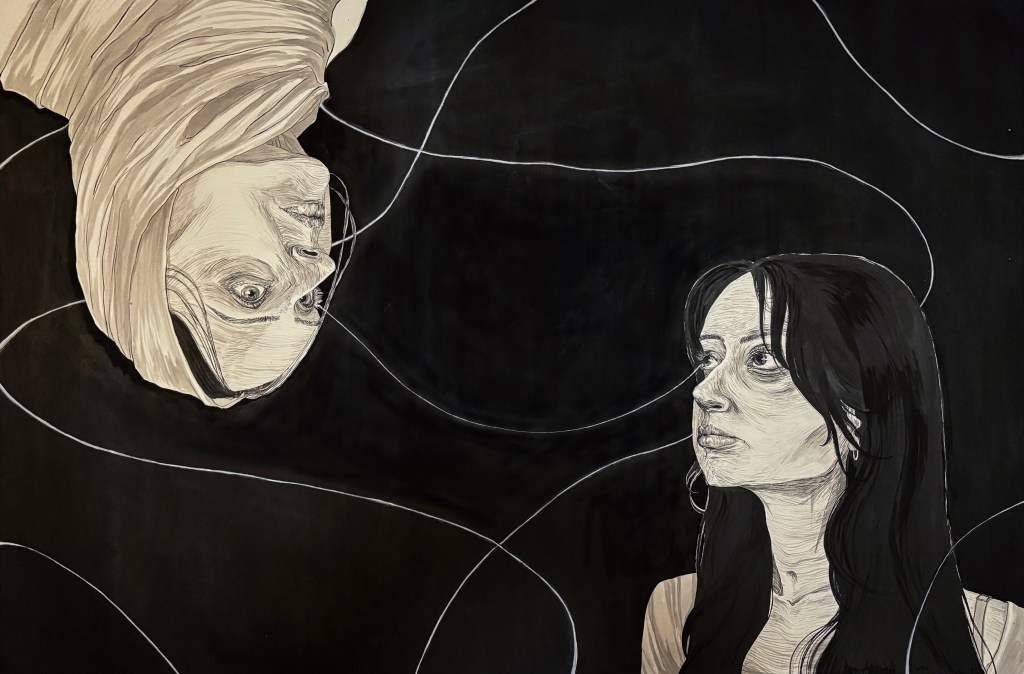
Sarah Rizvi
Modeled after “The Father From China” in China Men by Maxine Hong Kingston.
I have watched you beg, Mother.
You would say please after every request you had for my father, “Can you wash the dishes today, please?”, “Will you bring me some water, please?”, “Can’t you be nicer today, please?”, and each “please” would be more desperate than the last. You would ask with a casual smile on your face, but I could see the way your eyes widened slightly, quivering with the effort to keep your emotions from spilling out. And after every “no” you got in response, I would watch your face fall further to the ground with every passing day. Sometimes you would sink to the ground and mutter streams of Arabic with your eyes closed, and I would sit beside you and try to copy the sounds as if to multiply the effectiveness of your prayer. You would turn to me and drape the long end of your headscarf over my head, and you would correct my gibberish pronunciation by moving my mouth and squeezing my cheeks. I would laugh and start running around with you playfully running after me, and we’d soon be joined by my three older siblings, a big game of tag.
But often, you would stay sitting and the Arabic would get more and more intense, faster, and you wouldn’t wipe your tears. They ran down your face and left damp spots on the collar of your kurti that would grow larger until the bright green of the cloth would darken into a soggy moss color. You would scream if I interrupted you, and I would run upstairs and hide with my ears covered, until my siblings would find me and distract me with the special art supplies that they only took out for school projects. My eldest sister played the token obedient role of the eldest daughter in an immigrant family. She was a second mother to me. Mother, what you could not do for us, she did. We learned how to make friends properly, what jokes were appropriate and what weren’t, what family stories we could safely share and which ones would result in the
downfall of our family. At the time, I didn’t understand what she meant; how could our family get lower than we already were?
I remember the first day you put a hijab on me. I was seven years old, and at the time, the idea of hijab seemed far away, too adult for a child like me. You told me, “You’re a woman now.” Despite the Islamic required age to wear hijab being nine, you deemed me ready enough two years earlier. I felt the prickly feeling of discomfort in the pit of my stomach. Everyday, each wrap of the cloth around my head amplified the suffocating feeling. The first day I went to school with my hijab on was jarring. The same classmates who would sit next to me, talk to me, play with me, were suddenly strangers. The experience of watching the people who I thought were my friends start to look at me with fear and disgust was one that I would never forget. In their eyes, the cloth on my head was a label, I was now visibly Muslim, someone to be scared of. Mother, the same cloth that gave you freedom was what had chained me to a role I wasn’t ready to live yet.
One time, you caught my brother talking to a girl (a crime worse than anything for a Muslim family,) and you dumped orange gatorade over his head and locked him in the backyard for three hours. I watched from my place under the kitchen table as the backyard door rattled and shook with my brother’s punching and kicking, his angry face distorted by the cloudy glass of the door. You had your back to the door with tears in your eyes, as if looking at your son would break the strained thread of control you had. You let him back in the house right before my father came back from work. You said, “Don’t say anything to Baba, he will send you to India for this.” Your punishment was always only a small taste of the anger of my father. This was your way of being merciful, your way of protecting your only son from the wrath of his father, something you yourself could not escape.
There was a day that you could not act fast enough as a shield between my brother and my father, a day etched into my memory. Earlier that day, my brother and father had started their usual bickering about a topic I do not even remember. As usual, the argument spiraled onto bigger issues, issues that had been boiling beneath both of their skins, straining in their popped veins and white knuckles. It was a bizarre sight to watch from the safety of the stairs, the banister acting as a shield between me and the chaos, an eighteen year old boy looming over a 48 year old man, the same anger reflected in both of their eyes. When my brother’s fist made contact with my father’s face, I don’t remember my father’s reaction, I remember my eyes darting to you, Mother. You were pleading with them, crying for them to stop amidst the mayhem of the scene; a chair was thrown across the room, there were repeated thuds of fists beating on a back, slurred curse words so gruff and tense that I couldn’t even recognize the voices. It was strange to watch you so desperately protect the two people responsible for your irreversible sadness. I watched as my brother sprinted to the phone and dialed 911, saying “My dad is crazy, my dad is crazy” over and over. Before the ambulance arrived, my sister grabbed me and told me frantically, “Don’t say anything bad about Baba, no matter what.” There were two officers, a man and a woman; I remember both of them smiling at me and I tried to smile back the best I could, but my face felt like it had been dipped in ice water, my mouth too stiff to follow the directions I was giving it. The woman sat me down on my bed, and I rehearsed my lines in my head. I was ready to get into my script, but her first question was just “How old are you?” to which I said, “eight..” and she smiled again. I didn’t attempt to smile back. She reached past me to the picture my sister had quickly hung onto the pole of my headboard, a picture of me and my dad. She asked, “Is that you and your dad?” and I thought about how stupid she must be to not know when she had just seen him downstairs, but I answered obediently with a nod and a quiet “yes.” I was waiting for the question, the one where I would have to say my lines, but she just patted my hand and said, “it’s a lovely picture.” I wondered why the officer had not asked me anything about you, Mother. But I suppose I wouldn’t have known what to say, anyways. I only remembered the proper etiquette
you had drilled into my brain after the officer had already left the room, so my belated “thank you” was met by the closed door.
Sometimes, you would talk about your family back in India, your father, your sisters, and rarely, your late mother. I would listen closely because it was the only time you would smile your real smile. You told stories of your father’s education, how he was the top of his class and how his older brother was a famous speaker. I would sit and imagine my Nana, grandfather, through the stories. I remember in particular how your face would light up with pride when you told me about how his university had given him a plaque to honor his years as a professor. Your face would dim slightly when you talked about your mother though, with a longing I could see even at my young age. I would hear the pain in your voice mixed with the happy nostalgia of your short memories with her. There were only a few stories about her and they lacked the detail Nana’s stories had. You would mention her cooking, her fashionable clothing, the way she loved your father, but when I asked about what she looked like, you would get quiet and I would know to change the topic. Sometimes I would listen to you talk about the Jinn that supposedly roamed your courtyard, and I would get so scared that I couldn’t sleep at night thinking about it. The image of dark spirits listening in on me, watching me, haunted me for years, and at times, I felt like I could see them out of the corner of my eye at night. I was afraid they could see my thoughts, the ones I kept not only from you, but Allah too. I wondered if the Jinn would side with me, with my rejection of faith, or if they were really secretly devout and would rat me out to our god. But more than Allah, I was afraid of you finding out, Mother. But my thoughts would get cut short when we would hear the thud of a car door shutting and the jingle of keys in the front door. The abrupt silence was my signal to run upstairs, cover my ears, and wait. When my mother was born, her father was so disoriented that he wrote “baby girl” on her birth certificate where her name should have gone. For 6 weeks, my mother’s official name was Baby Girl. She was the first daughter, so she was pampered and coddled only up until her sisters were born, and then her child status was taken from her, replaced with “Apa,” urdu for older sister. My mother was allowed to experience the joy of being a child for a total of nine years, until the day her mother had a heart attack. Everyone in the family worked fast and rushed her into a car, but the traffic and unforgiving roads of India killed her before they could even reach the hospital. My mother was left with the burden of being the caregiver of her family at nine years old since, supposedly, it was a role no man could ever take. My mother says she chose to step up on her own, but the version I know is much more believable than hers.
***
My mother was left motherless at nine years old and her father was so crippled with grief that he took her own right to grief away from her and replaced it with the weight of maintaining a family all by herself. She played the role for seven more years until her name was signed onto a document, tying her to a man twice her age. Her father knew the man from his years working as a professor; he was the top student in Nana’s class, and his academic prowess was apparently enough of a qualification to take my mother’s childhood away from her. She was told she would get gifts and get to see the grand life of America, so she happily agreed, unbeknownst to the manipulation she was being faced with. At sixteen, my mother met my father for the first time at her own wedding and was across the world by the next day.
My mother’s first impression of America was the airport security’s “random” check, a story I would hear for years before every flight, our family’s token cautionary tale. They made her remove her hijab and interrogated her in a room for three hours. They asked her questions and dissected her life. She slipped up by saying her real age, sixteen, instead of her new age which was now twenty one, but got away by saying she was just tired from the flight. (If they found out a sixteen year old was traveling with her thirty one year old husband, there would have been bigger problems than just getting into America.) They used her broken English as a weapon, telling her she would need to work on becoming more American if she wanted to live here for the rest of her life. She was given question after question and lectures about America and what was deemed too “cultural” about her, and they let her go only after they had stripped her of the little dignity she had brought with her from India.
My mother’s experience of marriage started out the way a teacher and student’s relationship might be. Her husband, a thirty one year old man, spent a year learning the strengths and weaknesses of his wife, and took notes on what she should improve on, be better at. My mother was never treated as my father’s equal. But it wasn’t all that surprising to see an adult unable to see a child as his equal. At seventeen, my mother gave birth to a son. A mother at last, she had a new purpose for her life. She devoted her every living moment to raising her son, to make sure he was not motherless the way she was. The age difference between my mother and my brother is the same as the one between her and my father, and that must have explained why her son grew up to be a monster, just as my father was.
My mother gave birth to three more children, all girls. For every birth after her son’s, she was alone at the hospital, gripping the nurse’s hand as she pushed out another purpose to live. After hours of giving labor, my mother would drive home and make dinner for my father, and he would eat without guilt. When my father wouldn’t be yelling at my mother, my brother would. My father and brother were constantly at odds with each other; their differences and issues with each other grew more and more, but their one connection was their shared abuse of my mother. Bigger and more muscular now, my brother would often get violent. Once, my mother scolded him for not studying for his SATs when he was supposed to, and in a fit of rage, he pushed her and she fell and cut her arm on the counter. My father, in his usual place in the garage, ran into the house after hearing the noise and, happy for an excuse to be angry with his son, for the first time, my father was angry for my mother instead of at her.
At 35 years old, my mother’s hopes were slowly disappearing one by one, so she did the one thing she knew how to do: pray. She prayed at every given moment, and when she wasn’t praying she was thinking about what to pray for next. Her devotion to religion gave her a crumb of renewed motivation, and she became a well known reciter at the mosque. The mosque was the one place she could put on a facade of being put-together, the mask of a perfect family. Her practiced smile and script was always so polished that it would even convince me at times. But the ride home from the mosque would rid me of all those thoughts; her perfected act would drop almost immediately, replaced by her usual dim gaze. But slowly, the dimmed light behind her eyes began to flicker again. Her visits to the mosque and her mosque friends’ houses would keep her busy, distracted from the reality that waited for her at home. The same faith that had driven me away from my mother was keeping her alive. The prayers may have fallen on deaf ears, but my mother’s devotion to religion gave her a new purpose, one that couldn’t grow up and turn on her like the previous ones had.
My mother turned 36, and 37, and 38, but also 41 and 42 and 43 (legally), and she continued her praying though she saw no changes for the better in her life. Religion was my mother’s fixation; it came with a community of people, a hope for something better, and she thrived in the fact that religion wasn’t a definite thing. The unsurety of religion was key to her passion for it; it could never hurt her the way a human being could. But religion could not stop the passage of time. My mother watched as her children grew older and moved away, and her ache for family grew more and more painful. She spent each day the same, fulfilling her daily tasks demanded from her by my father without complaint. Her silent obedience was her resignation to the role given to her 22 years before. Her hobbies were childlike; the life she could not live in her youth she tried to replicate in the little pockets of time between my father’s demands. But despite the appearance of my mother’s inner child, she was undeniably getting older. Her face had begun to sag and her bones were colder. The weight on her frail shoulders grew heavier by the day, it was as if the ground was pulling her to it, waiting for her to sink down to her knees and resume her position beneath everyone else. But still, my mother remained upright, barely, but surely, alive.
Sarah Rizvi is an aspiring writer and artist who draws inspiration from her culture as an Indian Muslim woman. Through her writing, she wishes to portray the importance of the uniqueness of stories rather than catering to a universal outlook of cultural experiences. Rizvi’s focus on family is reflected in much of her work and emphasizes the complexities of having familial struggles paired with unbreakable bonds. As she writes, Rizvi hopes to continue to put her experiences into words that resonate with others.
-

Zane Duzant
See, all that I ask for is a glass of water with ice. Now that I am moving nearby, I’d like to stop in. Ideally, on a daily basis. I hope to not be a bother. I’m positive sometimes I’ll be bothersome; afterall, you and I are only human. That is, I have the potential to bother and ultimately you are entitled to being bothered. I just hope to not be wholly a bother. I’ve only asked for a glass of water with ice. I imagine if I had asked for 6 ice cubes – no more, no less – that I could be considered a bother; I don’t care how many there are, really. I just ask that it be a glass – not a mug – so that I may see your skewed image through the tilted cup as I drink; I wish to know how you look from elsewhere. How do you mean? All I mean to say is that someday, there will surely be no more days – for me or for you – and the film will be lifted from our eyes. I’d like to know how you look from elsewhere, in case I might see you there after all of this is said and done. I’m not sure I understand. Well, it’s not exactly a science. I do sympathize with your inability to understand and I hope you’ll be patient with just how long it may take me to explain. All that I ask for is a glass of water with ice. Now that I am moving nearby, I’d like to stop in. Ideally, on a daily basis. This will afford me the time to clarify what I mean by all of this. I’ve known you for all that I can remember, as far back as the arrow of time extends in my mind. I’m sure there were moments before you, but those memories have long since vanished. I’ve not been alive for even half of your life and young me couldn’t imagine your red hair turning silver, though it has. An early memory is cemented into my being. It is of you, my father, your daughter and I. You took us to a park for a playdate. Emmaline and I did our best to run alongside each other, with stumpy toddler legs. You and my father were like gods. You roamed in slow motion as we zipped through the grass. I remember Emmaline’s every detail. Only 10 years old when she was taken from us in the most heinous and brutal of ways: a knife through the heart, wielded by a man she trusted. I couldn’t bear to live with that truth, but 9-year-old me pictured it. I heard what happened. I watched it play in my head and I knew I should’ve been there. Surely I could’ve saved them from him! I was brainwashed by television to think that I had the ability to ward off evil. I was wrong, and I know that now. I have lived with the guilt of knowing that it was her and not me; and that I couldn’t have helped even if I had been given the chance. I remember her as her 10-year-old self, immortalized and set in stone. She was unique. I understand that everyone says that of a lost loved one, but something was different about her. She was truly special. I loved her! I love her too. Well, of course you do, she is your child after all. But, I want you to know that the memory of her is intertwined with every fiber of my being. I find myself breathing differently since that day. All that I ask for is a glass of water with ice. Now that I am moving nearby, I’d like to stop in. Ideally, on a daily basis. Just to watch you be. My father left us only a little while after her, and I see them both in you. Every moment with you is a moment with them. I’m sure you must be tired but also in no rush to sleep for good. The very essence of our relationship is built on loss: the loss of a child, the loss of a father, the loss of love. Eventually, it will happen again, and I’d like to be nearby when it does. I’d like to take care of your plants and help take the trash out. I can sprinkle the driveway with salt to melt the ice before you wake. I will hold your hand if you need help to the mailbox in the snow. I know you are alive and well, and so am I! And I’d like to stay that way, but I must admit I am feeling a bit hoarse after all of this talking. Would you like a glass of water with ice? Why yes, that’s exactly what I need.
Zane is a third-year philosophy student; originally from the forests of Connecticut, he finds himself writing about man’s relationship with nature and isolation. His ideas in philosophy inspire his writing and he finds the medium to be a tool well-fit for musing. Zane has high hopes of becoming a professional philosopher and would like to keep a close relationship with creative writing throughout his life.
-

Stephanie Ro
‘I am growing up,’ she thought, taking her taper. ‘I am losing my illusions, perhaps to acquire new ones,’ and she paced down the long gallery to her bedroom. — Virginia Woolf
Looking back, it was a peculiar aloneness that I felt during those months in Korea—donning the superpower of invisibility. The first night I landed, with only two suitcases in tow, I felt the strange and chilling freedom of finally being alone. This was the homeland of my parents, a city of 10 million strangers. Here my black hair and Korean eyes did not make me different and the clamor of voices in a familiar language, my mother tongue, blurred into a distant hum. Yet, here, no one knew my name.
Aristotle’s Politics describes isolated people as being “either a beast or a god.” As the blearing lights of Seoul’s skyline came into view through the fog of the bus window, I couldn’t help but wonder: ‘What is this isolation going to make me? A god or a beast?’ I sat in the silence of the packed bus, my signal-less phone idly in hand, overwhelmed, perhaps for the first time since childhood, by the loudness of my own thoughts.
***
A few weeks into my six months in Seoul, I took the blue city bus from my dorm to the National Museum of Modern and Contemporary Art in the Jongno District. It was an especially cold February day, and my thickest coat from Texas did little to protect me from the biting chill. I was there to see a special exhibition of one of my father’s favorite artists, Lee Jung Seop. The showroom was warm and crowded, filled with only the sound of the clicking of shoes on the polished floors as people silently made their way through the maze of paintings. These works, donated from the personal collection of Samsung’s founder Lee Gunhee after his passing, had never been displayed before. Lee Jung Seop’s signature oxen painted with bold strokes and teeming with vitality hung near the entrance under the soft glow of the lights.
Lee is beloved as one of the greats in Korean modern art, his most renowned work, Bull, is instantly recognizable to any Korean schoolchild. However, as I made my way through the displays, I noted how the monikers of ‘tragic artist’ and ‘lonely painter’ have haunted his legacy. As the Korean War ravaged the peninsula, Lee was separated from his wife and two sons as his family fled to Japan as refugees. He remained alone in Korea. The letters and postcards that he sent them hung on the walls of the exhibition, revealing his fond doodles and affectionate nicknames. Poverty-stricken and mentally deteriorating, Lee immersed himself in painting and turned to heavy drinking. He died alone from hepatitis at the age of 40. Perhaps it was the loneliness that killed him.
Towards the middle of the exhibition was a section with dimmed lights, kept low to preserve the art. Curiously, I approached the display and was met with a kind of shiny foil adorned with a careful but abstract sketch of two children embracing, all tangled together.
(Lee Jung Seop, ‘Eunjihwa 19’)
I learned that during the war, Lee did not have enough money to buy proper supplies to paint, so he etched his art onto the inner foil wrapping of his cigarette packs. Peering into the glass at the delicate carvings, I wondered what desperation, what courage kept him drawing. The more I stared at the etching, the more it stared back at me. I thought of the beast and of the god. It was loneliness that drove Lee mad at the end of his life but it was also loneliness that drove him to create amid despair. How much had he yearned for warmth? For love? Dozens of his foil etchings lined the room– an artistic cry in his war-torn and lonely reality. These were drawings born from necessity, of a pain that demanded to be expressed. A pain that demanded to be shared.
***
My dorm room was long and skinny, fitting only a bed, a desk, and a closet, with an attached private bathroom and balcony. I lived in a hallway of singles, surrounded on all sides by girls like me, alone in their rooms. I wondered what we looked like to God from above. What would he think of the walls we’ve built?
Like Lee’s art, those months in Seoul taught me how painful loneliness can be. The times it seems like no one truly hears us or sees us. When our bodies and minds cry out to be known. Aristotle never knew that that isolation in the 21st century is being simultaneously always and never alone. Aristotle didn’t know the beastly isolation of having hundreds of Facebook friends but no one to call.
Cities, I’ve found, are often the most lonely places on earth. On my daily evening walks through the ritzy financial district in Gwanghwamun, I would stare up at the hundreds of windows on the corporate offices of Seoul, some dark and some filled with golden light. I sometimes saw strangers moving about inside, revealing a strange paradox of exposure and separation.
I had always believed that a person was lonely because they were alone. But on that first night in my Korean dorm room, when I overheard the boisterous laughs of my neighbor in the room to my right as she called her mom, and later in the quietness of the night, I listened to her muffled sobs of homesickness seeping through the thin wall that separated us, I wondered how I felt so connected to this girl whose face I barely knew.
Even as I began to make acquaintances with classmates and girls that I shared a hallway with, on most days in Seoul I ate meals alone and took the bus alone and stared at the dark ceiling at 3 AM alone. I had been scared to face myself, to truly be alone with her. She knew too much—my every thought, my every fear. The thing about solitude is that it gives a person superhuman hearing. It is only in the very quiet where you can hear the sound of your own heart beating.
In high school, my English teacher spent four weeks teaching about the American transcendental movement of the 19th century, assigning Thoreau and Emerson. I remember reading and re-reading “Self-Reliance” and “Nature,” asking myself: What would I become if I set down the burdens of history, tradition, and religion? What did he mean by “man is a god in ruins?” The texts had struck something in my 17-year-old self who could not be herself because she was too busy being who she was supposed to be. When my friends would complain about how boring it was to read about some guy who lived by a lake all by himself, I feigned agreement. I remember being embarrassed about the Emerson quote that I had secretly scrawled down on the front of my planner: “Trust thyself: every heart vibrates to that iron string.”
Seoul’s solitude taught me that I love eating alone and hate sleeping alone and that my chest sometimes gets tight when I think too much. It showed me that the cure to loneliness is not simply meeting new people but befriending oneself. The power to hear yourself above the noise is to be divine.
Stephanie Ro is a senior at UT Austin double majoring in Government and Rhetoric and Writing. Born in Chicago and raised in Seoul and Austin, she has been a lifelong reader and admirer of writers. But it was not until she serendipitously stumbled into a creative writing class that she first seriously put pen to paper. Through her writing, she hopes to show the power of small and personal stories to change the world.
-
Olivia Savage
The female has always been a source of curiosity — a subject to study, speculate about and dismiss as an emotional liability. She is sensitive and vulnerable — deeply moved by the profundities of the world, or she is passionate and defensive — deeply inspired to challenge the injustices of the world, especially those committed against her. It is not a new concept that crimes against women are often closed without any real closure or justice, and when the system fails them, sometimes their only option is to take action themselves. In Mindy McGinnis’s novel, Female of the Species, small town high school senior, Alex Craft, is caught in the wake of her older sister’s brutal rape and murder, forwhich the offender is acquitted. McGinnis navigates the waters of how a flawed justice system has forced Alex to seek justice through her own methods, thus being labeled as vengeance, and creating this harmful dichotomy of the idealized “vigilante feminist” vs the condemnable “monstrous woman” that keeps women confined to a new but equally problematic space in literature.
Humans have developed a culture that loves to “other” woman; if she does not fit a mold previously defined or authorized by man in some capacity, there is something wrong with her— she is crazy —especially if she begins to reflect qualities that are used to define and uphold traditional masculinity, like aggression. As Paula Gilbert, professor of women’s and gender studies at George Mason University, puts it, “[t]he gender called man…often needs to reject the gender called woman…by distinguishing itself as strong, powerful, controlling, and often aggressive and violent” (1274). Men perpetuate this rejection of women through the creation of stereotypes for different patterns of behavior women can exhibit that exist outside of men’s comfort zones; this keeps the female within a definable space in order to continuously reinforce the male’s definable space as dominant to hers.
In the same spirit of rejection, the justice system—which is deeply intertwined with the patriarchy—often suppresses or dismisses crimes against women, especially sex-related crimes, because female rejection of the male does not sustain the masculine paradigm. Women who report rapes, specifically, are usually met with doubt (the officials file it as a false complaint), concealment (they will file it as a non-criminal code where it will not be investigated), or pressure to withdraw the complaint altogether (Anderson 909). A process commonly referred to as the “second rape” is the best case scenario for a woman choosing to press charges against her attacker; her case gets its day in court, but she is then subjected to intense cross examination about her personal/sexual history in order to undermine her integrity. For these reasons, women become tired, frustrated, or distrusting of the system that is designed to maintain the patriarchy and must resort to their own pursuit of justice.
In McGinnis’s Female of the Species, McGinnis attempts to break free from the woman’s “obligation” to be non-aggressive by introducing a volatile, female protagonist. Alex Craft is an adolescent female that challenges the forces (men) threatening her or those close to her with physically violent responses. Part of this aggression stems from watching the justice system fail to rectify her sister’s rape/murder, but Alex also just possesses “this unwieldy wrath that burns through [her] brain, turning reason into ash” that she inherited from her father (McGinnis 115). Alex boldly takes on this traditionally masculine quality a natural tendency to challenge power dynamics in her life, though she differs in that she only confronts unjust authorities rather than any force that doesn’t enable her ego, as men do.
However, simply introducing this violent female character does not shatter glass ceilings. Though Alex outwardly embodies a historically repressed female impulse, reader perceptions of her volatility problematically confine women to new and disempowering stereotypes. As McGinnis acknowledges herself, she largely covers the “fantasy of violence” in Female of the Species and how Alex “represent[s] wish-fulfillment” to her female readership (Bilyeau). She wants Alex to be an outlet for female readers who feel disempowered in their everyday lives, but at the same time, McGinnis fails to clarify if or to what extent Alex is intended to inspire female readers to take action against patriarchal oppression in the ways she does.
McGinnis doesn’t seem to condone violence as a realistic means of justice, but Alex’s strong will and bold stand taken against oppressive patriarchal behaviors are idealized as heroic following her death at the end of the novel. Alex’s best friend, Claire (Peekay), reflects on how “Alex is gone but she’s very much still [there]…in Sara’s willingness to skip class and erase [male genitalia graffiti] with [her],” and in open, retaliatory gestures taken against outright misogynistic behavior (McGinnis 340). There is this confusing double standard occurring that says Alex’s attitude toward misogyny is heroic, and this attitude is even romanticized as “woke” and empowering after her death, but at the same time this implies that the horrific narrative of violence she perpetuated, which resulted in multiple deaths and a permanent physical deformity for one assailant is also heroic and “woke,” which is very clearly an ethical issue concerning impressionable and naïve readership.
The novel complicates the perception of violence in the real world, as girls/women are discouraged from challenging or even responding to oppressive forces, especially men. This is typically accomplished through “direct punishment, withdrawal of affection, or simply cognitive training that ‘that isn’t the way girls act,’” and thus, the patriarchy sustains its disempowerment of females by reducing them to repressing their anger and physical impulses rather than expressing them (Richardson 239).
The festering of those repressed emotions has led to the creation of a new role in literature that offers female readership an agent that acts on their behalf within a story, a persona coined by Dr. Laura D’Amore as the “vigilante feminist.” The vigilante feminist is a young, female character that “exist[s] in [a] violent space” and “take[s] on the role of [protector] against that violence…outside the parameters of law and society” (D’Amore 4). She is an idealized heroine who redeems the female through “corrective action…but not for the sake of dominating or taking power” (D’Amore 4). She is someone the female reader can romanticize and desire to be like, but she still exists in this separate and fantastical realm that cannot occur in the real world.
Early on in the novel, McGinnis isolates a revealing line about Alex’s intent to avenge her sister’s death. Alex says she’s “not a court, and [she doesn’t] need proof,” referring to the offender’s acquittal based on the destruction of evidence (McGinnis 2). Here McGinnis vocalizes Alex’s operation outside of the bounds of law, a deviant yet empowering statement that women can exact justice for themselves, and implying, it in fact, would be a much more convenient way of doing so in that the process is more streamlined than the judiciary system.
However, while Alex does take measures outside the bounds of the law to defend the dignity of women in her life who have been violated by men, she is not intended to function as a vigilante feminist within Female of the Species. McGinnis implies her violent nature is not intended to be romanticized, which is problematic because young, vulnerable female readers facing disempowerment or hopelessness in their own lives are searching for someone to relate with, and they can easily identify with or idealize Alex with each “successful” violent encounter she has. This is also problematic because McGinnis contradicts herself, wanting Alex to be a standalone example of how violence can destroy one’s life, but at the same time, she memorializes Alex’s life and contributions to female empowerment within the novel through the use of violence. The vigilante feminist can problematically become an idol, or even worse, a martyr for young women, as Alex seems to become at the end of Female of the Species.
McGinnis intended to communicate a message dissuading women—and more generally men—from becoming involved with violence. She revealed in an interview that Alex serves as an example of “how violence damages the perpetrator as well as the victim,” but this seems to be undermined by the romanticizing of Alex’s legacy at the end of the novel and the success of her violence in the “takedown of rape culture in their society” (Bilyeau, Sio). If she is leaving a legacy of challenging the patriarchy, her main method of doing this was through violent confrontation, which then tells the reader that violence is acceptable in this context, especially if they relate to her as an agent of liberation and empowerment.
For those who cannot or choose not to identify with Alex as their heroine because of her blatantly criminal and immoral actions, she becomes a condemnable monster. Many critics/scholars, including McGinnis herself, label Alex as “a stone-cold killer” right up there with infamously sadistic Lizzie Borden, who hit her stepmother over the head around seventeen times with a hatchet (Reagan). Though in completely different realms as far as motive and possibly psychopathy, it is an understandable viewpoint to take that Alex is a deplorable human because anyone willing to take someone’s life has to be mentally ill in some capacity. In other words, murder is murder.
In respect to these antithetical roles that Alex takes on, the novel fails to accomplish anything new or progressive on the feminist front. McGinnis gives us a female with a unique temperament and a narrative that one-dimensionally deals with the issue of violence in young adulthood. She sets up the novel to literally focus on the “female of the species” as a force to be reckoned with, then proceeds to isolate solely Alex as an individual force to be reckoned with. Whether the reader chooses to receive her actions as heroic or monstrous, McGinnis has developed a new space for the female to be alienated in as one of two absolute extremes (heroine or monster), allowing her to step outside of her historically gentle disposition and ironically disempowering her in her own fight against alienation.
Within the YA genre, a field that probes the turbulence of the adolescent experience, socially unacceptable desires/impulses, such as this idea of female aggression, are uncovered and amplified. This allows readers an outlet to personally engage with that facilitates the vicarious release of feelings like insecurity or isolation. Karen Coats, a prominent scholar in the children’s and YA literature sector, reports that when we fail to see our “honest efforts bring us to the place in the world we wish for,” our response is to create these “imagin[ed] aggressive scenarios that lead to the vicarious release of real tension” (326). These scenarios are constructed from personal experiences with oppression and reflect institutionalized ideologies that have been impressed on the affected individual for so long that the individual begins to self-oppress and perpetuate their own marginalization, often subconsciously.
I argue that McGinnis does just this in Female of the Species. Although she intends for Alex to be nothing more than a vicarious, emotional thrill ride for the reader, Alex is much more than this: her defiance against the patriarchy’s oppression can either be digested as heroic or condemnable, and neither are a progressive nor healthy outlook for females to have walking away from this novel. McGinnis also creates these depictions of dichotomies within the story that are reflective of stereotypical gender roles/behavior, disempowering Alex in her womanhood, despite the narrative of empowering women against the patriarchy in the dismantling of rape culture in their school environment.
While Alex’s character reflects this stereotypical idea of the irrational and emotionally unchecked female, her father, the source of her same anger issues, is the wise and self-aware male that removes himself from the space that would cause him to act explosively on those impulses. Circling back to McGinnis’s introduction of Alex’s anger issues as a genetic inheritance from her father, her father is portrayed to have logically and reasonably removed himself from the family unit in order to prevent him “kill[ing their] mother, eventually” which Alex concurs is a respectable excuse for abandoning them (McGinnis 115). The fact of the matter is, “for women[,] aggression is the failure of self-control, while for men it is the imposing of control over others” (Campbell 1). Thus, it is Alex’s rage that turns “reason into ash” but the novel excuses her father’s rage even though it constitutes domestic abuse (McGinnis 115).
McGinnis appears to have entered into authorship of this novel with the predetermined notion that Alex was going to be an angry and vengeful murderess; she details that she took inspiration from a true crime show episode that occurred in a small town where everyone knew the murderer, but there was a lack of physical evidence, so she thought it would be interesting to see someone “just go there and dispense justice themselves” (Bilyeau). The fact that she settled on an adolescent female as the justice-seeker is reflective of McGinnis’s own biases toward young women, exploiting the stereotype that teenage girls experience more potent and irregular emotions (mood swings) like Alex’s fits of rage that consume her and negate any logical processing.
As far as the implication of this in the sense of justice, McGinnis also addresses that justice “becomes vengeance when the person executing justice is personally and emotionally involved,” such as Alex (Bilyeau). Though if a woman cannot rely on or trust in the legal system to rectify crimes committed against her, what else can she rely on but her own self? The only entity that has never confined, subjugated, nor criticized her is herself. Even other women are oppressing their female counterparts by writing them as their own worst stereotype, due to being conditioned by patriarchal ideology for so long, as shown through McGinnis and even my own writing in this paper.
Almost like Stockholm syndrome, women cling to men’s ideas of them because it’s comfortable and familiar as normalized by the patriarchy’s pervasion of society. As a society, we are “uncomfortable with other people,” and I would add ourselves, “until we have successfully placed them in a gender status” (Gilbert 1273). Even if that status is wildly stigmatized or oppressive, we are a culture that values our gendered labels and expectations because of the dominant/submissive framework the patriarchal model requires. When we are presented with a foreign gender concept like an aggressive female, we are quick to mock and reject this as McGinnis symbolically does by ending the novel with Alex’s very graphic death at the hands of a male who impulsively tackled her for defending her friend from an assault. He literally and figuratively disarms Alex, taking away her “voice” in a sense because she communicates through her actions. This represents the fall of the deviant narrative that a female can subvert the patriarchy and suggesting that there is no just, happy ending for women.The idea that a woman could be anything outside of what man authorizes her to be—gentle, content, and submissive—continues to be portrayed and rejected in new spaces, even perpetuated by women themselves. In Mindy McGinnis’s novel, Female of the Species, McGinnis introduces the deviant idea of the violent female embodied in protagonist, Alex Craft. Following her pursuit of justice for violated women in her life in the face of a flawed judicial system, McGinnis paints Alex to be vengeful, isolating her to become one of two roles: the empowered heroine, or the psychopathic killer. Both roles are damaging spaces that are new, yet equally confining and problematic for the YA female.
Olivia Savage is completing her senior year as an English Secondary Education student at Stephen F. Austin State University. Set to graduate in the spring of 2025, she has always enjoyed nonfiction writing, especially within the realm of feminist criticism. As her studies have advanced, so has her perception of and her desire to protect the sanctity of the feminine heart. Her intention is to illuminate ways in which women internalize oppression on a cultural level and to thus replace the lies of self-oppression with the freedom of knowing their inherent dignity is found in Christ.
-

Abigail Pfeifer
I felt a Funeral, in my Brain,
And Mourners to and fro
Kept treading – treading –
–Emily Dickinson
“Well, doctor, he seems to be having another episode….if you understand–What’s that?–Oh. Yes. Certainly–”
Arthur could hear the conversation occurring in the hall outside his room as if Mrs. Welch and Doctor Murphy were standing at the foot of his bed. The high undulations of her voice pierced his eardrums. A needle stuck in the canal. He couldn’t make sense of the doctor’s words, only deep rumblings, but they too, were uncomfortably loud somehow. Did they remember he had woken up blind, not deaf?
But they were the least of his concerns, really. The house was growing bolder. Before this morning, it had settled for making its presence known, only just. It hovered in corners and sent the odd chill down Arthur’s spine at sundown. Now, it had reached across that corporeal boundary–burrowed through skin and muscle and blood–and taken his eyes.
“–It is difficult to rush these things, you realize.” Ah, there was a coherent sentence. The housekeeper’s shrillness swelled. “Of course. But are you aware of today’s occasion?”
“I am.”
Arthur was irritated at being discussed without his input. He wasn’t a child. More pressing, though, was the writhing creature scraping its talons down the sides of his skull. And the weight sitting squarely atop his chest. There must be some beast from the bowels of
Chesterfield House taking up residence there, but Arthur could not see it. He couldn’t see anything. His eyes were open, and it was morning–the birds’ calls told him that, but the room was pitch black.
The doctor once again: “But nervous types like Mr. Reed–they cannot control their fits. Too much interference could worsen his condition. I suggest rescheduling the festivities.” Mrs. Welch began to sputter about logistics and guests that had traveled great distances, and the food and the florist, but the doctor ignored her and quietly entered the bedroom. Arthur heard his shoes click across the floor and felt the air shift as he approached his bed. He could only imagine what the scene looked like. Sheets tangled at the foot of the mattress, damp with sweat, Arthur flat on his back as if he were tied down.
“Mr. Reed?”
“Doctor?”
“I am going to conduct a brief physical exam. Can you tell me the symptoms you’re currently experiencing?”
“I can’t see.”
“Anything else?”
“My breath is short.”
“Right. Hold tight.”
Dr. Murphy poked at his throat, his feet, and pulled back his eyelids. Arthur managed to sit up while he listened to his heart.
Then he said what he always said, “There’s nothing wrong with you that I can determine. At least externally.”
What would the doctor say if Arthur told him If you leave me now, the walls will swallow me and stretch me to fit inside them? Would he ship Arthur off somewhere to be hidden away? Somewhere his delusions wouldn’t unsettle others? He only asked, “Well, can’t you do something?”
“I don’t believe so.”
“It’s my wedding day.”
“So I’ve been told.” A pause. “May I be frank, Arthur?”
“…Yes.”
“You’re not in full control of your body or mind.” The doctor sniffed. “I would think you want to be on such a day. You want to remember everything, enjoy it. What you need now is rest. You shouldn’t be stuffed into a suit and stood in the middle of a crowded room. From what you say, you could not even begin to find your way there, anyhow. If you’ll allow me to state the obvious. ”
Arthur felt a sick relief. No one ought to be shackled to him in marriage. Especially not Elizabeth, with her kind brown eyes and careful words. Chesterfield would delight in tearing apart such tenderness.
As Dr. Murphy left, he gave Arthur’s shoulder a gentlemanly pat and murmured something about seeing to other patients. Arthur flinched at the touch, then felt his cheeks flush in shame. Yes–better to stay here in this room for now. Forever, maybe. Everyone else could go
about their lives in that sturdy, automatic way he’d never fully learned. They wouldn’t have to hold him together anymore. He’d stop looking away from the house and face it head-on. And if it wanted to devour him after all, he’d let it.
Mrs. Welch came in and fussed about him, fluffed his pillows, and badgered him with tea. It was a pity her best intentions were wasted on Arthur. She deserved more. Arthur dug the heels of his hands into his eye sockets. The pressure blinked some sort of light behind his lids. “What will they say, Mrs. Welch?”
“To hell with them, Arthur.” She was still rustling around.
“What about the Cranes?”
“That’s not important now. We’ll deal with it all later. When you’re well.” Mrs. Welch would deal with it, she meant.
“We need them.” He needed the money. If Elizabeth’s family called off the marriage, Arthur would lose the house. He hated Chesterfield, but it loved him in its own consumptive way, and Arthur knew he didn’t have the strength to leave, anyway.
She stopped moving, and Arthur felt the bed dip as she perched on its edge. “I don’t need a reminder. Forgive me, dear, but would that be so horrible? To start again in another place?” No, it wouldn’t be horrible, far from it. The dusty halls sucked him dry with their memories and echoes, their strange pulse. But it was his parents’ home. He’d been born here, and every day, it felt more inevitable that he would die here.
Mrs. Welch took his clammy hand in hers. “These are problems for another day, Arthur.” She was so solid, so warm. “Rest now.”
He listened to her leave, and then he was alone in the dark.
Murmurs and rustling sounded outside his door, but Arthur did not move. He wasn’t asleep, but he wasn’t awake. Sometimes, he slipped into a dream, but never far enough because he was still inside of his body.
Time had slipped out of Arthur’s grip. It could’ve been the same day or the next or the next week, for all he knew. His eyes sometimes burned because he forgot to blink. He rubbed them every so often to find out if they might magically begin to see again. Arthur thought that maybe this was what being buried alive felt like. He thought of Elizabeth and the sympathy she was surely receiving, the outrage on her behalf, and the well-meaning advice in the face of his utter failure. He thought of a cabin in the countryside that he might build if he was a different sort of man. If he believed there was anything more to himself than the place where he had come from. In truth, all Arthur was and would ever be, had been fabricated by others. He reflected his parents’ hopes back to them. He pretended to understand the tutors who desperately tried to ignite some passion within him. Mrs. Welch deemed him a serious and well-behaved child, so he acted like one. He had always felt hollow, and there wasn’t enough of himself to fill the cracks, so Arthur let them pour into the empty spaces.
Eventually, the whispers grew too loud to ignore. The curtains swayed in a chill draft, and they spoke his name. What have we done to you? they said. Nothing, nothing. All we have tried to do is love you, but you do not want it. You do not want to join us, though with us is where you belong.
Arthur wrapped a pillow around his head but the voice was coming from inside him. He could not run from it or drown it out. The house wanted attention, though, and attention it would get. His quilt snaked around his ankles and tightened until he felt his heartbeat pulsing in his feet. Stay, a loose thread stitched into Arthur’s skin. S T A Y, s t a y. He tried to scream for Mrs. Welch, for anyone, but the house swallowed any sound before it could break the air.
If you do not see us, no one will see us, and we will fade away. See us. Hear us. It must be you. It is only you.
Then his mother’s cool fingers were pressed to his forehead as if he were a boy again, and she was checking for a fever. Arthur couldn’t see her, but he could feel her there. She asked, You fight so hard, darling. But why? Mother, help. I fear I am slipping away never to return. You are my son. I made you, and this house made me, and we will return to it in the end. I’m not ready. I’m not ready to return. I am not finished here. Shhhhhhhhhh, she said.
Elizabeth came to him later. Arthur? Oh, dear. They are telling me that you must let go. You are good, Arthur. You were good, but not good enough, I’m afraid. I am sorry, I’m sorry–Can you hear me? It was me, it was me, not you. There’s a hole somewhere in me, and I kept trying to fill it and–
His father. He said I always wanted to see more of myself in you. He pressed a thumb to Arthur’s forehead, and the touch set his head on fire. That blank stare of yours was quite distressing.
Please, please. But Arthur did not know what he was begging for. The house relished his desperation, his fear. It wanted more and more of it, more of him. The walls curved inward. They wanted to hold him closer. They wanted to spread him between their planks and behind their paint. Chesterfield would become what Arthur had been missing his entire life.
Arthur’s limbs became bedposts. His bones were carved into the cheery pinecone finials. He had never been more than chipped wood. How had he believed otherwise? Perhaps he was born to become one with Chesterfield House. Arthur had been made with that endless cavity within him because the house knew that, one day, it would replace the void. Yes, the house whispered.
He was in every room at once. He was every room.
Arthur felt the cold marble of the floors on his back. He could taste the rusted window panes. He was the cobwebs in the corners, the ashes gone cold in the fireplace. The parlor’s chess pieces were lodged in his throat. He shattered into a thousand pieces and became the chandelier.
I belong here?
You are perfect.
Look, you are beautiful.
It hurts. Why does it hurt? I can’t–
No.
It is not meant to hurt.
“Arthur? Arthur?”
He could see Mrs. Welch laying a cold cloth on his forehead. Candlelight flickered in her eyes. She smiled when he met her gaze.
“There you are,” she said.
“Mrs. Welch.” He tried to sit up. Arthur surveyed himself. Everything seemed to be where it should. “Am I–?” He couldn’t feel the house anymore. Its absence ached. New paragraph for Mrs. Welch’s dialogue
“I think you’re alright. Hmm?”
“I–Yes, I suppose,” Arthur said. “There’s just something I need to do.”
The pair of them got him upright, and Mrs. Welch helped him down the stairs. He opened the front door and smelled summer rain. Arthur stepped outside. The house awakened at his leaving, didn’t stop him, but called to him as he crossed the threshold. He knelt on the ground and felt mud soak into his nightshirt. He shoved his fingers into the grass.
The blades tickling his fingers felt new. Arthur looked to the treeline and the bruised expanse of sky.
He was untethered, free, floating with the wind. But Chesterfield towered over it all with open arms, waiting to embrace him again.
Abigail Pfeifer (she/her) is a 2024 graduate of UT Austin’s English and creative writing departments. She was a member of Texas’ NCAA Division I Swimming and Diving Team. Also, she enjoys baking and trying new coffee shops around town.
-

DJ Woodring
It was a nice day. It always was, at the blue house. Which people said was odd. Off-putting, even. But there it was. The sun was shining down on the tall grass, which was waving in a polite breeze, sending an earthy, pollen smell up to the porch and across the road to the tree line. It was almost spring, they said. It would be soon now. It was a nice day.
“Do you know what’s past the forest?”
Elliott had been sitting on the porch, book in his lap, for hours. He hadn’t read a single word. Instead, he simply sat and stared past the porch banister, across the fields and into the trees that stood on the edge of the property. His chair rocked gently beneath him.
“Sorry?”
“The forest. Right out there,” Elliott said again. “What’s past it?”
“Roads, I imagine. Highways.”
“Not people?”
“Well…” Jo chewed on her thumb absently as she thought, a nervous habit. She didn’t usually speak much. “Sure, people too. There’s people everywhere.”
“Oh.”
“Why do you ask?”
“Because I hear them sometimes.”
“What?” She stared at him from across the porch.
“The people. You can’t hear it?” He turned to her, the ghost of a smirk on his face. She shook her head.
“No, Elliott. I don’t hear anything.”
“Hm.” He rocked thoughtfully. “I think it’s because you’re not listening.”
She paused for a moment, then followed his gaze. The trees were still swaying, newly grown leaves emerald in the sun. It was quiet.
“I don’t hear anything,” she said softly again, more to herself this time.
“That’s alright.” Elliott shrugged, still smiling. “You will. I’m sure of it.”
Across the road, the trees went still. Jo didn’t speak again.
Night had crept across the horizon when the two of them went back in the house, Elliott sitting on the counter and watching as Jo methodically closed the curtains. The wind was starting to howl outside, and the chill was creeping through the spaces around the window frames. Nobody could remember when it had been built, but everyone knew the blue house was old.
Elliott hummed softly to himself as he rinsed dishes, seemingly lost in his own world. He hadn’t bothered to turn any of the lights on yet, and the kitchen sunk into shadows around the two of them as they worked. Jo sighed as she closed the last of the curtains, pulling her sweater tighter around herself. She missed the sun already, and it had barely gone down.
“It was a nice day,” she said absentmindedly, moving to sit down at the table.
“Yeah.” Elliott nodded, turning around and leaning against the sink. “You always say that.”
“Do I?”
“Every day.” He drummed his fingers against the countertop. “We come inside, and you close the windows, and you tell me what a nice day it was. Why?”
“I suppose because… because that’s what people say.”
Elliott stared at her a moment longer, and she fought the urge to lean back in her chair. It felt like he was trying to read her mind.
“Doesn’t it bother you?”
“What?”
“That you can’t remember,” he said plainly.
“Remember what?” Her hands had curled around the edge of the table.
“Anything.”
“That’s…” She laughed suddenly. There was no humor in it. “That’s silly.”
“Tell me what we did yesterday.” He had stood up to full height now, eyes bright and feet planted as he looked at her. Somewhere, way off, getting closer, there was thunder. She felt, quite suddenly, that perhaps she didn’t recognize him at all.
“I… I don’t know.” she breathed. And it was true. She didn’t. Perhaps she had, sometime ago, but now it was gone.
“And what about before that? Before the house?”
“I don’t… I don’t think there was anything before the house.”
“That’s what I thought.” He looked almost sad. “You don’t remember anything.”
She didn’t.
“I’m sorry.”
“It’ll be spring soon.”
“What?”
“Isn’t that what everyone says?” He crossed to the table and sat slowly down in a chair opposite her. A fork of lightning flashed behind one of the curtains.
“I… yes.”
“How long have you been waiting for soon, Jo?”
The silence was long and heavy between them. The wind had started howling more intently, rattling the shutters. She could feel her breath rattling in her lungs.
“They’re still out there, you know.” His eyes darted to the door, then back. “You could talk to them.”
“Who, Elliott?”
“Them.” He drummed his fingers where he had rested them on the table. It was getting louder outside. “They’re talking again.”
She shook her head.
“You have to hear them.”
“I don’t.” Her chest hurt. Somewhere in the distance, thunder rolled.
“Why are you so scared?” he asked, gently.
“Because I don’t know what’s happening.” She let out a small, shallow breath.
“Then listen.” His voice was soft. “Just listen.”
She nodded. Her hands were shaking. His eyes didn’t leave hers. The storm was picking up outside, rain lashing against the window. She tried to breathe.
“All you have to do is ask them.” Elliott said. He reached across the table to hold one of her hands in his.
“Ask them what?”
“Anything you want.”
“I… I have to know.” She faltered slightly, and he gave her hand a squeeze. “I have to know why I can’t remember any of it.”
“You’ll be fine, Jo. They want to help you.” he promised. Thunder crashed again, and he released her. “But you have to go now.”
“Why?”
“Because you can’t stay at the blue house forever.”
She cast a glance behind her, at the light flashing behind the curtains. She thought of the road, the woods. It wasn’t far. She could make it. When she looked back, Elliott was smiling.
“Go.” he said again. “You’ll know what to do.”
She stood slowly, eyes locked on the door. It was being buffeted back and forth by rain, railing against its hinges. She didn’t remember crossing the kitchen. Only that her hand was suddenly on the latch. She sucked in a shaky breath.
“Jo?” Elliott asked, making her hesitate. She turned back.
“I know.” She nodded once, hoping she looked braver than she felt. “Just listen.”
He nodded back, and she braced herself. Then she threw the door open.
The wind and the rain lashed against her face as she stumbled down the front steps and off of the porch, the ground soaking through her socks. She thought of her bed. Her rain boots. Lightning flashed overhead, illuminating the road and the tree line. She took off towards the asphalt, trying to stay on her feet. It was darker than she ever remembered it being.
The road seemed far. Farther than she remembered. But she ran, harder and faster, and suddenly the grass under her feet gave way to cement, and she fell to her knees. There were no cars. No people. Only the darkness and the rain. She couldn’t remember if she’d ever seen anyone on the road, driving past the blue house. She couldn’t remember why she’d come here in the first place. She took a deep breath, threw her head back, and tried to be heard over the howl of the wind.
“I’m listening!” she called. The water had soaked through her sweater. Was running in rivulets down her face, pooling around her knees. In the jagged light of the sky, it looked almost black.
“I’m listening.” she said again, soft enough that she couldn’t hear it.
Her hands were freezing, shaking as she wrapped them around herself. Her eyes were closed. She focused every fiber of her being on trying to hear. The rain beat down on the road, reaching a crescendo as the storm picked up. It was too loud to think, to see. There was only the ground and the sky, and was trapped between them. She didn’t know if she’d be able to find home again. The blue house was gone.
The sky was split open by a bolt of lightning. It was so bright that for a moment the entire world seemed to go purple, electric and sharp. Then, she gasped. Elliott hadn’t lied. There was a voice. A million voices. Ancient and deafening. They spoke as if the air itself had been given breath and words, surrounding her.
“Go.”
The trees loomed ahead as she got back to her feet, tearing towards the woods. They looked different in the dark. Tall and towering and old. She stopped just short of where they began, hesitating. Thunder cracked behind her.
“Go.”
It was even darker under the cover of the canopy, the leaves and branches gnarled together and blocking out even the light of the storm. Branches whipped past her arms and cut into her shoulders as she shoved past them, pain sharp and heavy in her side. Her feet sent water flying through the air as they slammed into the ground, over and over. She couldn’t hear anything over the sounds of the rain slicing through the leaves all around her, but she felt her heart hammering in her chest.
The ground got rockier, and the trees got thicker, until she couldn’t move forward anymore. She finally stumbled to a stop and heaved in a breath, leaning against one of the giant trunks. She thought of what Elliott had said to her. Anything you want to know. Then, steeling herself, she spoke. And the woods spoke back.
“Why can’t I remember?” she asked, clutching to the weathered bark as if it was the only thing tethering her to the earth.
“It is not the way.” The voice seemed to move past her, shaking the leaves.
“I don’t know how I got here.” She was crying. She felt it, distantly.
“We know.”
“Then tell me!” Her voice was raw. The storm raged on.
“And why must you know?”
“Because I…” She thought for a moment. “This can’t be it. I can’t be here forever. Someone will miss me.”
“They already do.”
“What?”
“You do not remember…” The voice paused. Thunder cracked. “Because you would want to go back. And you cannot.”
“I don’t understand.”
“We know.” The very forest seemed to sigh, bending and creaking under the weight of the thunderous wind. She gritted her teeth and held on tighter.
“And you know who I am?”
“We know who you were,” they said. “Who you are will always change. It must.”
“So I was someone else before?” She dug her fingers into the tree, trembling.
“You were.”
“And what about Elliott? Who was he?”
“He, too, was someone else.”
“We deserve to know.” Her voice wavered slightly, and she fought it against as she stood up straighter. “He and I, we can’t just forget. We must have had… people. People who loved us.”
“You did.” Something within the voice had shifted, ever so slightly. It almost sounded like regret.
“Then why won’t you tell us about them?” she pressed.
“It does not matter who you were. It only matters who you are, now. It is easier to forget.”
“I don’t believe that.” She glared out into the darkness. “I won’t.”
“Then you invite whatever pain the knowledge brings you.”
“I know.” She took a deep breath. “It’s okay.”
The trees bent in the wind once more, creaking and groaning with the effort of staying upright. It was pitch black. And suddenly, she knew. Who she had been. Who she had loved. Those that missed her, calling out. She couldn’t call back. Her skull thrummed with the energy of so many memories, pushing and pulling until she screamed, plummeting to her knees on the sharp ground below. There was no answer.
There were people. So many people. Reaching, talking, shouting, laughing. She was young and she was old and she had just been born and she had seen the end of time itself, crumpling before her like a piece of paper. She was a hundred people and a hundred lives, tearing and fighting to stay as they were. She was a hundred deaths, slow and fast and sharp and never anything like what she expected. She was words and she was light and she was music and she was noise and she was alive. And it was perfect. And whoever the voices were had been right. She did want to go back. More than anything.
“Did I not tell you…” the wind whispered, “that it is easier to forget?”
“You did.” Her eyes were glassy as she tipped her head back to look at the sky. The storm had quieted. Stars were appearing. “But you were wrong.”
“Wrong?”
“I don’t want to go back.” She let out a small laugh. “I want to go forward. Somewhere new.”
The voice was silent for a moment, as if it was thinking. There was no more thunder.
“You truly wish to do all of this again?”
“More than anything.” She was smiling, even if she couldn’t figure out what was so funny.
“There will be pain.”
“I know.” She nodded, breathing out a sigh. “But that’s how I’ll know.”
“Know what?”
“That I’m real.” She laughed again, tilting her head back as far as she could. “That I’m there.”
“Through the pain?”
“Through the pain. And the joy. And everything else.”
“You’ve been here before, you know.”
“I know.”
“And each time, you choose to leave. To start over. Why?”
“Because I know that it’s worth it. Every time.”
Somewhere, in the distance, there were crickets. The storm had taken the chill from the air, leaving only the fog of the night in its place. By only the light of the moon, the forest was strange and beautiful. The leaves overhead were thick and green. Maybe spring had come. Maybe she could finally stop waiting for soon. This time when the voice spoke, it was gentle, carrying through the mist.
“You really wish to go forward?”
“I do.” She touched her fingertips to the tree, and took a deep breath. “I’m ready. I want to go home.”
Elliott was alone when dawn broke at the blue house, rays creeping across the floor of his bedroom. The kitchen was empty when he made his way downstairs, and the door was ajar, letting in the smell of the earth after a storm. He smiled to himself as he made a cup of coffee, bringing it to the porch and sinking into his rocking chair. It creaked as he swayed back and forth.
“Well…” he breathed a happy sigh. “She did it again.”
“She did.” the wind replied, in a voice that was many and a voice that was one.
“I knew she would figure it out.” He took a small sip from the chipped mug in his hands. “She always does.”
“She always chooses to remember.”
“I know.”
For a moment, there was silence. The grass rustled against the porch. Then, the voices spoke again.
“Why do you stay?”
“Here?” he laughed. “Easy. Someone has to remind her.”
“Remind her of what?”
“To move forward. To do it all over again.”
“She always leaves you here.”
“I know.” He nodded slightly. “I don’t mind.”
“When will you leave, Elliott?” the voice asked, softer.
“Me? I’m not sure. I’ll probably stick around for a while longer yet.” He sighed, settling back into his chair. The wind moved through the trees across the road. The sky was blue and cloudless. He felt the most alive he had in a long time. “They say it’ll be spring soon.”
There was no longer a chill in the air as the sun continued to rise, painting the fields amber and orange. The rain had left everything glittering and new, even the paint of the blue house. The trees swayed against each other still, but this time, they were quiet. The smell of pollen and grass was thick in the air, and Elliott smiled as he took a deep breath in, looking out over the sky and the road and the endless fields. It was a nice day. It always was.
DJ Woodring is a senior at UT studying English, who loves gothic literature, karaoke, and reading Shakespeare plays.
-

DJ Woodring
It was a strange thing, to take a night job when you were afraid of the dark. It was a strange thing to be afraid of the dark at all, when you were almost twenty, but there you have it. But times were hard, and the lighthouse wasn’t going to tend to itself, and the ocean had started to get rougher and rougher as the season went on. Soon, things would start going missing, swept off the shore out of sight of unwatchful eyes. People too, sometimes. The ocean was an unforgiving creature.
“There’s going to be a storm tonight.”
“Hm?” Logan didn’t look up, busy lacing up his boots, and his mother sighed from her chair in the corner of the room, setting down the socks she’d been mending.
“There’s going to be a storm,” she said again. “It’s your first night, Logan. I don’t want you to get caught in anything.”
“I’ll be careful, Momma.” he promised.
He stood, smoothing out his jacket where it had bunched around his shoulders. It was still too big on his narrow frame, no matter how many hours he spent at the shipyard, hauling crates and pulling himself over the sides of the fishing boats. He would grow, his father kept saying. He would grow, and then he could be on the boats, not just helping unload them.
Being so small was half the reason Elias Kerse from down the street had asked Logan to take this job in the first place. The lighthouse tower was too small for some of the bigger men, he’d said, and with what had happened to the last keeper, they needed someone younger and more careful. Someone like him. He hadn’t mentioned how much the lighthouse terrified him. It wouldn’t have mattered anyway. Money was money, his father would say.
“Be sure you’re back at sunrise,” his mother told him as he headed towards the door, looking at him with the pinched brow she hadn’t lost since he’d first taken this job a few days before.
“Yes, Momma.” He nodded and bent down to give her a small kiss on the cheek. The worried look didn’t disappear.
“I’ll be careful.” he promised again.
The wind was already cold and biting as he opened the door, the last rays of light leaving the far horizon. It would be pitch black soon, and the rocks of the street were already slippery underfoot. He tapped his flashlight against his leg until it flickered to life, then pulled his jacket tighter around himself. The shoreline wasn’t far off, and he willed himself to walk faster, looking over his shoulder every few minutes. He missed the fishing boats and the sun that would beat down on their chipped white hulls. The laughter of the fisherman, and the easy conversation that came with it. The shore with its docked boats looked different at night, skeletal and strange.
He reached into his pocket for the key Elias had given him as he neared the tall and creaky building, taking a deep breath. There was a small, unlabeled side door, just as he’d been told there would be. The key made a horrible grating noise as it slid into the lock, and Logan grit his teeth. Somewhere far off, one of the fishing boats blew its horn as it drifted towards shore. He couldn’t make it out in the darkness.
With a rough push, the rusty door swung open, revealing a long flight of twisting stairs, ascending into a pitch-black cavernous ceiling. The very bottom stairs stood out from the others, gleaming white with fresh paint. He shuddered as he moved past them, starting the climb. The flashlight cast long shadows on the wall, and he tried to quiet his breathing, as if afraid something might hear him. The wind only got louder as he climbed, buffeting the glass windows that slowly came into view as he reached the top.
The darkened lighthouse bulb stood in the center of the room, a tall and imposing shadow against a flash of lightning outside. He took a deep breath and began looking for the switch to turn it on, shining his light across the row of metal plates on the wall. Only one of them was labeled, and the rest looked like they hadn’t been used since the place was built.
He flipped the switch slowly, and the bulb hummed to life behind him, slowly illuminating the room until it was almost blinding. There was a scraping noise of metal on metal as it started to spin, and then silence. He squinted against the harsh light, watching it rotate. Slowly, the glow revealed the rocky shore, waves churning and smashing against the beach below. The rain had started, quietly tapping against the glass.
Logan shivered as he moved toward the one chair that sat in front of the windows, the light spinning and spinning above his head. If he looked far enough when the glow of the bulb caught the ocean just right, he could see waves cresting thirty or forty feet high, careening into the sea below with a massive splash. The lights in the small houses of town were starting to go out, and he tried to relax as he resigned himself to a long and freezing night alone in the lighthouse tower.
It wouldn’t be hard, Elias had told him. Just make sure the bulb doesn’t need to be changed, and make sure it keeps spinning. As long as he watched for both of those things, everything would be fine. A job so simple anyone could do it, even the last keeper, who was almost eighty years old.
Logan didn’t know the last keeper’s real name because no one had ever told him. What he did know is that he’d quit the lighthouse two weeks ago, after some sort of accident that everyone was whispering about. Fallen down the stairs, they’d said. Cracked his head open and fell unconscious until the fishermen found him the next day. Somehow he’d managed to survive until they took him to the hospital. He only had a miniscule cut on his head. Nothing that would’ve justified all of the blood, but there it was. He didn’t remember falling, he said. Only waking up and feeling just fine. Nobody could figure out what had happened, only that it must have been some sort of freak occurrence, a combination of old age and tricks of the memory.
Logan tried not to think too hard about it as he sat, eyes fixed on the horizon. It was somehow even colder in the building than it was outside, and his breath billowed out as vapor in front of him as his teeth chattered. The rain was picking up, slapping against the glass in earnest, and the sound was almost hypnotic as he tried to sit still and stay awake. He’d brought a book with him in his jacket pocket, something his father had insisted on him reading, but it felt wrong somehow to take his eyes off of the sea, rising and falling in tempo with the howling storm.
He checked his watch and realized it had only been half an hour since he got there. He yearned for the sunrise, the light dappling the sides of the buildings and shining off the clear blue water, gently rocking the rowboats tied up at the docks. The rain continued to drum, and he sat back, breathing a deep sigh. The bulb was still spinning, and the ocean was spitting foam against the base of the building, murky and black. He pulled his knees against his chest to fend off the cold and waited.
He didn’t remember falling asleep, but when he awoke, it was to a crack of thunder so loud it seemed to shake the walls from the outside. He jumped, eyes flying open and feet slamming to the floor. His breathing was ragged as he stilled, listening earnestly to hear anything besides the thunder and the rain and the pounding of his heart against his ribs. He squinted out of the window, and found the sea had become even wilder as he slept, threatening to tip some of the tied boats as they were wrenched back and forth in the waves.
He checked his watch quickly and sighed as he realized he’d been asleep for almost two hours. Above his head, the light was still moving lazily in circles, making everything it touched a dingy yellow and casting strange shadows on the wall. Sleep had done nothing to relieve him of the creeping unease running down the back of his spine, and he idly flicked the flashlight in his pocket on and off as he tried to steady his heartbeat. The light swept along the shore once more, and his breath caught in his throat.
Far below, silhouetted only by the occasional flash of thunder and the glowing arc of the bulb, was a person standing on the shore. They didn’t seem to be affected by the wind whipping past them, still and unmoving. Logan’s eyes widened, watching as they stood, staring at the base of the lighthouse. They were too far away to make out their face, but whoever they were, they were small and wiry, wearing clothes so dark they only barely stood out against the rocks beneath them.
“Come on,” Logan whispered, gripping the flashlight in his pocket tighter. “Do something, come on.”
The light sliced over them once more, and they still didn’t move. Logan leaned closer, face almost pressed against the glass. The light slowly rotated once more, and he swore and stumbled back, breathing hard. Whoever they were, they were gone. Like they’d never been there. He strained and strained to see any sign of movement on the beach, but there was nothing. Just the waves and the rocks and the wind jostling the grass further up the beach near the road. Part of him wondered if he’d imagined someone standing down there. He hoped that he had.
The next hour crawled past slower than before, and he tried not to let his mind run wild. Overactive imagination, his mother had always said. Always finding something to be scared of. He tried to scold himself out of his nerves, pacing back and forth and trying to tune out the dull pounding of the rain against the roof and the windows. It had just been a fisherman, he told himself. Someone who was late coming home from one of the boats. Stranger things had happened.
He didn’t dare go near the stairs, seized by the fear that somehow, he’d fall down them as well, just like the old man before him. He didn’t want to think about the fresh white paint, or the old wives’ tales that people in town told about the sea and what it had done to people. Part of living and working near something so dangerous was losing people. It was in the job description. But what was worse is that they sometimes came back, different and wrong and worse than before.
Everyone knew someone who had been changed by the ocean. For Logan it had been a girl in his class, Alice, who went for a walk on the beach and never came home. They found her school bag snagged on a rock fifty feet out from the shore. A week later, she stumbled into a hardware store, stinking of saltwater but otherwise completely fine. She didn’t remember what had happened. She didn’t remember much of anything.
And there were others, too. Fishermen that were flung from their boats and crawled onto shore hours later, quiet and eerily calm. Women that disappeared from their cars and their work, then walked into their houses the next week as if they’d never been gone. Children that vanished in the grocery store, only to be found on the beach, happily playing in the sand. There was always blood, too. They were always drenched in it but never hurt. Always completely unharmed, if more silent than usual. No one ever remembered where they had been between disappearing and coming back. Eventually, people stopped asking.
Logan was still pacing as the next hour started, gritting his teeth against the cold and the feeling that there was something watching him. He looked furtively out the windows as he paced, eyes straining to catch any movement. All the houses were dark now, from what he could see through the sheets of water pounding against the rocks below. It was just him and the light at his back, slowly spinning in a way that hypnotized him if he looked for too long. It would be morning soon, he tried to tell himself. It couldn’t be night forever.
He had counted 150 times circling the room when he suddenly noticed that the sound had dissipated, the rain slowing down enough that he could see again. The ocean was still wild and raging, but the water against the windows had slowed, trickling along the glass in long jagged lines. He listened to the sound of the waves crashing against the shoreline and squinted toward the horizon. Thunder rolled, loud enough that he felt it in his chest. Then there was a fork of lightning, sharp white and purple against the sky, and he froze. The bulb turned, slow and silent, and from the shore, two people looked up.
“It’s alright,” he said softly to himself, hands shaking where they held his jacket tight around his chest. “They’re just people, it’s fine.”
They were still too far away to make out faces, but the clothes they wore could never have been mistaken for the raincoats of the fishermen or the dock workers. Instead, the shorter of the two wore some sort of dark jacket that billowed out behind them, snapping like a sail in the wind, and the other wore a long dress that pooled around their ankles. They were both drenched in water, but didn’t seem to feel it.
It was still almost pitch black, and Logan squinted to see as he watched them stand perfectly still, their faces tilted toward his window as if they were looking back at him. He sucked freezing cold air into his lungs as slowly as he could, trying to breathe normally. The light moved across the beach again, and he watched as the water began to churn, closer and closer to the shoreline. A wave slapped against one of the larger rocks, and suddenly there was another person, pulling themselves onto the top of it. Then a fourth, beside them.
Logan stepped back, slow and careful, never taking his eyes off of the figures on the beach. One of the first ones, the one in the jacket, suddenly moved, waving a hand over their head as if they were beckoning him. He jumped, then shook his head, even though they probably couldn’t see it. The rain had picked up again, making everything outside the window blurry and strange. The person kept waving their hands above their head, trying to get his attention, and suddenly the rest joined in, one of them even jumping up and down in their urge to be seen. All of them were being drenched by the waves and the rain, and Logan grimaced, trying to steel his nerves and figure out what he was meant to do.
Shipwrecks had happened before, certainly. He hadn’t been at the docks today, maybe not all the boats had been accounted for. Maybe they were people who needed his help. Maybe they weren’t even from here.
“Don’t be a coward.” he muttered, gritting his teeth as he finally turned to eye the top of the stairs. “Come on.”
He moved as quickly as he dared, minding his footing on the less stable steps. He couldn’t just leave whoever these people were, no matter how much his heart was racing at the thought of their silhouettes against the raging water, or the ghostly way they had looked up at him. The door at the bottom of the stairs was bathed in darkness, and he held the flashlight in his teeth as he shoved hard against it.
The sound of the storm was deafening as it swung open, and he squinted against the water that immediately drenched his face, struggling to find his footing on the uneven rocks as he circled the lighthouse. It was so dark he could barely make out anything past the dim glow of the flashlight, which was shaking in his hand.
“Hello?” he called, voice echoing against the rocks and mixing with the sound of the driving rain. “Who’s out here?”
He took another step forward, then cursed as his foot slipped out from under him and he hit the ground flat on his back, water soaking what little of his clothes he’d managed to protect from the rain. The flashlight skittered a few feet away as he fell, and he scrambled to grab it before it could roll any further. Grabbing it, he stood, then screamed as he illuminated a figure standing only a few feet in front of him, face hidden in the darkness of their jackets hood.
“Who are you?” Logan called, fighting to be heard as best he could. “Are you alright? I can help you!”
The figure’s shoulders shook, almost as if they were laughing, and Logan noticed that the fabric of their jacket was bunched around them, loose and wrinkled like it was meant for someone much larger. Lightning flashed overhead, and the figure pulled off their hood, smiling as the rain lashed against their face.
“We seem to have found ourselves a bit lost.”
Logan stood still, opening and closing his mouth as he tried to find anything to say. It was him. Or at least someone who looked exactly like him, down to the jacket that hung off his slender shoulders. There was more thunder, and Logan’s heart hammered against his sternum as he stared into his own eyes.
“Who are you?” he yelled again, holding the flashlight out like it might protect him. His twin smiled even wider, arms outspread like he was presenting himself on a stage.
“I’m you.” he replied.
Logan froze as the lighthouse bulb illuminated the beach, and he saw even more silhouettes, starkly outlined against the black ocean and sky. There had to be eight of them now. More. They were getting closer, ambling across the shore and towards where the two of them were standing. He shook his head and blinked hard, as if trying to clear his mind of something he was imagining. His twin just stood there, bathed in the glow of the flashlight, grinning like this was some sort of performance.
“Why are you here?” Logan stammered, inching one foot backwards as quickly as he could without drawing attention to it. Just a few steps, he told himself, then you can run. You’re fast. You can make it off the beach.
“The same reason as you.” His twin was still smiling. “This is our home.”
There was water lapping at both of their ankles now, the tide rolling in fast. The glow of the lighthouse showed the others were getting even closer, seemingly not even feeling the rocks beneath their feet. Logan yelped as something moved next to them, brushing against his leg, but didn’t move, flashlight still trained on the face of the person in front of him. His own face, his own teeth shining back at him. The twin spoke again.
“You’re not afraid, are you?”
“What the hell do you want?” Logan took another small step back, hated how shaky his voice sounded in his own ears.
“To take your place.” His twin gestured behind himself, and Logan slowly turned the flashlight beam onto the figures that had now made it all the way up the beach and were standing still once more, quiet and blank.
“We all do.”
He could feel his breath heaving in and out of his chest, cold stinging his lungs as he illuminated the rest of the faces. They were all people he knew. Boys from school, men from work, girls that he’d met at church. Elias was there too, and his parents, all looking on as he stood and shook in the rain and the wind, trying to gain a few more inches of ground.
“I don’t understand.” Logan shook his head. His twin’s grin got even wider, skin stretched and skeletal in the flash of lightning that slashed through the sky above them. Then there was a sharp cracking sound, and an explosion of pain in Logan’s nose. He dropped to his knees, fighting to keep a grip on the flashlight as blood poured over his face and down his shirt.
There was even more water now, pooling around his thighs as he tried to pick himself back up. The light from the lighthouse swung in a long arc across the water, and Logan stopped moving. Laying in the water at the feet of Elias was a body, gnawed to pieces by saltwater and birds and time. He was wearing fisherman’s clothes, and Logan felt bile rise in his throat as he realized who it was. The lighthouse keeper from before, very much dead. He looked back at himself, eyes wide, and his twin shrugged.
“There can only be one of him.”
He was laughing, loud and shrill, as he hauled Logan to his feet, gripping the collar of his jacket. Logan grunted, feet scrabbling against the rocks beneath them, struggling to pull out of the vice grip he was trapped in. His own hands, holding him in place as he thrashed. None of the others had moved. Not even his parents. It was still deafeningly loud, far too loud for anyone in town to hear him. He was alone.
He thought of the girl from his class, Alice, and the way she hadn’t known who he was when she came back to school. How people had whispered about those who had come back from the sea and been someone completely different. He thought of his mother, waiting for him to come home. Then he turned his head and bit down on one of the hands holding his jacket until he felt bones crunching.
His twin screamed, lurching back and pulling his hand to his chest, and Logan didn’t hesitate, turning on his heel and bolting back up the beach, past the lighthouse and towards the road. It was too dark to see his own feet, and he stumbled as he ran, but suddenly the ground sloped upward, rocks turning to grass, and he willed himself to go faster. The road was close now. It wouldn’t be long until he was back in town.
He swore as something slammed into him from behind, sending him sprawling. The flashlight flew out of his hand and into the darkness, and he was pinned to the ground, familiar breathing ragged in his ear.
“You can’t outrun me. I’m you, remember?” the voice growled, and Logan felt hot blood dripping onto his neck where he was being pinned to the ground. He sucked in a breath as the hand tightened.
“Please.” He groaned, hands scrabbling against the grass underneath him. There was sand and dirt under his nails, soaked from the rain.
The water was clouding his vision, making it impossible to make out the town. The hand pressed him down harder into the sodden earth, and he was gasping as he tried to get his arms underneath him and get up. His fingers sunk deeper into the dirt, and he felt his hand close on something hard and angular.
The hand on his neck let go and rolled him over, and he was shocked to see his twin was still smiling, teeth bared like he was going to devour Logan whole.
“There can’t be two of us.” he said again.
He was laughing again as he reached out to grab Logan’s throat, and Logan closed his eyes and summoned all the strength that he could, swinging his arm in a sharp arc until he felt the satisfying thud of the rock in it connecting with bone. He watched, frozen, as blood started to trickle down his fingers, soaking the sleeve of his jacket. Then the body above him went limp, and he went still for a moment, waiting to make sure. His twin was deathly silent, but he could feel him shallowly breathing. He couldn’t hear if any of the others had followed. He wasn’t waiting to find out.
He grunted as he freed himself, limbs weak and shaky. There was a pool of blood forming under his feet, and he shuddered. The thunder was still rolling, and in the near distance, the lighthouse bulb was still spinning, slow and placid against the rage of the storm. Lightning flickered, and the houses across the road cast long, strange shadows. He took a deep breath, hands balled into his fists in his pockets once more, and started towards them.
Only when he was across the road did he dare to look back. The light was dimmed by the storm, but there was no one on the beach. He couldn’t even see where the body, his body, was sprawled across the dirt anymore. It was like none of them had ever even been there. Like he had imagined the whole thing. But his nose was still throbbing, and he still had the jagged rock from the beach clutched in his hand, soaked in blood that was his and blood that wasn’t.
The rain eased up as he made his way back towards his home, but he still shivered, jacket pulled tight around his chest. It was quieter in the safety of the streets that he knew. He would be home soon, he told himself. It couldn’t stay night forever. Somewhere in the distance, waves crashed against the shore.
DJ Woodring is a senior at UT studying English, who loves gothic literature, karaoke, and reading Shakespeare plays.
-
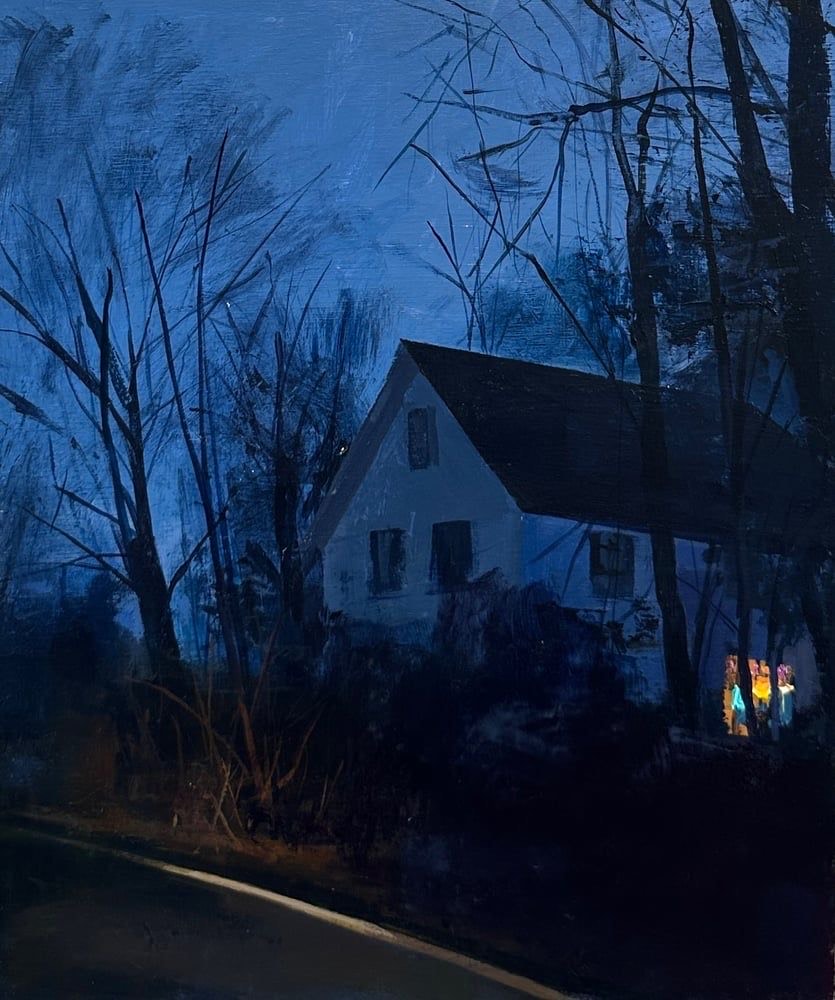
Abigail Pfeifer
They’re waiting on me. I’m late and I need to leave now, but I’ve sunken into the floor, the foundation, the earth below. It’s all too heavy to push off. I can’t move.
“Get up,” Dad says.
I can’t move. The sofa cushion below me is damp with drool.
He jabs my shoulder. “Up.”
He rips away the jacket I’m using as a blanket. Morning air pierces my skin like hail. “No no, no nono no no.” I tuck my arms under my body and curl into a ball. “I can’t.” “Stop whining. You knew we had practice this morning and you went and did stupid shit anyway. Made all the wrong choices.”
Everything was right, though, until that last shot. I’d been teetering sweetly on the edge before then. Until I hurled myself off. Always do.
“Sorry,” I say into a pillow.
“You’re not. And I’m not either.”
My nails cut into my palms. It wakes me up a little.
“Car in ten,” he says. Then he’s gone.
I sit up. I know what will happen if I don’t get in the car, don’t run. He’ll leave without me. I’ll sleep for another three hours. He’ll come back and not say a word. I’ll go to my room, sleep more, scroll on the computer until the space behind my eyes starts pulsing. Then dinner, more or less silent, maybe some questions about school or Alice. Nothing about last night or me bumbling in at two, nothing about the training session I missed. I’ll be the first to crack, I’ll say something safe, like did Nate show up? Did he make up some ailment to get out of shit like always? Dad’ll answer, detailed and animated. He knows how to tell a story. Quiet again then I’ll finally start. Nosedive into the grimy pool we’ve been dancing around. It was an off day, I’ll say. It would’ve been a shit practice anyway, not even worth it, won’t happen again. He’ll say he’s not keeping me in it, you can quit if you want, there’s no point if you’re miserable. I don’t want to quit. I don’t. Then stop acting like you do. Empty hours. This is the one thing you’re good at. What are you without it? Drown out all the noise with a police procedural. Probably an episode I’ve already watched. A detective gets kidnapped, and the rest of the team has to race against time to save her. They trace calls and decode messages hidden in sonnets sent by the serial killer. Everyone starts yelling at each other, swinging dicks, losing it. They’re too close to the case, they shouldn’t be working it. But they break procedure because they care. Their friend’s in trouble. They don’t want her to die. I’ll miss the rescue operation and the final shootout. I’ll already be asleep with my earbuds still wedged in.
Not worth it. Never worth it. So instead I stand and tie my hair up, ripping my fingers through matted knots. My breath comes faster. I swallow the nausea.
I tie my sneakers as tight as they’ll go. The knotted laces dig into the top of my feet. The heat’s on full blast in the car and we don’t talk. No radio, either. Just the sound of the blinker and the engine and the snowslush spin of the tires.
____________________
We park at the track and it’s bright, nearly glowing under the floodlights. The rest of the team’s already there, fidgeting to keep the cold at arm’s length.
Alice looks at me then looks away. I called her last night and left a voicemail. I might’ve been crying. Was definitely wasted. This is how we communicate now.
I fucking chuck it. See? See? There.
My body’s vibrating, singing. My thoughts are watery. I can’t hold them long enough for anything to form.
Dad gives me a “good,” but only once. He gives Nate pointers about his technique for the whole practice, though. I run so hard I feel the impact of my feet hitting the ground all the way up through my jaw.
It’s not enough. I gave too much too early. Alice beats me on our last rep. I scream and kick the fence. It feels good but only for the split second before the ache sets in.
Dad sniffs.
Alice walks over, hands laced behind her head, chest heaving. “Are you okay?” she asks. I’m leaning on my knees, still catching my breath. “You’ve been saving up…. all morning….just to do that on the last one.”
“I haven’t.”
“I’m fucking better than you. That doesn’t mean anything.”
Alice goes to stretch, but she keeps glancing back at me. Trying to get a glimpse of the flipped eighteen-wheeler on the side of the interstate. She has to move on, though. Eyes forward or she’ll wind up in that ditch, too.
I watch from the car as everyone files out, thanking Dad. He locks up.
“You could’ve beat her,” he says. “You got sloppy on the last hundred.”
He idles in the Andover cul-de-sac and waits for me to get out.
Before he can say more, I start. Dad stays in the car, driving it alongside where I run on the sidewalk. It’s stopped burning. Now it just feels like nothing. Like floating. He calls out my pace and it’s not enough. It’s never enough. I stop. Legs wobbling, I fall and land hard on my ass. Bone meets cement.
“We’re not finished,” he says.
“I’m done.”
“You want a repeat of today? You want to keep getting beat? You want to feel like this again?”
Not enough. Never enough. I start again. Two more loops around the neighborhood. Three more. I trip on the fourth and skid forward on the heels of my hands. The icy concrete scrapes off skin. My wrists nearly bend the wrong way. I prop myself up with an elbow and vomit.
Dad crouches next to me. The car’s still running. Exhaust flows into the sky. “Let me see,” he says.
I hold out my hands. They’re shaking and wet with blood. Dad turns them over gently and rolls my wrists around.
“You’re alright, bug.” He hauls me up by my shoulders, wipes my mouth with his sleeve, buckles me in. “I think that’s plenty for now.”
____________________
“Slow down, M,” Alice says.
She doesn’t do parties. I didn’t expect her to be here. I wouldn’t have come if I did. Morning practice, when I last saw her, feels like a week ago. My throat burns and I breathe fast in and out through my nose. The bottle suctions my lips. They lose circulation as I drain the last of the drink. I swallow the air that bubbles up from my stomach, and it lodges somewhere behind my sternum.
“Why are you hovering?” I ask. She stands with her arms crossed like the old lady on the corner of Strawn and Hillside shuffling outside to get her paper.
“You’re kind of freaking me out lately.”
“I’m fine.”
I root through Dill’s ice maker and crunch a cube between my molars. The screeching nerves steady me. I move toward the living room. Alice is still there with a sour notch between her brows.
“If you want to go home, Alice, just go home,” I say.
“Come with me. This sucks anyway.”
“I’m staying. Do what you want.”
A few girls I know from class huddle in a corner. There’s a gap in their circle, and I imagine myself walking up to them, filling it. They’ll smile, whole-face genuine. Their eyes’ll get a little brighter.
Alice asks, “Does your dad know you’re here?”
“Can you fuck off?”
“You know. I’m tired of your shit. I’m done. You’re mean and–and…you’re just mean.” “Okay, Alice.”
“I don’t know why you text me and say you’re sorry and you want us to be good if you turn around and do this every time. So stop doing that. You can fuck off.” “Okay, Alice.”
Then she’s gone, I’m free, let the night begin. I linger behind the group I’d decided on, close enough to hear their conversation. I wait for them to say something I know how to respond to. It’s not promising.
Ryan B’s shoulder smacks into my face and I bite my tongue. Some of his drink sloshes over the edge of his cup and soaks into my shirt. The shock of it makes my eyes water. While he’s getting his bearings, before he can figure out if he hit a wall or a person, I shut myself in the hall bathroom. I don’t want his sloppy apology or his blank expression when he can’t remember my name. I know my way. Earlier, I laid on the cool floor and found patterns in the tile while I waited for everything to kick in.
There’s a body in the bathtub. I flinch when it sits up and looks at me.
“…Sorry,” I say.
“Shhhh.” She blinks. “Too loud.”
I reach for the knob.
“No,” she says. “Stay.” She beckons with a hand. I sit on the toilet. She shakes her head, flaps her fingers some more. I step into the tub. She nods and pulls her legs to her chest to make room. I hunch forward so the faucet doesn’t dig into my spine.
She asks, “Why are you upset?”
“Someone ran into me.”
“Okay.”
“Why are you in the bathtub?”
“It kind of makes me feel like I’m in one of those log flume sleds from the Olympics.” She presents a wrinkly bag filled with rainbow gummies. I choose a blue star. The ceiling spins.
____________________
There’s pounding on the door.
“Cops are here!” someone says.
It takes me a few tries to get out of the tub. “Come on.”
She says, “I’m good here.”
“You’ll get suspended or expelled or something.”
“Bye, Mommy.”
I put my coat on backwards as I run out of the house. Mud snatches at my shoes and does its best to pull them off, but I’m gone I’m gone I’m gone. Into the woods, legs eating up ground. I’m faster than everyone, nobody’s better, I’ll never get caught.
I duck under branches and sidestep divots in the ground that wait to twist my ankle. I swear I have night vision.
“M! Mary!” Someone stumbles behind me. I whip around. The motion makes me queasy. “Jesus, Nate!” I say.
“Sorry, sorry…I didn’t…” He wheezes. “Didn’t mean to scare you.”
“What are you doing?”
“Same as you.”
“Going home?”
He nods.
“Can I come?”
“Fine. But if coach asks you were never there.”
“No shit.”
____________________
Nate pauses his video game. His character’s hidden in a bush preparing to snipe an enemy. The TV screen bathes the basement a pale green.
“You’re gonna get your ass handed to you,” he says.
The carbonation from the vodka Coke makes me feel like I could float away. “He’d still shit all over me if I stayed home and went to bed at seven,” I say. “He’d find something.” My legs throb. They’re still fucked from this morning.
Nate flicks at the Xbox controller. “Yeah if coach was my dad I’d be getting hammered, too.”
“Well, do it anyway so I’m not bored. You need to get on this level.” I pass him his can. Later:
“Nate do you think I’m a hard worker?”
“What?”
“Do you think I’m a hard worker?”
“You’re the fastest girl on the team. You grades are—”
“That’s not what I asked.”
“Yes, obviously you are. I don’t think you can do what you do without working hard.” “Dad— I mean coach says I only give eighty percent. Says I can be better.” “Eighty percent’s a lot. I don’t think I’ve ever given eighty percent to anything I’ve done ever.”
I straighten. If I touch Nate’s hair, it will probably be soft.
“Why are you looking at me like that?” he asks.
“I’m just looking,” I say.
“Do you wanna make out?”
“I think maybe.”
“Okay.”
“Okay.”
We stare at each other. He doesn’t move until I do. I keep my eyes open and watch his lashes flutter. He pulls away.
He says, “I–I don’t think… This isn’t… Your dad’ll kill me.”
“Yeah,” I say.
We don’t talk any more but I stay until he falls asleep on the sofa with his arms cradling his head. I go out his sliding doors. It’s snowing. Heavy flakes, big. They’ll stick. In the morning the ground will be covered.
I claw a hand through the grass. There’s not really enough to roll a snowball, but I try. Water drops trickle down the lines of my palms, stinging the cuts there. I hurl the ball at the brick side of Nate’s house and it bursts and breaks apart in every direction. I mold another, and another, sliding one into my pocket to see how long it’ll keep. I toss the other straight upward and it lands softer than I expect. My shoes leave prints on the sidewalk. I jump as far as I can, then shuffle my feet without lifting them off the ground, connecting the pairs of prints with straight lines.
On a pole, I see the individual flakes. Their delicate points and perfect symmetry. (See this, buggy? No two are the same.
They’re actually pretty like that? I thought snow was round. Just all pretty in movies. He smiled, pointed to one. Clear as day against a black mailbox.
Nope. Real life, too. )
The block is dark. One side of my coat is wet now, the snow melted into the fabric. I’m shivering but I feel hot. Like I need to strip a layer. I wrench off my jacket, drag it behind me. Just a thin sweater between me and the winter.
The long way home is still too short. I’m standing on the porch, frozen. I can’t get the key out of my pocket, can’t fit it in the lock, can’t go inside.
I sit cross-legged in the yard. Snow seeps into my jeans. A flake catches on one of my eyelashes and the world is half-white until I blink it out.
The kitchen light snaps on, and I can’t see him moving around with the blinds closed, but I know he’s there. Wiping down the counter, maybe cleaning out the fridge, leaving crusted old glass jars to soak in the sink. He doesn’t sleep. Hasn’t for as long I can remember. I’m just like you, now.
There’s a picture of me from when I first started cross country. I’m holding the first ribbon I ever got. It’s pink or something. A participation prize. Back then, my ponytail was stubby and my face was my father’s. I was always called his spitting image.
I used to be so proud, Dad, when they said that. I was so proud for everyone to know that I was a part of you. And you were proud, too. You’d put a hand on my shoulder and look down at me with a crooked smile. Maybe a wink. But you lingered for a second too long on the slope of my nose, the curve of my chin. It was like you were checking that they matched yours. Like you weren’t convinced that you–you–had brought me into the world to cling to your side. “Mary?”
The front door opens.
“What are you doing?” he asks. “I was worried.”
I’m quiet. I haven’t spoken in a while, and I don’t know if sound will come out of me now.
“Come inside.”
I shake my head, cross my arms. Like a toddler would.
He goes in, and without the warmth from the hall light, the snow seems gray. My socks are soaked through and the wind makes my nose run. Snot trickles down my nostril and I suck it up.
Footsteps behind me. Dad’s in his boots and coat. He holds out a hat and sweatshirt for me. I take the things but don’t put them on. He grunts as he lowers himself beside me. “Where were you?” he asks.
“Nate’s,” I say.
“You’re drunk.”
“No.”
“Yes.”
“Fuck you.”
“What was that?”
“Fuck you.”
He exhales like he’s trying to push something out of him. Something stuck deep in his center. “Why are you doing this?” he asks.
“Not doing anything.”
“It’s my fault.” Dad zips his coat up as far as it’ll go. I wrap my arms tighter around myself.
He says, “Your mother always said I would ruin you.”
“Do you think I’m ruined?” My teeth sink into my bottom lip. I taste blood. He gets up. “I just…” The snow comes down steady.
Abigail Pfeifer (she/her) is a student of English and creative writing at UT Austin. She was a member of Texas’ NCAA Division I Swimming and Diving Team. Also, she enjoys baking and trying new coffee shops around town.
-
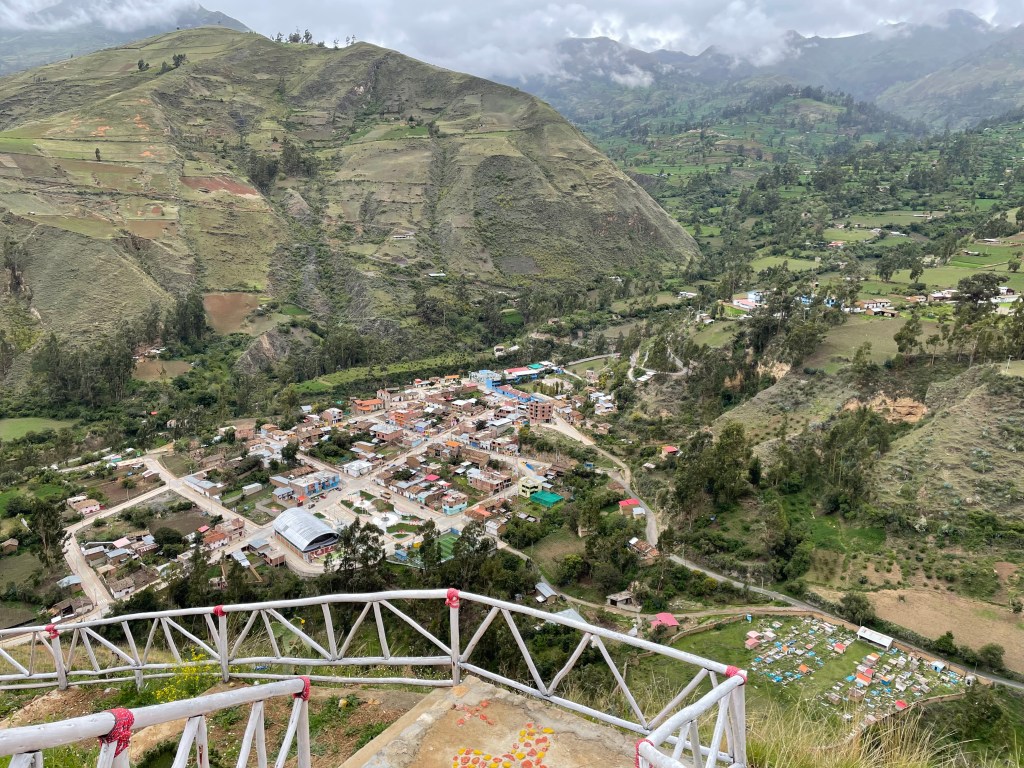
Jacob Keiser
For dinner, there are tubers, some yellow with flakes of pastel pink, and the rest are deep purple. Their skins are soft, and several have split, spilling steam that smells of heavenly dirt. Abuelito is standing over me. He puts a third potato on my plate and commands me to eat.
“Listen, or he’ll bring more,” says Valeria. She smiles and flicks my tummy. Abuelito finds this funny and gives a faint laugh, more cough than chuckle. He hobbles to his little chair and sits across from us. I know he’s looking at me expectantly, though his face is half covered by a stack of sandwich bread.
Andean hospitality and the mythicized appetite of Americans compound dangerously. I’ve eaten enough food in the town of Chinchihuasi to make my belly noticeably larger.
I grab the smallest purple tuber and take a timid bite. Abuelito laughs again, this time harder. He’s shaking his head, saying “veneco, veneco, veneco…”
I glance at Valeria.
“He’s calling you poor.” She looks embarrassed. “It’s because you didn’t peel it.”
“Ah.” In Peru, only slum-dwellers and indios eat potato skins. I start peeling, but it’s too late. An American desperate enough for pig food must be ravenous! Abuelito grabs the offending tuber and throws it into the rubbish bin. He gestures for me to grab some bread.
It’s white sandwich bread sold in plastic bags. The brand is Limean, made with wheat grown in North Dakota. It’s a little stale and more expensive than Chinchihuasi bread. Abuelito has money to spend and food to waste. His garden is ever bountiful, and his eight children have long left Chinchihuasi.
Valeria squeezes my leg and rests her head on my shoulder while I press a bit of potato flesh between two slices. Her head is sweaty, and her skin is unusually pale.
“Are you alright?” I ask.
She nods her head.
“You look sleepy.” I smile.
“I am a little.” She smiles back.
I take a bite. It dissolves into a starchy mush. Desperate for flavor, I reach for the little porcelain jar at the far end of the table. It’s filled with salsa de Rocoto, deliberately placed away from the gringo who will never learn to handle it. I smear a little on and wince as I chew. My tongue is shriveling, and I feel like I’ll die. Valeria has already passed me her mug. The drink is warm and filled with a third carbohydrate, ECCO roasted barley—a subsidiary of Nestle and perfect for hard-working farmers and stupid Americans. It’s coffee-brown and smells like plain oatmeal.
Now Abuelito is dying with laughter. His knobby shoulders shudder as high cheekbones pull up, stretching his lips and hiding thin eyes in rolls of brown wrinkles.
Valeria pulls me closer to her while the barley washes away the Rocoto flakes. I hear her breathing slowly and deeply, like she’s trying to smell me. Her chin is quivering, and I think she’ll cry again, but she only smiles and says, “I love you.”
Abuelito calms down when he starts coughing.
“Abueliiiito,” says Valeria, “El pescado!”
His eyes widen. “Oohhh.” Abuelito slowly stands. He bites his lip and winces. Some weeks ago, his leg was hurt in a farming accident. Abuelito has money and does not need to work the land, but he is stubborn and has lived off his plants for too long. Valeria says each would wither without the other. I know she feels guilty. Tomorrow morning, we will return to Valeria’s home in Lima. It’ll be a while before she can visit again, and no other family will come. They have their reasons, and I cannot say I disagree with them. I look at the old man. He’s so thin and angular. Abuelito can’t be younger than ninety. How do you look at a man you know will die before you ever see them again?
There is an understanding between Valeria and me, one established long ago. Her exchange program in the United States has ended, and I cannot run away from my life and move to Peru. This is our goodbye trip.
Abuelito shuffles to the kitchen, where a portable gas stove sits on the red clay floor. On the stove is a little pan filled with tuna, an onion, and diced tomatoes from the garden.
I clear my throat. “Should we…” It feels wrong to stay seated.
“No, no.” Valeria shakes her head. “It’s rude to make guests work.” As she spoke, however, Valeria was already standing and sneaked a kiss on my cheek. She grabs a clean plate and crouches next to the stove. Valeria is the old man’s granddaughter, and she’s a woman. Helping with food is expected.
My belly is close to bursting, but still, the tuna smells divine. Peruvians love their fish, even deep in the Andes. Their tuna is canned in oil and bits of garlic, which makes it rich and creamy. American brands are canned in water and use too much salt.
Abuelito spoons the tuna onto the plate, and Valeria sets it on the table. He pours warm water and hands me a bowl of bitter herbs from his garden. She has not told Abuelito what will happen. He would not have hosted us if she had. He would say, ‘Why show him to me if things are to end?’ One does not show a boy to their abuelo lightly, but Valeria said she wanted this. I am her first boyfriend and likely the only partner of hers Abuelito will see before he dies. She wants him to have these memories, but secretly, I suspect she also wants them. For me, I think the plane ride home will be long and miserable. Abuelito often talks of marriage.
Valeria rubs her bloated stomach. Dinner is set, and neither of us has recovered from lunch. For our last day in Chinchihuasi, Abuelito spared no expense. He took us to Texas City.
***
Surrounding Chinchihuasi is Our Lady of the Mountain Sumaqanka, a ring of mountain peaks that form the shape of a woman lying flat on her back and staring into the cosmos. Halfway up her bosom is Texas City, the best restaurant for miles. It’s covered in American iconography and many posters of women in bathing suits.
Abuelito ordered their most expensive meal for us, ceviche. It was raw trout caught from Sumaqanka’s streams. The fish was served with toasted corn called Cancha and potatoes with splotches of white and yellow and flecks of black. There were also sweet potatoes, which Abuelito found revoltingly small. Those in his garden are thrice the size! Finally, the server placed a large pitcher and three bowls on the table. It was alcoholic Chincha. Abuelito filled our bowls.
For breakfast, Abuelito’s neighbor brought thick slices of roast squash. We ate it with rice and leftover Cui, battered in cornflower. I looked down at my plate, my belly moaning in protest. “How much do you think the fish would be back home?” I asked.
Valeria was looking into the bowl of Chincha.
“Forty, fifty dollars?” I sipped the Chincha. It was strong.
“At least sixty.”
Abuelito quietly stuffed his mouth with fish and periodically drank from his bowl. On the table, he had piled his potato skins and the Cancha kernels that were small or burnt.
I took a bite of ceviche and turned to Valeria. Whenever I try something new, she asks what I think, but her attention is still on the Chincha. “Wow!” I said. “I don’t think fish is meant to taste this good.”
Her ceviche sits untouched. “It tastes better without the microplastics and Imperialism.” Valeria looked up at me. “You’ll miss it, the food? That’s what I missed the most.”
“Yeah,” I looked down at my plate. “It’s much cheaper and less greasy.” I take another bite. Surely, there were other things I could say, but I didn’t. I know what I will miss and that nothing can be done about it.
Valeria nodded her head slowly. Raising the Chincha, Valeria closed her eyes and drank deeply.
We ate and drank bowl after bowl, making us very sleepy.
When it was time to pay, the owner, delighted to have her first authentic American, gave us a discount. Before we left, she brought out a jar of something orange. She said it was salsa de Ají Qasqu.
“Bring my Ají Qasqu to the United States and make many good things with it,” said Valeria, acting as translator.
The owner smiled and pressed the jar into my hands. She spoke again very happily.
“And when you come back, bring me some real American barbeque.”
***
Abuelitio drives us in his shabby car that coughs and sputters like him. Its tires are old, and the mountain roads are nothing but dusty gravel.
I look out the window drinking the landscape. When we leave tomorrow, it’ll be early morning, too dark to see. Valeria shuts her eyes and nuzzles her head into my lap. I place one arm across her belly and the other under her head.
Chinchihuasi is a land of eternal spring. Pastures blanket the valley, crisscrossed by streams and groves of avocados. As Sumaqanka steepens, she becomes geometric, a patchwork of terraces filled with freshly planted corn and very legal coca. Above the terraces are potato patches and great squares of alfalfa. A thousand souls feed off Sumaqanka. Little clumps of houses clutch to her ridges, stubborn as their inhabitants who are very old. We see them on the road. Most are women, squat, and very short. They wear long braids and bowler hats adorned with orchids, some unknown to botanists. Their skirts are bright and their quipis colorful. The women come from the fields carrying crops and animals for their families. Abuelito stops for a little abuela and lets her in. She holds a headless chicken and has a sleeping lamb wrapped in her quipi. They chat in Quechua.
I look down, and Valeria’s eyes are open. Her golden skin is pale from the Chincha. She’s staring at the back of the little abuela while the lamb drools on the headrest. Three years ago was when they buried Abuelita. This was two months before Valeria left for America. God, she was a mess when I met her. Those were the hard days, but she got better. We got better. It was easy to love and not think about the future. Valeria’s holding the jar of Ají Qasqu, turning it slowly like there was a secret about it. Her knuckles are white, and her eyes are moist. I try to think of something to say but cannot. I’ll be gone so soon, and words are wind. Instead, I hold her tighter. I will miss her weight on my lap.
We wind down Sumaqanka’s spine and onto her leg, curving eastwards through wild groves of eucalyptus. Her foot delivers us to the valley, where streams burst from her rocky toes. A group of tíos waves from the water. They are waste-deep, and their nets are full of splashing silver.
After the avocado fields, we reach the town outskirts, where gangs of puppies trail the car. Chinchihuasi dogs aren’t mean like Limean dogs. Most have owners and are yap-yap dogs rather than the dreaded bark-bark, or even worse, yip-yip ‘dogs’ (it’s actually factually proven that chihuahuas are rodents). Abuelito drives slowly, and the people on the streets wave at us because everyone knows Abuelito, and very few know me. The only other gringos are a pair of Polish priests who run the church. They are very tall, have red hair, and speak terrible Quechua, worse English, and no Spanish. Everyone pretends to understand them at mass. Valeria suspects they’re lovers.
Abuelito stops the car, and the little abuela gets out, thanking us all.
Chinchihuasi is built around a central asphalt road that curves along Sumaqanka. Jutting out are smaller cobbled lanes with homes and little shops. Many are empty, and others are ruins. They are covered in cacti that thrive in decomposing adobe blown open by dynamite and RPGs. In the 1980s, Chinchihuasi was torn open by Shining Path rebels and government forces. Many, including Abuelito and his eight children, fled, making new lives in Lima or Huancayo. Only the old have returned. Valeria sits up, her eyes now clear. I hold her hand, and she responds by chomping my nose all cutesy. “I love you,” she says. I know she does.
I think I love Valeria, but I know I fear finality. I do not want to date long-distance, but I fear her absence. I don’t know if Valeria’s understanding fully matches my own. Is there a concrete stance for Valeria to match? This is our goodbye trip, but neither of us has called it that yet. The only comfort is that there’s nothing to be done. It is a cozy veil that’s suffocating. Tomorrow, we will leave Chinchihuasi, and two days from then, I will be on the plane.
We come to the central plaza, lined with municipal buildings and the church. In the middle are two large statues, a man and a woman. Valeria scoffs. They are Santiago dancers dressed in local finery. Their hair is light brown, and their skin is white. She’s written three papers about them.
Abuelito turns onto a side street and reaches his home. We will rest for several hours, then convene for dinner. Before we enter, he buys the sandwich bread and canned tuna from his neighbor’s window shop.
We follow Abuelito into his large compound of a home, surrounded by thick adobe walls. Attached are many buildings, enough to house twenty people. In the center is an open space, every inch filled with plants with purposes. Abuelito goes straight to the potato patch blooming with purple flowers. They blanket a low mound of earth from which thrusts a tall stone cross. Even in death, Abuelita provides. The old man sinks to his knees and starts pulling potatoes.
***
I spread the tuna just enough to wet the bread. The sandwich is further thickened by a yellow potato, mashed, and mixed with a white-friendly quantity of Rocoto. Valeria covers hers with a healthy coating of the Ají Qasqu, and Abuelito dutifully eats his tubers plain.
The fish I must ration carefully. The meat-to-carb ratio in Chinchihuasi cuisine is low, and if I finish the tuna before the carbohydrates, Abuelito will be embarrassed and will fry me an egg.
Dinners are challenging with Abuelito. He gets tired early and, unless prompted, will keep to himself. I would talk with Valeria, but it would be rude to exclude our host. My Spanish is not terrible, but Abuelito’s Quechua accent is thick. I think he finds my gringo accent equally incomprehensible. Still, it’s my last meal in Chinchihuasi, and I do not want to eat in silence. I nudge Valeria.
She looks up from her heavily sauced plate. Strands of loose hair hang in her face, bound together in wet clumps. Why is she sweating so much?
“Those statues…”
“The Santiago dancers?”
Valeria’s told me all about them. They were erected some fifty years ago by Abuelito’s brother, who was mayor. I nod my head at the old man. “What does he think of them?”
Her face furrows into a mischievous smirk. “Do you want me to ask him why they are white?”
I grin and shrug. Valeria’s condition is probably just indigestion from the high altitude. She asks the question, and Abuelito’s tired eyes sharpen a little.
“I was working as a doctor,” says Valeria translating. “The dancers came from Huancayo. The department was paying them to go to little towns, and I wanted Chinchihuasi to have a real statue because every city needs a statue. So I told Miguel—that’s his brother—to put one up, and he did. We all came together—I don’t think he understood the question—and made the man.” Valeria pauses, and to my surprise, Abuelito keeps talking. “Then I became mayor, and I built another statue, the woman. I thought the man was lonely.”
Abuelito points his finger at me. “Cada hombre necesita una buena mujer.”
“Every man needs a good woman,” says Valeria.
Abuelito is looking me up and down. I take small bites of bread. He’s trying to read me. What for? He can’t change the plane tickets. I can’t move to Peru. I quickly glance at Valeria. Her beautiful brown eyes are calm, too calm. God, she’s terrified.
I try to redirect. “¿Què otra addiciones haces a la estatures?”
Valeria laughs a little too hard and translates the question correctly: What other additions have you made to the statues?
Abuelito looks down at the food. “Después de que los terroristas colgaron los cuerpos, se cubrieron de sangre. Los volví a pintar.”
“I repainted them.” Valeria clears her throat. “Why don’t you tell us about the Inca and Huanca!” The Huanca are this area’s native culture.
A look of pure satisfaction erupts on Abueltio’s wrinkled face.
“Tawantinsuyu—the Inca—tried to kill us,” translates Valeria, “but we fought back and won. They killed everyone around but not us, Huancas. We were protected by Our Lady Sumaqanka.” Valeria gives me a smirk. Abuelito loves Chinchihuasi history but is wrong. While never fully incorporated, the Inca formerly subjugated the Huanca, but she doesn’t tell him that.
Abuelito’s face shrivels like he ate something tart. “Malditos cobardes.”
“Cowards,” translates Valeria.
“Sumaqanka siempre protege,” his eyes are distant. “La abandonamos. Ella te proveyó y tú la abandonaste.”
“Sumaqanka would have protected us.” She bites her lip. “¿Estás bien, Abuelo?”
The old man shakes his head but continues. Valeria nods along but does not translate. Abuelito clinches his jaw. “Dile lo que yo digo.” He wants her to translate.
Her eyes fill with unease, but she speaks. “Chinchihuasi was so big,” says Valeria. “There were many families. Now, they are all packed in cities like anchovies.” She is breathing heavily. I see her hand twitching. She sees I see and moves the offending hand to scratch her leg.
Abuelito says more.
“Without Sumaqanka, they will wither away, and she will have no one to love. Her forests will fall. Her fields will rot. Chinchihuasi will be weeds and dogs, and Sumaqanka will die of sadness.”
Now Abuelito is looking at me. His chin is quivering.
“Chinchihuasi needs young people.” Valeria is staring at her cold plate. “It needs children. The quiet has killed more than the terrorists.”
I reach for my plate and find it empty. Somehow, I have eaten it all. My throat is bone dry, and the water is tepid.
“I cannot blame them,” translates Valeria, “the people who left. I made my money in Lima like everyone else. When you find love, it lays you a path. I walked off mine again and again and again, but it will drag you back.” Her body is still, except for her hand, still scratching.
I wait for Abuelito to blink, but he does not. He speaks and stares.
“It dragged me back screaming. It dragged me back…” Valeria stops. Abuelito’s Spanish is incomprehensible, but I catch a name. He speaks of Abuelita. Valeria is trembling, but Abuelito doesn’t stop. He’s no longer looking at us. The old man stares past us. What is he looking at? “When you find love,” Valeria closes her eyes, “you grab it tight and let it pull. You keep your grip strong and don’t ever let go.”
Abuelito’s eyes are wide as saucers. He is desperate. He knows the gringo will not marry his granddaughter half a world away. He knows because he wouldn’t. Valeria has told me. Theirs was an arranged marriage. Abuelito had a job in Lima and could speak Spanish. Before they married, Abuelita had another lover driven from Chinchihuasi by her father. Some say he was shot. Abuelito was unfaithful and was aggressive when he drank. After fleeing Chinchihuasi, his children moved far away and will not speak to him. Now his wife is dead, and the silence will kill him. Abuelito’s gaze lowers to his plate. It is half-full and cold.
“Hey.” I reach for Valeria’s leg and squeeze it reassuringly. “You okay?” Her leg is wet. “Valeria?”
She looks down, and her eyes widen. “I need to use the restroom.” She stands suddenly.
“Valeria?”
“I love you.” She excuses herself to Abuelito and leaves the kitchen.
I’m about to follow, but then I see the blood, a thin sheen on my palm—a spike of cold shoots through my belly. My body is petrified. Valeria has always had a nervous tick. She must have scratched her legs bloody.
“A-Abuelito?” I raise my bloody hand. “Es de Valeria’s pierna.”
The old man nods his head. “Ella es así.”
“¿Q-qué?” What?
Abuelito says each word slowly and clearly. “Muy nerviosa.” Very nervous. “Valeria es una chica muy nerviosa.” Valeria is a very nervous girl. Abuelito stands, groaning softly in pain. He starts gathering our plates.
I also stand, my heart thumping so fast it hurts. The blood is sliding down my palm and into the crevices of my fingers. “Ayuda para Valeria de medicas?” There isn’t a modern hospital for a hundred miles.
“Tranquilízate, chico,” says Abuelito. I think he wants me to be calm. He gives a tired laugh. “He visto más sangre. Chinchihuasi ha visto más sangre. Ñuqayku Huancayku Sumaqanka kutichipuyku…” He trails off, murmuring in Quechua and bits of Spanish all jumbled together. He dumps the plates in the sink and grabs a first aid kit.
Why is he so calm? I slam my bloody fist into the table. “WHAT DO WE DO?”
Abuelito gives me nothing but an uninterested look and puts on his jacket. I follow him outside. It is dusk on the verge of night. I can see light and distant movement coming from the outhouse.
“Abuelito.” My voice is shaky. “¿Qué hago? What do I do?
He stops before Abuelita’s cross and gives me a long look that speaks a million words. “Quédate aquí,” stay here, he finally says. Abuelito walks across the garden and knocks on the outhouse door, then enters.
I want to follow him in, but my phone buzzes. It’s Valeria. She texts sorry more than a dozen times and begs me not to intrude. So, I am stuck.
I cannot go to Valeria, nor can I simply leave. I am trapped in the garden’s center beneath Abuelita’s cross and the looming body of Sumaqanka. The blood on my hand is starting to thicken. I drop to my knees.
I grab leaves, vines, and stalks, and I pull, and when I have a fistful of plant, I scour my bloody hand. I clean until I see no blood, but I can still smell it. My bloated stomach screams. It must be on my arms. I remove my shirt and dig my shaking fingers into the soil. I pull clumps of dirt and handfuls of roots, and I scrub, and I scrub, and I scrub, but the smell only grows, which I know is impossible, but it’s there, and I will leave her, and so I must scrub, but it’s only getting stronger, and I’m taking off my shoes when I hear the outhouse door open. I jump to my feet. Abuelito comes out and gives me an incredulous look.
“Sangre,” blood. I gesture at my filthy body like it would make me look less insane.
To my surprise, Abuelito laughs. It’s a long and wistful thing. “Sí gringito, sangre.” Abuelito says nothing else. He shuffles past me and retires to his room.
There is quiet except for a mountain breeze that makes me shiver. I really must find my shirt, but before I can, the outhouse lights snap off. My body freezes. I see only her silhouette.
“Are you covered in something?” says Valeria.
I don’t respond. It’s not blood I smell, only Chinchihuasi dirt.
She comes to me and buries her face in my chest, and I press my cheek against her head. I pull her tight, and together, we rock.
“I’m okay,” she says. “I’m okay, I’m okay…” We sink to the ground.
The last bits of light are sinking behind Our Lady of the Mountain Sumaqanka. Her body is pitch black, the sky above a little lighter. The ridges form a single perfect line. I trace the tip of her nose down the gorge of her neck, up again for her breast, then down gently across her belly and leg.
Valeria and I lean on each other. Her eyes are shut, her heartbeat quick. It would be cruel to disturb this moment, but I know one of us must. When I speak, a lump forms in my throat. I manage only, “Hey.”
Valeria nuzzles her body closer to mine. “Hi.”
“Your leg…” I see it wrapped tightly in gauze. “I think some things have been unspoken about us, about this trip, and what comes after. By not talking about them, I think some tensions have been caused, and,” my body shutters slightly, “I think we should talk about them.”
Valeria says nothing.
“My understanding is that once I leave, our relationship will end. I don’t know if this is your understanding, and I do not know if you agree with it.” I take a deep breath. “Honestly, I don’t really know what I think. Selfishly, I think I’ve been thinking more about what you think, so I don’t have to think about what I think as much, and that just makes it harder for everyone.”
Valeria says nothing.
“I don’t know if we can agree before I leave. If not, then just an understanding, something we can work off of—” I stop when I see Valeria shaking her head.
“You’re right,” she says. “It is healthy, and responsible, and necessary.” She is crying. “I want to, I want to, I want to…”
“But It’s been a long day.”
“I’m really fucking tired, and I’m really fucking full.” Valeria smiles. There are so many things contained in a smile. “I’m going to hate tomorrow. I’m gonna hate it so much. I just want tonight. Can I please, please, please, please have tonight, just one night, and we don’t need to worry about anything at all?” She looks up at me. She is scared, and I am scared.
I grab her head and kiss her. We fall into the dirt and are content because in Chinchihuasi, at this moment, time is liminal. We stare into the cosmos with Our Lady of the Mountain Sumaqanka and everyone else who is looking.
Jacob Keiser is a junior history major minoring in the creative writing certificate program. He is unpublished but has worked on several history manuscripts as a research assistant, several of which are in the process of getting published. Finally, he is an aspiring author working on my debut novel, an original epic adult fantasy book, an undergraduate history thesis about the historiography of the Ethiopian Empire, and various short stories.
-

Reese Beebe
I only have one secret. It’s the thing that comes in the night. As I lie flat on my mattress, I expect her. I brace myself for her warm breath, her cool touch, the way she hovers over the ground, footsteps so light they do not seem to exist. I study the grooves in the popcorn ceiling to distract myself, finger the old quilt blanketed over me. To the rhythmic droning of Abuelo’s snoring in the other room, my eyelids flutter shut.
The shadow beast meets me in the alleyway behind the old arcade, always the same place. She does not have a face. Yet I know she is me, I am her. I’m leaning against a red brick wall that’s damp and warm, like the summer air. The shadow beast moves closer to me beneath the violent gleam of the lone street light. She is me, I am her. I hear Mama’s favorite song playing somewhere far away. I hear the scrape of cars speeding down the highway. She comes closer, closer, closer. Her blackened hand cradles the side of my face, and I can feel it is wet with blood. Her fingers meet my lips, then my neck. I taste the blood in my mouth, the tang of overripe berries and strong perfume overcoming me.
I know you.
She doesn’t say it, but I hear it. I know it is meant for me somehow.
I know you. I say to the shadow. I know you.
Then I brace myself, squeezing my eyes shut as her grip tightens around my throat, as jolts of pain shoot through my veins. It has to hurt. There is no other way. I understand this now. Then I awake to sunlight teasing my eyelids and the sound of pots clanging in the kitchen. She is gone.
I do not feel at home in myself. Never have. It’s a scary thought, but one that constantly follows me around, follows me to sleep, follows me up to the loft of the barn. We sit in a circle amongst stray hay and mayflies, the Texas heat bringing a suffocating stillness to the air, even in the dead of night. The dull moonlight streaming through the open window paints our skin with a milky, watercolor white. The inside of my cheeks taste of cheap tequila. Alex sits beside me. The boy is made of sharp lines, cigarettes, and deep wells under his eyes. He keeps his hand on the back of my neck, stroking my skin to show some kind of ownership over me. I don’t mind it much when I’m drunk. Lorenzo sits beside him. I see him at school sometimes. All I know about him is that he stole the tequila from his older brother, and we drink it inside his family’s barn.
My eyes wander across the circle to those cherry lips, always cherry. Ines, Ines, Ines. The curly shape of her name flutters through my mind. Her long hair cascades down her back, dark like a black sea, shiny and wet. I can only look at her like this when I’m drunk. Her skin looks too smooth, her laugh too musical, her eyes too soft when they fall on me. I drink from the bottle. Its fire blooms in my chest.
I first met Ines in art class last year. She sat next to me once and then stayed there the whole semester. She used to doodle cats with big, cartoonish eyes. We would spend the entire period chatting about our favorite music artists. She liked the punk bands that I always thought were too cool for me. As she spoke, describing the lyrics to her favorite song, I admired her hoop earrings and the one dimple that appeared on her left cheek when she smiled. I see it now as she laughs at whatever stupid thing Lorenzo said.
He scratches his underdeveloped mustache with yellowed fingernails and gestures for me to hand the bottle over. I do so reluctantly.
“Gettin’ greedy, I see,” Lorenzo grins.
Greedy. Greedy. Greedy.
“Where is your church dress, mija?” Mama only looks at the coffee mug she cleans, hunched over the sink. Water streams from the faucet, tumbling over piles of bowls and plates. I grab the crimson washcloth hanging over the oven door and begin drying off the dishes she hands me.
“I had to wash it,” I say, though I don’t mention why. I don’t mention her, the shadow beast. My hands work mindlessly as I stare out the window above the sink—the old porch swing sways in the wind, covered in amber oak sap and buzzing flies. I don’t think anybody has sat there for years.
“Go put it on. We’re going to be late.”
I don’t mind going to church. Sometimes, it makes me feel clean. As I kneel in the pews, sunlight streaming in through a high window, I almost feel holy. I feel like a good girl. I finish drying off a plate, then hang the washcloth back over the oven. When I turn around, tio Carlos is standing by the front door, a cigarette lazily hanging from his lips. “Morning,” I say.
His sharp eyes rake over my body in an all too familiar way, the crinkle of his crow’s feet, the raise of his overgrown brows.
I am paralyzed there, barefoot on the cold morning tile. It is my fault that my pajama pants cling to my hips. It is my fault that the shirt I wear exposes the adolescent curve of my bare shoulder.
“Valeria!” says Mama, “Go!”
And I do. I walk down the hall at a brisk pace, rush into my bedroom, and close the door tight behind me.
And I know she is angry at me, not for something I did, but for something I am. Something we both are.
The burn of the tequila had felt so good in the moment, the rough scrape of it traveling down my throat, ears ringing with the sweet satisfaction of knowing nothing at all. But the mirror scared me later that night. I stumbled quietly through the door, the agile bones in my body now sticky and lethargic. I locked myself in the bathroom, and that’s when I saw her beneath the eerie flickering light, trapped behind the dirty mirror Mama would ask me to clean the next morning. But everything was red: my hands, my clothes, red and slick, the tile floor, red smeared over the mirror. Only my church dress hanging from the towel rack behind me was clean. A pristine white rose blooming from such a hellscape, floating behind me like a wrath.
My shadow self moved only when I moved. When I approached the mirror, sneakers squeaking over the bloodied floor, she seemed to get closer as well. At first, she didn’t have a face, like always, but the more I blinked, the more her features began to take shape. Soft, doe-like eyes. A strong, wide nose. Elegant, pouty lips. Her skin. Her hair, still the deepest black, the deepest shadow you could think of, but now she was familiar. Ines, Ines, Ines. Yes, she was beautiful.
It had to have been some compulsive, demonic force inside me that forced me to climb onto the bathroom counter. I straddled the sink basin, blue jeans painted a deep merlot as I scrambled closer, closer, closer through the wild marsh of blood. Ines brought her blackened hand to my throat, her other hand caught in my curls. I’d never kissed a boy like that before. It was deep and dark and hungry, but not a greedy hunger, not one that can be satiated with a hardy meal. This was a yearning, a begging for something sweet, a dessert that’s served, savored. Tongues swiping over and in between lips, silky, sweet. She tasted like overripe berries and a hint of tequila. It felt as if we were on the brink of complete osmosis. We would soon disappear as individual, separate entities, and then it would just be this, forever,
over and over again.
I don’t remember pulling away, but I remember seeing her face, though it wasn’t her face anymore. I was looking at myself, caressing my own skin somehow, feeling the frizzy texture of my hair between my fingers.
I felt the fire in my belly arise again, then the burn of the tequila creeping up my chest into my esophagus. I scrambled off of the counter, away from myself, away from her. When I turned around, I came face to face with my church dress, that hanging angel, that ghost. I yearned to reach out and touch it, prayed that it would take me away from here, take me to the clean, pure feet of Mother Mary. Instead, the fire inside me exploded. A thick, black substance dribbled out of my mouth, over my chin, besmirching the crisp white fabric in front of me. It was hot, the rancid tang of rotten berries overcoming my senses.
I know you. I know you. I know you.
It was a mercy to wake up in my bed the next morning, a mercy that I did not remember how I got there. The bathroom was not covered in blood, as I had remembered. It was just as before, somewhat clean, mirror blemished by water droplets. But through that mirror, I saw it. The dress hanging behind me was no longer holy, ghost-like, but now cursed with the dark pigment that possessed me the night before. It scared me to death. It scared me because now she was here. She didn’t just occupy my dreams, my darkest fantasies, my mortifying shame. She was now living among me, haunting me.
Dress shoes clop on cobblestones as we walk out of the church. Mama’s hand snakes beneath my hair, and she adjusts the collar of my dress. I had to wear my old dress. It’s an ugly pastel pink and too tight around my ribcage. Her hands are too cold for summer. They shock me as her fingers graze my warm skin.
Ines stands on the corner by the streetlight. She’s talking to her older brother. He’s checking his watch. The noon sun shines bright on her silky skin, and I think I may die when she smiles at me when she waves subtly.
I wave back, but it hurts. My wave is tainted. It’s a sin. She doesn’t know I’ve kissed her all over. She doesn’t know I’m rotten on the inside.
“Why do you wave at that girl,” Mama’s arm comes down my back, pulling me closer to her.
I watch Ines, her hair half up, tied with a ribbon. She and her brother walk across the street, out of my line of sight.
“She’s my friend,” I say, “from school.”
Mama looks back at her over her shoulder before adding, “I don’t like what I hear about her, mija.”
I look down at the hem of my dress.
“She will go to hell for all that, you know,” she whispers. Then she grabs my hand, almost as if she is about to kiss it. Instead, she inspects my fingernails. “You need a bath, mija.”
I look at my hands, and I see it too. Black. Black dirt caked beneath my fingernails. Black dirt coming to the surface.
Reese Beebe is a Sophomore English major currently attending UT Austin. Along with English Literature, she studies creative writing. She is originally from Fort Worth, Tx. In the summer, she teaches kids singing, dancing, and acting. In her free time, she enjoys baking cookies, listening to Taylor Swift, and playing competitive games of catch phrase with her family. She hopes to be a writer or teacher one day.
-

Wynn Wilkinson
I am driving back from El Paso & have been for three hours. You are quiet; you are letting me drive because the road is open & flat & empty or something, & I am grateful you’re letting me focus on the sun dipping in the rearview, restraining yourself from commenting on my drifting in & out of the lane, hands bloodless & shaky on the wheel. I pretend you aren’t searching for the right angle, that the silence is peaceful. When you finally speak, I pretend that the silence hasn’t ended; your words interlock with the radio, fitting between lyrics like puzzle pieces, like footnotes.
I know this town grounded in a compass…
I think you give up but I can’t tell if it’s you staring at me or the yuccas spattered across the landscape like parade-goers dotting the street, like bodies crowding the street. How can I admit that my every treasured memory was experienced from the backseat, & that now I’m carsick even behind the wheel? Every time I glance at the side-view mirror, envy blooms within me, the only two hints of deep green for miles sequestered in my throat & cheeks. The rhizome settles deeper into my stomach, feeds off the acid. I’m mulching. I think I interrupt you. “Are you hungry at all?”
Asinine. But we both know that’s not what I mean. I mean appetite, I mean the deep pit occupied only by desperate, grasping adventitious roots & bile. I mean we haven’t eaten in so long that we’re emaciated— God, just look at us. But I’ve tried this before, insisted that he who eats My flesh & drinks My blood abides in Me, & I in him, & yet you never budge. I can tell you’re starving— right? I guess in the end I still can’t look at you.
I keep going over it over & over, my steps iterate my shame…
If the New Testament is ever revealed to have its own set of Satanic Verses, I’d not be surprised to learn it was the Devil’s pen which scrawled 1 John 4:12: No one has seen God at any time. If we love one another, God abides in us, & His love has been perfected in us. We are proof of this diabolical incision— the loveless in whom God is a chick pecking at the shell, the rat snake disguised as a lover. But you would never accept this infantilizing assessment, long-chewed but ill-digested, & it slithers back down my esophagus to flavor the simmering pot of vomit. I try again.
“Actually, the yearning isn’t so bad, I think. It’s hot to the touch & it burns to hold. But its extended existence in the psyche or (uh) the soul (or the heart) demonstrates a zest (I won’t
say lust) for life that one can reflect on & receive as generally positive, & like when Mitski sings I love everybody because I love you, one can experience the inverse, wherein because I love everybody…”
I grip the wheel tighter, white-knuckled & desperate for stability amidst the potholes of my own making, for something to hold onto.The asphalt cracks a little more. “Well, I love everybody.”
I kept saying I just wanted to see it, saying “what’s wrong with that”…
We’re quiet for a while, entranced by a distant mesa out the driver’s side window. Mesas are deceptive because there’s no elevational feedback; I mean it’s just flat, cliff face, flat. Consider the mesa-dwelling wolf hunting the mesa-dwelling deer through the thicket. One moment the chase is on, the next moment the chase is vertical, the next moment the chase is over. If I were that wolf, I’d try to draw up a quid pro quo with my prey: You run at 50%, & you’ve got my word that I’ll do the same. Then again, I were the deer, I’m sure I’d skip the meeting & take my chances with the plunge. To each their own.
When you finally speak, you’re so quiet that at first I imagine it, but your voice determinedly peeks out above the radio’s static-backed hum, cautious, probing. I get distracted thinking about groundhogs, how your speech is similarly careful, but you know better than to appear as shocked; after all, you’ve already lived much longer than the average groundhog, even in captivity. At least their shock is expressive, external, while yours is masked… but I cut you off mid-thought to ask you to start over.
“It’s fine, it wasn’t important. I was just saying, that’s how living beings were made: discrete, never merged. It sucks. I empathize. But everyone’s song is their own to perform, right?”
“Well… you’ve never wanted to sing through someone else’s throat?”
I mean mine.
“I like my own throat just fine, honestly.”
I don’t feel undone in a big way…
I want to tell you the sculpture is already complete within the marble block. There’s no need for violence, the chisel & hammer in the glovebox; gradual erosion will do. I am patient. I want to tell you that the way to your heart is through my ears, locked behind mountains of Bianca Carrara, & that every time you speak the bird call sounds a little clearer. I don’t want a
sculptor, I want a river. I want to tell you that I promise, but I can’t. You’re a better liar than me anyways. I nervously swerve around a pothole instead.
“I guess it’s less about attaining continuity with another individual & more about prolonging the anguish of desire. I think that’s noble, at least when the coals of that desire are stoked for all beings.”
“On one coast a cinder, on the other a conflagration. I don’t give a shit you skimmed Batailles.”
I laugh nervously because you’ll never know how sorry I am, & because I feel like your voice wasn’t always this loud.
“Damn, I thought you liked me.”
“If I didn’t, I wouldn’t be sitting here right now.”
I should tell my friends when I love them…
The truth is, I think everyone was right about amalgamated selves before they brought the gross sex stuff into it. I think exposure can look like cruising uncomfortably down I-10 together. It can look like me, anxious in the driver’s seat, sweat in my eyes, fiddling with the radio, trying to find a song that matches your voice. I dare you to agree. If all you wanted me to admit is that the right atrium does, in fact, burn brighter than the other quadrants, then I’d blush & say sure, of course, just a moment. & then bashfully: My everybody is the many yous, a sunflare for each solar system of yous, yous in whom everybody’s seen God & fought or fled, yous in whom God’s love is perfected & shelved.
I got too caught up in my own shit, how every outcome is such a comedown… Now I begin to cry for the first time in three hours (or at least tear up, which is enough for me to have been taught to smother, but I have grown tired of smothering & could use some time off) because I experience a revelation that you carry like a burden: the pious butcher recites Tasmiyah but remains a butcher. The car clatters clumsily through another depression in the road. I drove right into it, preoccupied with images of you called to the light in my heart, nearer to me than my jugular vein, et cetera— you get the idea, you get these visions before I do. The sudden movement jolts us, & your curious ātman splashes unceremoniously— I wasn’t sure you could do that— into my bloodstream. I speak without thinking, which means I really mean it this time: “Sure you’re not hungry?”
& when you inevitably don’t reply, I bite the bullet, take in the external shocks first: the yuccas & mesas beyond the plexiglass, beyond the weighty absence in the passenger seat. I pull over slowly, listen dully as the song fades out, taking your voice along with it. I knew happiness when I saw it…
Then I swallow the nascent shoots of hunger & heartbreak & half-hearted references to books I haven’t read & I’m honest for the first time all evening: you’re lonely in El Paso & I’m lonely in Roosevelt-or-wherever-the-fuck & tomorrow— when we somehow get to tomorrow— we’ll be 57,000 heartbeats closer to being strangers. The sun tumbles behind a mesa cliff (it really ought to know better) & drains the final fleeting daylight from our landscape. Dull-eyed out the window, your window, I struggle fruitlessly to differentiate the celebrant yuccas from the slain. I wonder if you’ll wait for me.
(I saw it…)
I daydream that future the whole way home & decide, in the end, that you shouldn’t.
Wynn Wilkinson is a recent UT graduate (COLA ’24, Government & Religious Studies!) He likes pointing out cute birds to friends and vice versa, as well as climbing trees and agonizing over empty Google docs. With UT in the rearview, he plans to mysteriously vanish for a number of years— only to return when he’s needed most with a cool eyepatch.

 Hothouse