Jacob Keiser
For dinner, there are tubers, some yellow with flakes of pastel pink, and the rest are deep purple. Their skins are soft, and several have split, spilling steam that smells of heavenly dirt. Abuelito is standing over me. He puts a third potato on my plate and commands me to eat.
“Listen, or he’ll bring more,” says Valeria. She smiles and flicks my tummy. Abuelito finds this funny and gives a faint laugh, more cough than chuckle. He hobbles to his little chair and sits across from us. I know he’s looking at me expectantly, though his face is half covered by a stack of sandwich bread.
Andean hospitality and the mythicized appetite of Americans compound dangerously. I’ve eaten enough food in the town of Chinchihuasi to make my belly noticeably larger.
I grab the smallest purple tuber and take a timid bite. Abuelito laughs again, this time harder. He’s shaking his head, saying “veneco, veneco, veneco…”
I glance at Valeria.
“He’s calling you poor.” She looks embarrassed. “It’s because you didn’t peel it.”
“Ah.” In Peru, only slum-dwellers and indios eat potato skins. I start peeling, but it’s too late. An American desperate enough for pig food must be ravenous! Abuelito grabs the offending tuber and throws it into the rubbish bin. He gestures for me to grab some bread.
It’s white sandwich bread sold in plastic bags. The brand is Limean, made with wheat grown in North Dakota. It’s a little stale and more expensive than Chinchihuasi bread. Abuelito has money to spend and food to waste. His garden is ever bountiful, and his eight children have long left Chinchihuasi.
Valeria squeezes my leg and rests her head on my shoulder while I press a bit of potato flesh between two slices. Her head is sweaty, and her skin is unusually pale.
“Are you alright?” I ask.
She nods her head.
“You look sleepy.” I smile.
“I am a little.” She smiles back.
I take a bite. It dissolves into a starchy mush. Desperate for flavor, I reach for the little porcelain jar at the far end of the table. It’s filled with salsa de Rocoto, deliberately placed away from the gringo who will never learn to handle it. I smear a little on and wince as I chew. My tongue is shriveling, and I feel like I’ll die. Valeria has already passed me her mug. The drink is warm and filled with a third carbohydrate, ECCO roasted barley—a subsidiary of Nestle and perfect for hard-working farmers and stupid Americans. It’s coffee-brown and smells like plain oatmeal.
Now Abuelito is dying with laughter. His knobby shoulders shudder as high cheekbones pull up, stretching his lips and hiding thin eyes in rolls of brown wrinkles.
Valeria pulls me closer to her while the barley washes away the Rocoto flakes. I hear her breathing slowly and deeply, like she’s trying to smell me. Her chin is quivering, and I think she’ll cry again, but she only smiles and says, “I love you.”
Abuelito calms down when he starts coughing.
“Abueliiiito,” says Valeria, “El pescado!”
His eyes widen. “Oohhh.” Abuelito slowly stands. He bites his lip and winces. Some weeks ago, his leg was hurt in a farming accident. Abuelito has money and does not need to work the land, but he is stubborn and has lived off his plants for too long. Valeria says each would wither without the other. I know she feels guilty. Tomorrow morning, we will return to Valeria’s home in Lima. It’ll be a while before she can visit again, and no other family will come. They have their reasons, and I cannot say I disagree with them. I look at the old man. He’s so thin and angular. Abuelito can’t be younger than ninety. How do you look at a man you know will die before you ever see them again?
There is an understanding between Valeria and me, one established long ago. Her exchange program in the United States has ended, and I cannot run away from my life and move to Peru. This is our goodbye trip.
Abuelito shuffles to the kitchen, where a portable gas stove sits on the red clay floor. On the stove is a little pan filled with tuna, an onion, and diced tomatoes from the garden.
I clear my throat. “Should we…” It feels wrong to stay seated.
“No, no.” Valeria shakes her head. “It’s rude to make guests work.” As she spoke, however, Valeria was already standing and sneaked a kiss on my cheek. She grabs a clean plate and crouches next to the stove. Valeria is the old man’s granddaughter, and she’s a woman. Helping with food is expected.
My belly is close to bursting, but still, the tuna smells divine. Peruvians love their fish, even deep in the Andes. Their tuna is canned in oil and bits of garlic, which makes it rich and creamy. American brands are canned in water and use too much salt.
Abuelito spoons the tuna onto the plate, and Valeria sets it on the table. He pours warm water and hands me a bowl of bitter herbs from his garden. She has not told Abuelito what will happen. He would not have hosted us if she had. He would say, ‘Why show him to me if things are to end?’ One does not show a boy to their abuelo lightly, but Valeria said she wanted this. I am her first boyfriend and likely the only partner of hers Abuelito will see before he dies. She wants him to have these memories, but secretly, I suspect she also wants them. For me, I think the plane ride home will be long and miserable. Abuelito often talks of marriage.
Valeria rubs her bloated stomach. Dinner is set, and neither of us has recovered from lunch. For our last day in Chinchihuasi, Abuelito spared no expense. He took us to Texas City.
***
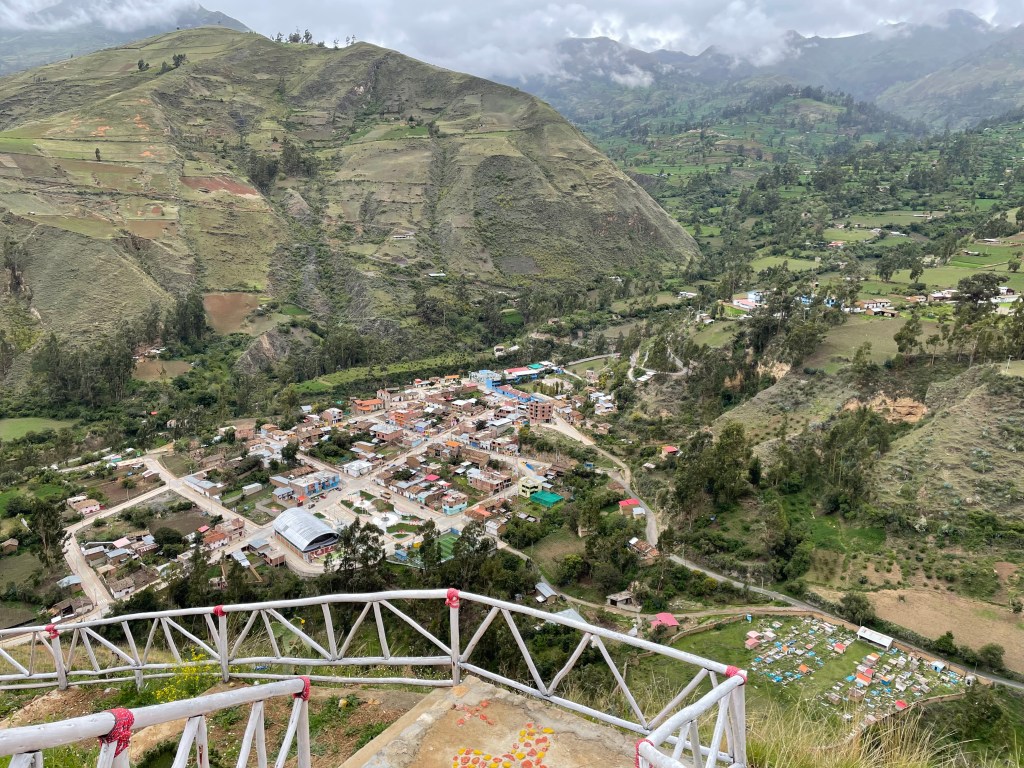
Surrounding Chinchihuasi is Our Lady of the Mountain Sumaqanka, a ring of mountain peaks that form the shape of a woman lying flat on her back and staring into the cosmos. Halfway up her bosom is Texas City, the best restaurant for miles. It’s covered in American iconography and many posters of women in bathing suits.
Abuelito ordered their most expensive meal for us, ceviche. It was raw trout caught from Sumaqanka’s streams. The fish was served with toasted corn called Cancha and potatoes with splotches of white and yellow and flecks of black. There were also sweet potatoes, which Abuelito found revoltingly small. Those in his garden are thrice the size! Finally, the server placed a large pitcher and three bowls on the table. It was alcoholic Chincha. Abuelito filled our bowls.
For breakfast, Abuelito’s neighbor brought thick slices of roast squash. We ate it with rice and leftover Cui, battered in cornflower. I looked down at my plate, my belly moaning in protest. “How much do you think the fish would be back home?” I asked.
Valeria was looking into the bowl of Chincha.
“Forty, fifty dollars?” I sipped the Chincha. It was strong.
“At least sixty.”
Abuelito quietly stuffed his mouth with fish and periodically drank from his bowl. On the table, he had piled his potato skins and the Cancha kernels that were small or burnt.
I took a bite of ceviche and turned to Valeria. Whenever I try something new, she asks what I think, but her attention is still on the Chincha. “Wow!” I said. “I don’t think fish is meant to taste this good.”
Her ceviche sits untouched. “It tastes better without the microplastics and Imperialism.” Valeria looked up at me. “You’ll miss it, the food? That’s what I missed the most.”
“Yeah,” I looked down at my plate. “It’s much cheaper and less greasy.” I take another bite. Surely, there were other things I could say, but I didn’t. I know what I will miss and that nothing can be done about it.
Valeria nodded her head slowly. Raising the Chincha, Valeria closed her eyes and drank deeply.
We ate and drank bowl after bowl, making us very sleepy.
When it was time to pay, the owner, delighted to have her first authentic American, gave us a discount. Before we left, she brought out a jar of something orange. She said it was salsa de Ají Qasqu.
“Bring my Ají Qasqu to the United States and make many good things with it,” said Valeria, acting as translator.
The owner smiled and pressed the jar into my hands. She spoke again very happily.
“And when you come back, bring me some real American barbeque.”
***
Abuelitio drives us in his shabby car that coughs and sputters like him. Its tires are old, and the mountain roads are nothing but dusty gravel.
I look out the window drinking the landscape. When we leave tomorrow, it’ll be early morning, too dark to see. Valeria shuts her eyes and nuzzles her head into my lap. I place one arm across her belly and the other under her head.
Chinchihuasi is a land of eternal spring. Pastures blanket the valley, crisscrossed by streams and groves of avocados. As Sumaqanka steepens, she becomes geometric, a patchwork of terraces filled with freshly planted corn and very legal coca. Above the terraces are potato patches and great squares of alfalfa. A thousand souls feed off Sumaqanka. Little clumps of houses clutch to her ridges, stubborn as their inhabitants who are very old. We see them on the road. Most are women, squat, and very short. They wear long braids and bowler hats adorned with orchids, some unknown to botanists. Their skirts are bright and their quipis colorful. The women come from the fields carrying crops and animals for their families. Abuelito stops for a little abuela and lets her in. She holds a headless chicken and has a sleeping lamb wrapped in her quipi. They chat in Quechua.
I look down, and Valeria’s eyes are open. Her golden skin is pale from the Chincha. She’s staring at the back of the little abuela while the lamb drools on the headrest. Three years ago was when they buried Abuelita. This was two months before Valeria left for America. God, she was a mess when I met her. Those were the hard days, but she got better. We got better. It was easy to love and not think about the future. Valeria’s holding the jar of Ají Qasqu, turning it slowly like there was a secret about it. Her knuckles are white, and her eyes are moist. I try to think of something to say but cannot. I’ll be gone so soon, and words are wind. Instead, I hold her tighter. I will miss her weight on my lap.
We wind down Sumaqanka’s spine and onto her leg, curving eastwards through wild groves of eucalyptus. Her foot delivers us to the valley, where streams burst from her rocky toes. A group of tíos waves from the water. They are waste-deep, and their nets are full of splashing silver.
After the avocado fields, we reach the town outskirts, where gangs of puppies trail the car. Chinchihuasi dogs aren’t mean like Limean dogs. Most have owners and are yap-yap dogs rather than the dreaded bark-bark, or even worse, yip-yip ‘dogs’ (it’s actually factually proven that chihuahuas are rodents). Abuelito drives slowly, and the people on the streets wave at us because everyone knows Abuelito, and very few know me. The only other gringos are a pair of Polish priests who run the church. They are very tall, have red hair, and speak terrible Quechua, worse English, and no Spanish. Everyone pretends to understand them at mass. Valeria suspects they’re lovers.
Abuelito stops the car, and the little abuela gets out, thanking us all.
Chinchihuasi is built around a central asphalt road that curves along Sumaqanka. Jutting out are smaller cobbled lanes with homes and little shops. Many are empty, and others are ruins. They are covered in cacti that thrive in decomposing adobe blown open by dynamite and RPGs. In the 1980s, Chinchihuasi was torn open by Shining Path rebels and government forces. Many, including Abuelito and his eight children, fled, making new lives in Lima or Huancayo. Only the old have returned. Valeria sits up, her eyes now clear. I hold her hand, and she responds by chomping my nose all cutesy. “I love you,” she says. I know she does.
I think I love Valeria, but I know I fear finality. I do not want to date long-distance, but I fear her absence. I don’t know if Valeria’s understanding fully matches my own. Is there a concrete stance for Valeria to match? This is our goodbye trip, but neither of us has called it that yet. The only comfort is that there’s nothing to be done. It is a cozy veil that’s suffocating. Tomorrow, we will leave Chinchihuasi, and two days from then, I will be on the plane.
We come to the central plaza, lined with municipal buildings and the church. In the middle are two large statues, a man and a woman. Valeria scoffs. They are Santiago dancers dressed in local finery. Their hair is light brown, and their skin is white. She’s written three papers about them.
Abuelito turns onto a side street and reaches his home. We will rest for several hours, then convene for dinner. Before we enter, he buys the sandwich bread and canned tuna from his neighbor’s window shop.
We follow Abuelito into his large compound of a home, surrounded by thick adobe walls. Attached are many buildings, enough to house twenty people. In the center is an open space, every inch filled with plants with purposes. Abuelito goes straight to the potato patch blooming with purple flowers. They blanket a low mound of earth from which thrusts a tall stone cross. Even in death, Abuelita provides. The old man sinks to his knees and starts pulling potatoes.
***
I spread the tuna just enough to wet the bread. The sandwich is further thickened by a yellow potato, mashed, and mixed with a white-friendly quantity of Rocoto. Valeria covers hers with a healthy coating of the Ají Qasqu, and Abuelito dutifully eats his tubers plain.
The fish I must ration carefully. The meat-to-carb ratio in Chinchihuasi cuisine is low, and if I finish the tuna before the carbohydrates, Abuelito will be embarrassed and will fry me an egg.
Dinners are challenging with Abuelito. He gets tired early and, unless prompted, will keep to himself. I would talk with Valeria, but it would be rude to exclude our host. My Spanish is not terrible, but Abuelito’s Quechua accent is thick. I think he finds my gringo accent equally incomprehensible. Still, it’s my last meal in Chinchihuasi, and I do not want to eat in silence. I nudge Valeria.
She looks up from her heavily sauced plate. Strands of loose hair hang in her face, bound together in wet clumps. Why is she sweating so much?
“Those statues…”
“The Santiago dancers?”
Valeria’s told me all about them. They were erected some fifty years ago by Abuelito’s brother, who was mayor. I nod my head at the old man. “What does he think of them?”
Her face furrows into a mischievous smirk. “Do you want me to ask him why they are white?”
I grin and shrug. Valeria’s condition is probably just indigestion from the high altitude. She asks the question, and Abuelito’s tired eyes sharpen a little.
“I was working as a doctor,” says Valeria translating. “The dancers came from Huancayo. The department was paying them to go to little towns, and I wanted Chinchihuasi to have a real statue because every city needs a statue. So I told Miguel—that’s his brother—to put one up, and he did. We all came together—I don’t think he understood the question—and made the man.” Valeria pauses, and to my surprise, Abuelito keeps talking. “Then I became mayor, and I built another statue, the woman. I thought the man was lonely.”
Abuelito points his finger at me. “Cada hombre necesita una buena mujer.”
“Every man needs a good woman,” says Valeria.
Abuelito is looking me up and down. I take small bites of bread. He’s trying to read me. What for? He can’t change the plane tickets. I can’t move to Peru. I quickly glance at Valeria. Her beautiful brown eyes are calm, too calm. God, she’s terrified.
I try to redirect. “¿Què otra addiciones haces a la estatures?”
Valeria laughs a little too hard and translates the question correctly: What other additions have you made to the statues?
Abuelito looks down at the food. “Después de que los terroristas colgaron los cuerpos, se cubrieron de sangre. Los volví a pintar.”
“I repainted them.” Valeria clears her throat. “Why don’t you tell us about the Inca and Huanca!” The Huanca are this area’s native culture.
A look of pure satisfaction erupts on Abueltio’s wrinkled face.
“Tawantinsuyu—the Inca—tried to kill us,” translates Valeria, “but we fought back and won. They killed everyone around but not us, Huancas. We were protected by Our Lady Sumaqanka.” Valeria gives me a smirk. Abuelito loves Chinchihuasi history but is wrong. While never fully incorporated, the Inca formerly subjugated the Huanca, but she doesn’t tell him that.
Abuelito’s face shrivels like he ate something tart. “Malditos cobardes.”
“Cowards,” translates Valeria.
“Sumaqanka siempre protege,” his eyes are distant. “La abandonamos. Ella te proveyó y tú la abandonaste.”
“Sumaqanka would have protected us.” She bites her lip. “¿Estás bien, Abuelo?”
The old man shakes his head but continues. Valeria nods along but does not translate. Abuelito clinches his jaw. “Dile lo que yo digo.” He wants her to translate.
Her eyes fill with unease, but she speaks. “Chinchihuasi was so big,” says Valeria. “There were many families. Now, they are all packed in cities like anchovies.” She is breathing heavily. I see her hand twitching. She sees I see and moves the offending hand to scratch her leg.
Abuelito says more.
“Without Sumaqanka, they will wither away, and she will have no one to love. Her forests will fall. Her fields will rot. Chinchihuasi will be weeds and dogs, and Sumaqanka will die of sadness.”
Now Abuelito is looking at me. His chin is quivering.
“Chinchihuasi needs young people.” Valeria is staring at her cold plate. “It needs children. The quiet has killed more than the terrorists.”
I reach for my plate and find it empty. Somehow, I have eaten it all. My throat is bone dry, and the water is tepid.
“I cannot blame them,” translates Valeria, “the people who left. I made my money in Lima like everyone else. When you find love, it lays you a path. I walked off mine again and again and again, but it will drag you back.” Her body is still, except for her hand, still scratching.
I wait for Abuelito to blink, but he does not. He speaks and stares.
“It dragged me back screaming. It dragged me back…” Valeria stops. Abuelito’s Spanish is incomprehensible, but I catch a name. He speaks of Abuelita. Valeria is trembling, but Abuelito doesn’t stop. He’s no longer looking at us. The old man stares past us. What is he looking at? “When you find love,” Valeria closes her eyes, “you grab it tight and let it pull. You keep your grip strong and don’t ever let go.”
Abuelito’s eyes are wide as saucers. He is desperate. He knows the gringo will not marry his granddaughter half a world away. He knows because he wouldn’t. Valeria has told me. Theirs was an arranged marriage. Abuelito had a job in Lima and could speak Spanish. Before they married, Abuelita had another lover driven from Chinchihuasi by her father. Some say he was shot. Abuelito was unfaithful and was aggressive when he drank. After fleeing Chinchihuasi, his children moved far away and will not speak to him. Now his wife is dead, and the silence will kill him. Abuelito’s gaze lowers to his plate. It is half-full and cold.
“Hey.” I reach for Valeria’s leg and squeeze it reassuringly. “You okay?” Her leg is wet. “Valeria?”
She looks down, and her eyes widen. “I need to use the restroom.” She stands suddenly.
“Valeria?”
“I love you.” She excuses herself to Abuelito and leaves the kitchen.
I’m about to follow, but then I see the blood, a thin sheen on my palm—a spike of cold shoots through my belly. My body is petrified. Valeria has always had a nervous tick. She must have scratched her legs bloody.
“A-Abuelito?” I raise my bloody hand. “Es de Valeria’s pierna.”
The old man nods his head. “Ella es así.”
“¿Q-qué?” What?
Abuelito says each word slowly and clearly. “Muy nerviosa.” Very nervous. “Valeria es una chica muy nerviosa.” Valeria is a very nervous girl. Abuelito stands, groaning softly in pain. He starts gathering our plates.
I also stand, my heart thumping so fast it hurts. The blood is sliding down my palm and into the crevices of my fingers. “Ayuda para Valeria de medicas?” There isn’t a modern hospital for a hundred miles.
“Tranquilízate, chico,” says Abuelito. I think he wants me to be calm. He gives a tired laugh. “He visto más sangre. Chinchihuasi ha visto más sangre. Ñuqayku Huancayku Sumaqanka kutichipuyku…” He trails off, murmuring in Quechua and bits of Spanish all jumbled together. He dumps the plates in the sink and grabs a first aid kit.
Why is he so calm? I slam my bloody fist into the table. “WHAT DO WE DO?”
Abuelito gives me nothing but an uninterested look and puts on his jacket. I follow him outside. It is dusk on the verge of night. I can see light and distant movement coming from the outhouse.
“Abuelito.” My voice is shaky. “¿Qué hago? What do I do?
He stops before Abuelita’s cross and gives me a long look that speaks a million words. “Quédate aquí,” stay here, he finally says. Abuelito walks across the garden and knocks on the outhouse door, then enters.
I want to follow him in, but my phone buzzes. It’s Valeria. She texts sorry more than a dozen times and begs me not to intrude. So, I am stuck.
I cannot go to Valeria, nor can I simply leave. I am trapped in the garden’s center beneath Abuelita’s cross and the looming body of Sumaqanka. The blood on my hand is starting to thicken. I drop to my knees.
I grab leaves, vines, and stalks, and I pull, and when I have a fistful of plant, I scour my bloody hand. I clean until I see no blood, but I can still smell it. My bloated stomach screams. It must be on my arms. I remove my shirt and dig my shaking fingers into the soil. I pull clumps of dirt and handfuls of roots, and I scrub, and I scrub, and I scrub, but the smell only grows, which I know is impossible, but it’s there, and I will leave her, and so I must scrub, but it’s only getting stronger, and I’m taking off my shoes when I hear the outhouse door open. I jump to my feet. Abuelito comes out and gives me an incredulous look.
“Sangre,” blood. I gesture at my filthy body like it would make me look less insane.
To my surprise, Abuelito laughs. It’s a long and wistful thing. “Sí gringito, sangre.” Abuelito says nothing else. He shuffles past me and retires to his room.
There is quiet except for a mountain breeze that makes me shiver. I really must find my shirt, but before I can, the outhouse lights snap off. My body freezes. I see only her silhouette.
“Are you covered in something?” says Valeria.
I don’t respond. It’s not blood I smell, only Chinchihuasi dirt.
She comes to me and buries her face in my chest, and I press my cheek against her head. I pull her tight, and together, we rock.
“I’m okay,” she says. “I’m okay, I’m okay…” We sink to the ground.
The last bits of light are sinking behind Our Lady of the Mountain Sumaqanka. Her body is pitch black, the sky above a little lighter. The ridges form a single perfect line. I trace the tip of her nose down the gorge of her neck, up again for her breast, then down gently across her belly and leg.
Valeria and I lean on each other. Her eyes are shut, her heartbeat quick. It would be cruel to disturb this moment, but I know one of us must. When I speak, a lump forms in my throat. I manage only, “Hey.”
Valeria nuzzles her body closer to mine. “Hi.”
“Your leg…” I see it wrapped tightly in gauze. “I think some things have been unspoken about us, about this trip, and what comes after. By not talking about them, I think some tensions have been caused, and,” my body shutters slightly, “I think we should talk about them.”
Valeria says nothing.
“My understanding is that once I leave, our relationship will end. I don’t know if this is your understanding, and I do not know if you agree with it.” I take a deep breath. “Honestly, I don’t really know what I think. Selfishly, I think I’ve been thinking more about what you think, so I don’t have to think about what I think as much, and that just makes it harder for everyone.”
Valeria says nothing.
“I don’t know if we can agree before I leave. If not, then just an understanding, something we can work off of—” I stop when I see Valeria shaking her head.
“You’re right,” she says. “It is healthy, and responsible, and necessary.” She is crying. “I want to, I want to, I want to…”
“But It’s been a long day.”
“I’m really fucking tired, and I’m really fucking full.” Valeria smiles. There are so many things contained in a smile. “I’m going to hate tomorrow. I’m gonna hate it so much. I just want tonight. Can I please, please, please, please have tonight, just one night, and we don’t need to worry about anything at all?” She looks up at me. She is scared, and I am scared.
I grab her head and kiss her. We fall into the dirt and are content because in Chinchihuasi, at this moment, time is liminal. We stare into the cosmos with Our Lady of the Mountain Sumaqanka and everyone else who is looking.
Jacob Keiser is a junior history major minoring in the creative writing certificate program. He is unpublished but has worked on several history manuscripts as a research assistant, several of which are in the process of getting published. Finally, he is an aspiring author working on my debut novel, an original epic adult fantasy book, an undergraduate history thesis about the historiography of the Ethiopian Empire, and various short stories.
 Hothouse
Leave a comment