By Wynn Wilkinson
This is a gay bar, Jesus. It looks like any other bar on the outside, only it isn’t. Men stand three and four deep at this bar– some just feeling a sense of belonging here, others making contacts for new partners. This isn’t very much like a church, Christ, but many members of the church are also here in this bar. Quite a few of the men here belong to the church as well as to this bar. If they knew how, a number of them would ask you to be with them in both places. Some of them wouldn’t, but won’t you be with them too, Jesus?
-Rev. Malcolm Boyd, 1965
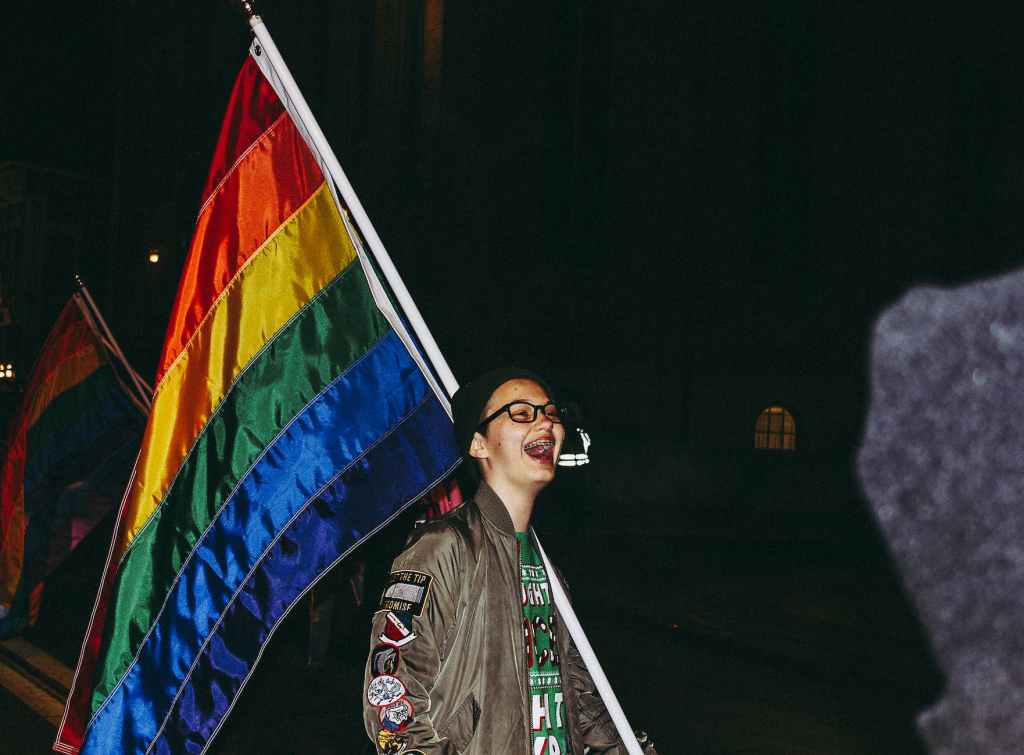
Under the sticky, mid-day August heat, a party is raging in Austin. The sights and sounds are built to dazzle; every color of the rainbow streams past without cessation, overwhelming the iris with glitz and glam. Club music pumps from a distant stage where drag performers strut, undeterred by the sun’s unceasing fervor. The downtown procession glides by, showcasing the diversity of the enthusiastic, accepting community– including the wolves that have identified said community as a sound financial opportunity. A UT student with dyed hair and assless chaps strikes up friendly conversation with a graying white woman sporting a “Free Mom Hugs” shirt. A float for a company that routinely donates to the political campaigns of homophobes wafts by a socialist in a sexy cop outfit reminiscent of the Village People. Real cops, sporting rainbow armbands, march past an aging lesbian who, many moons ago, hurled stones during the Stonewall protests. A girl my age wearing an asexual pin exclaims that she likes my outfit. That I’m slaying. Thanks mama, you too!
The ritual I’ve identified is, of course, the Austin Pride parade, although for decades now, similar celebrations have and do occur annually across the country. When I attended my first Pride event, I was 17 years old, bisexual, and felt far from welcomed in the small Texas town where I’d been raised. The unrelenting summer heat enhanced by the unforgiving burning asphalt of downtown Austin set the scene for the beautiful ritual of radical acceptance that is a Pride celebration. On that special day, strangers embrace, hug, kiss, love, and hold in community other unknowns, connected by the shared experience of queer oppression, by the miracle that is queer love. Maybe your parents were closed-minded. Maybe your pastor told you you’d burn in hell. Maybe you’re new in town and are just desperate for community. Nobody asks; knowing smiles take the place of questions, skipping straight to the important bit: You– we– are here now, together. Four years later, I’ve yet to take part in a ritual where I feel more encouraged to express myself, to liberate my oft-caged queer soul, than at Pride. I’ve never felt more welcome.
My usage of the term ritual is not accidental. Pride, to the uninitiated “baby gay” on the first steps of the journey of self-discovery, is downright baptismal. The 20th century Romanian historian of religion Mircea Eliade developed the concept of the eternal return, the argument that religious ritual symbolically transports the devotee(s) to the time of mythical inception. The Catholic envisions himself in sacred time walking alongside Jesus, the Buddhist imagines that she meditates at the feet of the Buddha. I console the skeptic that this flight need not be literal, and is more accurately a spiritual proximity to the source, a return to the elements of this life that are sacred and everlasting. I make no claims that homosexuality is a religion, but most queer people would agree that love, welcoming, tolerant, queer love, is sacred, special, fundamental. Love— romantic, platonic, agape, familial— is so often denied to us, yet here is a space where we may not only drink our fill, but our cups runneth over. Even the listless rainbow capitalism on display during the festival parades facilitates love, an object of collective scorn and ridicule, a binding agent that promotes unity in the face of deception and deceit.
It’s significant, too, that this love is not merely an internal feeling, but an outward, expressive manifestation of care which selects a subject, be it a community, individual, or concept. The welcoming love espoused in symbols such as the various pride flags, makeup-and-fashion-based expression, song and dance— what one might ascribe to the category of “queer culture”— are devotional practices in a morality that prioritizes love as the most sacred of gifts. The famously eccentric, pluralistic Hindu saint Sri Ramakrishna conceptualized five valid archetypal forms of devotion or God-realization, one of which is friendship, another the love of a mother for her child, another the woman for her lover. A friend says to another, “Come sit with me.” Another friend remarks: “I like your outfit today”. The mother sees God in the eyes of a boy whose birth parents see naught but the Devil. She hugs him and they weep; their acceptance, care, and mutual appreciation reach to the heavens. Two men, mystical outcasts for proclaiming their truths in the tradition of al-Hallaj, discover one another in the night; each believer caresses the other’s Christ-body, recreating the reception of the Eucharist, returning by sacred time to the Last Supper of the Messiah. Beauty, truth, freedom, love– the ritual of Pride can be nothing but an eternal return, a celebratory worship of the fundamentals of human experience from which the community has so often, throughout the history of this country, been gatekept.
After Pride 2019, while waiting for my Uber after the climactic parade and cruel sun had come and gone, I wept and wondered if I should wipe off my makeup before getting in the car. The ritual is never permanent; we must always return to the profane world. I pictured returning to my hometown, where I would concede to Caesar what is his and simply pretend that my worship had never occurred. The city skyscrapers faded into the distance as I stared out the backseat window, the lights and sounds of 4th Street an evanescent sensory experience. A light drizzle began to coat the glass, blurring my vision of the ritual site. How can you up and leave the clutches of the divine? I mentally marked my calendar for the next event, blissfully unaware of the approaching cancellations that would be inflicted by Covid. I had been welcomed to peer into the heart of God and had seen the overflowing oceans of love-blood. How could I bear to, for even an instant, look away?
 Hothouse
Leave a comment